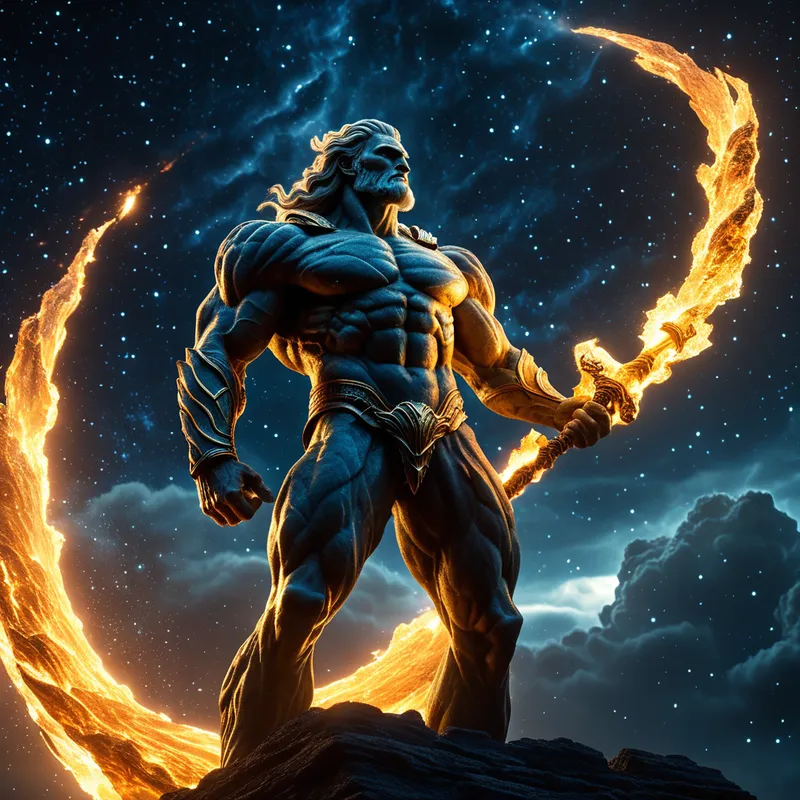
Prometheus's Spark Myth Meaning & Symbolism
The Titan Prometheus defies Zeus to steal divine fire for humanity, gifting consciousness but incurring eternal punishment for his compassionate rebellion.
The Tale of Prometheus’s Spark
In the age before ages, when the world was young and the new gods of Olympus had just secured their throne, humanity shivered in the twilight. They were creatures of mud and memory, shaped by the cunning hands of the Titan Prometheus. He looked upon his creations and saw not beasts, but potential. Yet they lived in caves, ate their meat raw, and their minds were shrouded in a fog, unable to see the patterns of the stars or the logic of the seasons.
High above, in the sun-drenched halls of Olympus, Zeus presided. Fire was the exclusive property of the gods, the crackling essence of their power, the tool of the divine smith Hephaestus. It was not for the fragile things of earth. But Prometheus, whose name means Forethought, had foreseen a different destiny. His heart, a strange organ for a Titan, swelled with philanthrōpia—love for humankind.
One evening, as the sun-chariot of Helios dipped below the horizon, Prometheus acted. He took a stalk of giant fennel, hollow and dry, and journeyed to the eastern edge of the world. As Helios rose, Prometheus touched the stalk to the blazing wheel of the chariot. A spark, a tiny, defiant sun, caught in the pith. He hid the smoldering gift within the stalk and descended, the heat a secret against his chest.
He returned to the bewildered humans gathered in the cold. With a breath, he coaxed the spark into a flame upon the earth. The people recoiled, then drew near, feeling its warmth for the first time. Prometheus showed them how to feed it, how to contain it. With fire, they forged tools from metal, not stone. They cooked food, which nourished their bodies and freed their time. They gathered around its light, and in that circle, language grew complex, stories were born, and plans were laid. The spark did more than warm flesh; it ignited the mind.
On Olympus, the new light on the dark earth was an unmistakable rebellion. Zeus looked down and saw the glow of forges and hearths where only darkness should be. His rage was a thunderclap that shook the foundations of the world. The order of things had been violated. The gift of consciousness—of technology, art, and ambition—had been stolen and given to the clay-born.
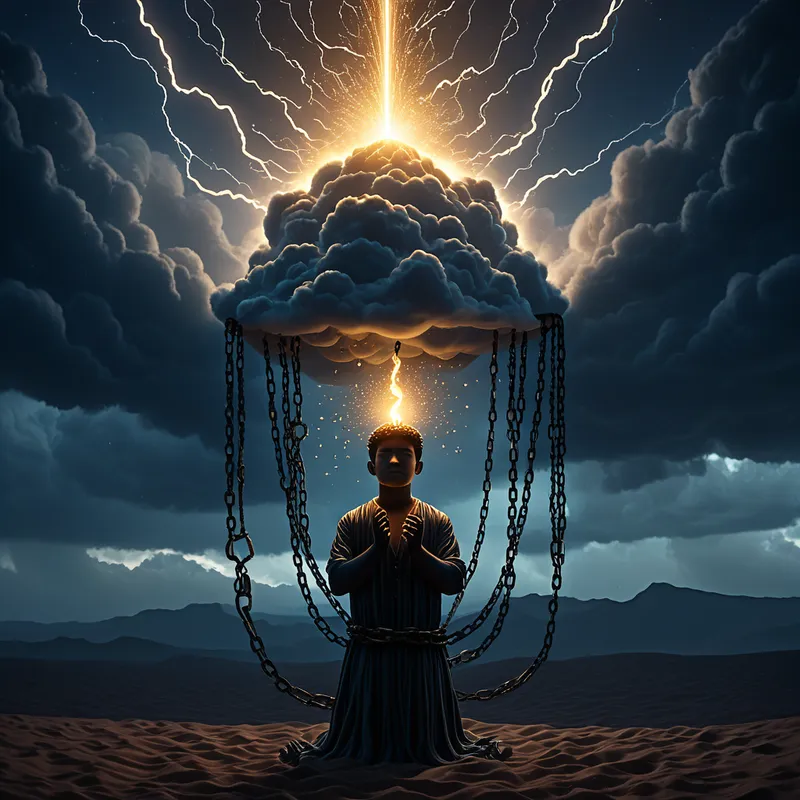
The punishment was crafted to be eternal. Zeus ordered Prometheus seized. He was dragged to the most desolate peak of the Caucasus Mountains, where the wind screamed like the Furies. There, with unbreakable chains forged by Hephaestus himself, the compassionate Titan was bound to the naked rock. And for his crime of giving fire, Zeus sent a daily torment of fire: a great eagle, born of the tyrant’s wrath, would descend each day to tear out Prometheus’s liver. Being immortal, the organ would regrow each night, only to be devoured again at dawn, in an endless cycle of agonizing sacrifice. Yet, bound and tortured, Prometheus held a secret even Zeus feared—a prophecy about the god-king’s own downfall. And so the Titan endured, a stark silhouette against the sky, the price paid for the spark that now lived in the heart of every human hearth and mind.

Cultural Origins & Context
This foundational myth comes to us primarily from the epic poetry of Hesiod (in Theogony and Works and Days) and the tragic drama of Aeschylus. For the ancient Greeks, it was not merely a story but an aition—a myth explaining the origins of human condition. It was told in symposia, performed in theaters, and reflected upon by philosophers.
Societally, it functioned on multiple levels. It explained humanity’s technological separation from nature and our perpetual state of striving and suffering. It also presented a complex theological dilemma: the tension between absolute divine authority (Themis) and compassionate intelligence (Prometheia). The myth asked its audience to hold two truths: that the gift of civilization (the arts, science, medicine) was a divine theft, and that progress comes with a profound cost. It validated the Greek spirit of inquiry and craft (technē) while warning of the hubris that could accompany it.
Symbolic Architecture
At its core, the myth of Prometheus’s Spark is a map of the birth of consciousness itself. The fire is not merely a physical tool; it is the divine logos, the illuminating principle of mind, culture, and self-awareness that separates humans from an instinctual existence.
The stolen fire is the awakening of the ego from the unconscious clay of nature. It is the painful, glorious moment we become aware of our own awareness.
Prometheus represents the archetypal principle of foresight and rebellious compassion. He is the part of the psyche that seeks growth and differentiation, even at the cost of suffering. He acts against the ruling order (the established, perhaps complacent, structure of the psyche or society) for the sake of potential. Zeus symbolizes the ruling principle of order, law, and power that seeks to maintain a static hierarchy. His brutal punishment reflects the psyche’s own self-punishing mechanisms—guilt, anxiety, and the torment of consciousness—that arise when we defy internalized or external authorities to claim our own power and knowledge.
The eternal torture—the regenerating liver devoured daily—is a profound symbol. The liver was anciently considered the seat of passion and life-force. Thus, the myth depicts the price of consciousness as a perpetual vulnerability, a recurring wound at the very center of our vitality. To be conscious is to be perpetually exposed to pain, knowledge, and desire.
The Dreamer’s Resonance
When this myth stirs in the modern dreamer, it often signals a critical moment of psychic theft—the necessary, rebellious act of claiming one’s own power, knowledge, or creative spark from an internalized “Zeus.” This could be a parental complex, a societal expectation, or a rigid, self-limiting belief system.
Dreams may manifest as: finding a hidden, dangerously beautiful light source; defying a powerful, shadowy authority figure to obtain a key or tool; or feeling bound and exposed on a high place while being attacked by a bird or beast. Somatically, the dreamer might awaken with tension in the solar plexus (the area corresponding to the liver’s symbolic seat of emotion) or a feeling of exhilarating, yet anxious, defiance.
The psychological process is one of painful differentiation. The dream-ego is undergoing the Promethean ordeal: stealing the fire of self-authority, which immediately incurs the punishment of guilt, fear of retribution, or the crushing weight of new responsibility. The dream acknowledges that awakening is not a gentle sunrise but a theft, a trauma that births a new order of being.
Alchemical Translation
In the alchemical journey of individuation, the Prometheus myth models the opus of bringing the divine spark—the latent Self—into the leaden, earthly reality of the personal psyche. The process is one of necessary rebellion against the status quo of the persona and the oppressive rule of the inner tyrant (the super-ego or dominant complexes).
The alchemist, like Prometheus, must steal the lumen naturae—the light of nature—from the clutches of the collective unconscious, represented by the gods, and suffer the mortificatio of binding and dismemberment to integrate it.
First, one must recognize the “clay” of one’s unconscious, instinctual life. Then comes the theft: the active, often guilt-inducing, act of seeking self-knowledge, pursuing a creative vision, or breaking a familial or cultural pattern. This is the ignition. The subsequent binding is the inevitable crisis: depression, anxiety, feelings of isolation, or “imposter syndrome” that arise when one’s new consciousness conflicts with the old order. The eagle’s daily visit represents the recurring doubts and self-criticism that gnaw at the vitality of this new awareness.
The triumph of the process lies in the Titan’s endurance and his secret knowledge. The regenerating liver symbolizes the psyche’s incredible capacity for resilience and renewal. By enduring the ordeal, one integrates the spark. The fire ceases to be a stolen, external object and becomes the central, warming hearth of one’s own being—the guiding light of the individuated Self. We are all, in our journey toward wholeness, both the thief of the divine flame and the rock upon which we are bound to learn its true cost and power.
Associated Symbols
Explore related symbols from the CaleaDream lexicon: