
Prometheus's Fire Myth Meaning & Symbolism
The Titan Prometheus defies Zeus to steal divine fire for humanity, sparking civilization and enduring eternal punishment for his defiant gift.
The Tale of Prometheus’s Fire
In the first, grey dawn of the world, humanity shivered. They were creatures of clay and breath, huddled in caves, their bellies empty, their minds dark. They knew only the cold, the fear of the night, and the distant, indifferent gaze of the gods on high Olympus.
But one being watched them with a different heart. Prometheus, whose name means Forethought, saw not mud and misery, but potential. He had shaped them from the earth, and in them, he saw a spark—not yet kindled. He saw his own kin, the mighty Titans, cast down into the abyss of Tartarus by the new king, Zeus. He saw the order of the cosmos, rigid and absolute, where gods feasted on ambrosia and mortals groveled for scraps.
A fire began to burn in Prometheus, not of rebellion for power, but of rebellion for love. He journeyed to the sun-chariot of Helios and, with a cunning that was his birthright, he plucked a single, seed of pure solar essence. Or perhaps, as other whispers tell, he ascended the sacred, mist-wreathed slopes of Olympus itself, to the very hearth of the gods. There, he took a stalk of giant fennel, hollowed it, and stole a fragment of the divine, everlasting flame. He hid the blazing coal within the stalk, a secret sun cradled in a simple reed.
He descended from the realm of the eternal to the world of the dying. Before the awestruck eyes of the first people, he opened the fennel stalk. The fire leaped out. It did not just burn; it taught. It showed them how to warm their bones against the winter, to drive back the predators of the dark. They learned to cook meat, to harden spear tips, to bake clay into pottery. The fire was a teacher, and its first lesson was that the world could be changed. With this gift, Prometheus gave them more than comfort; he gave them techne—craft, art, the means to shape their own destiny. He gave them a share of the divine prerogative: creation.
On Olympus, Zeus felt the theft in his very bones. The order was broken. A sacred boundary had been crossed. His wrath was not merely that of a king robbed, but of a principle violated. The lot of mortals was to be lowly; this was the natural law. Prometheus had introduced chaos, had elevated the lowly, had made them, in a small but terrifying way, god-like. The punishment would be a lesson for all eternity.
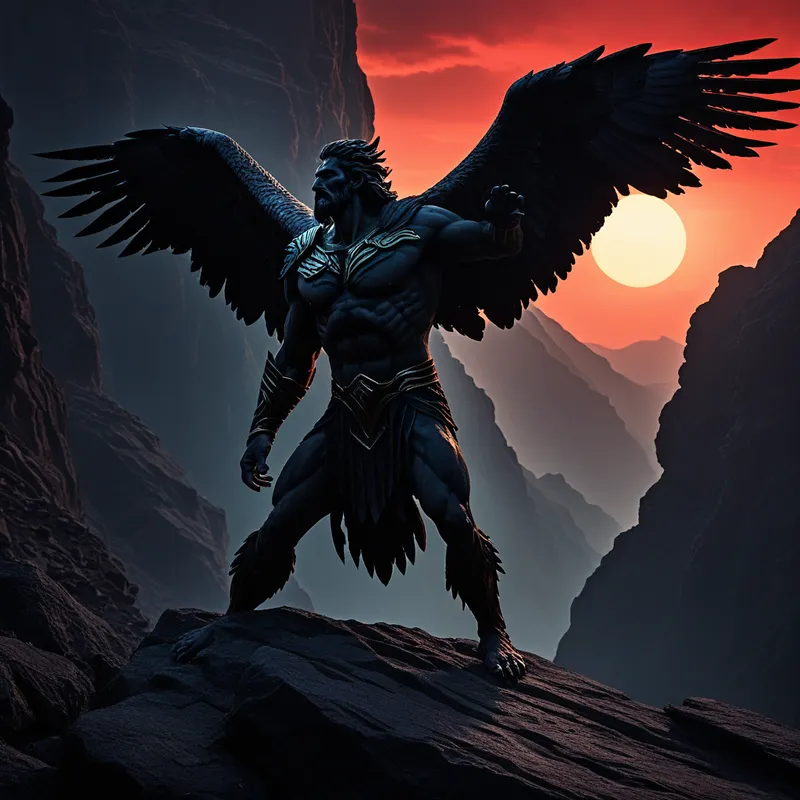
Prometheus was seized by the might of Kratos and Bia. They dragged him to the farthest, most desolate crags of the Caucasus mountains. There, with unbreakable chains forged by Hephaestus himself—who wept as he worked—they bound the Titan to a naked rock. Zeus sent his eagle, a monstrous bird with feathers like polished obsidian, to visit him each day. The eagle would descend, tearing open Prometheus’s immortal flesh to feast upon his liver. Each night, the liver would regrow, ensuring the agony was as infinite as his crime. The wind howled a dirge through the stones. The sun scorched him by day, the frost bit him by night. And yet, Prometheus did not cry out for mercy to the distant Zeus. He held his secret—a prophecy of the god’s own eventual downfall—close to his remaining heart, a final, unyielding ember of defiance in the face of infinite torment.
Cultural Origins & Context
The myth of Prometheus is a foundational pillar of the Greek cosmological narrative, primarily preserved in the epic poetry of Hesiod’s Theogony and Works and Days (8th-7th century BCE) and later dramatized with profound humanity in Aeschylus’s tragedy Prometheus Bound (5th century BCE). It was not a mere fireside tale but a sacred story explaining the fundamental condition of human existence. In a culture that saw its gods as personifications of natural and social order, the myth served a crucial societal function: it explained the paradoxical human condition of being both blessed and cursed.
The story was told by bards and playwrights to audiences grappling with their place in a world of suffering, toil, and fleeting joy. It answered the poignant question: Why do we struggle? Why is life so hard, yet filled with the gifts of art, technology, and community? The myth placed the blame not on human failing, but on a primordial act of divine compassion that provoked divine jealousy. It framed civilization itself—with all its pains and wonders—as a stolen, illicit gift, making humanity inherently rebellious and inventive. The myth also reinforced the Greek value of metis (cunning intelligence) and the terrible cost of overstepping boundaries (hubris), while simultaneously heroizing the one who overstepped for a noble cause.
Symbolic Architecture
At its core, the myth is an archetypal drama of consciousness arising from the unconscious. The fire is not merely a physical tool; it is the quintessential symbol of awakened mind, of logos and nous—reason, intellect, and creative spirit.
The stolen fire is the moment the unconscious clay becomes a conscious, culture-creating self. It is the spark of individuation stolen from the complacent, collective realm of the gods.
Prometheus represents the psychopomp or the rebellious aspect of the Self that defies the ruling, established order (Zeus as the dominant, often tyrannical, conscious attitude or super-ego) to retrieve a vital, life-giving energy from the unconscious (the divine hearth). His punishment symbolizes the inevitable suffering that accompanies enlightenment and differentiation. To become conscious is to be torn apart daily by the eagle of scrutiny, doubt, and the pain of isolation. The regenerating liver—the organ ancient Greeks associated with passion and vitality—signifies that this is not a one-time ordeal, but a perpetual process of being consumed and renewed by the very knowledge one carries.
Zeus represents the established, conservative principle that seeks to keep energy contained and order maintained. His wrath is the psyche’s resistance to fundamental change, the fear of the chaos that new consciousness can unleash.

The Dreamer’s Resonance
When this myth stirs in the modern dreamer, it often manifests as a profound somatic and psychological crisis of awakening. One might dream of stealing something precious from a powerful, forbidding authority figure—a key from a parent’s desk, a book from a locked library. The dream is charged with fear, exhilaration, and a deep sense of transgression.
Somatically, this can correlate with a feeling of a “fire in the belly”—anxiety, inflammation, or passionate drive centered in the solar plexus and gut (the region of the metaphorical liver). Psychologically, the dreamer is at the precipice of claiming a forbidden knowledge about themselves: perhaps a creative talent they’ve been told is impractical, a sexual identity that defies family tradition, or a spiritual insight that breaks with dogma. The eagle’s attack in a dream might appear as a sudden job loss, a shaming message, or a physical illness that feels like a punishment for stepping out of line. The dream is the psyche’s way of narrating the terrifying, glorious, and painful process of stealing one’s own fire from the internalized “gods” of societal expectation, parental voices, or outdated self-concepts.

Alchemical Translation
The Promethean myth is a perfect map for the alchemical process of individuation. It models the necessary rebellion, sacrifice, and endurance required for psychic transmutation.
The first stage is separatio: Prometheus separates himself from the collective of the Titans and the dominion of the Olympians. The dreamer must differentiate from family, tribe, or mass culture to hear their own inner Titan. Then comes the theft, the coniunctio with the divine spark. This is the active, daring retrieval of one’s own latent potential from the unconscious—the artist claiming their voice, the thinker their heresy, the lover their authentic desire.
The binding to the rock is the crucial mortificatio or nigredo—the dark night of the soul. The gifted fire now burns its bearer. The new consciousness isolates and seems to destroy the old self.
This suffering is not meaningless punishment; it is the tempering. The daily rending by the eagle is the painful integration of shadow material, the constant confrontation with the consequences of one’s own authenticity. The regenerating liver is the promise of the alchemical process: the psyche’s incredible capacity for renewal. One is not consumed once and for all, but is continually remade, stronger and more resilient. The final, unyielding secret Prometheus holds—the prophecy—is the knowledge that even the most rigid, tyrannical inner authority (the Zeus complex) can and will be overthrown by the emerging, more complete Self.
Thus, the modern individual’s journey is not to avoid the Caucasus, but to recognize they are already bound there. The task is to understand that the eagle is not merely a tormentor, but the agent of a terrible, necessary transformation. To hold the stolen fire, despite the cost, is to fully become human.
Associated Symbols
Explore related symbols from the CaleaDream lexicon: