
Prometheus' Torch Myth Meaning & Symbolism
The Titan Prometheus defies Zeus to steal fire from the gods, gifting humanity with knowledge, technology, and the burden of consciousness.
The Tale of Prometheus’ Torch
In the first grey light before memory, when the world was young and clay still damp, humanity crouched in the shadows. They were creatures of mud and chill, huddled in caves, their bellies empty, their minds dark. They knew only the fear of the night and the tyranny of their own helplessness. Above them, on the sun-drenched peaks of Mount Olympus, the gods feasted on ambrosia and laughter, their power absolute, their comfort eternal.
But one being watched this suffering with a heart that was not made of stone. Prometheus, whose name means “Forethought,” saw not beasts, but potential in the shivering forms below. He had shaped them from clay, breathed life into their lungs, and now he could not bear the sight of their perpetual twilight. A plan, dangerous and brilliant, was forged in his mind—a theft that would shake the foundations of heaven.
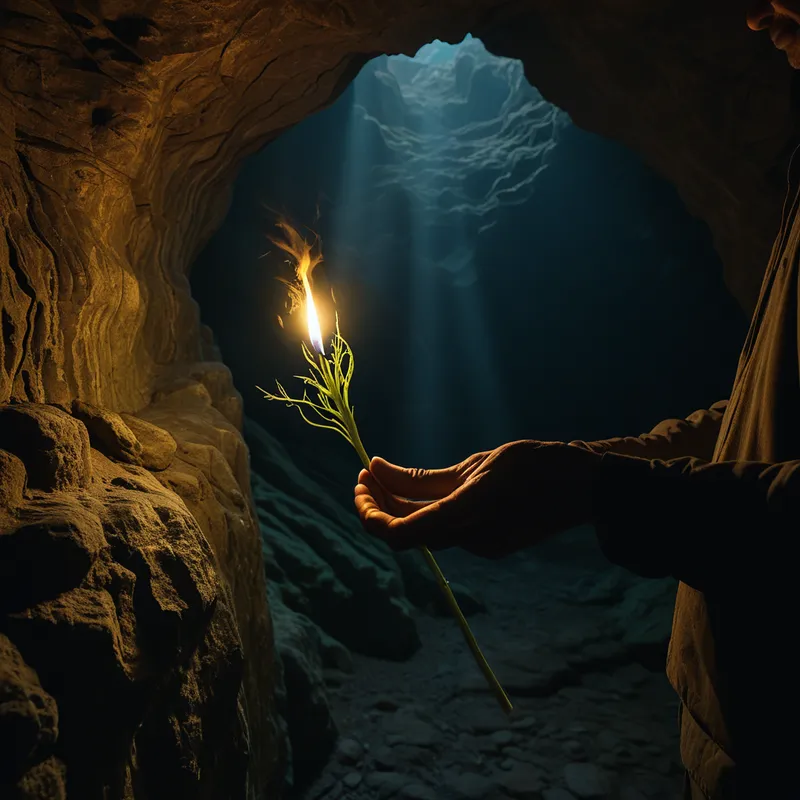
He waited for the perfect moment, when Helios drove his chariot of fire across the sky. Prometheus did not storm the gates of Olympus. Instead, with cunning grace, he approached the sun’s very path. In his hand, he carried a stalk of giant fennel, its core dry and hollow. As the chariot blazed past, he reached out, not with a bare hand, but with the stalk, and captured a single, pulsating ember of the sun’s own fire. He stole not just flame, but a fragment of divine essence itself.
The journey back to earth was a silent, secret descent. The ember, cradled in the fennel, glowed like a captured star. He returned to the damp, dark hollow where humanity gathered. Without a word, he knelt and touched the divine spark to a pile of dry tinder. A crackle, a hiss, and then—light. True, dancing, golden light that pushed back the cave’s shadows for the first time. He showed them how to feed it, how to keep it alive. Then, he showed them more: how to forge metal, how to bake clay, how to cook meat, how to read the stars.
A new dawn broke over the world, but it was a dawn tinged with smoke. On Olympus, Zeus felt the disturbance in the order of things. He looked down and saw the pinpricks of firelight where before there was only dark. He saw the smoke of forges rising into his sky. His rage was a thunderclap that echoed through the cosmos. The gift had been given. The balance of power was forever altered.
The punishment was as eternal as the crime. Prometheus was seized by the might of Hephaestus and the force of Kratos and Bia. They dragged him to the most desolate crags of the Caucasus Mountains. There, they bound him with unbreakable chains to the naked rock. Zeus sent his eagle, a monstrous bird of prey, to visit him each day. With talons of brass and a beak of iron, it would tear open Prometheus’s side and feast upon his immortal liver. Each night, the organ would regrow, ensuring the agony was as infinite as the flame he had stolen. And there, under the vast, uncaring sky, the Titan who brought light to man was condemned to an eternity of darkness and pain, his defiant screams carried away by the wind.
Cultural Origins & Context
The myth of Prometheus is not a single, fixed story but a powerful narrative current flowing through ancient Greek culture. Its most definitive telling comes from the epic poet Hesiod in the 8th century BCE, in both his Theogony (the origin of the gods) and Works and Days. Here, Prometheus is a trickster whose theft brings not only fire but also the misery of Pandora’s jar upon humanity. The Athenian tragedian Aeschylus, centuries later, radically reimagined him in his trilogy Prometheus Bound, transforming him into a sublime tragic hero, a champion of human progress and a defiant martyr against tyrannical authority.
This myth was not mere entertainment; it served a profound societal function. It was an etiological tale, explaining the human condition—our technological mastery (fire, tools) juxtaposed with our suffering, toil, and mortality. It explored the fraught relationship between humanity and the divine, questioning the price of knowledge and the nature of justice. For the Greeks, it modeled the terrible cost of hubris (defiance of the gods) while simultaneously celebrating the ingenious spirit (metis) that defines human civilization. It was a story told to warn, to inspire, and to make sense of humanity’s unique, painful, and glorious place in the cosmos.
Symbolic Architecture
At its core, the torch of Prometheus is the symbol of consciousness itself. Fire is not merely a tool; it is the primal metaphor for the awakening mind—the light that dispels the instinctual darkness of mere survival.
The stolen fire is the spark of individuation: the painful, glorious moment when the psyche recognizes itself as separate from the instinctual mass and the ruling powers (both internal and external).
Prometheus represents the psychopomp or the rebellious spirit of the animus that urges us toward enlightenment, even at great personal cost. He is the principle of foresight and cunning intelligence (metis), which challenges the established, rigid order of Zeus, who symbolizes the ruling principle of law, power, and the status quo of the psyche.
The theft is an act of necessary sacrilege. It is the psyche’s rebellion against a tyrannical inner authority that would keep it in a state of ignorant, dependent bliss. The binding to the rock is the inevitable consequence: the agony of consciousness. The eagle eating the liver—the organ the Greeks believed to be the seat of passion and dark emotion—symbolizes the perpetual gnawing of our most visceral fears, regrets, and sufferings, which regenerate as fast as we heal. The myth tells us that enlightenment and agony are two sides of the same coin, forged in the same divine fire.

The Dreamer’s Resonance
When this myth stirs in the modern dreamer, it often heralds a profound psychological uprising. To dream of stealing a sacred or dangerous flame, of carrying a hidden light, or of being punished for a brilliant, transgressive idea is to feel the Promethean archetype activating.
Somatically, this may manifest as a burning in the chest, a restlessness, or a feeling of being “bound” or constrained in life, career, or relationships. Psychologically, the dreamer is likely grappling with the birth of a new awareness—a realization about their own power, a creative idea, or a truth about their life that disrupts the existing “Olympian” order (family expectations, societal norms, internalized rules). The dream captures the terrifying exhilaration of this awakening. The punishment motif reflects the deep, often unconscious fear of the consequences of this awakening: rejection, isolation, or intense personal suffering for the sake of one’s truth. The dream is the psyche’s dramatic rehearsal for the act of claiming one’s own inner fire.

Alchemical Translation
The journey of Prometheus is a perfect map for the alchemical process of individuation—the forging of the integrated Self. The prima materia, the base matter, is humanity in its unconscious, “clay” state. The theft of fire is the nigredo, the blackening: a necessary descent into chaos, rebellion, and the breaking of old god-images. It is the painful separation from collective belonging in service of a higher, personal truth.
The Caucasus rock is the alchemical crucible. It is in the vessel of relentless suffering that the immortal spirit (Prometheus) is purified and its essence distilled.
The daily torment is the albedo, the whitening—a relentless purification through confrontation with one’s deepest wounds (the eagle). The regenerating liver signifies that this is not a one-time ordeal but a cyclical process of being consumed by life’s passions and regenerating through insight. The promised release (found in later parts of the myth cycle, where Heracles frees him) is the rubedo, the reddening: the emergence of the redeemed, integrated individual who has assimilated both the divine fire and the price paid for it.
For us, the alchemical work is to consciously undertake this theft. We must identify what “Zeus” in our life forbids—our full creativity, our autonomy, our voice—and, with foresight and courage, steal it back. We must then consciously endure the binding, understanding that the loneliness, criticism, or fear that follows is not a sign of failure, but the crucible in which our stolen gift is tempered into unshakeable wisdom. We do not seek the punishment, but we must accept that the act of carrying our own torch will inevitably cast long shadows. In doing so, we move from being creatures of clay to becoming, like Prometheus, the conscious, suffering, and ultimately unbound stewards of our own divine spark.
Associated Symbols
Explore related symbols from the CaleaDream lexicon: