Prometheus' Stolen Fire Myth Meaning & Symbolism
The Titan Prometheus defies Zeus to steal divine fire for humanity, gifting them knowledge and technology at the cost of eternal torment.
The Tale of Prometheus’ Stolen Fire
Listen, and hear the tale of the fire-bringer, the one who thought for mortals.
In the age after the Titans fell, the world was ordered, but cold. Zeus and his kin held court in splendor on Olympus, while below, in the misty valleys, humanity shivered. They were creatures of clay and twilight, eking a meager existence. They ate their meat raw, their bones brittle with cold; their minds were shrouded, knowing only immediate need and fear. They had no art, no craft, no hope to lift their gaze from the mud.
But one among the older powers watched. Prometheus, whose name means Forethought, felt a pang that was not pity, but something deeper—a recognition. He had shaped these creatures from earth and water. He saw in their dull eyes a latent spark, a capacity for more. He saw the cruelty of their existence, a deliberate design by Zeus, who feared that a empowered humanity might one day challenge the divine order.
The conflict simmered in the very air. At Mecone, Prometheus played his first trick, dividing a great ox for sacrifice. He wrapped the rich meat and innards in the unappealing stomach, and piled the bare, gleaming bones with a layer of glistening fat. He offered Zeus the choice. The lord of Olympus, deceived by appearance, chose the fat-covered bones, establishing the sacrificial practice where gods received smoke and scent, and humans kept the nourishing meat. Zeus’s fury was a silent thunder, a grudge nursed in the cloud-wrapped peaks.
And so, Prometheus resolved. The final gift, the essential spark, must be taken. Not given, for no god would permit it. Stolen.
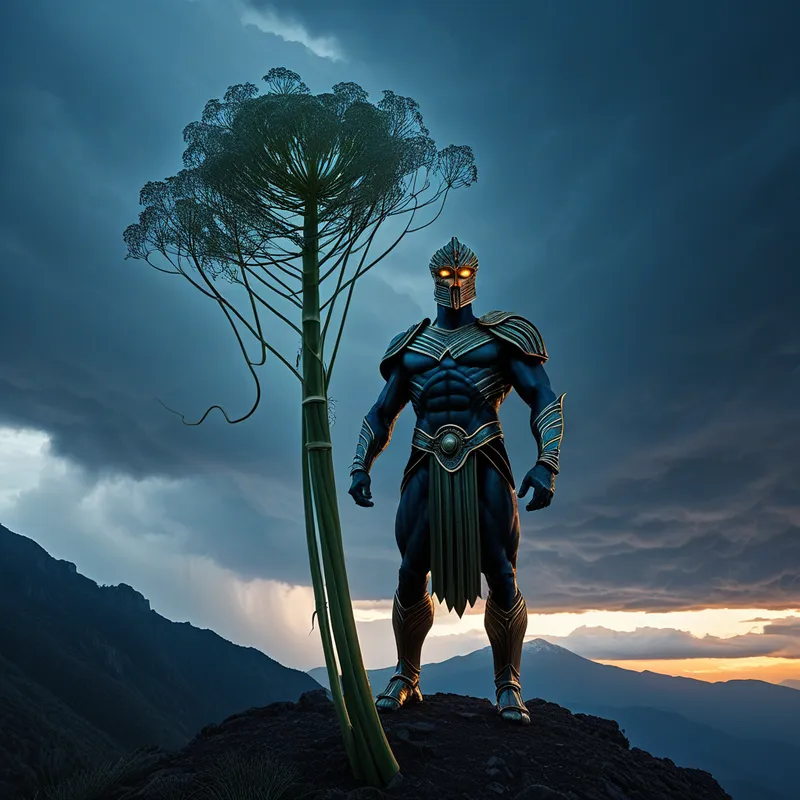
He did not march to Olympus’s gates. He was cunning. He waited for the sun-chariot of Helios to complete its arc. As dusk bled into the world, he approached the celestial forge. Not the central hearth of the gods, but a place where the essence of celestial fire leaked into the world—a crack in a divine wall, the ember of a fallen star. There, he took a stalk of giant fennel, a hollow, smoldering reed. With a breath both gentle and fierce, he coaxed a single, perfect seed of the Olympian flame into its core.
The descent was an eternity. The ember, hidden in the stalk, glowed like a captured sunset against his chest. He could feel the eyes of the cosmos upon him, the weight of divine law like chains already forming in the aether. He brought it down to the trembling, huddled mortals. He showed them how to nurture the spark, to feed it twigs, to build a hearth. The first fire lit a human face from within—not just the skin, but the mind. They saw not just warmth, but possibility. In that flickering light, the idea of the potter’s wheel was born, the shape of the plow, the melody of the first song.
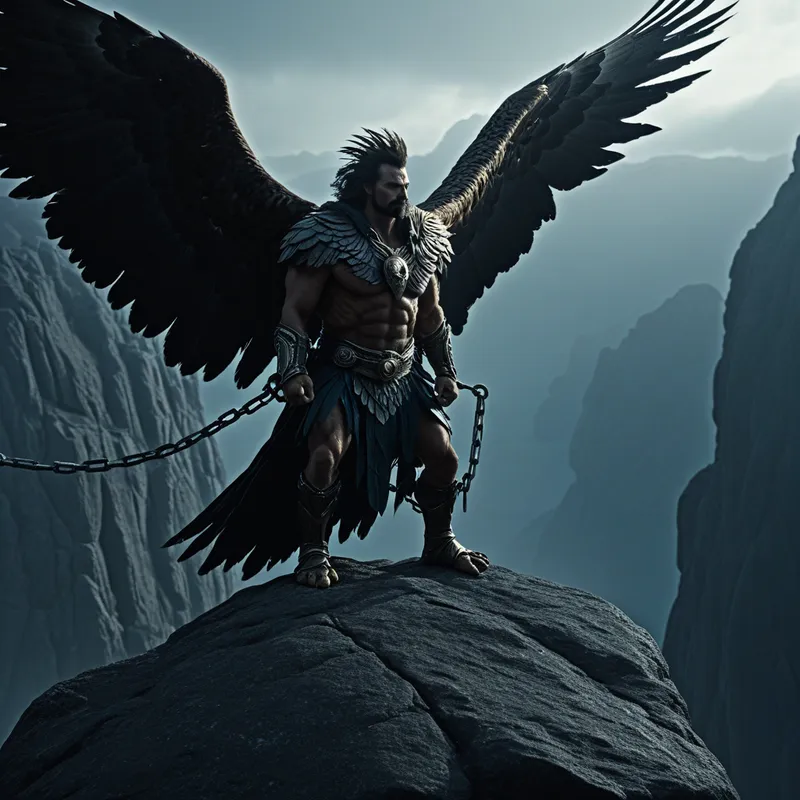
On Olympus, the new light was seen. It was a blasphemy upon the dark earth, a tiny, defiant mirror of the divine realm. Zeus’s wrath shook the mountains. The price for theft of divine property was absolute. Hephaestus, the craftsman god, was ordered to forge chains of unbreakable adamant. With heavy heart, for he too was a friend to craft, Hephaestus bound the Titan to a barren, storm-lashed cliff in the Caucasus Mountains.
But chains were not enough. A sentence of eternal, regenerative agony was pronounced. Each day, an eagle with feathers like polished bronze—the emblem of Zeus himself—would fly to the cliff. It would sink its talons into Prometheus’s side and tear out his liver, the seat of passion and life. Each night, as the cold stars witnessed, the liver would regrow, ripe for the eagle’s return at dawn. Torment without end, for a gift without recall. And there, bound between heaven and earth, the fire-bringer hung, his sacrifice a silent roar against the sky, while below, by the light of his stolen gift, humanity began to build its world.
Cultural Origins & Context
This foundational myth was not a singular story but a living narrative woven into the fabric of ancient Greek thought. Its most famous and cohesive tellings come from the epic poet Hesiod in the 8th century BCE, in his Theogony and Works and Days. Here, it functions as a divine etiology—a story explaining the origins of human condition, sacrifice, and our fraught relationship with the gods. Later, the tragedian Aeschylus immortalized Prometheus as the ultimate tragic hero in his trilogy, Prometheus Bound, elevating the tale to a profound meditation on resistance to tyrannical authority.
The myth served multiple societal functions. It explained the human possession of technology (techne)—fire as the root of all crafts, from metallurgy to cooking. It justified the ritual practice of animal sacrifice, anchoring it in a primordial divine conflict. Most importantly, it articulated a core cultural tension: the celebration of human intelligence, cunning (metis), and progress, forever balanced against the necessity of piety and the acknowledgment of limits imposed by a higher, often capricious, order. Prometheus was both a culture hero and a warning.
Symbolic Architecture
At its heart, the myth is a grand allegory for the awakening of consciousness. The fire is never merely physical flame.
Fire is the light of the mind—the spark of reason, self-awareness, technology, and the creative impulse that separates human from beast.
Prometheus represents the archetypal principle of Forethought—the capacity for foresight, planning, and rebellion against instinctual or imposed limitation. He is the psychic force that urges evolution beyond a comfortable, unconscious state. His theft is the necessary act of individuation, seizing one’s own source of light and authority from a parental or collective “god” (the established order, tradition, the super-ego) that wishes to keep one in a state of dependent ignorance.
Zeus symbolizes established Law, Order, and Power. His punishment is not mere cruelty, but the inevitable backlash of the system when its foundational energy is appropriated. The eagle is the relentless, daily gnawing of guilt, doubt, or the oppressive weight of the consequence that follows revolutionary action. The regenerating liver signifies that the wound of consciousness—the price of knowledge and the burden of responsibility—never fully heals; it is a perpetual condition of the awakened state.

The Dreamer’s Resonance
When this myth stirs in the modern psyche, it often manifests in dreams of illicit acquisition or defiant creation. You may dream of stealing a precious jewel from a heavily guarded museum, or of secretly lighting a candle in a vast, dark cathedral. The somatic feeling is one of thrilling tension in the chest—the hidden ember—mixed with a dread of being discovered.
Psychologically, this dream pattern signals a critical stage in the dreamer’s development. It is the soul’s rebellion against an internal or external tyranny. This could be breaking free from a stifling family narrative, claiming one’s own artistic voice against internal critics, or challenging a dogmatic belief system. The “fire” is the unique talent, the repressed truth, or the authentic identity that the dreamer is ready to “steal back” from the psychic “gods” who have hoarded it—be they internalized parents, societal expectations, or a stagnant self-concept. The impending “eagle” in the dream represents the anxiety of the consequences: rejection, isolation, or the heavy burden of maintaining one’s hard-won autonomy.

Alchemical Translation
The journey of Prometheus is a perfect map for the alchemical process of psychic transmutation, what Carl Jung called individuation.
The first stage, Nigredo (the blackening), is humanity’s initial state: unconscious, bound to the earth, living in the shadow of the gods (the dominant, unconscious psyche). Prometheus’s act is the Separatio—the daring separation from the divine whole. He extracts the fiery spiritus (spirit) from the collective unconscious (Olympus) and brings it down to the human realm of ego and matter.
The theft is the essential, blasphemous act of self-creation. One cannot petition the gods for one’s own soul; one must seize it.
His binding to the rock is the Mortificatio (the mortification). This is the painful, necessary stage where the ego, having claimed its power, is crucified by the reality of its choice. The eagle’s daily feast represents the ongoing suffering of consciousness—the anxiety of freedom, the guilt of ambition, the loneliness of seeing differently. Yet, the liver’s regeneration is the secret, vital process of Coagulatio (coagulation). The suffering is not meaningless; it continually renews the very substance of the Self. The Titan does not die; he endures, and in that endurance, his identity is forged in adamantine certainty.
Finally, the myth promises a Solutio (dissolution) and liberation—hinted at in later myths where Heracles slays the eagle and frees Prometheus. This symbolizes the integrated psyche, where the heroic ego (Heracles) resolves the tension between the rebellious spirit (Prometheus) and the ruling principle (Zeus). The once-stolen fire is no longer a crime, but a reconciled, integrated part of a more complete cosmic order. For the modern individual, this is the state where one’s hard-won knowledge and rebellious authenticity are no longer a source of perpetual conflict, but have become the grounded, warming hearth at the center of a life lived with conscious, and costly, purpose.
Associated Symbols
Explore related symbols from the CaleaDream lexicon: