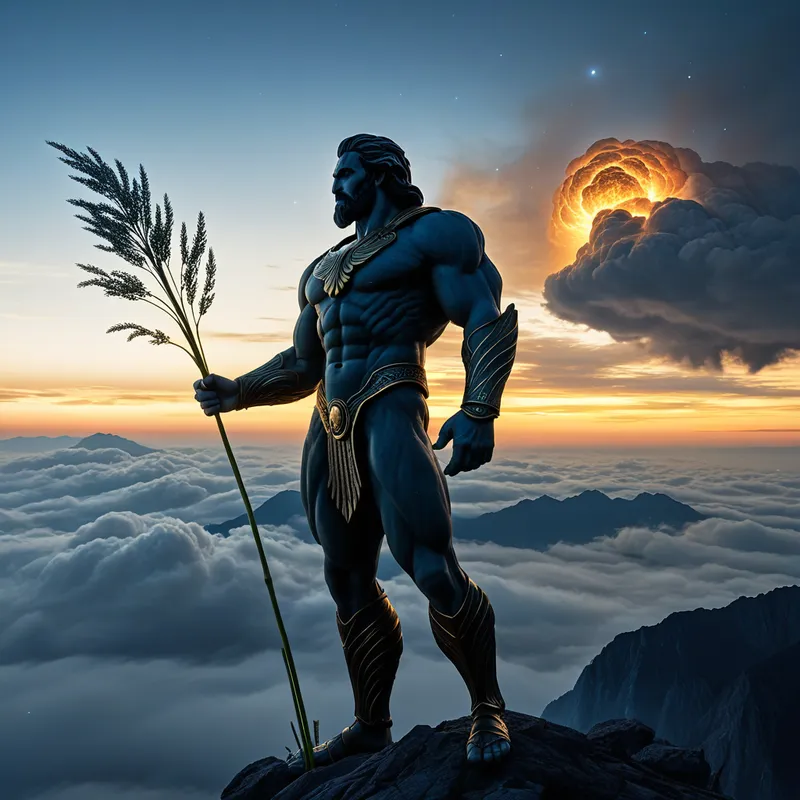
Prometheus stealing fire from Myth Meaning & Symbolism
The Titan who defied the gods to steal divine fire for humanity, gifting them knowledge and technology at the cost of eternal torment.
The Tale of Prometheus stealing fire from
Listen. In the age before memory, when the world was new and raw, humanity shivered in the dark. They were creatures of clay and twilight, huddled in caves, their bellies empty, their minds shrouded. Above them, on the sun-drenched peaks of Mount Olympus, the gods feasted on ambrosia and reveled in their eternal, careless power. Their king, Zeus, had claimed dominion over all, his thunderbolt the final argument in all debates.
But one being watched the suffering below with a heart that was not entirely divine. This was Prometheus, whose name means “Forethought.” A Titan, older than the Olympians, he had aided Zeus in the great war against his own kind. He saw in the lumpen forms of men and women a spark of potential, a capacity for more than mere animal existence. He had shaped them from clay, breathed life into them. Now, he could not bear their perpetual night.
Zeus, wary of this potential, had expressly forbidden the gift of fire to mortals. Fire was the province of the gods alone—the tool of the smith-god Hephaestus, the essence of the sun-chariot of Apollo. It was the dividing line between the immortal and the mortal, the empowered and the helpless.
Prometheus’s resolve hardened like tempered steel. He did not march to Olympus in open rebellion. He chose cunning, the weapon of the wise. Under the cloak of a starless night, he ascended the sacred mountain. The air grew thin and cold, smelling of ozone and divine incense. He passed the silent halls of the gods, their laughter echoing from within like distant thunder. His destination was the sun-chariot as it rested, or the sacred forge of Hephaestus—the stories vary. But his tool was a humble stalk of giant fennel.
He crept to the very source of the divine flame. With a swift, decisive motion, he thrust the hollow stalk into the celestial fire. A spark, then a glow, then a vibrant, dancing tongue of flame caught within the plant’s core. He stole not just a brand, but the very principle of fire itself. Cradling the flickering light within the fennel, he turned his back on Olympus and began his descent.
His journey back to earth was a race against the dawn. The stolen fire illuminated his determined face, casting long, defiant shadows on the rocks. He could feel the gaze of the heavens upon him, a pressure building in the air. But he did not falter. He reached the world of men as the first grey light touched the horizon.
He gathered the trembling, fearful humans. He did not speak. Instead, he knelt and touched the fennel stalk to a pile of dry tinder. A crackle, a pop, and then—a miracle. A flame, independent and alive, bloomed on earth for the first time. He showed them how to feed it, how to shelter it. The light pushed back the physical dark, yes. But more: it lit a fire behind their eyes. They saw not just to eat, but to cook. Not just to hide, but to forge. Not just to fear, but to wonder. The gift was given.
On Olympus, Zeus felt the theft in his very bones. The balance of the cosmos had been altered. Looking down, he saw the pinpricks of hearth fires dotting the land like defiant stars. His rage was a storm that shook the foundations of the world. The benefactor would pay. The price for illuminating humanity would be an eternity of darkness and pain.

Cultural Origins & Context
The myth of Prometheus is a cornerstone of ancient Greek mythology, primarily preserved in the epic poetry of Hesiod’s Theogony and Works and Days (8th-7th century BCE), and later given profound tragic depth in Aeschylus’s play Prometheus Bound (5th century BCE). It was not a mere folktale but a foundational narrative told by bards and playwrights to explore the most pressing questions of the human condition: our relationship to the divine, the origins of technology and culture, and the nature of suffering.
In the context of Greek society, a culture that valued cunning intelligence (metis) as much as brute strength, Prometheus embodied a complex, ambivalent archetype. He was a culture hero, responsible for humanity’s rise from savagery, yet also a symbol of dangerous overreach (hubris). The myth served as a cautionary tale about the limits imposed by the gods (or the natural/cosmic order) and the terrible cost of transgressing them, while simultaneously celebrating the defiant spirit that drives progress and self-determination.
Symbolic Architecture
At its heart, the myth is an allegory for the dawn of consciousness. Fire is the ultimate symbol of transformative energy. It is technology, art, science, and spirit—all the faculties that lift humanity out of a purely instinctual, biological existence and into the realm of culture and self-awareness.
The stolen fire is the spark of reflexive consciousness—the moment the universe begins to know itself through the human mind.
Prometheus represents the rebellious aspect of the psyche that challenges stagnant authority (Zeus as the established, often tyrannical, world order) for the sake of growth and enlightenment. He is Forethought, the capacity for foresight and planning that distinguishes human endeavor. His opposite, his brother Epimetheus (“Afterthought”), who heedlessly accepts the gift of Pandora, represents impulsive, shortsighted action. The myth pits proactive, sacrificial intelligence against reactive, punitive power.
The eternal punishment—the eagle devouring his regenerating liver—is a devastating symbol of the psychic cost of this awakening. The liver was anciently considered the seat of passion and life-force. His torment is the perpetual gnawing of guilt, anxiety, and the burden of knowledge that accompanies consciousness. We are forever both blessed and cursed by the fire we carry.
The Dreamer’s Resonance
When this myth stirs in the modern dreamer, it often signals a profound, rebellious activation of the psyche. To dream of stealing a sacred or forbidden light, of taking a vital energy from a powerful, authoritarian figure or institution, points to a necessary act of psychological rebellion.
The somatic experience might be one of thrilling terror—a racing heart, a sense of being pursued, combined with the exhilarating weight of a secret, potent prize in one’s hands. This is the psyche initiating its own liberation from internalized “gods”: oppressive parental complexes, societal mandates, or limiting self-beliefs that keep one’s full potential in the dark. The dream may culminate in the act of giving this stolen fire to others (one’s inner community or a project), or it may freeze at the moment of discovery, reflecting the dreamer’s fear of the consequences of their own awakening.

Alchemical Translation
The journey of Prometheus is a brutal but precise map of the alchemical process of individuation. It begins with nigredo—the blackness of humanity’s unawakened state. Prometheus, as the guiding spirit of the Self, performs the separatio, separating the divine spark (fire) from the complacent whole (Olympus).
The theft is the essential, blasphemous act of differentiation: claiming one’s own authority and creative power from the collective unconscious (the gods).
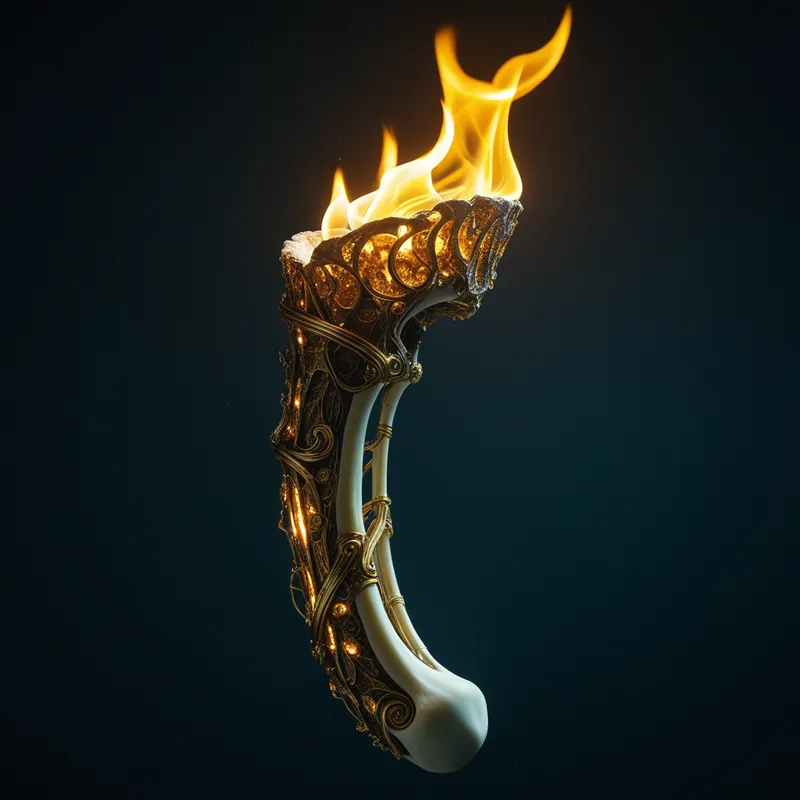
The carrying of the fire in the fennel stalk is the coniunctio—the sacred marriage of the stolen divine principle with a humble, earthly vessel (the human body and mind). This is the integration of spirit and matter within the individual.
The eternal punishment on the rock is the protracted stage of mortificatio and putrefactio—the necessary suffering and dissolution of the old ego that identified with the powerless mortal. The eagle is not merely a tormentor, but an agent of this transformation, repeatedly exposing the vulnerable core (the liver/passions) to be consumed and renewed. This is the ongoing cost of maintaining consciousness: the perpetual cycle of facing one’s deepest wounds and complexes.
The promise of the myth (fulfilled later by Heracles) is that this torment is not meaningless. It serves a cosmic purpose. Through enduring it, the Promethean individual ultimately forges a consciousness that is not just stolen, but earned. They move from being a thief of light to becoming a sovereign source of it, having transmuted the gods’ fire into a flame uniquely their own. The gift to humanity, in the end, is the map to our own difficult, glorious becoming.
Associated Symbols
Explore related symbols from the CaleaDream lexicon: