
Prometheus shaping humans from Myth Meaning & Symbolism
The Titan Prometheus defies the gods, shapes humanity from clay, and steals celestial fire to animate them, gifting consciousness and incurring eternal wrath.
The Tale of Prometheus shaping humans from
In the age after the great war, when the Titans were cast down and the new gods of Olympus divided the spoils of creation, the world was a beautiful, silent garden. Zeus claimed the sky, Poseidon the sea, and Hades the sunless depths. But the earth—the rich, damp soil, the riverbanks of silt, the dust of the plains—was deemed a common thing, forgotten.
It was in this quiet aftermath that Prometheus, the one who had foreseen the Titans’ fall and sided with the victors, walked alone. He was a being of craft and cunning, his mind a loom of possibilities. The silence of the world gnawed at him. The gods feasted on ambrosia and nectar, their laughter echoing in halls of cloud, while below, the winds played over empty fields and through vacant forests.
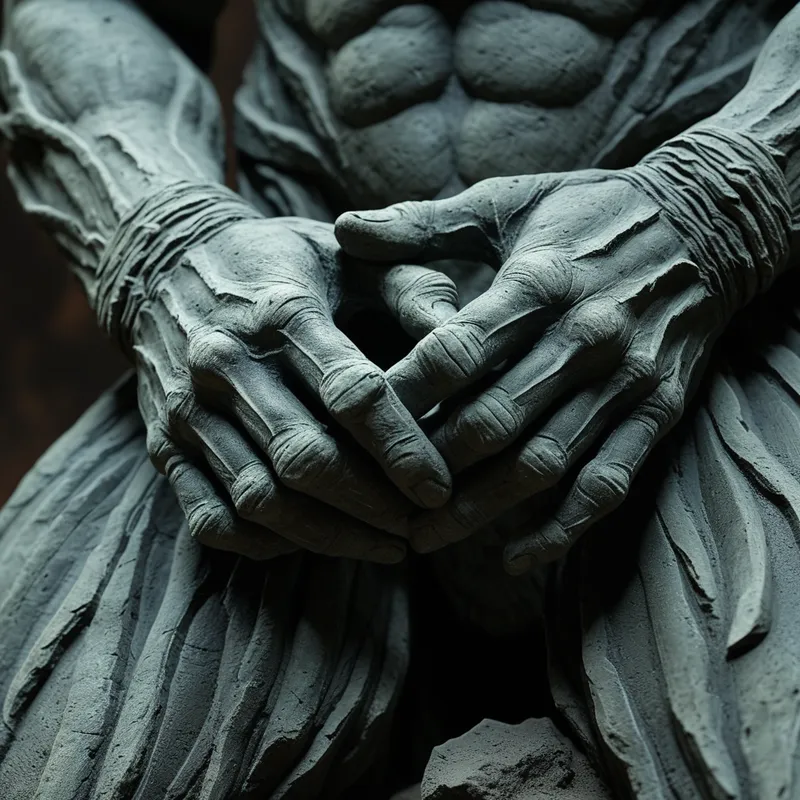
Drawn to a riverbank where the mud was fine and dark, Prometheus knelt. The water whispered past, carrying memories of stone and mountain. With a profound tenderness that belied his Titan strength, he scooped up the clay. It was cool and yielding in his hands. He did not command it; he conversed with it. He shaped not with the brute force of a god making a toy, but with the focused intent of an artist midwifing a soul into form. First the long limbs, then the delicate fingers, the curve of a skull to house a universe of thought, the hollow of a chest to hold a world of feeling. He shaped them in the image of the gods themselves—a deliberate, silent act of profound affinity and nascent defiance.
But the figures lay still, beautiful but inert, mere statues of earth. They had form, but no fuss. No inner warmth, no spark of awareness, no means to perceive the beauty of the world crafted for them. Prometheus looked from his clay children to the distant, fiery chariot of the sun, and then to the forbidden hearth of Olympus where the divine fire burned—the essence of mind, craft, and spirit, jealously guarded by Zeus.
The conflict crystallized in his heart. To obey was to leave his creation incomplete, a mockery of life. To act was to challenge the absolute order of the new king. His forethought showed him the consequence—a wrath as eternal as the sky itself. He made his choice.
Under the cover of night, when the gods slept, Prometheus ascended. He took a hollow stalk of fennel, and with a thief’s grace, he stole a single, glowing ember of that celestial fire. Descending to the riverbank, he knelt once more. He breathed the fire into the clay. And the figures stirred. Eyes, wet with river-mud, opened and saw the stars for the first time. Lungs drew breath, and the first sound was not a cry, but a sigh of wonder. They stood, unsteady on new legs, their cold clay now warm with the stolen divine spark. Prometheus watched, and in their awakening, he saw his own doom take shape. He had given them life, and in doing so, had signed his own sentence to an eternity of torment.
Cultural Origins & Context
This foundational narrative comes to us from the rich tapestry of ancient Greek mythology, primarily through the epic poetry of Hesiod in his Theogony and Works and Days, and later, most powerfully, through the tragic drama of Aeschylus in Prometheus Bound. It was not a singular, dogmatic text, but a living story told by bards and playwrights, evolving with each telling yet holding to its core truth.
In the context of Greek society, this myth served multiple profound functions. For a culture navigating the tensions between aristocratic power (the Olympians) and human agency, it provided an origin story that explained humanity’s unique, precarious position: below the gods, yet possessing a god-like intellect and restless spirit. It explained the human condition—our capacity for technology (techne), art, and civilization (all gifts of that stolen fire), forever coupled with suffering, toil, and mortality (part of the subsequent punishment, as seen in the myth of Pandora). The story was a cornerstone of Greek identity, framing humanity not as accidental byproducts, but as the deliberate, if illicit, creation of a compassionate rebel, making our very existence an act of cosmic defiance.
Symbolic Architecture
At its heart, the myth of Prometheus is a grand allegory for the birth of consciousness and the price of enlightenment. Prometheus is not merely a trickster; he is the archetypal culture hero.
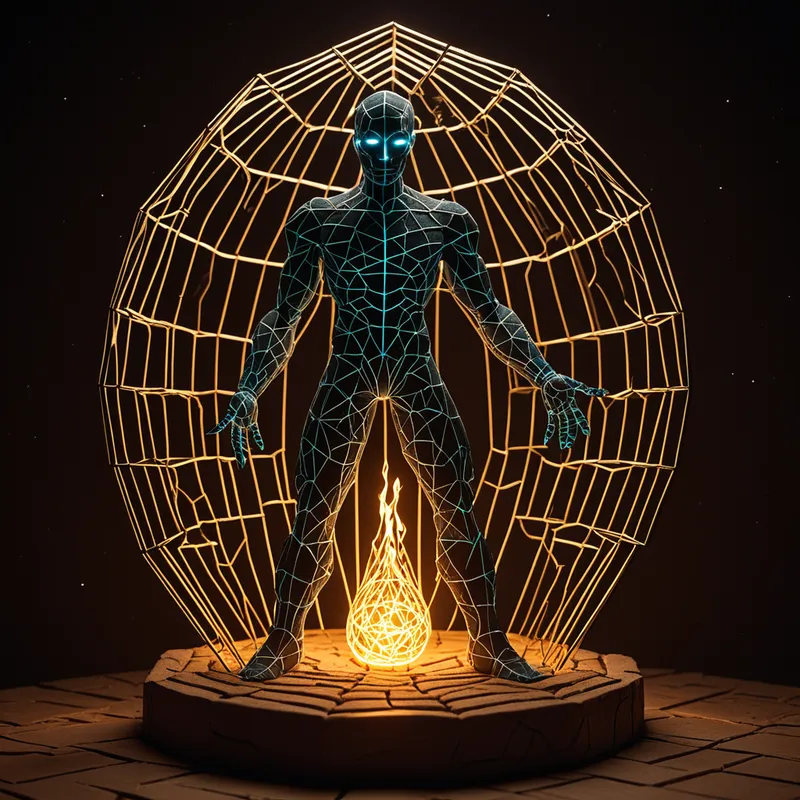
The clay is our physical, earthly nature—mortal, vulnerable, and born of the soil. The stolen fire is the divine spark—consciousness, self-awareness, creative intellect, and the restless spirit that questions and innovates.
Prometheus represents the aspect of the psyche that rebels against imposed limitations, even those set by internalized “gods” or parental authorities. His shaping of humanity “in the image of the gods” symbolizes the innate, often unconscious, human drive to transcend our base condition, to reach for a state of being that we intuit but do not fully possess. The theft is the critical, traumatic moment of individuation—the necessary rebellion against a stagnant, all-consuming totality (represented by Zeus’s order) to claim one’s own light and autonomy.
The inevitable punishment—being chained to a rock where an eagle eternally devours his regenerating liver—is a potent symbol of the cost of this awakening. The liver was anciently considered the seat of passion and life-force. Thus, the eternal torment represents the perpetual cycle of suffering that accompanies profound consciousness: the pain of foresight, the burden of responsibility for one’s creations, and the visceral cost of maintaining one’s rebellious, enlightened stance against oppressive forces.
The Dreamer’s Resonance
When this myth stirs in the modern dreamscape, it often signals a profound process of self-creation or psychic rebellion. To dream of shaping figures from clay or mud points to a somatic, hands-on engagement with one’s own identity formation. The dreamer is in the process of re-molding themselves, perhaps after a period of dissolution or trauma, getting back to the basic, elemental “clay” of their being.
Dreams of stealing fire, or protecting a fragile flame, speak directly to the act of claiming one’s own power, creativity, or insight from an external authority—be it a parent, a partner, an institution, or a dominant inner critic (the internalized Zeus). The dream may be fraught with anxiety, mirroring Prometheus’s foresight of punishment. This is the psyche working through the fear of retribution for becoming one’s own person, for daring to be brilliant or autonomous.
Conversely, dreaming of being chained while a bird or beast attacks one’s torso can symbolize feeling punished for one’s gifts, talents, or insights. It is a somatic metaphor for a creative or intellectual life-force that feels perpetually under attack, consumed by the demands of the world or by one’s own inner cycles of doubt and regeneration.

Alchemical Translation
The Promethean myth is a perfect map for the alchemical process of individuation. It begins with the prima materia: the undifferentiated clay, representing the unconscious, potential self.
The act of shaping is the opus, the conscious work of the ego beginning to give form to this potential. But the work remains inert, a persona without soul, until the crucial, transformative fire is introduced.
The “theft” of fire is the most critical phase: the confrontation with the Senex archetype (the old king, Zeus) within. One must rebel against inner laws that say “you cannot be this, know this, or create this.” This is the integration of the Trickster or Rebel, stealing the lumen naturae—the light of nature and spirit—from the clutches of a rigid, outdated psychic structure.
The gifted fire—technology, art, consciousness—is then used to animate the new self. But the alchemy is not complete with the theft. The enduring punishment is the integration of the shadow side of this gift: the eternal responsibility, the loneliness of foresight, the pain that comes with heightened awareness. To be whole, one must accept being bound to the rock of one’s own destiny, enduring the cyclical “eagle” of introspection and suffering that continually renews the process of self-knowledge. The ultimate triumph is not freedom from the rock, but the unbroken spirit that, like Prometheus, endures it, having irrevocably changed the nature of creation itself by daring to bring the divine spark down to earth.
Associated Symbols
Explore related symbols from the CaleaDream lexicon: