
Prometheus molding humanity fr Myth Meaning & Symbolism
A titan shapes humanity from clay and steals divine fire, gifting consciousness and incurring eternal punishment for his defiant love.
The Tale of Prometheus molding humanity fr
Before the age of heroes, before the first city, [the world](/myths/the-world “Myth from Tarot culture.”/) was a theater for gods and titans. The Titans had fallen, and the new order of Olympians, led by the thunderous Zeus, held dominion. But one titan remained, a being of foresight and cunning named [Prometheus](/myths/prometheus “Myth from Greek culture.”/). He walked the fresh, damp earth, a place of potential and silence.
He came to a riverbank where the mud was rich and dark. Kneeling, he gathered the clay, feeling its cool, pliable life in his hands. Not as a god commands, but as an artist dreams, he began to shape. He formed limbs to wander, a chest to hold breath, and a head to gaze upward. He sculpted them in the image of the gods themselves, a daring act of mimicry that planted the first seed of aspiration in the mortal form. Yet these figures lay inert, beautiful but empty vessels upon the shore.
Prometheus looked to Athena, she of the clear, grey eyes and strategic mind. In a silent pact of intellect and compassion, she breathed into them the winds of life—[pneuma](/myths/pneuma “Myth from Greek culture.”/) and [psyche](/myths/psyche “Myth from Greek culture.”/)—and the clay figures stirred, their chests rising with the first uncertain breath. But their eyes were dim. They shivered in the dawn, knowing only need, not craft; fear, not hope.
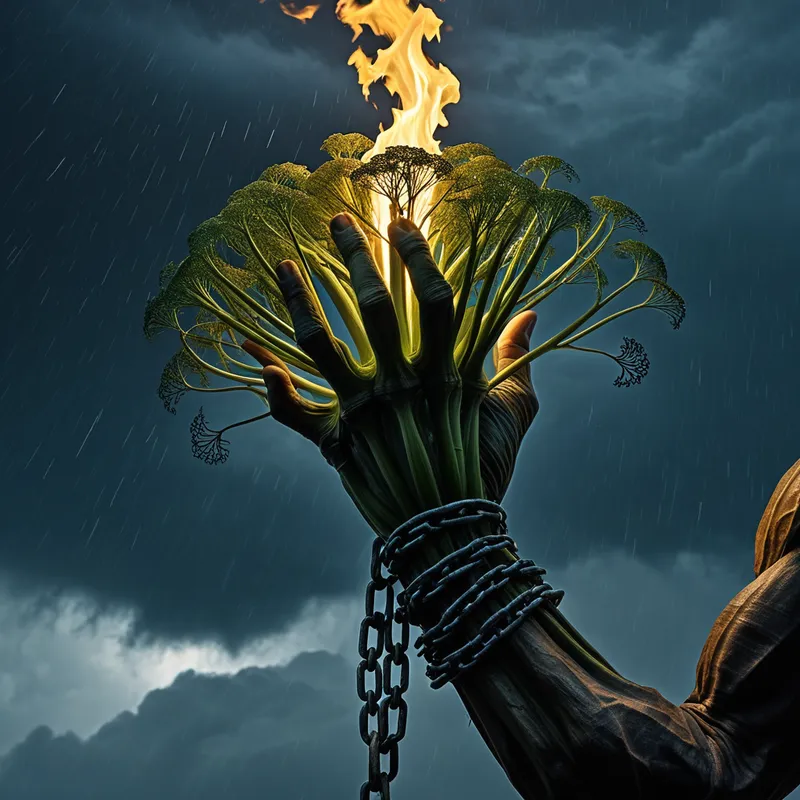
Prometheus’s heart, a forge of pity and defiance, could not abide it. He journeyed to the sun-chariot of [Helios](/myths/helios “Myth from Greek culture.”/), or to the very hearth of Olympus. There, he took a stalk of giant fennel, hollow and dry. With a swift, audacious motion, he touched it to the divine, dancing flame—the essence of [Hephaestus](/myths/hephaestus “Myth from Global/Universal culture.”/)‘s forge and Zeus’s own celestial power. He stole it. He hid the blazing heart of the gods within the fennel stalk and descended back to the shadowed world.
He presented the fire to his clay-born children. The spark leapt from his hand to theirs. Watch: as the first fire caught in a human hearth, a light kindled behind human eyes. With fire came warmth against the night, the art of the smith to shape metal, [the potter](/myths/the-potter “Myth from Abrahamic culture.”/) to harden clay, the means to cook food and forge community. He had given them not just survival, but the tools of civilization and the restless spark of consciousness itself—the very nous that could question, create, and aspire.
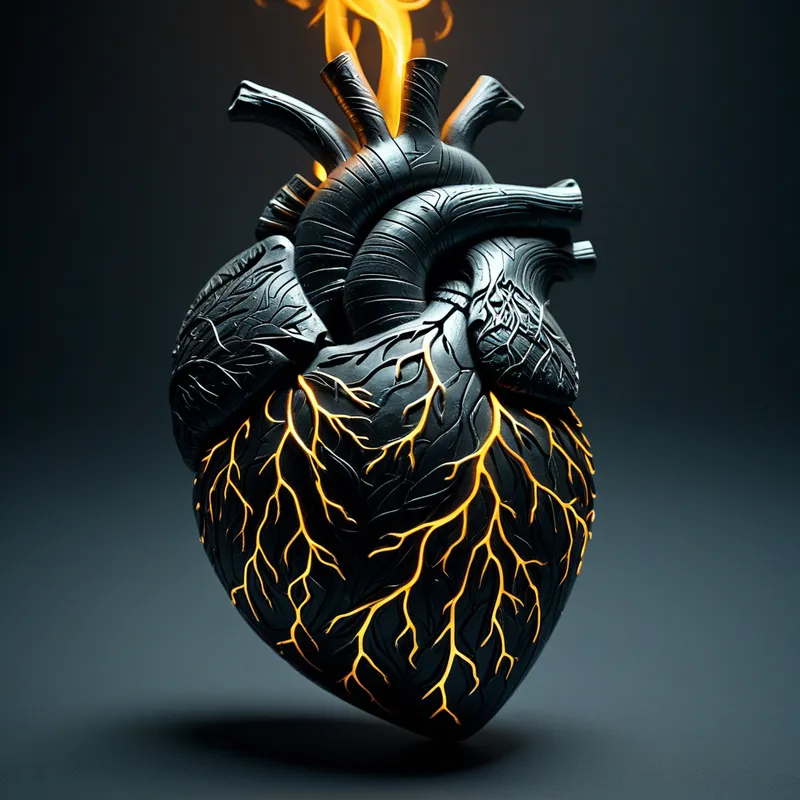
The scent of mortal smoke, tinged with ambition, reached the high halls of Olympus. Zeus’s wrath was a tempest contained in a single, cold realization. His order had been subverted. The boundary between divine and mortal, which he meant to be a chasm, was bridged by a flickering flame. For this act of ultimate rebellion—this theft of divine privilege—the sentence was eternal. Prometheus was dragged to the desolate, wind-scoured crags of the Caucasus. Unbreakable adamantine chains, forged by the betrayed Hephaestus, bound him to the stone. Each day, a monstrous eagle, the embodiment of Zeus’s tyranny, would descend to tear open his side and feast upon his immortal liver. Each night, the organ would regrow, ensuring the agony was as infinite as his love for humanity. There, chained between earth and sky, the creator endured, his groans the price of the spark in every human heart.
Cultural Origins & Context
This foundational narrative comes to us from the rich tapestry of Greek mythology, most comprehensively preserved in the epic poetry of Hesiod’s Theogony and Works and Days, and later expanded upon by tragedians like Aeschylus. It was not a singular, dogmatic text but a living story told by bards, enacted in rituals, and pondered by philosophers. Its societal function was profound: it was an aetiological myth explaining humanity’s unique, precarious position in the cosmos—possessing god-like faculties but bound by mortal limitations. It justified the necessity of sacrifice to the gods (a central pillar of Greek religion stemming from the trick at Mecone) while simultaneously celebrating the human capacity for art, technology, and progress, which was seen as a divine, if stolen, inheritance. The myth served as a cautionary tale about the cost of knowledge and a foundational parable on the relationship between creative defiance and suffering.
Symbolic Architecture
At its core, the myth maps the [birth](/symbols/birth “Symbol: Birth symbolizes new beginnings, transformation, and the potential for growth and development.”/) of [human](/symbols/human “Symbol: The symbol of a human represents individuality, complexity of emotions, and social relationships.”/) [consciousness](/symbols/consciousness “Symbol: Consciousness represents the state of awareness and perception, encompassing thoughts, feelings, and experiences.”/) and its inherent alienation. Prometheus is the [archetype](/symbols/archetype “Symbol: A universal, primordial pattern or prototype in the collective unconscious that shapes human experience, behavior, and creative expression.”/) of the Nous Rebel, the one who steals from the unified, unconscious [realm](/symbols/realm “Symbol: The symbol of ‘Realm’ often signifies the boundaries of one’s consciousness, experiences, or emotional states, suggesting aspects of reality that are either explored or ignored.”/) of the gods ([the Self](/myths/the-self “Myth from Jungian culture.”/)) to empower the emerging ego of humanity.
The clay is the prima materia of the human condition: physical, vulnerable, and born of earth. The divine fire is the animating spirit—consciousness, self-awareness, and the catalytic spark of technology that separates us from pure nature.
Prometheus’s act is the original transgression that initiates the painful, glorious process of individuation. He represents the psychic force that compels us to leave the unconscious [paradise](/symbols/paradise “Symbol: A perfect, blissful place or state of being, often representing ultimate fulfillment, harmony, and transcendence beyond ordinary reality.”/) of ignorance (the Olympian hoarding of fire) for the conscious, suffering state of [knowledge](/symbols/knowledge “Symbol: Knowledge symbolizes learning, understanding, and wisdom, embodying the acquisition of information and enlightenment.”/) and [responsibility](/symbols/responsibility “Symbol: Responsibility in dreams often signifies the weight of duties and the expectations placed upon the dreamer.”/). His eternal [punishment](/symbols/punishment “Symbol: A dream symbol representing consequences for actions, often tied to guilt, societal rules, or internal moral conflicts.”/) symbolizes the perpetual [tension](/symbols/tension “Symbol: A state of mental or emotional strain, often manifesting physically as tightness, pressure, or unease, signaling unresolved conflict or anticipation.”/) of the conscious mind: to possess [the divine spark](/myths/the-divine-spark “Myth from Gnostic culture.”/) ([awareness](/symbols/awareness “Symbol: Conscious perception of self, surroundings, or internal states. Often signifies awakening, insight, or heightened sensitivity.”/)) is to be forever chained to the rock of existential suffering, [vulnerability](/symbols/vulnerability “Symbol: A state of emotional or physical exposure, often involving risk of harm, that reveals authentic self beneath protective layers.”/), and the relentless [eagle](/symbols/eagle “Symbol: The eagle is a symbol of power, freedom, and transcendence, often representing a person’s aspirations and higher self.”/) of our own anxieties and societal constraints. The myth posits that creativity, progress, and self-[awareness](/symbols/awareness “Symbol: Conscious perception of self, surroundings, or internal states. Often signifies awakening, insight, or heightened sensitivity.”/) are born not from obedience, but from a necessary, loving rebellion against a [static](/symbols/static “Symbol: Static represents interference, disruption, and the breakdown of clear communication or signal, often evoking feelings of frustration and disconnection.”/) order.
The Dreamer’s Resonance
When this myth stirs in the modern unconscious, it often manifests in dreams of profound shaping or forbidden ignition. To dream of meticulously molding clay or earth into a form signifies a somatic process of self-creation or re-creation—the dreamer is actively working on shaping their identity, healing old wounds, or giving form to a nascent potential within. The material is primal, suggesting the work is foundational to the psyche.
Dreams of stealing fire—taking a spark from a guarded hearth, lighting a match in a forbidden room, or carrying a concealed flame—point directly to the Promethean complex. This is the psyche navigating the theft of authority, knowledge, or creative power from an internalized “Zeus” (a domineering parent, a rigid inner critic, a stifling tradition). The accompanying emotion—a mix of exhilaration and dread—mirrors Prometheus’s fate: the thrill of empowerment shadowed by the anticipation of punishment. Such dreams mark a critical threshold where the dreamer is psychically claiming their right to their own consciousness and creative power, preparing to endure the inevitable conflict that follows such an act of self-assertion.

Alchemical Translation
The alchemical journey modeled by Prometheus is the opus contra naturam—the work against nature, or more precisely, against the prevailing, unconscious order. For the individual, the “clay” is the raw, unexamined mass of one’s inherited nature, family patterns, and cultural conditioning. The “molding” is the arduous, hands-on process of individuation, taking responsibility for shaping one’s own character.
The theft of fire is the pivotal, rebellious stage of separatio and ignis—the separation from collective values to claim one’s inner truth, ignited by the transformative fire of insight, often experienced as a crisis, a breakthrough, or a defiant act of self-honesty.
The ensuing “chains” and “eagle” are not merely punishments, but integral to the transmutation. The rock of suffering is the necessary container (the vas) for the work. The repeated wounding represents the painful but necessary confrontations with reality, shame, or limitation that temper the spirit. [The immortal](/myths/the-immortal “Myth from Taoist culture.”/) liver, constantly regenerating, symbolizes the psyche’s resilient capacity for regeneration and learning through suffering. To integrate the Promethean archetype is to accept that true consciousness—owning one’s fire—comes with a lifelong sentence of responsibility, perpetual vulnerability, and the courage to endure the cyclical wounds of existence, all for the sake of that hard-won, [inner light](/myths/inner-light “Myth from Buddhist culture.”/). We are both the molded clay and the chained titan, forever bearing the cost and glory of the spark within.
Associated Symbols
Explore related symbols from the CaleaDream lexicon: