Prometheus' Gift Myth Meaning & Symbolism
The Titan Prometheus defies Zeus to steal divine fire for humanity, gifting them knowledge and technology at the cost of eternal torment.
The Tale of Prometheus’ Gift
In the age before memory, when the world was new and the gods were young upon Olympus, humanity lived in shadows. They were creatures of clay, shaped by the cunning Titan Prometheus. They huddled in caves, their breath misting in the perpetual chill, eating their meat raw, their minds as dark and silent as the deepest earth.
High above, the Olympians feasted. The scent of ambrosia and the sound of golden laughter drifted down from the cloud-wreathed peaks. Zeus, the Thunderer, had claimed his throne through brutal war against the old Titan order. Now, he demanded tribute. He decreed that at Mecone, a great feast should be held to decide what portion of sacrifice belonged to the gods and what to mortals.
Prometheus, whose heart held a strange love for his fragile creations, devised a trick. He slaughtered a great ox and divided it. On one side, he placed the rich, succulent meat and innards, hiding them beneath the unappealing stomach of the beast. On the other, he arranged the white bones, artfully concealing them with a glistening layer of fat. He then bade Zeus to choose his portion. The Lord of Olympus, deceived by the shining fat, chose the bones. From that day, the smoke of bones and fat rose to the gods, while humanity kept the nourishing meat.
Zeus’s rage was a storm contained. He saw the trick, felt the insult to his divine order. In retaliation, he withheld from mankind the final gift: fire. Let them shiver in the dark, he commanded. Let them remain beasts.
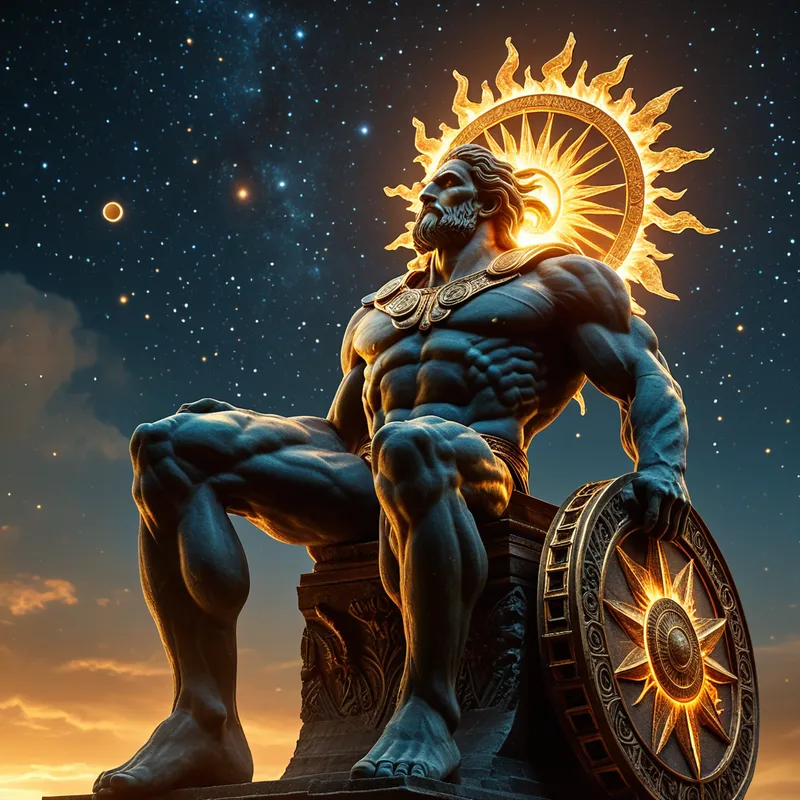
But Prometheus could not bear it. He saw his children, blind and helpless. So, he journeyed to the eastern edge of the world, where Helios drove his chariot of fire from the depths of Oceanus. There, as the sun passed, Prometheus took a hollow stalk of fennel, touched it to the blazing wheel, and stole a single, glowing ember of celestial fire.
He carried it down to the damp earth. He placed it in the hands of the trembling mortals. And with that spark, everything changed. The darkness retreated. Fingers, once numb, felt warmth. Raw flesh sizzled and became food. Clay hardened in the heat into pottery. Metal softened and was shaped into tools. The night was no longer a terror, but a space illuminated by the hearth, where stories were born. The gift of fire was the gift of technology, of culture, of a mind that could see its own path.
When Zeus looked down and saw the pinpricks of light scattered across the black earth, his fury was absolute. The order had been broken. A Titan had defied the king of gods for the sake of mud-creatures. The punishment must be eternal, a warning carved into the very flesh of the cosmos. He had Hephaestus, the master craftsman, forge unbreakable chains. He had the might of Kratos and Bia drag the defiant Titan to the most desolate crags of the Caucasus Mountains. There, they bound him, driving adamantine stakes through his immortal flesh.
And each day, as the sun rose, a great eagle—the emblem of Zeus himself—would descend. With a shriek that split the sky, it would tear open Prometheus’s side and feast upon his liver, the seat of passion and emotion. Each night, as the stolen fire twinkled below, the liver would regrow, ensuring the agony was as infinite as his crime. There he hung, a testament to the price of divine knowledge, his suffering a silent scream against the vault of heaven.

Cultural Origins & Context
This foundational myth was not mere entertainment; it was a cultural operating system. It was codified most famously in Hesiod’s Theogony and Works and Days (8th-7th century BCE) and later dramatized in Aeschylus’s tragic play Prometheus Bound. For the ancient Greeks, it served multiple vital functions. It was an aetiological myth, explaining the origin of human technology and the practice of sacrificial ritual (the division of the ox). It established a core theological tension: the fraught relationship between humanity and the gods, defined by a debt (charis) that could never fully be repaid.
The myth was told in symposia, performed in theaters, and contemplated in philosophical schools. It asked the audience: What is the cost of progress? What obligations do we owe to the powers that be for the gifts of consciousness? Prometheus, the “Forethinker,” represented the cunning intelligence necessary for survival in a world ruled by capricious, often hostile, divine forces. His story validated the Greek virtues of metis (cunning intelligence) and techne (craft, art), while simultaneously warning of the inevitable backlash from established power.
Symbolic Architecture
At its heart, the myth is a profound allegory for the awakening of consciousness and the inherent suffering of self-awareness. The fire is not merely physical flame; it is the light of the mind.
The stolen fire is the spark of logos—reason, foresight, and the divine discontent that separates us from innocent nature.
Prometheus represents the archetypal benefactor-rebel, the part of the psyche (or the culture-hero) that must defy the stagnant, tyrannical “father” (Zeus as the ruling consciousness or superego) to access a more potent, transformative energy. His theft is the ultimate act of individuation, stealing power from the collective, unconscious godhead to empower the nascent individual ego (humanity).
His eternal torment symbolizes the psychological burden of consciousness. The daily devouring of the liver—the organ ancient Greeks associated with passionate feeling—speaks to the perpetual cycle of emotional pain, anxiety, and creative yearning that accompanies an awakened mind. We are forever “eaten” by our own passions, insights, and the responsibilities that knowledge brings.
The Dreamer’s Resonance
When this myth stirs in the modern dreamer, it often signals a profound crisis or initiation related to illumination and its consequences. To dream of stealing a forbidden light, of being punished for a profound insight, or of being bound while watching one’s own vitality be consumed, points to a somatic process of integrating a new level of awareness.
The dreamer may be undergoing a “Promethean” moment in their life: acquiring a difficult truth (a diagnosis, a betrayal, a creative vision), mastering a potent new skill, or rebelling against an internal or external oppressive authority (a family system, a corporate structure, a limiting belief). The eagle in the dream is not merely an attacker; it is the relentless, sharp-beaked scrutiny of the conscious mind or societal judgment, pecking away at the vulnerable, feeling-self (the liver). The dream is the psyche’s way of ritualizing the inevitable suffering that comes with growth, framing it within an ancient, meaningful pattern.

Alchemical Translation
The alchemical journey modeled by Prometheus is the opus contra naturam—the work against nature, or more precisely, against the accepted, unconscious order. The process is one of psychic theft and transmutation.
First, one must recognize the “Zeus” within—the internalized tyrant, the rigid rules, the voice that says “know your place” and denies access to one’s own inner fire (potential, creativity, spirit). The Promethean act is the courageous, cunning decision to defy this inner authority. It is the soul’s rebellion, stealing the anima mundi (the world-soul, the creative spark) from the complacent heavens of one’s own psyche.
The binding to the rock is not the end of the work, but its central, transformative phase. It is the necessary crucifixion, the holding of the tension between the glorious gift and its agonizing price.
This is the alchemical mortificatio and putrefactio—the dissolution and dark night where the old self is consumed. The eagle, in this inner work, becomes an agonizing but necessary instrument of distillation, repeatedly extracting the “passionate liver” (the raw, emotional content) so it may be regenerated in a purer form each night. The ultimate goal is not escape from the rock, but the integration of the theft, the punishment, and the gift into a new, more resilient consciousness. One becomes, like the later-reconciled Prometheus of some traditions, the holder of a terrible and beautiful secret: that wisdom is born in defiance, sustained through suffering, and is the only true property of the soul.
Associated Symbols
Explore related symbols from the CaleaDream lexicon: