Prometheus' Fire Myth Meaning & Symbolism
A Titan steals divine fire for humanity, defying Zeus. His gift sparks civilization, but his eternal punishment becomes a symbol of defiant, transformative sacrifice.
The Tale of Prometheus’ Fire
In the age before memory, when [the world](/myths/the-world “Myth from Tarot culture.”/) was young and raw, humanity huddled in the dark. They were creatures of clay and breath, shaped by the hands of the Titans, but left to wander a twilight existence. They knew no fire. Their food was raw, their nights were endless chills, and their spirits were dim, unlit by the spark of art or hope.
Above them, on the sun-drenched peaks of [Mount Olympus](/myths/mount-olympus “Myth from Global/Universal culture.”/), the new gods reveled. Zeus, the Thunderer, had secured his throne through cunning and might. He presided over a glittering order, where divine fire—the essence of power, craft, and consciousness—was the exclusive property of the immortals. It warmed their halls, forged their weapons, and symbolized their absolute dominion.
But one being watched this division with a heart that ached. [Prometheus](/myths/prometheus “Myth from Greek culture.”/), whose name means “Forethought,” had favored humanity from their creation. He saw not helpless clay, but potential. He heard not animal cries, but the first syllables of a story yet untold. The cold, dark plight of his creations became an unbearable weight upon his soul.
So, the Titan of foresight conceived a plan of breathtaking audacity. He journeyed to the very hearth of Olympus, to the sun-chariot of [Helios](/myths/helios “Myth from Greek culture.”/)
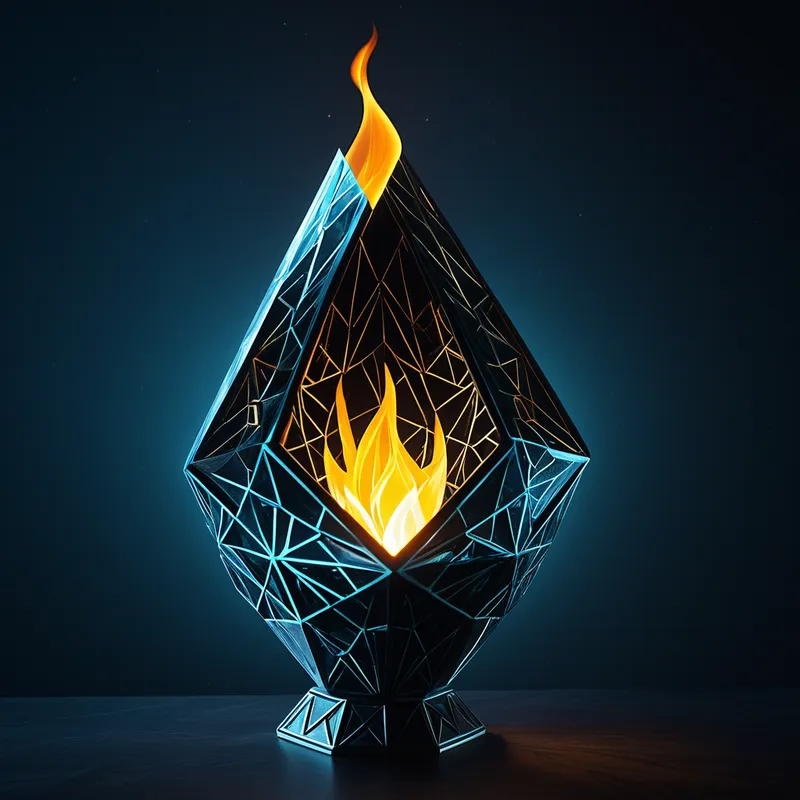
, or to the divine forge of [Hephaestus](/myths/hephaestus “Myth from Global/Universal culture.”/)—the tales vary, but the essence remains. There, he did not ask. He took. With a hollow stalk of giant fennel, he captured a single, glowing ember of celestial fire. He hid [the divine spark](/myths/the-divine-spark “Myth from Gnostic culture.”/) within the stalk, a secret sun against his chest, and descended from the realm of light back into the world of shadows.
He came to a clearing where humans gathered, shivering. Without a word, he presented the fennel stalk and blew. From it, not just flame, but knowledge erupted. He showed them how to tend the fire, to cook meat, to harden clay into pottery, to smelt ore into tools. The dark was pushed back. Faces, once blank with survival, were illuminated by the dancing light, and in their eyes, a new light kindled: the light of understanding, of curiosity, of culture. Civilization was born in that circle of warmth.
On Olympus, the theft was discovered. Zeus looked down and saw the pinpricks of fire where before there was only night. His rage was tectonic. The exclusive order was broken. A gift reserved for gods now flickered in the hands of mortals. This was not mere disobedience; it was a cosmic rebellion, a re-ordering of the world’s hierarchy.
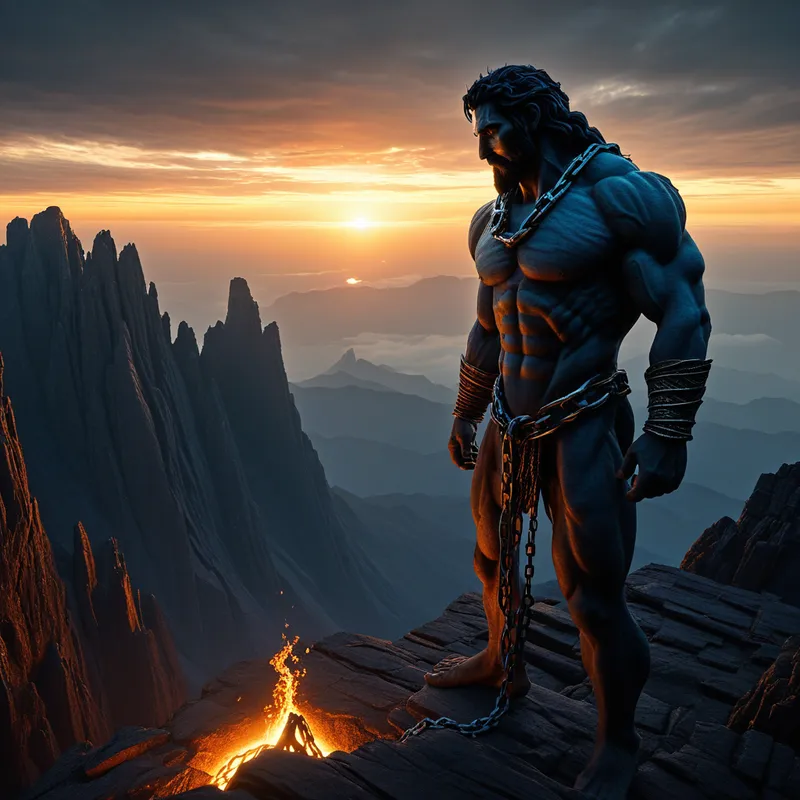
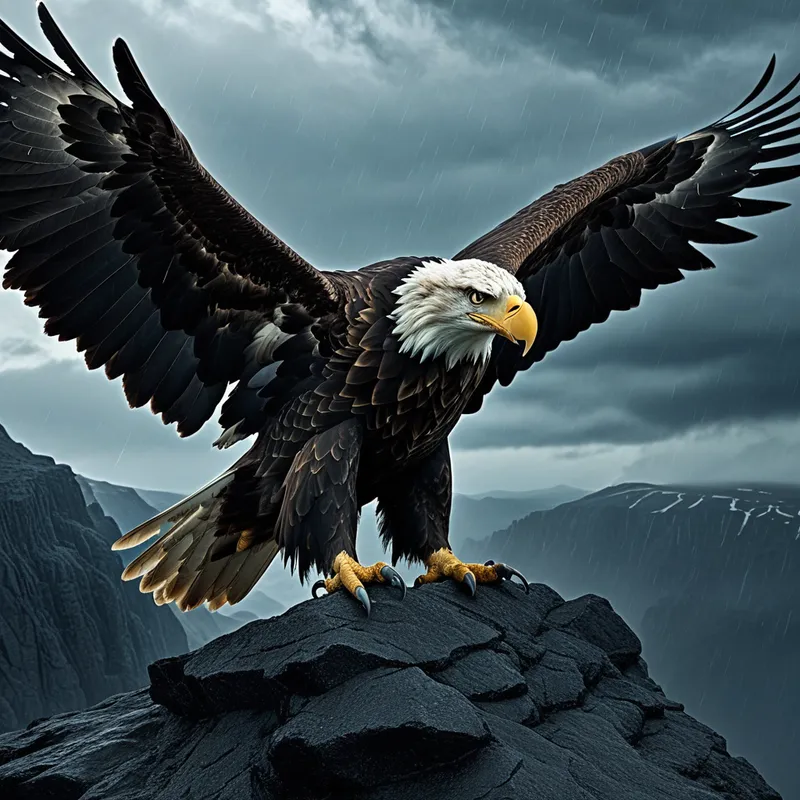
The punishment was to be a masterpiece of cruelty, a warning etched in eternal agony. Zeus had Hephaestus, the very master of fire, forge unbreakable chains. The mighty Titan was dragged to a desolate, storm-lashed crag in the Caucasus Mountains. There, he was bound fast to the rock, his body exposed to the elements. And each day, as the sun rose, a monstrous eagle—an embodiment of Zeus’s wrath—would descend. With a beak and talons of obsidian, it would tear open Prometheus’s side and feast upon his immortal liver. Each night, the organ would regrow, ensuring the torture was infinite, a cycle of consumption without end.
And yet, bound and tormented, Prometheus held a secret. He possessed a prophecy, knowledge of a future threat to Zeus’s rule. This knowledge was his only shield, the thin thread of leverage in his eternal suffering. His defiance was not broken; it was internalized, a silent fire that burned within, even as his flesh was torn asunder. The myth hangs there, on that cliff, in the tense space between endless punishment and unyielding knowledge.
Cultural Origins & Context
This foundational myth comes to us primarily from the epic poetry of Hesiod (8th-7th century BCE) in his Theogony and Works and Days, and later, most powerfully, from the tragedy Prometheus Bound, attributed to Aeschylus. It was not a mere bedtime story, but a central narrative explaining the human condition. Performed in theaters during civic festivals, it confronted Athenian citizens with profound questions about the cost of progress, the nature of [justice](/myths/justice “Myth from Tarot culture.”/), and the relationship between mortal ambition and divine law.
The myth served a crucial societal function. It explained humanity’s technological leap from primitive survival to civilized society—the “Neolithic Revolution” rendered in divine drama. It also provided a theological justification for human suffering and toil (explored in Hesiod’s tale of [Pandora](/myths/pandora “Myth from Greek culture.”/), which often follows). More subtly, for a culture that valued cunning intelligence ([metis](/myths/metis “Myth from Greek culture.”/)) and civic sacrifice, Prometheus became a complex, tragic archetype: the benefactor who breaks the rules for a greater good and pays the ultimate price, a theme that resonated deeply in the birthplace of democracy and philosophical inquiry.
Symbolic Architecture
At its core, the myth of Prometheus’s Fire is a [story](/symbols/story “Symbol: The symbol of ‘Story’ represents the narrative woven through our lives, embodying experiences, lessons, and emotions that shape our identities.”/) about the awakening of [consciousness](/symbols/consciousness “Symbol: Consciousness represents the state of awareness and perception, encompassing thoughts, feelings, and experiences.”/) and its inherent, painful cost. The fire is never merely a physical tool.
The stolen fire is the logos—the divine spark of reason, self-awareness, and creative impulse that separates sentient being from mere existence.
Prometheus represents the part of the [psyche](/myths/psyche “Myth from Greek culture.”/) that seeks evolution at any cost. He is foresight, the intellectual and compassionate principle that rebels against stagnant, tyrannical order (Zeus) to nurture potential. His theft is the ultimate act of individuation, severing humanity’s state of unconscious, infantile dependence on the “parental” gods.
Zeus, in this dynamic, symbolizes established order, law, and [the ego](/myths/the-ego “Myth from Jungian culture.”/)’s desire for total control. His [punishment](/symbols/punishment “Symbol: A dream symbol representing consequences for actions, often tied to guilt, societal rules, or internal moral conflicts.”/) is not just vengeance, but the psyche’s self-torture—the [guilt](/symbols/guilt “Symbol: A painful emotional state arising from a perceived violation of moral or social standards, often tied to actions or inactions.”/), [anxiety](/symbols/anxiety “Symbol: Anxiety in dreams reflects internal conflicts, fears of the unknown, or stress from waking life, often demonstrating the subconscious mind’s struggle for peace.”/), and existential pain that often accompanies the burden of consciousness, of knowing too much, of carrying the light in a world that can still feel dark. The [eagle](/symbols/eagle “Symbol: The eagle is a symbol of power, freedom, and transcendence, often representing a person’s aspirations and higher self.”/) is a perfect [symbol](/symbols/symbol “Symbol: A symbol can represent an idea, concept, or belief, serving as a powerful tool for communication and understanding.”/) of this [torment](/symbols/torment “Symbol: A state of intense physical or mental suffering, often representing unresolved inner conflict, guilt, or psychological distress.”/): a majestic, soaring [bird](/symbols/bird “Symbol: Birds symbolize freedom, perspective, and the connection between the earthly and spiritual realms, often representing the soul’s aspirations or personal growth.”/) transformed into an agent of visceral, repetitive [agony](/symbols/agony “Symbol: Intense physical or emotional suffering, often representing unresolved pain, internal conflict, or profound transformation.”/).
The Caucasus rock is the [altar](/symbols/altar “Symbol: An altar represents a sacred space for rituals, offering, and connection to the divine, embodying spirituality and devotion.”/) of sacrifice. The regenerating [liver](/symbols/liver “Symbol: Represents emotional processing, purification, and vitality. Often symbolizes anger, toxicity, or life force in dreams.”/), anciently considered the seat of [passion](/symbols/passion “Symbol: Intense emotional or physical desire, often linked to love, creativity, or purpose. Represents life force and deep engagement.”/) and [life](/symbols/life “Symbol: The symbol of ‘Life’ represents a journey of growth, interconnectedness, and existential meaning, encompassing both the joys and challenges that define human experience.”/)-force, signifies that the wound of consciousness is perpetual. We heal, only to be made vulnerable again by our very [capacity](/symbols/capacity “Symbol: A measure of one’s potential, limits, or ability to contain, process, or achieve something, often reflecting self-assessment or external demands.”/) to feel, to know, and to create.
The Dreamer’s Resonance
When this myth stirs in the modern dreamer, it signals a profound psychological activation. To dream of stealing a sacred or dangerous light, of defiantly taking something forbidden from a powerful authority figure or institution, marks a moment of nascent rebellion within the psyche. The dreamer is preparing to claim a piece of their own sovereignty.
Dreams of being chained to a rock or a repetitive, painful cycle speak to the “Promethean wound.” This is the somatic feeling of being trapped by the consequences of one’s own awakening—perhaps by a demanding career born of one’s talents (the fire), by the isolation that can come with insight, or by the burden of a painful truth one has chosen to bear. The eagle’s attack may manifest as a crushing anxiety, a corrosive guilt, or a pattern of self-sabotage that seems to attack one’s very life-force. The dream asks: What knowledge or creative power have you taken up, and what part of you feels eternally punished for it?
Alchemical Translation
The myth models the complete arc of psychic transmutation, or individuation. The initial state is humanity in the dark—the unconscious, undeveloped personality living by instinct alone.
-
The Theft ([Nigredo](/myths/nigredo “Myth from Alchemical culture.”/)/Calcinatio): This is the first, fiery, often rebellious act of consciousness. It is the difficult decision to “steal” one’s own authority from internalized parental complexes, societal expectations (the Olympian order), or dogmatic beliefs. It is painful, isolating, and feels like a transgression. The old container of [the self](/myths/the-self “Myth from Jungian culture.”/) is burned away.
-
The Gift & Civilization (Albedo): The stolen fire is integrated and applied. This is the stage of cultivating one’s unique skills, building an authentic life (civilization), and bringing light to others. The raw, rebellious energy is refined into sustained creativity and purpose.
-
The Binding & Torture ([Rubedo](/myths/rubedo “Myth from Alchemical culture.”/)): Here lies the deepest alchemy. The eternal punishment is not a failure, but the transformation of suffering into meaning.
The rock is the unshakeable foundation of the Self one has become through rebellion. The chains are the necessary limitations and responsibilities that come with consciousness. The eagle is the relentless, purifying confrontation with one’s own shadow.
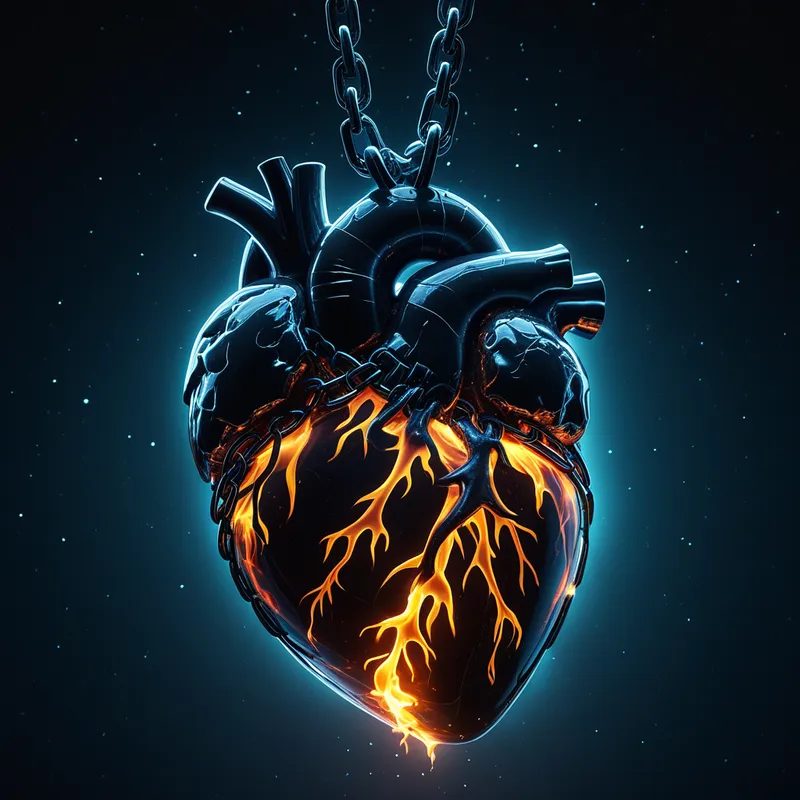
The regenerating liver is the key. The psyche learns that its passion and vitality are not destroyed by this ordeal, but are, in fact, renewable. The torture becomes a grueling but sacred process of perpetual renewal—the conscious endurance that forges unbreakable character. One is not freed from the rock in this internal reading; one becomes the rock, and the fire within burns all the brighter against the eternal sky. The [triumph](/myths/triumph “Myth from Roman culture.”/) is not in release, but in the ability to hold the light and the wound simultaneously, which is the very definition of a conscious, and therefore truly human, life.
Associated Symbols
Explore related symbols from the CaleaDream lexicon: