Prometheus & Epimetheus Myth Meaning & Symbolism
A tale of two brothers, foresight and afterthought, whose actions shape humanity and ignite a divine conflict that defines the human spirit.
The Tale of Prometheus & Epimetheus
Before the age of heroes, when the world was still raw clay in the hands of the gods, there existed two brothers, sons of the ancient Iapetus. Their names were their natures: Prometheus, who saw the end in the beginning, and Epimetheus, who understood only in the wake of action.
The great task fell to them from the cunning Zeus. They were to fashion the creatures of the earth and grant each a means to survive. Epimetheus, with a heart full of generous impulse, begged to distribute the gifts. “Brother,” he said, “allow me this joy.” Prometheus, his eyes clouded with a vision of a yet-unformed creature, assented, but with a whisper of caution.
So Epimetheus set to work with reckless delight. To the lion, he gave mighty claws and a thunderous roar. To the eagle, he bestowed the dominion of the sky and eyes like piercing suns. To the fox, cunning; to the turtle, an impenetrable home. He poured speed into the legs of the deer and strength into the shoulders of the bear, until the earth teemed with perfectly equipped life, singing and snarling and soaring.
Then Prometheus came, guiding from the river’s clay a form that stood upright, naked and trembling, its eyes wide with a strange, silent question. It was the first human. Epimetheus turned, his hands empty, his storeroom of gifts barren. He had given everything away. He had acted, and only now, in the hollow silence, did he think.
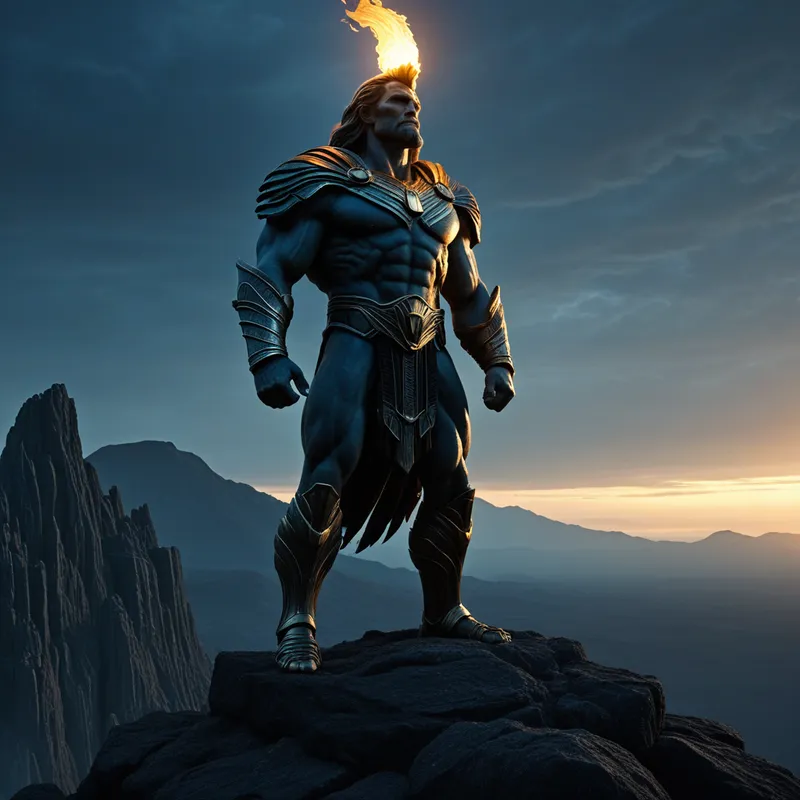
It was then that Prometheus, the forethinker, made his choice. He looked upon the fragile, shivering creature—his creation—and then he looked up, to the sun-chariot of Apollo and the forbidden hearth of Olympus. A plan, terrible and beautiful, crystallized in his mind. He journeyed to the secret heart of the divine forge, took a hollow stalk of fennel, and within it, stole a fragment of the celestial fire—not just flame, but the spark of techne, of arts and civilization. He delivered this stolen divinity to humanity.
The world changed. Huts became houses, grunts became language, fear became curiosity. Zeus, looking down from Olympus, saw the glow of this new fire in the night and knew the theft. His wrath was a cold, tectonic thing. For humanity, he crafted Pandora, a “gift” of alluring doom. For Prometheus, he devised a more personal eternity.
The Titan was dragged to the desolate peaks of the Caucasus. Unbreakable adamantine chains bit into his flesh, binding him to the stark rock. Each day, an eagle with wings like blackened bronze—the emissary of Zeus—would descend, its beak and talons tearing into his side, devouring his liver, the seat of passion and life. Each night, under the cold, watchful stars, the organ would regrow, ensuring the agony was as infinite as his defiance. And there he remained, a testament etched in suffering, his groans the wind through the mountain passes, his steadfast gaze forever fixed on the distant, fire-lit settlements of the beings he had dared to love.
Cultural Origins & Context
This foundational myth was not a single, static story but a living narrative woven into the fabric of Greek thought, primarily transmitted through the epic poetry of Hesiod in his Theogony and Works and Days (8th-7th century BCE). For the Greeks, it served as a profound aetiology—an origin story explaining the paradoxical human condition. It answered fundamental questions: Why must we labor and suffer? Why do we possess technology and arts? Why are we separate from, and in tension with, the natural world and the divine order?
The tale functioned as a cornerstone of their worldview, establishing humanity’s place in the cosmic hierarchy. It framed human existence as inherently tragic yet dignified, born from an act of rebellious compassion and cemented by eternal consequence. The myth was a cultural tool for navigating the central themes of hubris (defiant pride), nemesis (retributive justice), and the bittersweet gift of consciousness and civilization (techne). It was a story told to remind people of the cost of their own ingenuity and their precarious, gifted position between the beasts and the gods.
Symbolic Architecture
At its core, the myth presents a profound psychological map of the human psyche itself, split into two eternal brothers.
Prometheus embodies the forward-driving, conscious principle. He is the spark of foresight, the rebellious intellect, and the sacrificial spirit that steals potential from the complacent realm of established order (the gods) to nurture nascent consciousness (humanity). His fire is not merely tool-making; it is the light of self-awareness, innovation, and the painful burden of knowing one’s own fate.
The fire stolen is the light of consciousness itself, and its first illumination is the shadow it casts—the knowledge of our own vulnerability and mortality.
Epimetheus represents the reactive, instinctual, and often regrettable unconscious. He acts from impulse and immediate generosity without foresight, exhausting resources (the gifts) on immediate, instinctual creations (the animals). He is the part of us that acts first and thinks later, that is governed by hindsight and often paralyzed by regret. His acceptance of Pandora is the quintessential act of the unreflective psyche, embracing a beautiful catastrophe because he cannot see the consequence hidden within the gift.
Together, they form a complete, yet fractured, psychic unit. One cannot exist without the other. Prometheus’s brilliant, forward-looking theft is necessitated by Epimetheus’s short-sighted, backward-glancing distribution. Humanity is born from this intra-psychic tension between planning and impulse, between visionary sacrifice and blind consequence.

The Dreamer’s Resonance
When this mythic pattern stirs in the modern dreamscape, it often signals a critical juncture in the dreamer’s relationship with their own creative or intellectual power (the Promethean fire) and their past actions or neglected responsibilities (the Epimethean burden).
Dreaming of carrying or hiding a secret, painful light (a smoldering coal, a flashlight that burns the hand) may reflect the individual’s sense of carrying a gifted but burdensome insight, talent, or responsibility that sets them apart and may feel punishable. The somatic sensation is often one of heat, pressure, or a sacred ache in the chest or gut—the location of the stolen fire and the devoured liver.
Conversely, dreams of being unprepared, of empty hands, or of a beautiful, alluring box or figure that brings chaos speak to the Epimethean complex. This is the psychology of the regretful aftermath, where the dreamer is confronted with the consequences of actions taken without sufficient forethought—a relationship, career move, or financial decision made on impulse. The somatic feeling here is often a hollow nausea, a weight of shame, or a sense of being irrevocably “too late.”
Alchemical Translation
The individuation process—the journey toward psychic wholeness—is modeled perfectly in the crucible of this myth. The initial state is one of division: the brilliant, suffering Prometheus (conscious ego/intellect) is chained far from the regretful, earth-bound Epimetheus (the unconscious shadow of impulse).
The first alchemical stage is acknowledging the theft. One must recognize and own the “stolen fire”—the unique spark of consciousness, ambition, or creativity that makes one feel both gifted and guilty, both elevated and isolated. This is the separatio, the necessary alienation from collective norms.
The torment of the eagle represents the nigredo, the dark night of the soul, where the conscious principle is repeatedly devoured by the demands of the outer world (the eagle of Zeus’s law) or one’s own inner critic. The regenerating liver is key—it signifies that the core of one’s passion and vitality is indestructible, capable of renewal through suffering.
The goal is not to free Prometheus from the rock, but to discover that the rock, the chains, and the eagle are also part of the Self.
The final transmutation involves the sacred reconciliation of the brothers. This is the coniunctio oppositorum (union of opposites). One must integrate Epimetheus—not to become impulsive, but to honor the wisdom of hindsight, to accept the irrevocable consequences of one’s journey, and to find the humility that comes from acknowledging one’s own past foolishness. The integrated Self is neither purely the defiant foreseer nor the regretful after-thinker, but a being who can plan with wisdom and reflect with compassion, who carries the fire while tending to the wounds its light has revealed. In this reconciliation, the stolen divine spark is no longer a crime against heaven, but the very lamp that illuminates the path to one’s own wholeness.
Associated Symbols
Explore related symbols from the CaleaDream lexicon: