Prometheus and Zeus Myth Meaning & Symbolism
The Titan Prometheus defies Zeus by gifting humanity with fire and knowledge, enduring eternal torment as the price for awakening consciousness.
The Tale of Prometheus and Zeus
In the age after the Titans fell, when the new order of Olympus was young and stern, the world lay in a grey twilight. Humanity, molded from clay, shivered in the damp, eating their meat raw, their minds as dark and silent as the caves they called home. They knew no arts, no crafts, no hope beyond the next sunrise.
But one being watched them with a heart that burned with a different fire. Prometheus, whose name means Forethought, saw not mere clay puppets, but potential. He was a son of the old order, a Titan, yet he had sided with Zeus in the great war. He believed in the new king’s promise of justice. But from his golden throne, Zeus looked upon mortals and saw only frail, forgetful creatures, fit for sacrifice and little else. He decreed they should remain in their ignorant state, a decision sealed when he demanded they give the best portions of their sacrificial oxen to the gods, leaving themselves the gristle and bone.
Prometheus’s cunning stirred. At the great feast at Mecone, he presented two piles from a great ox. One held the rich, succulent meat, hidden cunningly inside the unappealing stomach of the beast. The other was a gleaming pile of bones, artfully wrapped in a glistening layer of pure white fat. “Choose, great Zeus,” said Prometheus, “which portion shall be forever reserved for the gods.” Deceived by the shining fat, Zeus chose the bones. When he realized the trick, the thunder that rolled from Olympus shook the very roots of the world. In his wrath, he withheld the final gift from humanity: the all-giving fire.
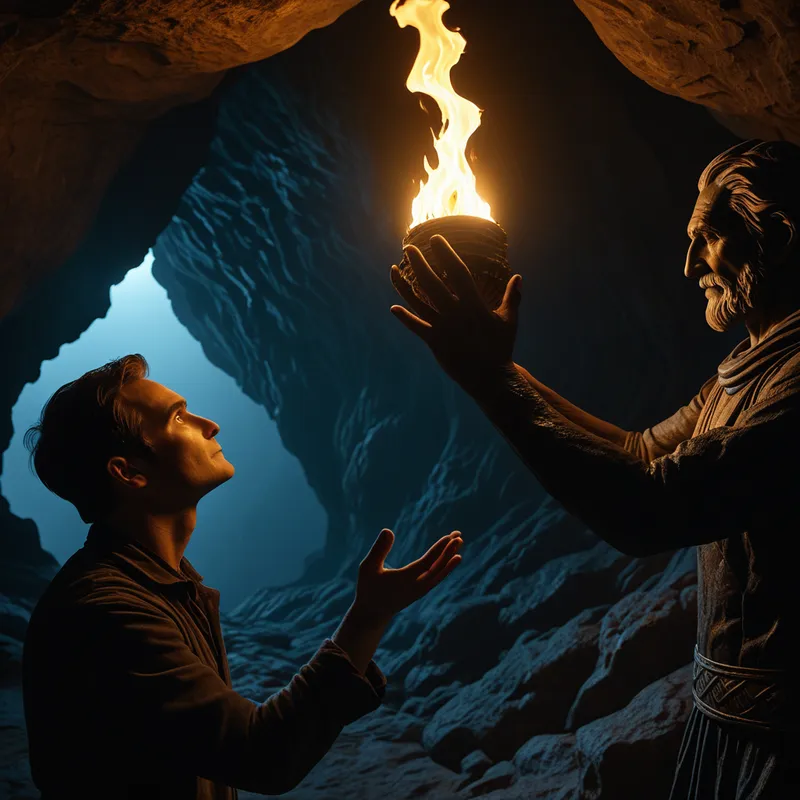
But Prometheus was not finished. His compassion had become rebellion. He journeyed to the sun-chariot of Helios, or perhaps to the very forge of Hephaestus. There, he took a hollow stalk of fennel, and within its pith, he stole a single, glowing seed of celestial fire. He descended to the mortal realm, and in a dark cave, before trembling figures, he breathed that seed onto dry tinder. The first human fire roared to life, its light dancing on walls that had known only shadow.
The gift was not merely warmth. With fire came all the arts: pottery, metalwork, medicine, the very concept of civilization. Humanity awoke. Zeus, gazing down from Olympus, saw the new lights flickering in the night and knew the work of the defiant Titan. His fury was cosmic, absolute. This was not mere trickery; this was theft of divine privilege, an act that threatened the very hierarchy of the cosmos.
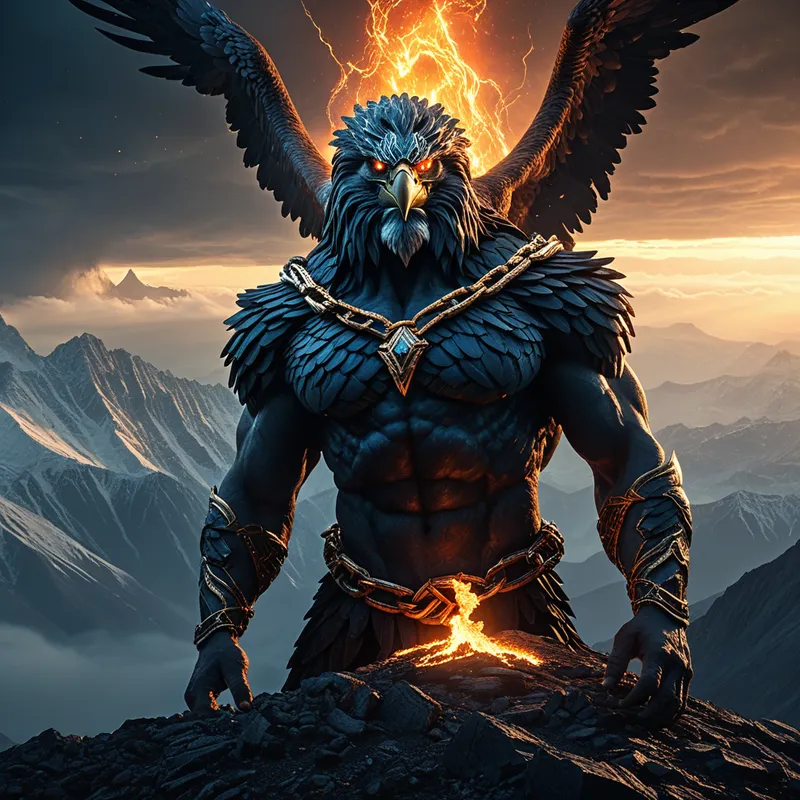
His vengeance was crafted to be eternal. He commanded the strong-armed god Hephaestus and his servants, Kratos and Bia, to seize Prometheus. They dragged him to the most desolate peak of the Caucasus mountains. There, with chains forged in the divine smithy, unbreakable and cold as celestial void, they bound him to the naked rock. But the binding was not enough. Zeus sent his eagle, a monstrous bird with feathers like storm clouds and a beak of obsidian. Every day, at the sun’s zenith, the eagle would descend, rip open Prometheus’s flesh, and feast upon his immortal liver. Every night, as the cold stars wheeled overhead, the liver would regrow, ensuring the agony was as infinite as his sentence.
And there Prometheus remained, chained between earth and sky, a testament to the price of awakening. He bore his torment, his groans echoing in the winds, his defiance unbroken, holding within his suffering the secret of a prophecy even Zeus feared—a knowledge of the future that would one day force the king of gods to seek his prisoner’s counsel. The fire, however, was never taken back. It burned on in the hearths of humanity, a stolen spark forever illuminating the long, painful road from ignorance to consciousness.
Cultural Origins & Context
This foundational myth was not the property of a single poet but a core narrative thread woven into the fabric of ancient Greek thought. Its most famous and complete telling comes from the epic poem Theogony by Hesiod (c. 700 BCE), who framed it within the grand, brutal genealogy of the gods. Here, Prometheus is a pivotal figure in the transition from the old Titan order to the rule of Zeus, establishing the fraught relationship between gods and mortals. The tragedian Aeschylus later immortalized him in his trilogy Prometheus Bound, elevating the Titan’s suffering into a supreme dramatic symbol of resistance against tyrannical authority.
The myth functioned as a divine charter story. It explained the human condition—our possession of technology (techne) and culture, set against a backdrop of suffering, toil, and our ambiguous, distant relationship with the divine. It justified the practice of animal sacrifice (keeping the meat for themselves, offering the bones and fat to the gods) and explored the existential cost of consciousness. Told in symposia, performed in theaters, and recounted in philosophical debates, it served as a timeless template for discussing authority, justice, innovation, and the heavy responsibilities that come with knowledge.
Symbolic Architecture
At its heart, this myth is the archetypal drama of consciousness itself. Prometheus represents the principle of foresight and purposeful intelligence that rebels against static, unquestioned order. He is the spark of individuation that refuses to accept a pre-ordained, subordinate fate for himself or for humanity.
The stolen fire is not merely a tool; it is the light of psyche—the awakening of self-awareness, culture, critical thought, and the capacity to shape one’s own world.
Zeus embodies the established cosmic order, the ruling principle of law, structure, and hierarchy. His punishment is not mere cruelty, but the system’s inevitable, brutal response to a fundamental challenge to its authority. The conflict is not between good and evil, but between two necessary, yet opposing, cosmic principles: stabilizing structure (Zeus) and liberating, disruptive consciousness (Prometheus).
The liver is the perfect symbolic organ for this eternal torture. The ancient Greeks saw it as the seat of passions, desires, and darkest emotions. Its daily consumption represents the ceaseless gnawing of the consequences of our awakening: anxiety, longing, existential dread, and the visceral pain of a consciousness that knows its own fragility. The eagle, Zeus’s sacred bird, is the punishing agent of the super-ego or the collective authority, pecking away at the very source of our deepest, most vital feelings.
The Dreamer’s Resonance
When this myth erupts into modern dreams, it signals a profound psychic rebellion underway. To dream of being chained or imprisoned, especially while a bird or beast attacks your torso, speaks to the somatic experience of a creative or intellectual impulse being brutally suppressed—often by an internalized authority (a “Zeus complex” of rigid inner rules, societal expectations, or a tyrannical job or relationship).
Dreaming of stealing something precious and forbidden—a light, a key, a book—and the ensuing terror of being caught, mirrors Prometheus’s act. This is the dreamer’s psyche grappling with the theft of their own fire: perhaps claiming a talent, a truth, or an identity that some internal or external system has forbidden. The dream captures the exhilarating terror of stepping into one’s own power and the anticipated (or experienced) retribution. The Promethean dream is a rite of passage, marking the painful but necessary divorce from a state of unconscious compliance.
Alchemical Translation
The alchemical journey modeled here is the transmutation of the prima materia of unconscious existence into the gold of individual consciousness, a process that is inherently traumatic and revolutionary. The myth maps the individuation process with stark clarity.
First, the separatio: Prometheus separates himself from both the old Titan order and the new Olympian consensus. Psychologically, this is the ego’s differentiation from the collective—realizing one’s thoughts and values are not those of the family, tribe, or culture. Then comes the theft, the coniunctio with the divine spark: integrating a piece of the Self (the divine fire) that the ruling consciousness (Zeus) had hoarded. This is the moment of inspiration, the “aha” that brings a new level of awareness.
The ensuing punishment is the nigredo, the dark night of the soul. The chaining is the feeling of being trapped by the consequences of your own awakening; the eagle is the relentless, painful introspection and suffering that deepens consciousness.
The key to the alchemy is that the liver—the passions—regrows. The suffering is not annihilating; it is transformative. Each attack deepens resilience and wisdom. The modern individual’s “Caucasus” may be a period of depression, isolation, or crisis following a bold life choice. The promise of the myth is that enduring this, while holding onto the stolen fire (the hard-won truth), eventually forces a reconciliation. Just as Zeus needed Prometheus’s prophecy, the rigid, ruling aspect of our psyche must eventually negotiate with the rebellious, insightful spirit it once punished. The outcome is not the dethroning of Zeus, but the establishment of a more conscious, complex order within the self, where authority and innovation, structure and fire, find a new and tense balance. We are left, like humanity in the myth, forever bearing the light, and forever bearing the cost of seeing by it.
Associated Symbols
Explore related symbols from the CaleaDream lexicon: