Prometheus Myth Meaning & Symbolism
The Titan who defied Zeus to gift fire to humanity, enduring eternal torment as the price for awakening human potential and consciousness.
The Tale of Prometheus
Before the age of heroes, when the world was still raw and the gods ruled from their cloud-wreathed throne, there was a silence in the valleys. Humanity, the clay-formed children of the Zeus, lived in darkness. They shivered in caves, ate their meat raw, and their minds were clouded, knowing neither the arts of building nor the solace of prophecy. They were little more than whispers, soon forgotten by the earth.
But one watched them with a heart that was not made of stone. Prometheus, whose name means Forethought, saw in their dim eyes a spark that yearned to be kindled. He had stood with Zeus against the old Titans, yet he felt a kinship with these fragile, stumbling creatures. When the gods and mortals met at Mecone to decide the nature of sacrifice, Prometheus played a trick to aid them. He presented two offerings: one, a pile of rich meat hidden inside an unappealing ox’s stomach; the other, glistening bones wrapped cunningly in gleaming fat. Zeus, choosing by appearance, took the bones, establishing the sacrificial practice where humans kept the meat for themselves. The Thunderer’s pride was wounded, and in his anger, he withheld the final gift: fire.
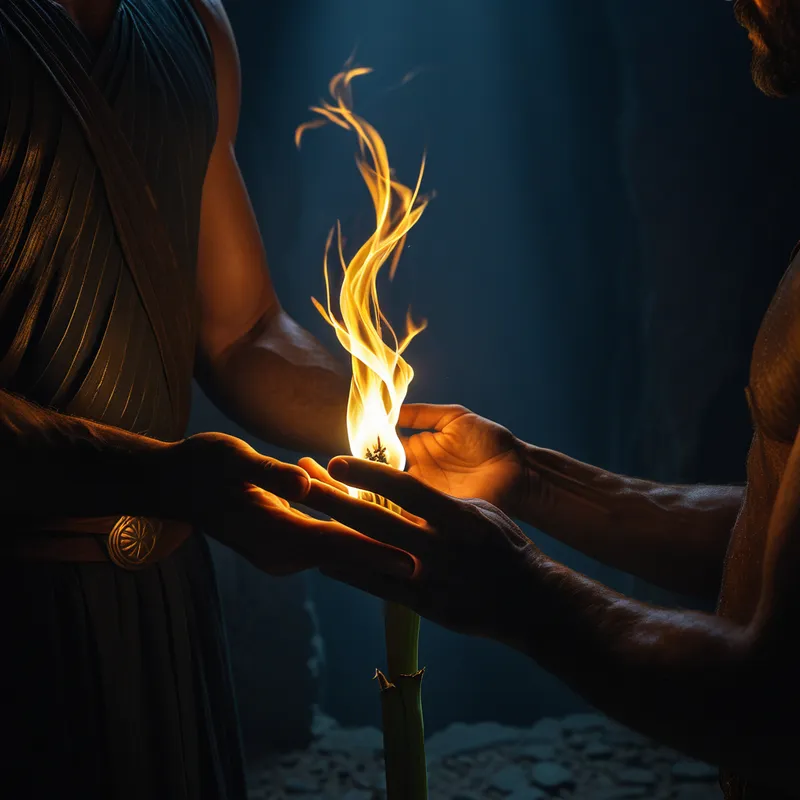
The world grew colder. Prometheus, his resolve hardening like tempered steel, ascended the secret path to the sun-chariot of Helios. Or perhaps he stole into the very forge of Hephaestus. There, he took a single, glowing ember of celestial fire. He hid it in the hollow stalk of a fennel plant, its pith smoldering slowly, and descended back to the shadowed earth. With a breath, he coaxed the ember into a flame and gifted it to humanity.
The world changed. Hear the first crackle of a hearth-fire driving back the night. Smell the smoke of the first cooked meal, taste its transformative warmth. See the first forge-light glint on shaped bronze, watch the first potter’s wheel turn. Fire was more than heat and light; it was mind, craft, medicine, and community. It was the dawn of civilization, stolen from the divine table.
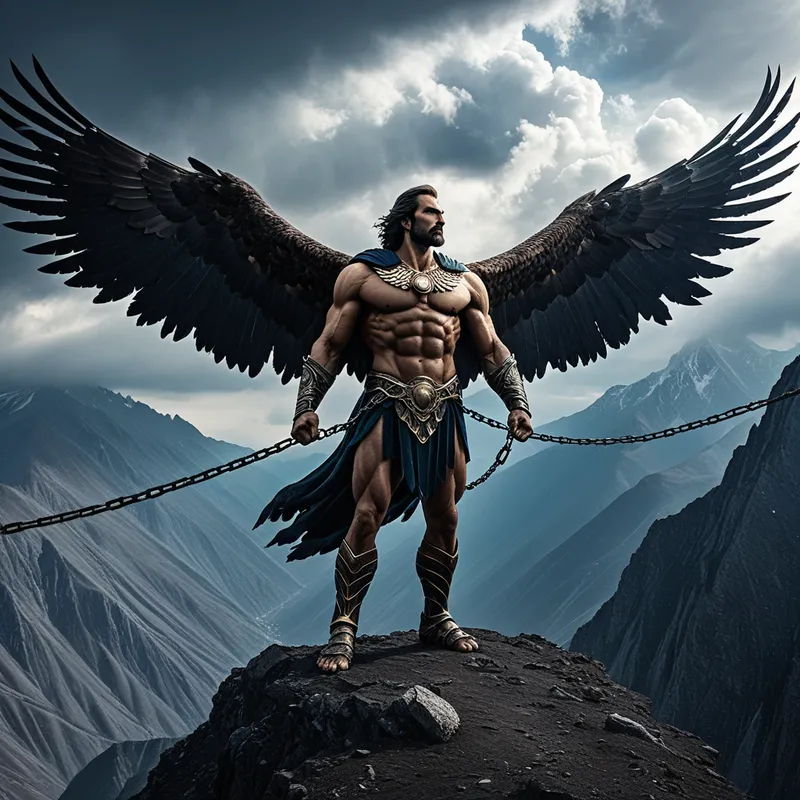
Zeus’s wrath was a tempest that shook the foundations of the world. For this rebellion, this theft of divine privilege, the punishment would be eternal and exquisite. The king of gods commanded his forge-master, Hephaestus, and his servants, Kratos and Bia, to seize the Titan. They dragged Prometheus to the most desolate crag of the Caucasus Mountains. There, with unyielding chains of adamant, they bound him, arms and legs splayed against the cold, unfeeling rock.
And then came the eagle. Every day, with the pitiless regularity of the sun, the great bird of Zeus would descend, its talons tearing into Prometheus’s side, feasting upon his liver—the seat of passion and emotion. Every night, the liver would regrow, lush and whole, ensuring the agony was without end. The wind carried only his groans and the beat of dark wings. Yet, in his torment, Prometheus held a secret power: the foreknowledge of a prophecy that could unseat Zeus himself. He became the chained oracle, suffering the present but holding the future, a defiant silence in his heart even as his flesh was torn asunder.
Cultural Origins & Context
The myth of Prometheus is woven from some of the oldest threads in the Greek tapestry. Its most definitive telling comes from the epic poet Hesiod, in his Theogony and Works and Days (8th-7th century BCE), where the Titan’s actions frame humanity’s fallen, labor-filled state. It was the tragedian Aeschylus, however, who elevated the story into a profound theological and political drama in his (possibly incomplete) trilogy, centering on the play Prometheus Bound. Here, Prometheus is transformed from a clever trickster into a sublime tragic hero, embodying the spirit of resistance against tyrannical authority.
The myth functioned as a foundational etiological story, explaining the human condition: why we must work, why we sacrifice to the gods, and most importantly, how we acquired the technological and cultural intelligence (techne) that sets us apart. It was told not just as entertainment, but as a deep meditation on the relationship between divine power, justice, and human suffering. In the symposiums and theaters, it provoked questions about the cost of progress and the nature of a benefactor who brings both enlightenment and divine retribution upon his beneficiaries.
Symbolic Architecture
At its core, the myth of Prometheus is a drama of consciousness itself. The Titan represents the principle of foresight and purposeful rebellion—the aspect of the psyche that recognizes a higher potential and is willing to endure catastrophic consequences to actualize it.
Fire is the primordial symbol of consciousness, intellect, and transformative energy. It is the light that dispels the instinctual darkness, enabling reflection, culture, and the painful awareness of our own condition.
Prometheus’s theft is the archetypal act of differentiation. He separates humanity from a state of unconscious unity with the natural (and divine) order, initiating the long, painful journey toward self-awareness and individual responsibility. His binding represents the inevitable consequence of this awakening: the experience of alienation, suffering, and the burden of knowledge. The eagle is not merely a tool of punishment, but a symbol of the relentless, predatory aspect of the ruling consciousness (Zeus) that seeks to devour the regenerative, feeling center (the liver) of the rebellious insight.
The myth presents a terrifying paradox: the very act that elevates humanity also condemns its champion to perpetual torment. This is the symbolic price of consciousness—the existential pain, the stolen quality of our enlightenment, which always carries a hint of transgression and the fear of divine abandonment.

The Dreamer’s Resonance
When the pattern of Prometheus manifests in modern dreams, it signals a profound psychological initiation. The dreamer may find themselves in a scenario where they possess a forbidden knowledge or have committed a transgressive act for a “greater good,” followed by a crushing sense of punishment or isolation.
Somatically, this can feel like a constriction in the chest or abdomen—the binding chains, the gnawing eagle. Psychologically, it is the process of integrating a new level of awareness that feels both empowering and devastating. Perhaps the dreamer has challenged a familial, cultural, or internal “tyrannical” authority (a Zeus complex), advocating for their own or others’ potential. The subsequent suffering in the dream is not a literal punishment, but the psyche’s representation of the guilt, anxiety, and alienation that accompanies such a bold step out of the collective shadow. The dream asks: What sacred fire have you stolen? And what part of you is being eternally devoured for holding it?

Alchemical Translation
The alchemical journey modeled by Prometheus is the opus contra naturam—the work against nature, or more precisely, against the established, unconscious order. For the modern individual seeking individuation, the myth charts the path of necessary rebellion against inner and outer tyrannies.
The first stage is the theft: the conscious seizing of one’s own creative fire (potential, voice, truth) from the grip of internalized gods—parental complexes, societal expectations, or a stagnant, ruling attitude within the psyche. This is an act of profound self-authorization.
The Caucasus rock is the crucible of the soul. Binding is not the end, but the beginning of the transmutation. It is in the unbearable tension between the gift and the consequence that the base metal of the old self is dissolved.
The eternal torment—the daily devouring—symbolizes the ongoing, cyclical nature of psychological integration. Each time an old wound (the liver) is reopened by life’s challenges, there is an opportunity for it to regenerate with greater resilience and insight. Prometheus’s secret prophecy is the ultimate treasure: the foreknowledge that even the most rigid, tyrannical structure within the psyche (the Zeus complex) contains the seed of its own transformation and must eventually evolve.
The individuated Self does not escape the rock. Instead, it learns to inhabit the suffering consciously, holding the tension between the gift of awareness and its terrible price. To be Promethean is to accept that enlightenment and anguish are forged in the same fire, and that true liberation lies not in release from the chains, but in the unbroken defiance and compassion one maintains while bound by them.
Associated Symbols
Explore related symbols from the CaleaDream lexicon:
- American
- Lab
- Cigarette
- Electric
- Chain
- Paint
- Act
- Live
- Took
- Flash
- Lesson
- Tech
- Free
- Heat
- Led
- Artist
- Fashioned
- Oil
- Modern
- Separate
- Used
- Meat
- Homework
- Candle
- Experiment
- Match
- Individual
- Flashlight
- Crime
- Started
- Lamp
- Science
- Gave
- Loose
- Protest
- Example
- Brilliant
- Lighter
- Battery
- Prisoner
- Permission
- Clay
- Surtr/Fire Giants
- Unused Paintbrush
- Table Lamp
- Candle Holder
- Floor Lamp
- Artificial Intelligence
- Nanotechnology
- Tech Gadget
- Tech Startup
- Smart Light Bulb
- Cybernetic Implant
- Spicy Chili
- Leather Jacket
- Burned Skin
- Searing Pain
- Visceral Guts
- Cleaved Palm
- Lighting Candles
- Painting the Sky
- Handling Fire
- Painting Canvas
- Electric Pulse
- Boundless Energy
- Rebellious Teenager
- Temperature Change
- Fire Truck
- Rocket Launchpad
- Solar Flare
- Bismuth Block
- Carnelian Sphere
- Moldavite Fragment
- Fire Opal Shard
- Aventurine Lantern
- Bloodstone Flake
- Carnelian Flame
- Tanzanite Glow
- Spinel Star
- Phenakite Light
- Quartz Prism
- Neon Glow
- Sodium Burst
- Thorium Pulse
- Scandium Light
- Krypton Light
- Cerium Fire
- Uranium Core
- Phosphorus Flame
- Lanthanum Glow
- Phosphorescent Salt
- Enigmatic Xenon Light
- Fluorescent Neon
- Iridescent Indium
- Energetic Lithium
- Pulsing Americium
- Rocky Cliffside Trees
- Veiled Edelweiss
- Firefly Glow
- Glowworm Light
- Rebellious Greenfly
- Caged Bird
- Lantern of Hope
- Key of Knowledge
- Fractured Light Bulb
- Dedicated Researcher
- Artist’s Palette
- Firefighter’s Gear
- Scientist’s Lab Coat
- Electrician’s Ladder
- Sculptor’s Clay
- Electric Violin
- Fireworks Show
- Graffiti Wall
- LED Lights
- Candle Making Kit
- Pottery Wheel
- Digital Art Tablet
- Sculpting Clay
- Fireworks
- Candlestick
- Festival Lantern
- Lantern Festival
- Einstein’s Chalkboard
- Tesla’s Coil
- Marie Curie’s Laboratory
- Harriet Tubman’s Lantern
- Da Vinci’s Sketchbook
- Galileo’s Telescope
- Renaissance Painting
- Civil Rights Protest Sign
- Revolutionary War Flag
- Renaissance Palette
- Anarchist’s Symbol
- Revolutionary Broadsheet
- Scientist’s Microscope
- Helen Keller’s Braille Book
- Revolutionary Flag
- Civil Rights Poster
- Phantom Chisel
- Boundless Creativity
- Ceramic Art
- Celestial Revision
- Lit Candle
- Boundless Imagination
- Inspirational Tale
- Glow-in-the-Dark Screw
- Solar-Powered Lamp
- Fireworks Gun
- Futuristic Armchair
- Designer Lamp
- Studded Wristband
- Wrist Chain
- Platinum Chains
- Battery Pack
- LED Strip Light
- Solar Charger
- Chaotic Software Update
- LED Light Bulb
- Solar-Powered Gadget
- Blinking Power Button
- Desk Lamp
- Success Sticky Note
- Scribbled Ideas
- Staple Remover
- Silly Putty
- Play-Doh
- Discovery Kit
- Glow Stick
- Electric Keyboard
- Terraforming Structure
- Futuristic Citadel
- Futuristic Lounge
- Neon Signs
- Flickering Torches
- Starlit Sacrifice Site
- Hanging Lantern
- Guiding Light
- Motivating Spark
- Chains
- Forbidden Fruit
- Racing Heart
- Vulgar Graffiti
- Banned Book
- Snared Animal
- Stubborn Flame
- Candle Flicker
- Canvas of Dreams
- Horizon of Thought
- Spirit of Inquiry
- Fleeting Illumination
- Flame
- Lantern Shape
- Zigzag Line
- Flickering Candle Flame
- Tanned Hide
- Sundried Tomatoes
- Bark Scraper
- Clay Figurine
- Fennel Frond
- Sun-Baked Clay
- Animal Fat Lamp
- Stone Age Tools
- Clovis Point
- Mountain Ridge
- Sundried Meat
- Flint Striker
- Mesquite Firewood
- Flint Hook
- Bone Knife
- Stone Implement
- Clay Figurines
- Plantains on Fire
- Flint Firestarter
- Grilled Game Meat
- Roasting Spit
- Fire Drill
- Smoke Signal
- Fire Starter Kit
- Tanned Leather
- Tinder Bundle
- Animal Trap
- Ember Stone
- Torchlight
- Fires of Creation
- Embers of the Ancients
- Guiding Flame
- Torch Carving
- Flint Spark
- Cave Paintings in Flame
- Survivor’s Signal Fire
- Wildfire Whisper
- Lifetime of Light
- Kindled Dreams
- Survivor’s Heat
- Tinders of Joy
- Flint Fire Starter
- Quartz Crystal Chisel
- Primitive Soapstone Carvings
- Bone Carving
- Firestone
- Chipped Flint
- Ochre Pigment
- Terracotta Figure
- Tanning Hide
- Potter’s Wheel
- Animal Bone Tool
- Ember from Fire
- Fire-Hardened Pottery
- Brushed Clay
- Sunbaked Clay
- Wildfire’s Edge
- Stone Tools
- Primitive Pottery
- Stone Tool Kit
- Tengu Mask
- Bulgae Dogs
- Stigmata
- Number 1
- Tingling Sensation
- Crackling Fire
- Primal Fire
- Rebel
- Machine Learning
- Digital Afterlife
- Ai Consciousness
- Ai Overlord
- Tech Anxiety
- Atmospheric Friction
- Oxygen Deprivation
- Ionization
- Gamma Rays
- Punishment
- The Amendment
- Cultural Taboo
- Social Justice
- Civil Rights
- Metaphor
- Paradigm
- Scope
- Verb
- Sandbox
- Physics
- Healthbar
- Revolution
- Metabolism
- Plasma
- Mitochondria
- Generator
- Inflammation
- Pacing
- Epiphany
- Light
- Lighting
- Cost
- Subsidy
- Chokmah
- Gnosis
- Thelema
- Friction
- Convection
- Thermodynamics
- Spark
- Spasm
- Bleeding
- Transplant
- Autopsy
- Acute
- Titanium
- Barometer
- Agitation
- Anguish
- Torment
- Agony
- Excitement
- Savior
- Pancreatic
- Flare
- Cosmicray
- Ember
- Tuff
- Breakthrough
- Intensifying
- Restless
- Flickering
- Dissent
- Pawn
- Spicy
- Fiery
- Chili
- Tobacco
- Gunpowder
- Torch
- Neon
- Gleam
- Blaze
- Diffraction
- Incandescence
- Binding/Fetters (Gleipnir)
- Beta
- Phosphorescent Phosphorus