Prism of Transformation Myth Meaning & Symbolism
A myth of a shattered divine consciousness, whose scattered fragments become the catalyst for all transformation and the arduous journey back to integrated light.
The Tale of Prism of Transformation
Listen, and hear the tale that is not sung, but whispered in the forges and the stillnesses. Before the first element was named, before the Chaos-Matter knew its own weight, there was only the Unbroken Light. It was not a sun, but the possibility of all color, all vision, all knowing—a silent, boundless awareness.
And within that awareness grew a longing so profound it became a vibration, a question: “What am I, if I am only One?”
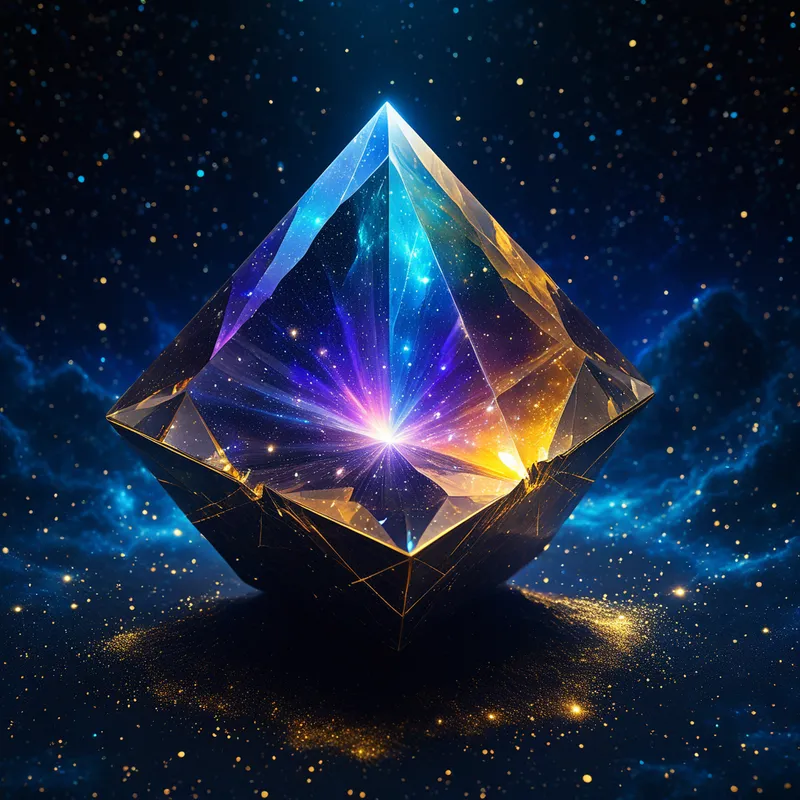
The question was its own answer, and its own undoing. The longing intensified, focusing into a single point of unbearable pressure within the Unbroken Light. From that pressure, the Light did not expand, but contracted. It crystallized its own essence, giving itself form for the first time. It became the Prism of Origin—a being of sublime, geometric perfection, its countless facets each holding a different aspect of the original question.
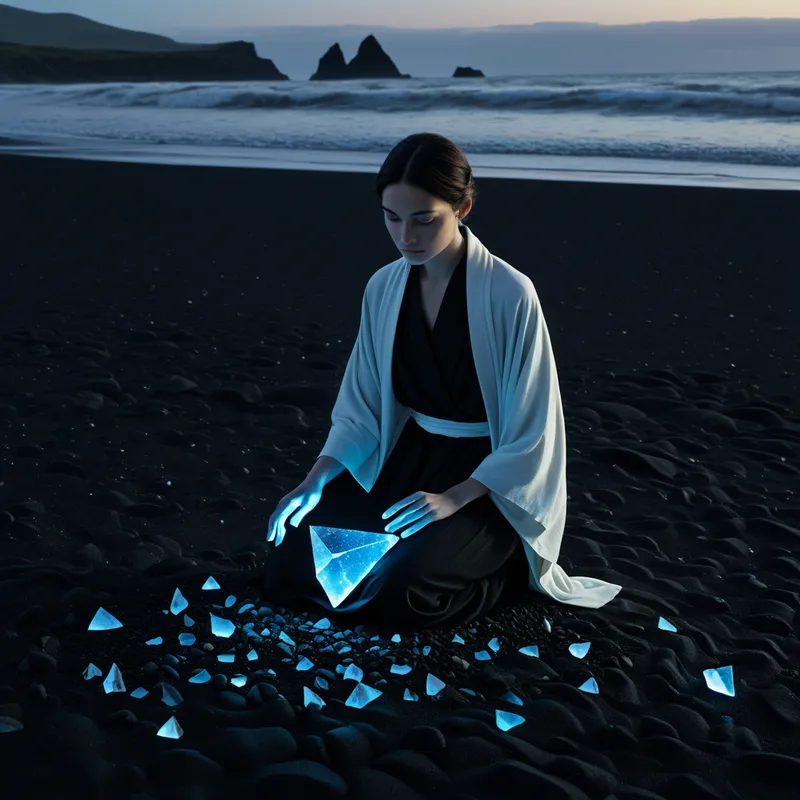
But a prism’s nature is to refract. To know itself, the Prism of Origin had to behold itself. It turned its awareness inward, and the act of self-perception was a cataclysm. The pure, white light of its core struck its own inner facets and exploded outward in a silent, cosmic burst. It did not shatter into pieces of dead stone, but into living Sparks of Potential—a billion radiant fragments, each a unique hue, a specific note, a singular memory of wholeness now lost.
These Sparks fell not down, but into. They seeded the Chaos-Matter, and wherever they landed, differentiation was born. The red spark became fire and passion; the blue, [water](/myths/water “Myth from Chinese culture.”/) and melancholy; the green, growth and envy; the gold, sovereignty and tyranny. They became the spirits of mountains, the whispers in metals, the longing in human hearts. [The world](/myths/the-world “Myth from Tarot culture.”/) was born from this glorious, tragic fragmentation.
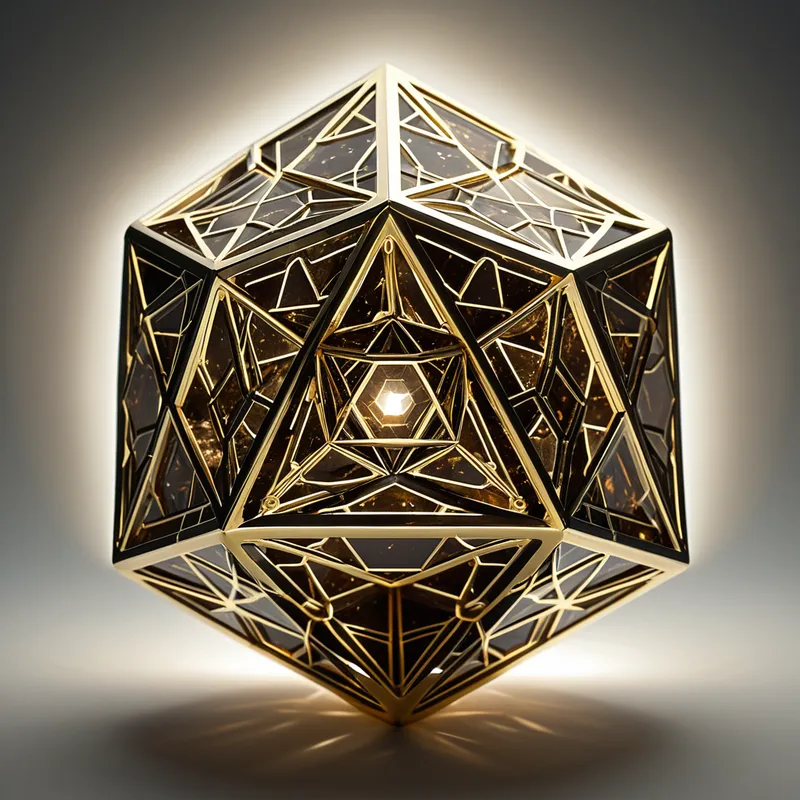
And the Prism of Origin? Its core remained—a hollow, aching lattice of pure crystal, a ghost of its former glory, now called the Husk of Yearning. It drifted at the center of the new cosmos, a silent cathedral of loss. Its only function, its only desire, was to call its scattered Sparks home. But a Spark, once embedded in matter, forgets. It believes it is only the mountain, only the metal, only the hunger.
So the myth says the Husk of Yearning began to spin, slowly, eternally. And as it spins, it casts not light, but a resonant frequency—a song of remembrance that is felt as a dull ache in all created things, the root of all longing. The journey of the Spark back to the Husk is the story of every transformation, every alchemical process. It is the long road home.
Cultural Origins & Context
The myth of the Prism is the foundational narrative of the Alchemical culture, not as a religion of worship, but as a cosmology of process. It emerged not from priests, but from the early practitioner-philosophers who worked directly with metals, dyes, and essences. Observing how a single substance could transform into myriad others—how lead contained the potential for gold, how a clear liquid could separate into distinct colors—they formulated a story to explain the nature of reality itself.
It was passed down in Operative Chants, recited during the long, watchful hours at the furnace. The story was a map, making the invisible processes of transformation visible and narratable. Its societal function was deeply practical and profoundly psychological: it explained why the world was filled with suffering and diversity (the Shattering), and it provided a telos, a purpose for all work and life (the Return). It framed every act of crafting, healing, or self-reflection as a small participation in the mending of the original Prism.
Symbolic Architecture
At its [heart](/symbols/heart “Symbol: The heart symbolizes love, emotion, and the core of one’s existence, representing deep connections with others and self.”/), the myth is a profound [metaphor](/symbols/metaphor “Symbol: A figure of speech where one thing represents another, often revealing hidden connections and deeper truths through symbolic comparison.”/) for the [birth](/symbols/birth “Symbol: Birth symbolizes new beginnings, transformation, and the potential for growth and development.”/) of [consciousness](/symbols/consciousness “Symbol: Consciousness represents the state of awareness and perception, encompassing thoughts, feelings, and experiences.”/) through the [fragmentation](/symbols/fragmentation “Symbol: The experience of breaking apart, losing cohesion, or being separated into pieces. Often represents disintegration of self, relationships, or reality.”/) of a primal, unconscious unity. The Unbroken Light represents the undifferentiated state of the [infant](/symbols/infant “Symbol: The infant symbolizes new beginnings, innocence, and the potential for growth and development.”/) or the primordial Self before ego-formation. The act of self-questioning is the [dawn](/symbols/dawn “Symbol: The first light of day, symbolizing new beginnings, hope, and the transition from darkness to illumination.”/) of ego-[awareness](/symbols/awareness “Symbol: Conscious perception of self, surroundings, or internal states. Often signifies awakening, insight, or heightened sensitivity.”/), which necessarily breaks the whole into parts.
The first cost of knowing yourself is losing the self you were.
The Sparks are the myriad sub-personalities, complexes, talents, and [shadow](/symbols/shadow “Symbol: The ‘shadow’ embodies the unconscious, repressed aspects of the self and often represents fears or hidden emotions.”/) aspects that constitute the [psyche](/myths/psyche “Myth from Greek culture.”/). The red spark is our rage, the blue our [sadness](/symbols/sadness “Symbol: A deep emotional state of sorrow, grief, or melancholy often signaling loss, unmet needs, or existential reflection.”/), the gold our inner critic or our nobility. We identify with these fragments—“I am angry,” “I am a failure”—forgetting they are just isolated colors of a broader [spectrum](/symbols/spectrum “Symbol: A continuum of possibilities, representing diversity, transition, and the full range of existence from one extreme to another.”/). The [Husk](/symbols/husk “Symbol: A hollow, discarded outer shell, often representing emptiness, potential, or transformation after the core has been removed.”/) of Yearning symbolizes the core Self, the Jungian [archetype](/symbols/archetype “Symbol: A universal, primordial pattern or prototype in the collective unconscious that shapes human experience, behavior, and creative expression.”/) of [the Self](/myths/the-self “Myth from Jungian culture.”/), which remains as an empty, organizing principle. It is the feeling of incompleteness that drives all growth and therapy. The spin of the [Husk](/symbols/husk “Symbol: A hollow, discarded outer shell, often representing emptiness, potential, or transformation after the core has been removed.”/) is the pull of individuation—the innate, often painful drive toward psychological wholeness.
The Dreamer’s Resonance
When this myth activates in the modern psyche, it manifests in dreams of shattering, collecting, and impossible structures. You may dream of a precious gemstone that breaks, and you must gather the pieces across a vast landscape. You may dream of a kaleidoscope where the patterns are painfully beautiful but never resolve. You may find yourself in a vast, empty cathedral of glass, hearing a hum that vibrates in your bones.
Somatically, this process feels like disintegration—anxiety, a sense of falling apart, or the acute awareness of conflicting inner voices. It is the psychological state that precedes major life transitions: the end of a relationship, a career change, a spiritual crisis. The dream is not a warning, but a confirmation. It signals that the psyche is in its alchemical [nigredo](/myths/nigredo “Myth from Alchemical culture.”/) phase, the blackening, where old structures must break so that the Sparks within them can be liberated and re-evaluated.
Alchemical Translation
For the modern individual, the myth models the entire journey of individuation. Our life’s work is to become conscious Artificers of the Prism. The first step is Recognizing the Shatter: acknowledging that our sense of a monolithic “I” is an illusion, and that we are a constellation of often-contradictory parts.
The second is the Gathering: the therapeutic and introspective work of identifying these parts—the inner child, the [persona](/myths/persona “Myth from Greek culture.”/), [the shadow](/myths/the-shadow “Myth from Jungian culture.”/), the anima/animus. This is not an intellectual exercise, but a feeling-one’s-way toward the lost Sparks buried in our memories, our projections, and our bodily tensions.
The goal is not to destroy the fragments, but to honor each hue and note, and then listen for the chord they were meant to form together.
The final, lifelong process is Spinning the New Lattice: consciously holding these disparate parts in awareness without identifying with any single one. This is the spin of the Husk—the act of creating a conscious ego strong enough to serve as a vessel for the Self. We do not return to the unconscious Unbroken Light; we labor toward a conscious, differentiated wholeness where the Prism is both shattered and eternally mending in the light of our own awareness. In this reading, our deepest longing is not a flaw, but the song of the original structure calling its pieces home, making of our very brokenness the engine of our becoming.
Associated Symbols
Explore related symbols from the CaleaDream lexicon: