Preserved Tablet Myth Meaning & Symbolism
A celestial tablet of luminous law, inscribed before time, holding the unalterable script of all that was, is, and will be.
The Tale of the Preserved Tablet
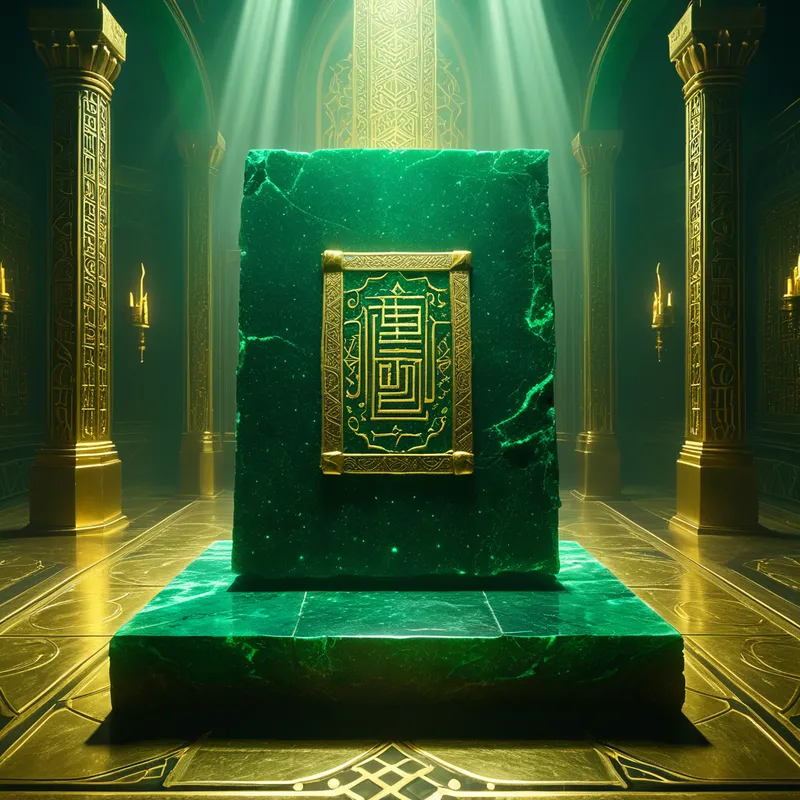
Before the first breath of time, in a silence so profound it was a kind of hearing, there existed a chamber beyond chambers. This was the precinct of the Throne, not a place of stone or jewel, but a dominion of pure, unmediated command. And there, suspended in the breathless dark before creation’s dawn, rested the Lauḥ al-Maḥfūẓ.
It was not a tablet as men know them. It was a plane of living emerald, a sea of solidified light, its dimensions encompassing all that would be. Its surface was not still. Upon it flowed a river of script, a cursive fire of gold and white, writing itself from no pen. This was the First Pen, the Qalam, moving by the command of the One who spoke the first and final word: Kun—“Be.”
And it wrote. It wrote the names of all things before they were shaped from [the void](/myths/the-void “Myth from Buddhist culture.”/). It wrote the arc of every star, from its fiery birth to its silent ash. It wrote [the fall](/myths/the-fall “Myth from Biblical culture.”/) of every leaf, the course of every river, the laughter of a child not yet conceived, and the tear of a mourner at an end not yet begun. It wrote the rise and fall of kingdoms whose dust still slept within unmade mountains. It wrote the longing in the heart of the first human, and the final sigh of the last.
Angels, beings of constrained light, would draw near its periphery, and the knowledge flowing from it would illuminate them, sending them forth as executors of a will they revered but whose totality they could not bear. They saw the script cascade—a chronicle of grace and trial, of guidance sent and choices made. Every divine revelation, every prophet’s message, every fateful turn was there, not as a dead record, but as a living, present-tense truth. The [Laylat al-Qadr](/myths/laylat-al-qadr “Myth from Islamic culture.”/) was inscribed upon it, a night brighter than a thousand months, marking the moment the Tablet’s wisdom would begin to pour into [the world](/myths/the-world “Myth from Tarot culture.”/) of time.
The conflict here is not of clashing swords, but of scales: the immense, silent, completed knowing of the Tablet against the fragile, trembling, unfolding experience of the creature. The human soul, cast into [the river](/myths/the-river “Myth from Buddhist culture.”/) of time, swims against the current of its own pre-written story, seeking a freedom that is already accounted for in the grand, compassionate calculus of the script. The drama is in the living of the line, not in its erasure.
And so it rests, eternal, preserved, complete. The story of every soul is already told there in its final, redeemed form. The journey of humanity is the slow, painful, glorious awakening to the story that has always been written in light, waiting in the silence before time for us to live our way home to its meaning.
Cultural Origins & Context
The mythos of the Preserved Tablet is woven into the very fabric of Islamic cosmology, primarily derived from the Quran and the rich tapestry of Ḥadīth and classical theological scholarship. References in the Quran, such as “Nay, this is a glorious Qur’an, (Inscribed) in a Tablet Preserved!” (85:21-22), anchor it as the source of revelation. It is the master ledger from which all scriptures—the Scrolls of Abraham, [the Torah](/myths/the-torah “Myth from Jewish culture.”/), the Psalms, the Gospel, and the Quran—are sent down.
This was not a myth for the marketplace in a literal sense; it was a cornerstone of scholastic and spiritual discourse. Theologians like Al-Ghazali and Ibn Arabi grappled with its implications, wrestling with the paradox of divine foreknowledge and human free will. For the common believer, it was a article of awe—a concept that inspired both humility, in the face of a pre-ordained destiny (Qadar), and profound trust (tawakkul), knowing one’s life was inscribed by a wisdom beyond comprehension. Its societal function was to provide an ultimate framework of order and meaning, placing every individual life, no matter how small, within a cosmic narrative of divine purpose and ultimate [justice](/myths/justice “Myth from Tarot culture.”/).
Symbolic Architecture
Psychologically, the Preserved [Tablet](/symbols/tablet “Symbol: A tablet symbolizes personal connectivity, information access, and the blending of work and play in the digital age.”/) represents the archetypal [realm](/symbols/realm “Symbol: The symbol of ‘Realm’ often signifies the boundaries of one’s consciousness, experiences, or emotional states, suggesting aspects of reality that are either explored or ignored.”/) of [the Self](/myths/the-self “Myth from Jungian culture.”/)—the total, integrated [blueprint](/symbols/blueprint “Symbol: A blueprint represents the foundational plan or design for something, often symbolizing potential, structure, and the mapping of one’s inner self or future.”/) of the [psyche](/myths/psyche “Myth from Greek culture.”/) that exists outside of time. It is the complete [pattern](/symbols/pattern “Symbol: A ‘Pattern’ in dreams often signifies the underlying structure of experiences and thoughts, representing both order and the repetitiveness of life’s situations.”/) of who we are meant to be, containing all our potentials, wounds, triumphs, and destined lessons long before we consciously encounter them.
The Tablet is the psyche’s own genome, the immutable code of the soul’s journey from fragmentation to wholeness.
The flowing [script](/symbols/script “Symbol: The symbol of ‘script’ indicates a narrative or roadmap for one’s life, representing the conscious and unconscious stories we tell ourselves.”/) symbolizes the dynamic, living [nature](/symbols/nature “Symbol: Nature symbolizes growth, connectivity, and the primal forces of existence.”/) of this [destiny](/symbols/destiny “Symbol: A predetermined course of events or ultimate purpose, often linked to spiritual forces or cosmic order, representing life’s inherent direction.”/). It is not a [static](/symbols/static “Symbol: Static represents interference, disruption, and the breakdown of clear communication or signal, often evoking feelings of frustration and disconnection.”/) [prison](/symbols/prison “Symbol: Prison in dreams typically represents feelings of restriction, confinement, or a lack of freedom in one’s life or mind.”/) sentence, but a narrative in progress, where our conscious choices are the very [mechanism](/symbols/mechanism “Symbol: Represents the body’s internal systems, emotional regulation, or psychological processes working together like a machine.”/) by which the pre-existing [story](/symbols/story “Symbol: The symbol of ‘Story’ represents the narrative woven through our lives, embodying experiences, lessons, and emotions that shape our identities.”/) is realized. The Qalam represents the active, creative principle of the divine—or, in psychological terms, the transcendent function that guides the [individuation process](/symbols/individuation-process “Symbol: The psychological journey toward self-realization and wholeness, integrating conscious and unconscious aspects of personality.”/). The [tension](/symbols/tension “Symbol: A state of mental or emotional strain, often manifesting physically as tightness, pressure, or unease, signaling unresolved conflict or anticipation.”/) between the “written” decree and lived freedom mirrors the core [human](/symbols/human “Symbol: The symbol of a human represents individuality, complexity of emotions, and social relationships.”/) struggle between the pull of [fate](/symbols/fate “Symbol: Fate represents the belief in predetermined outcomes, suggesting that some aspects of life are beyond human control.”/) (the unconscious patterns, complexes, and archetypal dramas we inherit) and the agency of [the ego](/myths/the-ego “Myth from Jungian culture.”/). The Tablet assures us that even our struggles, our wrong turns, and our suffering are part of a meaningful, coherent whole we cannot yet see.
The Dreamer’s Resonance
When this myth stirs in the modern unconscious, it often manifests in dreams of vast archives, immutable lists, or being shown a book containing one’s own life. One might dream of trying to erase or change a line in such a book, only to watch it rewrite itself. Or of finding a room with a single, luminous object—a stone, a screen, a crystal—that holds overwhelming, total knowledge.
Somatically, this can feel like a profound tightening in the chest—the awe of confronting a truth too large—or a paradoxical sense of release in the shoulders, as if a burden of ultimate responsibility has been lifted. Psychologically, these dreams signal a confrontation with the concept of destiny. The dreamer is likely at a crossroads, grappling with a deep sense that their life is following a pattern they cannot control, or conversely, feeling terrified of their own freedom. The dream presents the Lauḥ al-Maḥfūẓ as an image of the objective psyche, insisting that there is a pattern, a teleology to their existence that transcends their momentary confusion or fear. It is the unconscious affirming, “Your story makes sense, even when you are lost within it.”
Alchemical Translation
The alchemical work modeled by this myth is the transmutation of anxiety into trust, and fragmentation into coherence. The modern individual, drowning in choice and burdened by the myth of total self-authorship, is invited to a profound mortificatio—the humbling death of the ego’s illusion of absolute control.
The process is not one of passive surrender to fate, but of active alignment with a deeper current of the Self.
First, one must “read” their own tablet—not to know the future, but to understand their nature. This is the stage of [nigredo](/myths/nigredo “Myth from Alchemical culture.”/): shadow work, confronting the innate complexes and archetypal patterns (the “inscribed” wounds and gifts) that shape their reactions. Next comes the albedo: the purification of accepting these patterns not as flaws, but as the given material of the work. The struggle for free will becomes a conscious collaboration with this deeper script.
The final transmutation, the [rubedo](/myths/rubedo “Myth from Alchemical culture.”/), is the realization that true freedom lies not in writing a new story from nothing, but in willingly, creatively, and courageously incarnating the unique, majestic, and already-complete story of the Self that has always existed in the preserved tablet of the soul. One becomes, at last, both the faithful reader and the lived expression of the golden script. The conflict between fate and freedom dissolves into a unified act of becoming.
Associated Symbols
Explore related symbols from the CaleaDream lexicon: