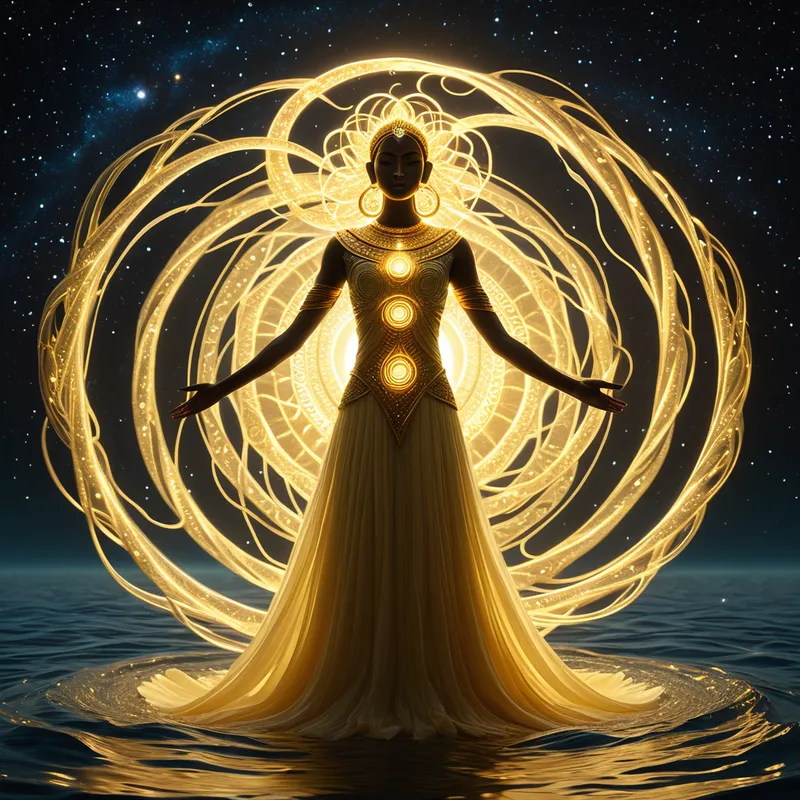
Pranamaya Kosha Myth Meaning & Symbolism
The story of the vital energy sheath, a cosmic breath binding spirit to flesh, revealing the sacred architecture of life itself.
The Tale of Pranamaya Kosha
Listen. Before the world was named, before the first thought took form, there was a great stillness. Not an empty stillness, but a pregnant one, a silence humming with potential. From this womb of Brahman, a spark emerged—not a thing, but a desire. The desire to be. To know itself. And so, the great Atman, the Self, wrapped itself in its first garment.
It did not weave this garment from thread, but from rhythm. From the in-and-out of a breath that was not yet breath. This was the first sheath, the Annamaya Kosha, a cloak of earth and water, dense and slow. But the spark within felt trapped, a fire banked by cold clay. It stirred. And with that stirring came a sigh—a cosmic exhalation that rippled through the stillness.
This sigh became a wind, a current, a river of invisible force. It poured into the earthen form, not as air, but as movement itself. It was the pulse in the wrist, the thrum in the throat, the gentle expansion and contraction of the sleeping form. This was the birth of the second sheath, the Pranamaya Kosha. It was not a body, but the animation of a body. It was the dancer inhabiting the doll, the lightning filling the cloud.
The great sages, the Rishis, in their deep meditation, perceived this not as a story of the past, but as the eternal present of every living being. They saw that with each inhalation, the universe pours itself into us, a gift of life-force, of Prana. With each exhalation, we offer a part of ourselves back to the cosmos. The Pranamaya Kosha is this sacred exchange, this golden cage of breath that holds the immortal bird of spirit captive, yet also gives it the means to sing.
They spoke of five vital winds, the Vayus, coursing through this sheath: Prana (not to be confused with the general term) drawing life in, Apana rooting it down and releasing waste, Samana fanning the digestive fires at the core, Udana carrying thought and sensation upward, and Vyana weaving it all into a seamless whole. This was the resolution—not an end, but a perfect, dynamic balance. The spark was no longer trapped, but riding a chariot of wind, ready for the journey inward through the deeper sheaths yet to come.
Cultural Origins & Context
The concept of the Pranamaya Kosha is not a singular myth with characters and plot, but a foundational metaphysical model articulated in the ancient Upanishads, particularly the Taittiriya Upanishad. It is part of the doctrine of the Pancha Kosha (Five Sheaths), a map of human existence from the gross to the subtle.
This knowledge was transmitted orally from guru to disciple in the forest academies of ancient India. It was not mere philosophy for debate, but experiential technology for liberation (Moksha). Its societal function was profound: it provided a framework for understanding life, disease, and the path to transcendence. By mastering the breath (Pranayama), one could directly influence this vital sheath, calming the mind, healing the body, and preparing the consciousness to pierce through to the deeper layers of reality. It grounded spiritual pursuit in the tangible reality of the living, breathing body.
Symbolic Architecture
The Pranamaya Kosha is the archetypal symbol of the animated intermediary. It represents the crucial interface where spirit becomes embodied and matter becomes ensouled. It is not matter, and it is not pure consciousness; it is the dynamic relationship between them.
The body is the lute, the breath is the string, and the mind is the musician. Pranamaya Kosha is the vibration that creates the music of a life.
Psychologically, it symbolizes our vital energy, our emotional and instinctual "weather system." The five Vayus are not physiological facts but symbolic representations of psychic functions: Prana is our inspiration and intake of experience; Apana is our ability to let go, to release trauma and psychic waste; Samana is our capacity to digest and integrate experiences into our sense of self; Udana is our expression, our will, and our movement toward higher understanding; Vyana is the overall integrity and circulation of our personality, connecting all parts into a cohesive whole. A blockage in any "wind" manifests as a psychological or somatic symptom—anxiety, depression, digestive issues, creative stagnation.
The Dreamer's Resonance
When the pattern of the Pranamaya Kosha stirs in the modern unconscious, it often manifests in dreams of breath, wind, and vital currents. One might dream of being a conduit for a great storm, of breathing underwater, or of having lungs made of light. There may be dreams of suffocation, symbolizing a life constricted by anxiety or depression—a blockage of Prana. Dreams of being rootless and blown about by chaotic winds point to a weakness in Apana, a lack of grounding and release.
Somatically, the dreamer may be processing a profound re-regulation of their autonomic nervous system. The dream is the psyche's attempt to re-establish flow in a system choked by chronic stress (excess Prana/sympathetic arousal) or heavy stagnation (excess Apana/parasympathetic collapse). To dream of the Pranamaya Kosha is to dream of the body's innate intelligence trying to re-balance its fundamental life-rhythm, often during periods of recovery, deep therapy, or spiritual practice.

Alchemical Translation
The journey through the Pranamaya Kosha models the first great alchemical operation in individuation: separating the subtle from the gross. Our identification is initially trapped in the physical sheath (Annamaya Kosha)—"I am my body, my possessions, my status." The alchemical work begins with the realization, "I am more than this."
To master the breath is to take the reins of the chariot of the senses; it is the first act of sovereignty over the chaotic kingdom of the body.
This is the stage of practicing awareness. By turning attention to the breath—the most tangible aspect of the Pranamaya Kosha—one begins to differentiate the experiencer from the experience. One discovers they are not their anxiety (a disturbed breath pattern), but the awareness that can observe and eventually calm it. This is the transmutation: converting unconscious, automatic life-force (instinct, raw emotion) into conscious, directed energy (attention, will).
The integration of the five Vayus becomes a blueprint for psychological wholeness. We learn to consciously draw in (Prana) what nourishes us, release (Apana) what poisons us, digest (Samana) our experiences into wisdom, express (Udana) our authentic voice, and circulate (Vyana) this vitality through every aspect of our being. By mastering this vital sheath, we build the resilient, flowing vehicle necessary to navigate the deeper, more subtle realms of the mind and spirit that lie within. We cease to be victims of our inner weather and become skilled navigators of our own soul's atmosphere.
Associated Symbols
Explore related symbols from the CaleaDream lexicon: