Potlatch Myth Meaning & Symbolism
A mythic ritual where status is gained not by hoarding, but by the sacred, competitive act of extravagant, even ruinous, giving and communal feasting.
The Tale of Potlatch
Let the cedar smoke carry the story. Let the drumbeat of [the sea](/myths/the-sea “Myth from Greek culture.”/) be its pulse.
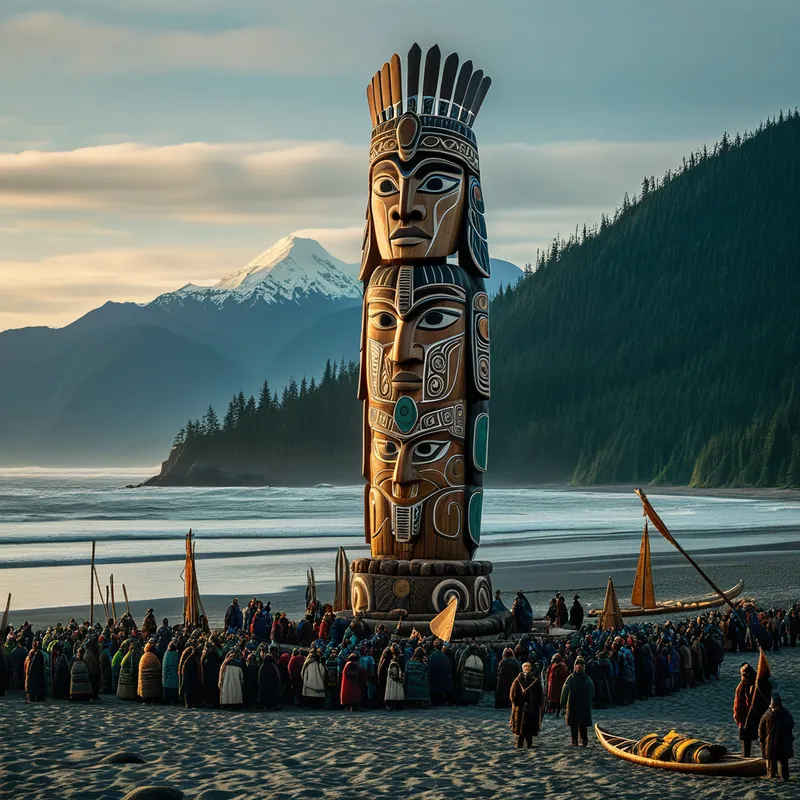
In the time when [the world](/myths/the-world “Myth from Tarot culture.”/) was still wet with creation, along [the mist](/myths/the-mist “Myth from Celtic culture.”/)-shrouded shores where the cedar giants touch [the sky](/myths/the-sky “Myth from Persian culture.”/) and the salmon run thick as stars, there lived a people whose wealth was measured not in what they kept, but in what they gave. Their greatest chief, a man whose name was like the thunder in the mountains, faced a silence. His house was full—stacked to the rafters with the finest Chilkat blankets, his treasure boxes heavy with the gleaming copper shields, his beaches lined with swift canoes carved from single trees. Yet, in this fullness, there was a hollow wind. His prestige was a mountain, but it cast a long, cold shadow. His rivals, chiefs of neighboring villages, watched from across the [water](/myths/water “Myth from Chinese culture.”/), their own storehouses growing, their own ambitions hardening like winter ice.
The great chief felt the weight. Not of the wealth, but of the holding. He called his speaker, whose voice could carry across the great water. “Prepare the feast,” he commanded, his voice low as a rockslide. “Carve the invitation poles. Send them to every house, to every village, even to those who speak my name with envy in their hearts. Tell them to come. Tell them to bring their hunger and their eyes.”
For a year, the village stirred like a stirred anthill. Women gathered mountains of oolichan, berries, and roots. Men hunted the deep waters and the dense forests. Carvers sang to the cedar, releasing at.oow in [the forms](/myths/the-forms “Myth from Platonic culture.”/) of eagle, bear, and killer whale. The air grew thick with the smell of smoking fish and the sound of adzes.
The day arrived, cloaked in a fine, misting rain that made the world gleam. Canoes arrived in fleets, painting the grey water with color. The guests were seated in strict order of rank, a living map of the social universe. For days, they were fed—not merely fed, but submerged in abundance. Steaming feast bowls of salmon, mountains of dried berries soaked in precious oil, delicacies from land and sea. Stories were told, dances performed, the histories of clans sung into the smoky air. The wealth of the host was displayed, item by magnificent item, its spiritual and material power palpable.
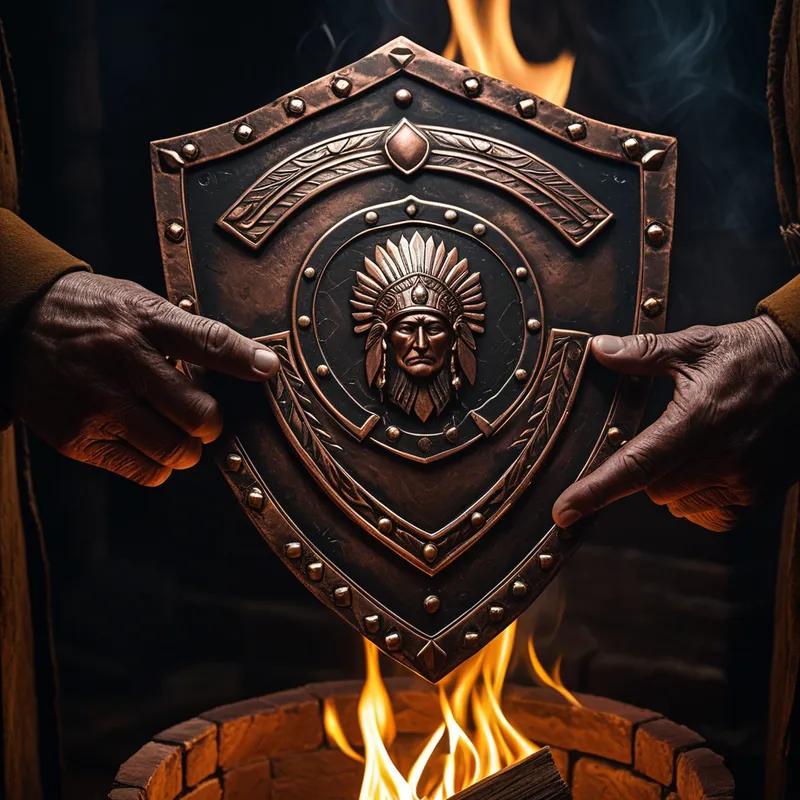
Then came the moment of turning. The great chief rose, his regalia whispering of power. He did not speak of war or conquest. He began to give. Not a token, but a torrent. Priceless blankets were carried and piled before a rival chief until the man was nearly buried. A gleaming copper shield, worth a lifetime of labor, was presented with a recitation of its history and value. Canoes, tools, food—a river of wealth flowed from the host to his guests. The climax was not a gift, but a destruction. Before the stunned silence of hundreds, the chief took one of his most valued coppers, named “Bringer of Mountains,” and called for his youngest heir. Before [the child](/myths/the-child “Myth from Alchemy culture.”/), he cast the copper into the heart of the ceremonial fire. The metal did not melt, but it blackened and warped, its value now transformed from material to mythic. In that act of sacred ruin, he demonstrated a truth that shook the foundations of the world: his power was so vast, his connection to the spiritual so sure, that he could annihilate the ultimate symbol of wealth and remain, unshaken, a mountain.
The guests departed, their canoes laden not with plunder taken, but with gifts given. The chief’s great house stood, its physical stores diminished. But his name? His name now echoed in the mountains, carried on [the wind](/myths/the-wind “Myth from Various culture.”/), woven into the fabric of the world. He had not conquered his rivals; he had obligated them. He had transformed wealth from a [thing](/myths/thing “Myth from Norse culture.”/) held, into a story told. And in that story, he was forever the giver, the center from which all abundance flowed.
Cultural Origins & Context
The potlatch, from the Chinook Jargon word patshatl meaning “to give,” was not merely a ceremony but the central nervous system of social, economic, and spiritual life for many Indigenous nations of the Pacific Northwest Coast, including the Kwakwaka’wakw, Haida, Tlingit, and Nuu-chah-nulth. It was the living enactment of the mythic principles of reciprocity, status, and cosmic balance.
Far from a simple “party,” the potlatch was a complex legal, political, and spiritual institution. It was the stage upon which the drama of society played out: names, titles, and crest privileges were validated and transferred; marriages were solidified; debts were settled; and the hierarchical order of clans and houses was publicly affirmed and challenged. The stories told, dances performed, and masks revealed were not entertainment but the sacred naxnox, the spiritual property and history of the hosts. The extravagant giving was a calculated, high-stakes investment in social capital. To accept a gift was to acknowledge the giver’s status and to enter into a binding obligation to reciprocate, with interest, at a future potlatch. In this way, wealth was kept in motion, preventing hoarding and ensuring a dynamic, competitive circulation of resources and prestige throughout the region.
Symbolic Architecture
At its core, the myth of the potlatch inverts the modern [psyche](/myths/psyche “Myth from Greek culture.”/)‘s most cherished axiom: that [security](/symbols/security “Symbol: Security denotes safety, stability, and protection in one’s personal and emotional life.”/) lies in accumulation. It presents a radical, alchemical equation where power is not consolidated through possession, but is activated and amplified through [dissolution](/symbols/dissolution “Symbol: The process of breaking down, dispersing, or losing form, often representing transformation, release, or the end of a state of being.”/).
The ego builds its fortress by gathering stones; the soul establishes its kingdom by giving them away.
The towering piles of blankets and coppers symbolize not just [material](/symbols/material “Symbol: Material signifies the tangible aspects of life, often representing physical resources, desires, and the physical world’s influence on our existence.”/) [wealth](/symbols/wealth “Symbol: Wealth in dreams often represents abundance, security, or inner resources, but can also symbolize burdens, anxieties, or moral/spiritual values.”/), but the accumulated psychic [energy](/symbols/energy “Symbol: Energy symbolizes vitality, motivation, and the drive that fuels actions and ambitions.”/) of the individual or clan—their [history](/symbols/history “Symbol: History in dreams often represents the dreamer’s past experiences, lessons learned, or unresolved issues that continue to influence their present.”/), labor, skill, and spiritual power. To hoard this [energy](/symbols/energy “Symbol: Energy symbolizes vitality, motivation, and the drive that fuels actions and ambitions.”/) is to let it stagnate; it becomes a [weight](/symbols/weight “Symbol: Weight symbolizes burdens, responsibilities, and emotional loads one carries in life.”/), a “hollow wind” as in the tale. The act of giving, especially competitive, ruinous giving, is a symbolic sacrifice to the greater social and cosmic order. The destroyed [copper](/symbols/copper “Symbol: Copper symbolizes conductivity and connection, representing the ability to channel energy, ideas, and emotions between people or concepts.”/) is the ultimate [symbol](/symbols/symbol “Symbol: A symbol can represent an idea, concept, or belief, serving as a powerful tool for communication and understanding.”/) of this [transmutation](/symbols/transmutation “Symbol: A profound, alchemical process of fundamental change where one substance or state transforms into another, often representing spiritual evolution or personal metamorphosis.”/). Its physical form is annihilated, but its value—its [story](/symbols/story “Symbol: The symbol of ‘Story’ represents the narrative woven through our lives, embodying experiences, lessons, and emotions that shape our identities.”/), its impact on the witnesses—is immortalized and magnified. It moves from the [realm](/symbols/realm “Symbol: The symbol of ‘Realm’ often signifies the boundaries of one’s consciousness, experiences, or emotional states, suggesting aspects of reality that are either explored or ignored.”/) of having to the realm of being.
The rival guests are not enemies to be defeated but essential partners in the [ritual](/symbols/ritual “Symbol: Rituals signify structured, meaningful actions carried out regularly, reflecting cultural beliefs and emotional needs.”/). They represent the “other,” the outer world, the collective mirror. Without witnesses, the act of giving is meaningless. The [community](/symbols/community “Symbol: Community in dreams symbolizes connection, support, and the need for belonging.”/) is the [crucible](/symbols/crucible “Symbol: A vessel for intense transformation through heat and pressure, symbolizing spiritual purification, testing, and alchemical change.”/) in which the base [metal](/symbols/metal “Symbol: Metal in dreams often signifies strength, transformation, and the qualities of resilience or coldness.”/) of material wealth is transformed into the gold of [legacy](/symbols/legacy “Symbol: What one leaves behind for future generations, encompassing values, achievements, possessions, and memory.”/) and [authority](/symbols/authority “Symbol: A symbol representing power structures, rules, and control, often reflecting one’s relationship with societal or personal governance.”/).
The Dreamer’s Resonance
When this mythic pattern stirs in the modern dreamer, it often manifests as dreams of extravagant, anxious giving or of shocking loss that leads to an unexpected sense of liberation. You may dream of handing the keys to your house to a stranger, of scattering all your money from a rooftop, or of a beloved heirloom melting in your hands. There is a somatic quality of both panic and profound release.
Psychologically, this signals a critical juncture where the psyche is straining against the confines of a wealth-complex. This “wealth” may be literal finances, but more often it is psychic capital: stored-up resentment, rigid self-identity, intellectual knowledge hoarded but not shared, or emotional reserves guarded too closely. The dream is presenting the potlatch as a solution—a terrifying, counter-intuitive, yet necessary ritual of expenditure. The anxiety comes from [the ego](/myths/the-ego “Myth from Jungian culture.”/), which perceives only loss. The latent sense of liberation points to [the Self](/myths/the-self “Myth from Jungian culture.”/), which understands that true authority and abundance are cyclic, requiring a sacred release to generate new life.

Alchemical Translation
For the individual on the path of individuation, the potlatch models the ultimate stage of relating to one’s own “possessions” in the journey toward psychological sovereignty.
[The first stage](/myths/the-first-stage “Myth from Alchemical culture.”/) is Accumulation. We build the ego, gathering skills, identities, defenses, and stories. We become a “chief” of our own small domain. Yet, as in the myth, this leads to a silent, hollow prestige. The ego, isolated in its fortress, feels the weight of its own maintenance.
The alchemical call is to The Invitation. This is the conscious decision to bring one’s hidden complexes, one’s shadow, one’s prized self-concepts (“the rivals”) into the light of awareness. It is an act of profound courage to say, “I will look at what I have built, and I will risk it.”
The core operation is The Sacred Destruction. This is not random loss, but the willed, ritualized sacrifice of a psychic structure that has outlived its usefulness but to which we are deeply attached. It could be the “copper” of an old grievance we cherish, a self-image of victimhood or superiority, or a talent we use only for self-aggrandizement. Throwing it into the “fire” of conscious attention and voluntary letting-go feels like ruin. The ego screams in protest.
The king is not crowned by what he keeps in his vault, but by what he distributes from his throne. To become the ruler of your inner world, you must first become its most generous benefactor.
The result is Obligated Space. You do not emerge “poorer.” You emerge with your story rewritten. The energy that was locked in the defended structure is now liberated and circulating in your wider psyche and in your relationships. You have, through an act of supreme confidence in your own inner abundance, transformed having into being. Your authority is no longer dependent on the hoarded treasure, but on the undeniable, witnessed act of generosity itself. You have held a potlatch for your own soul, and in the giving away, you have finally come to possess your true name.
Associated Symbols
Explore related symbols from the CaleaDream lexicon: