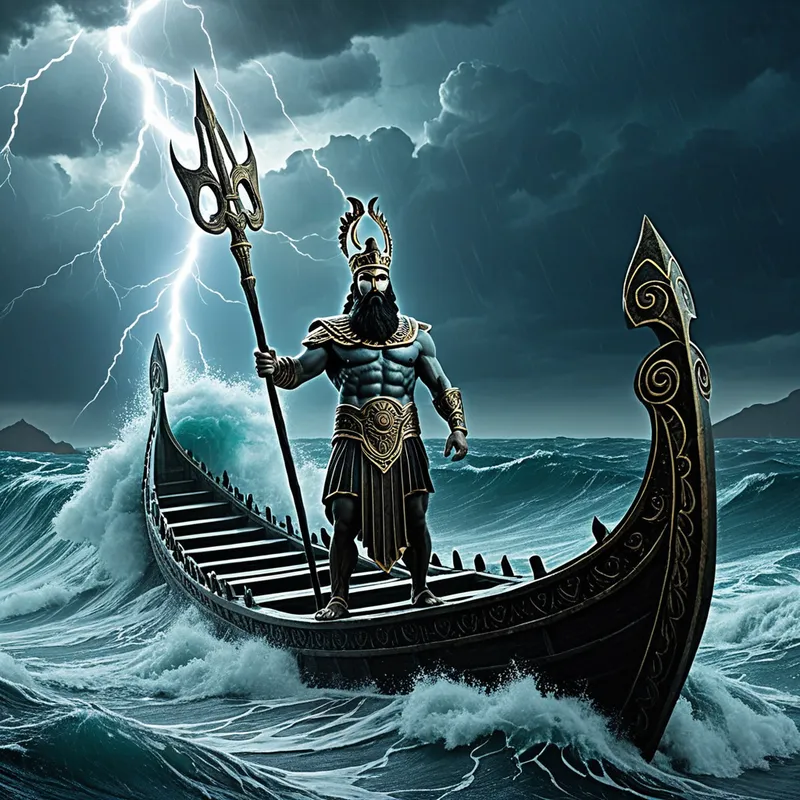
Poseidon's Wrath Myth Meaning & Symbolism
A myth of divine fury punishing human hubris, revealing the sea's dual nature as life-giver and destroyer, and the psyche's chaotic depths.
The Tale of Poseidon’s Wrath
Hear now the tale of [the Earth](/myths/the-earth “Myth from Hindu culture.”/)-Shaker’s fury, a story not of gentle waves but of [the abyss](/myths/the-abyss “Myth from Kabbalistic culture.”/) unleashed. It begins not on the calm sea, but in the heart of mortal pride.
The sun was a merciless bronze disc over the wine-dark sea. A ship, its sail fat with a favoring wind, cut the [water](/myths/water “Myth from Chinese culture.”/) like a blade. On its deck stood [Odysseus](/myths/odysseus “Myth from Greek culture.”/), his eyes not on [the horizon](/myths/the-horizon “Myth from Various culture.”/) but on the spoils of war piled high. He had blinded the one-eyed giant, [Polyphemus](/myths/polyphemus “Myth from Greek culture.”/), and with a laugh born of relief and reckless [triumph](/myths/triumph “Myth from Roman culture.”/), he had shouted to the weeping monster, “If any ask who took your sight, tell them it was [Odysseus](/myths/odysseus “Myth from Greek culture.”/), sacker of cities!”
The words hung in the salt air, a blasphemy. They traveled down through the dark water, past the silver flicker of fish, past the silent forests of kelp, to the cold, marble halls where [Poseidon](/myths/poseidon “Myth from Greek culture.”/) sat upon his throne of coral and [pearl](/myths/pearl “Myth from Chinese culture.”/). The god heard his son’s name, heard the boast. [The sea](/myths/the-sea “Myth from Greek culture.”/) floor trembled. In the god’s hand, his trident grew cold, then hot with a blue, crackling light.
He rose. The ocean groaned. He pointed the trident not at the ship, but at [the sky](/myths/the-sky “Myth from Persian culture.”/) itself. The favoring wind died in an instant, replaced by a silence so profound the sailors could hear the blood rushing in their ears. Then came the groan, a sound from [the world](/myths/the-world “Myth from Tarot culture.”/)’s bones, as the horizon turned the color of a bruise. The sea, once a flat plain, became a range of moving mountains. A wall of water, taller than the highest cliff of Ithaca, rose with a roar that swallowed all sound. It was not mere water; it was the god’s will given form—a liquid, crushing hatred.
The ship was a leaf, a splinter. The proud mast snapped like a twig. Men who moments before had sung of home were swallowed without a cry, pulled into the green gloom by forms with too many arms and eyes of cold fire. Odysseus, lashed to a broken timber, tasted salt and terror and the iron tang of his own folly. For nine days and nights, Poseidon’s wrath was the world. The sea was no longer a road home, but a chaotic, sentient prison. It offered not passage, but punishment. It did not drown a man; it dismantled him, piece by piece, until all that was left was the raw, screaming core of a creature who had dared to forget the scale of things. The god’s fury was an education in the abyss, a lesson written in waves and delivered by storm.
Cultural Origins & Context
This narrative pattern—the mortal hero provoking and enduring the sea god’s rage—is woven deeply into the fabric of Greek epic poetry, most famously in [Homer](/myths/homer “Myth from Greek culture.”/)’s Odyssey. For a culture whose lifeblood was the Aegean, Poseidon was not a distant symbol but a daily reality. His domain was the source of livelihood, trade, and connection, yet it remained the ultimate wilderness, an unknowable frontier of sudden storms and hidden depths.
The myth was not mere entertainment; it was a foundational cautionary tale performed by bards at feasts and in public squares. It served a vital societal function: to codify the concept of hubris and its inevitable consequence, [nemesis](/myths/nemesis “Myth from Greek culture.”/). In a worldview where the gods were intimately involved in human affairs, the story taught respect for forces beyond human control. It articulated the fragile contract between humanity and nature—the sea gives, but it can also take, especially when its laws (and its ruler’s honor) are disrespected. The myth was a collective memory of the sea’s absolute power, a narrative anchor in the terrifying and sublime face of the natural world.
Symbolic Architecture
Poseidon’s [wrath](/symbols/wrath “Symbol: Intense, often destructive anger representing repressed emotions, moral outrage, or survival instincts.”/) is the [psyche](/myths/psyche “Myth from Greek culture.”/)’s own [chaos](/symbols/chaos “Symbol: In Arts & Music, chaos represents raw creative potential, uncontrolled expression, and the breakdown of order to forge new artistic forms.”/) unleashed. The sea he rules is the perfect [symbol](/symbols/symbol “Symbol: A symbol can represent an idea, concept, or belief, serving as a powerful tool for communication and understanding.”/) for the unconscious—vast, fertile, teeming with [life](/symbols/life “Symbol: The symbol of ‘Life’ represents a journey of growth, interconnectedness, and existential meaning, encompassing both the joys and challenges that define human experience.”/) and [mystery](/symbols/mystery “Symbol: An enigmatic, unresolved element that invites curiosity and exploration, often representing the unknown or hidden aspects of existence.”/), yet capable of annihilating the conscious ego (the ship) when provoked.
The trident is not merely a weapon; it is the triune instrument that stirs the depths, fractures the stable ground of the ego, and summons the latent monsters of the deep self.
The [hero](/symbols/hero “Symbol: A hero embodies strength, courage, and the ability to overcome significant challenges.”/)’s boast represents [the ego](/myths/the-ego “Myth from Jungian culture.”/)’s [inflation](/symbols/inflation “Symbol: A dream symbol representing feelings of diminishing value, loss of control, or expansion beyond sustainable limits in one’s life or psyche.”/), its belief in its own sovereignty and [separation](/symbols/separation “Symbol: A spiritual or mythic division between realms, states of being, or consciousness, often marking a transition or loss of connection.”/) from the greater powers that sustain (and could destroy) it. Polyphemus, the blinded son, symbolizes a wounded, instinctual force—a part of the natural, primal self that has been violently wronged by “clever” [consciousness](/symbols/consciousness “Symbol: Consciousness represents the state of awareness and perception, encompassing thoughts, feelings, and experiences.”/). Poseidon’s [response](/symbols/response “Symbol: Response in dreams symbolizes how one reacts to situations, often reflecting the subconscious mind’s processing of events.”/) is not petty vengeance, but a necessary rebalancing. The storm is the psyche’s corrective, a violent reintegration where the inflated ego is shattered, stripped of its trophies and identities, and reduced to its essential, struggling being. The [journey](/symbols/journey “Symbol: A journey in dreams typically signifies adventure, growth, or a significant life transition.”/) through the storm is the dark [night](/symbols/night “Symbol: Night often symbolizes the unconscious, mystery, and the unknown, representing the realm of dreams and intuition.”/) of the [soul](/symbols/soul “Symbol: The soul represents the essence of a person, encompassing their spirit, identity, and connection to the universe.”/), where one is forced to confront the raw, unmediated power of what one has ignored or insulted.
The Dreamer’s Resonance
When this myth stirs in modern dreams, it rarely appears as a literal god on a chariot. It manifests as somatic and emotional landscapes. The dreamer may find themselves in a car suddenly engulfed by a tidal wave on a city street, or watching helplessly as their house floods from within with black water. They may dream of being on a stable boat that inexplicably splinters, or of a loved one transforming into a cold, distant sea creature.
These dreams signal a psychological process of inundation. The conscious attitude has become too rigid, too prideful, or has “blinded” some vital instinct (a creative drive, an emotional need, a bodily truth). Now, the unconscious rises up in a corrective flood. The somatic feeling is one of utter helplessness, of being dismantled by a force of nature within oneself. It is the psyche’s way of washing away an unsustainable structure of [the self](/myths/the-self “Myth from Jungian culture.”/). The dreamer is not drowning, but being forcibly baptized in the chaotic waters of their own neglected depths.

Alchemical Translation
The alchemical journey mirrored in this myth is the [nigredo](/myths/nigredo “Myth from Alchemical culture.”/), the necessary dissolution that precedes transformation. The ego’s proud, sunlit vessel must be broken apart in the mare tenebrosum, the dark sea.
To be saved from the sea, one must first be utterly lost within it. The triumph is not in escaping the wrath, but in being fundamentally reshaped by its passage.
The goal is not to defeat Poseidon, but to learn to navigate his domain with a humility born of terror and respect. For Odysseus, the ordeal transmutes the boastful sacker of cities into the patient, enduring, and cunning man who can finally return home a stranger, ready to rebuild. Psychically, this is the process of individuation. The wrath forces a confrontation with the Shadow (the monsters of the deep) and the immense, transpersonal power of the archetypal Father (Poseidon as the Great Other). The individual does not conquer these forces, but integrates their reality. They learn to build a sturdier vessel of consciousness—one that acknowledges the sea beneath it, that respects the trident’s power, and that sails not with hubris, but with a hard-won wisdom written in salt and memory. The wrath, in the end, becomes a brutal but sacred initiation into wholeness.
Associated Symbols
Explore related symbols from the CaleaDream lexicon: