Poseidon's Steeds Myth Meaning & Symbolism
The story of the god of the sea creating and mastering his immortal horses, symbols of raw oceanic power, untamed emotion, and sovereign will.
The Tale of Poseidon’s Steeds
Hear now the tale not of a hero, but of a god and his first creation. In the beginning, when [the world](/myths/the-world “Myth from Tarot culture.”/) was raw and the domains newly divided, the lord of the deep, [Poseidon](/myths/poseidon “Myth from Greek culture.”/), surveyed his kingdom. It was a realm of boundless, formless potential—a churning abyss of salt and shadow, of crushing pressure and silent, lightless trenches. It was power, yes, but wild, undirected, a ceaseless roar without a voice.
Dissatisfied with mere chaos, [the Earth](/myths/the-earth “Myth from Hindu culture.”/)-Shaker desired a symbol of his sovereignty, a living embodiment of [the sea](/myths/the-sea “Myth from Greek culture.”/)’s dual nature: its terrifying, ship-shattering fury and its life-giving, fertile grace. He walked the barren, wave-lashed shores where land and [water](/myths/water “Myth from Chinese culture.”/) warred eternally. There, he struck the grey rock with his trident, and a spring of salt water burst forth. But he did not seek to tame the land; he sought to give the sea a form it could wear.
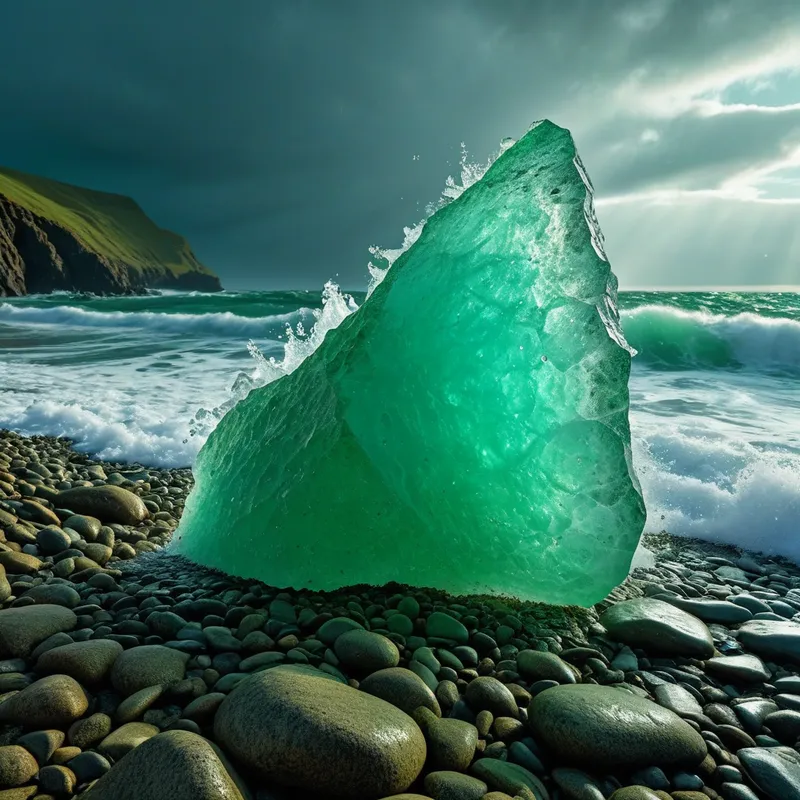
He thrust his hands into the seething foam where the waves died upon the sand. He gathered not water, but the very spirit of motion—the white-maned crest of a breaker, the swift current of a riptide, the muscular surge of a tidal bore. From these, with a god’s will as his forge, he shaped the first of them. Their bodies coalesced from liquid emerald and aquamarine, solidifying into sleek, powerful flanks that shimmered like a sunlit reef. Their hooves, harder than any coral, were the color of storm clouds, and when they stamped, the very earth trembled in sympathetic quakes.
Their manes and tails were not hair, but captured surf, a perpetual cascade of white foam that smelled of salt and ozone. Their eyes held the abyssal green of deep water, intelligent and ancient, mirroring the god’s own tempestuous soul. He named them, these children of the primal surge. Some say their names were Skeiron and Aithon, among others—names that spoke of earthquake and swiftness.
But they were born wild, as untamed as the ocean from which they sprang. They would not be mounted. They raced across the waves, turning the sea into a frenzied plain, churning up maelstroms with their passing. They were Poseidon’s power made manifest, yet they refused his hand. The conflict was not of rebellion, but of nature: could the source of chaos also be its master?
So the god, in his cunning, went not to the forges of [Hephaestus](/myths/hephaestus “Myth from Global/Universal culture.”/), but to the depths of his own domain. In a hidden grotto lit by bioluminescent creatures, he fashioned a bridle of pure gold, woven with strands of kelp and set with pearls that held [the moon](/myths/the-moon “Myth from Tarot culture.”/)’s pull within them. This was no mere tool of restraint; it was a covenant, a language.
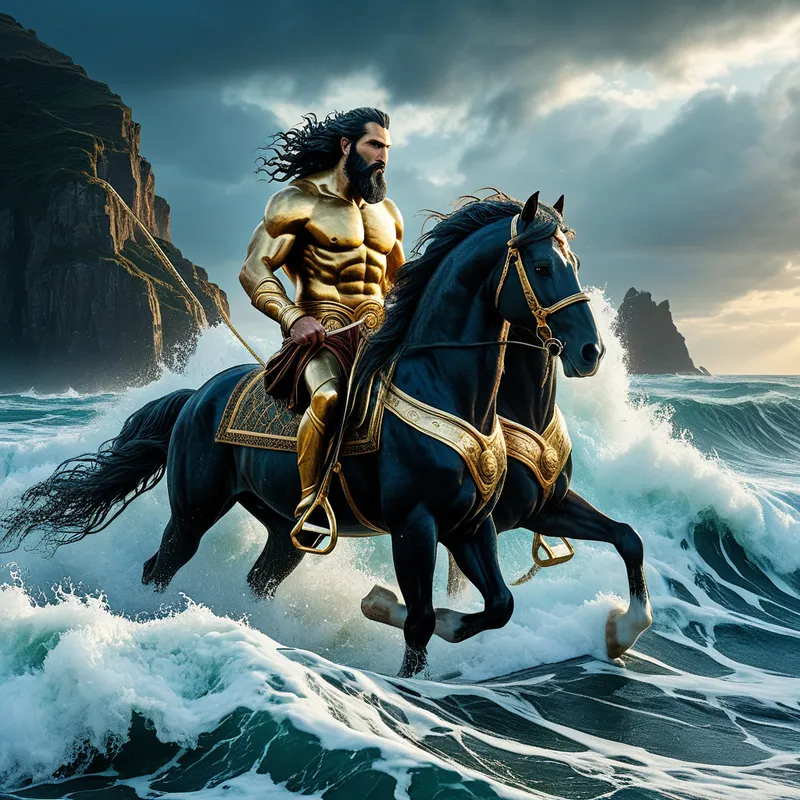
He found his steeds where the sea meets [the sky](/myths/the-sky “Myth from Persian culture.”/) in a haze of spray. He did not chase them. He stood, trident in hand, and let the bridle chime with a sound like sinking bells. The horses of the deep slowed, their abyssal eyes fixed on the god. They recognized in the golden artifact a order that complemented their chaos, a will that matched their strength. It was not submission, but recognition. The greatest of them approached, and Poseidon laid the bridle upon its head. In that moment, the unruly surge became directed force. The god mounted, and for the first time, the lord of the oceans rode his own soul across the face of the waters, master and manifestation united, the wild heart of the sea given glorious, obedient form.
Cultural Origins & Context
The myth of Poseidon’s steeds is woven into the very fabric of early Greek maritime identity. Unlike the grand, narrative epics of [Homer](/myths/homer “Myth from Greek culture.”/), this story belongs to the older, more elemental stratum of myth—the hieros [logos](/myths/logos “Myth from Christian culture.”/) (sacred story) that explains the nature of a god and his domain. It was likely told in coastal communities, by fishermen who knew the sea’s dual personality intimately, and by horse-breeding cultures of Thessaly, who famously attributed the origin of their prized animals to the god.
The horse was, in the ancient Greek world, the ultimate symbol of aristocratic power, mobility, and tamed natural force. By making Poseidon not just the god of the sea but also the creator of the horse (Hippios), this myth performed a crucial cultural function: it unified two pillars of their world—the unpredictable, all-encircling sea and the land-based prestige of cavalry and chariotry. It declared that the same divine force that could shatter cliffs also gifted civilization with one of its most potent tools. The story was passed down in hymns, local cult practices, and the works of early poets like Hesiod, solidifying Poseidon’s complex identity as both the fearsome Earth-Shaker and a civilizing god who gifts mastery over nature’s raw power.
Symbolic Architecture
At its core, the myth is a profound [allegory](/symbols/allegory “Symbol: A narrative device where characters, events, or settings represent abstract ideas or moral qualities, conveying deeper meanings through symbolic storytelling.”/) for the process of creation and mastery, not over the external world, but over the internal, psychic [landscape](/symbols/landscape “Symbol: Landscapes in dreams are powerful symbols representing the dreamer’s emotional state, personal journey, and the broader context of life situations.”/). The steeds are not separate creatures; they are hypostases of Poseidon’s own essence—the embodied dynamis (power) of the unconscious, emotional, and instinctual self.
The formless, churning sea represents the primordial, undifferentiated state of the [psyche](/myths/psyche “Myth from Greek culture.”/)—the unconscious in its raw, potential state, full of [energy](/symbols/energy “Symbol: Energy symbolizes vitality, motivation, and the drive that fuels actions and ambitions.”/) but without [direction](/symbols/direction “Symbol: Direction in dreams often relates to life choices, guidance, and the path one is following, emphasizing the importance of navigation in personal journeys.”/) or form. The act of creation—shaping the steeds from [foam](/symbols/foam “Symbol: Foam represents ephemeral boundaries, cleansing processes, and the tension between substance and emptiness. It symbolizes what appears solid but dissolves easily.”/) and current—is the first [movement](/symbols/movement “Symbol: Movement symbolizes change, progress, and the dynamics of personal growth, reflecting an individual’s desire or need to transform their circumstances.”/) of [consciousness](/symbols/consciousness “Symbol: Consciousness represents the state of awareness and perception, encompassing thoughts, feelings, and experiences.”/) attempting to give recognizable form to this inner [chaos](/symbols/chaos “Symbol: In Arts & Music, chaos represents raw creative potential, uncontrolled expression, and the breakdown of order to forge new artistic forms.”/). We create symbols (the horses) to comprehend our own [depths](/symbols/depths “Symbol: Represents the subconscious, hidden emotions, or foundational aspects of the self, often linked to primal fears or profound truths.”/).
The god must master his own creations, for the ego that gives form to unconscious content can easily be overwhelmed by the power it has named.
The initial wildness of the horses symbolizes the terrifying autonomy of complex emotions and drives once they are acknowledged. [Grief](/symbols/grief “Symbol: A profound emotional response to loss, often manifesting as deep sorrow, yearning, and a sense of emptiness.”/), rage, [passion](/symbols/passion “Symbol: Intense emotional or physical desire, often linked to love, creativity, or purpose. Represents life force and deep engagement.”/), creativity—once summoned from the deep, they can seem to run rampant, threatening to destabilize the conscious self. The golden bridle, crafted from the sea’s own treasures, is the crucial [symbol](/symbols/symbol “Symbol: A symbol can represent an idea, concept, or belief, serving as a powerful tool for communication and understanding.”/). It represents the sovereign function of [the Self](/myths/the-self “Myth from Jungian culture.”/) (the total, integrated psyche), which does not repress or destroy these powerful forces, but instead offers a conscious [structure](/symbols/structure “Symbol: Structure in dreams often symbolizes stability, organization, and the framework of one’s life, reflecting how one perceives their environment and personal life.”/)—a discipline, a practice, a containing myth—that allows for a [relationship](/symbols/relationship “Symbol: A representation of connections we have with others in our lives, often reflecting our emotional state.”/) of [guidance](/symbols/guidance “Symbol: The act of receiving or seeking direction, advice, or leadership in a dream, often representing a need for clarity, support, or a higher purpose on one’s life path.”/) and partnership.
The Dreamer’s Resonance
When this myth stirs in the modern dreamer, it often surfaces during periods of intense emotional flux or creative burgeoning, where one feels at the mercy of powerful, unnamed internal forces. The dream imagery is rarely of literal horses. Instead, one might dream of:
- Trying to drive a car with a mind of its own on a road that is also a raging river.
- A beloved pet that suddenly transforms into a massive, magnificent, but uncontrollable beast.
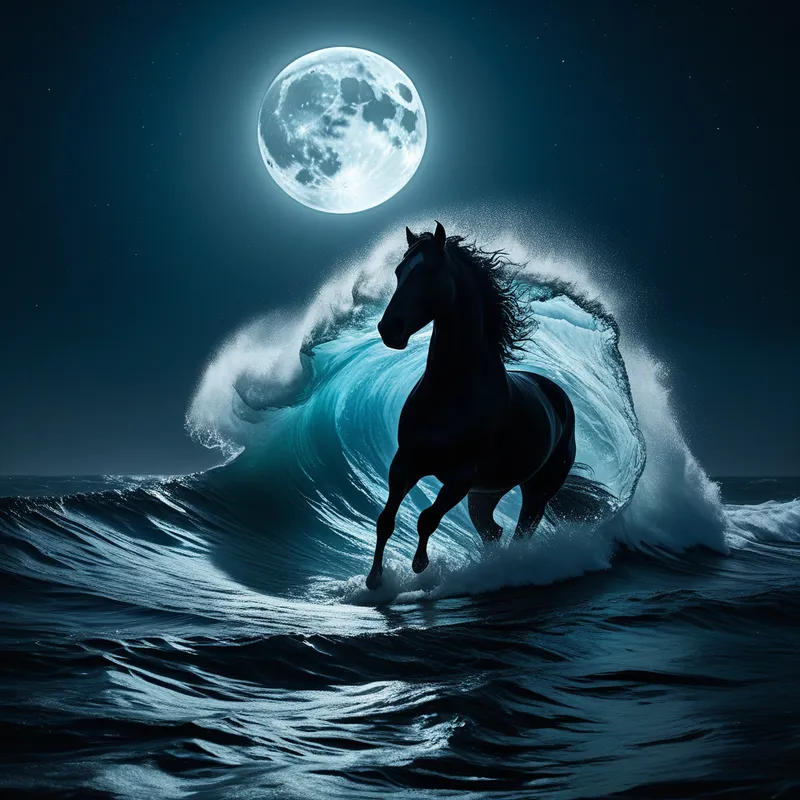
- Standing on a shore as a tidal wave approaches, only to see the crest form into the shape of charging animals.
- Holding a fragile, beautiful object (the bridle) while surrounded by overwhelming natural chaos.
Somatically, this can feel like agitation in the chest or gut, a feeling of being “ridden” by anxiety or passion, or a thrilling yet terrifying sense of boundless energy with no outlet. Psychologically, the dream signals that a powerful content of the unconscious—a deep feeling, a latent talent, a long-buried trauma—has taken on a life of its own and is demanding recognition and relationship. The conflict in the dream mirrors the psyche’s struggle to integrate this new, potent energy without being dissolved by it.
Alchemical Translation
The alchemical journey modeled here is that of coagulatio—the process of taking the volatile, watery [prima materia](/myths/prima-materia “Myth from Alchemical culture.”/) (the chaotic sea) and giving it a solid, enduring form (the steeds), which can then be integrated under the guidance of the conscious mind (the bridle). This is the heart of individuation.
First, we must have the courage to engage with our own inner chaos, to stand at the shore of the self and call forth what is hidden. This is the creative act: giving form to the formless through art, journaling, therapy, or deep reflection. We name our “horses”—our oceanic grief, our seismic anger, our tidal creativity.
The inevitable phase of “wildness” follows. The newly conscious complex feels overwhelming. We may fear our own creativity, our anger, our depth of feeling. [The ego](/myths/the-ego “Myth from Jungian culture.”/) feels inadequate, like Poseidon watching his creations churn up storms. The temptation is to repress, to push the energy back into the unconscious sea.
The alchemical gold is not found in eliminating the chaotic water, but in forging a tool from its essence that allows for conscious partnership.
The final, transformative stage is the crafting of the “golden bridle.” This is the development of a conscious attitude or vessel strong enough to relate to this power. It might be a daily meditation practice that contains anxiety, an artistic discipline that channels chaotic inspiration, or a commitment to emotional honesty that directs passion. This bridle is not a cage; it is a means of communication and direction. To mount the steed is the [triumph](/myths/triumph “Myth from Roman culture.”/) of the individuated Self—not a victory of control over instinct, but a [sacred marriage](/myths/sacred-marriage “Myth from Alchemy culture.”/) where conscious will and unconscious power move as one, carrying the individual forward with the combined force of both realms. We do not conquer the inner sea; we learn to ride its waves, becoming sovereign in our own psychic domain.
Associated Symbols
Explore related symbols from the CaleaDream lexicon: