Pomegranate Seeds Myth Meaning & Symbolism
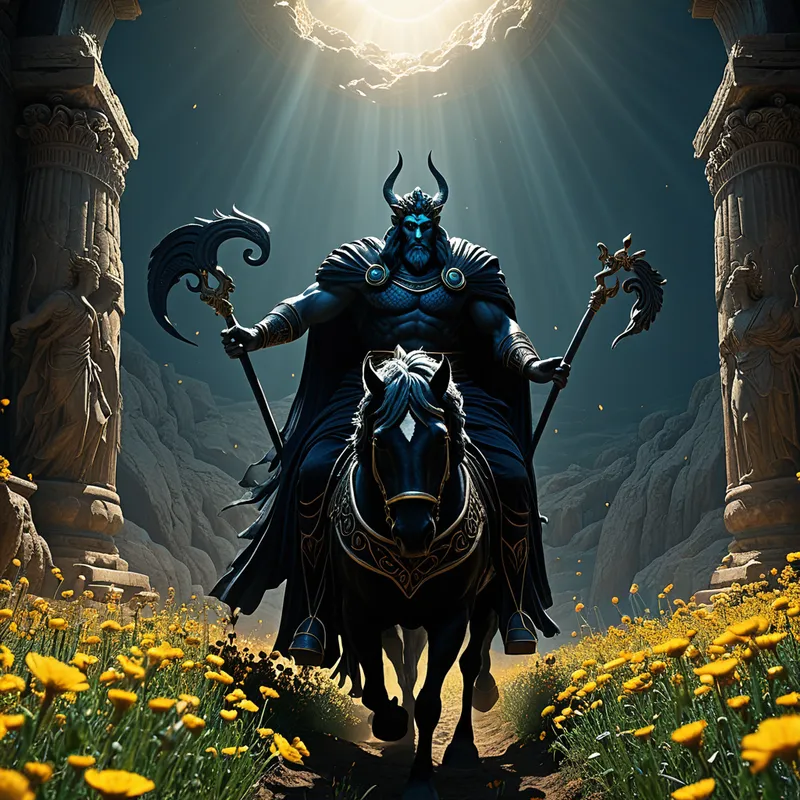
The goddess Persephone is abducted by Hades. Eating six pomegranate seeds binds her to the Underworld, creating the cycle of seasons.
The Tale of Pomegranate Seeds
Hear now the story that explains the turning of [the world](/myths/the-world “Myth from Tarot culture.”/), the reason [the earth](/myths/the-earth “Myth from Hindu culture.”/) grows cold and then blooms again. It begins not in the sun, but with a cry that tore through it.
In [the golden age](/myths/the-golden-age “Myth from Greek culture.”/) when the world was younger, Demeter walked the fields, her touch the very breath of life. Her joy was her daughter, Kore, whose laughter made flowers unfurl and whose footsteps were meadows. Kore was gathering blossoms with her companions in a sun-drenched field of Nysa—roses, crocuses, violets—her white arms laden with color. The earth was a cradle of light.
Then, the ground roared.
From a deep, jagged fissure that split the meadow asunder, a chariot of obsidian and smoke erupted, drawn by horses whose breath was frost. At its helm stood [Hades](/myths/hades “Myth from Greek culture.”/), lord of the unseen realms, his form both terrible and majestic. In one swift, silent motion, he seized Kore. Her scream was swallowed by the chasm as the earth closed above them, leaving only a scattering of trampled flowers and a silence so profound it was a sound unto itself.
Demeter’s grief was a blight upon the world. She cast off her divinity, wrapped herself in the cloak of a mortal crone, and wandered the earth, a hollow-eyed ghost. In her sorrow, she forbade the seeds to sprout, the trees to bear fruit. The soil turned to iron, the green world withered into a gray, silent tomb. Famine gripped the land; the prayers of mortals grew faint.
Meanwhile, in the sunless kingdom, Kore sat upon a throne of ebony. Hades offered her not a prison, but a crown. He showed her the silent, orderly beauty of his realm—the fields of asphodel, the halls of forgotten heroes. She was no longer just Kore, the Maiden. She was becoming [Persephone](/myths/persephone “Myth from Greek culture.”/), the one who must be reckoned with. Yet, a hunger for the world above gnawed at her. A hunger for her mother’s face.
Back in the withered world, the sun god [Helios](/myths/helios “Myth from Greek culture.”/), who sees all, revealed the truth to the grieving Demeter. Fury replaced despair. She stormed the gates of Olympus and demanded her daughter’s return from Hades. The balance of all life was at stake. The great Zeus was forced to intervene. A deal was struck: if Persephone had eaten no food of the dead, she could return.
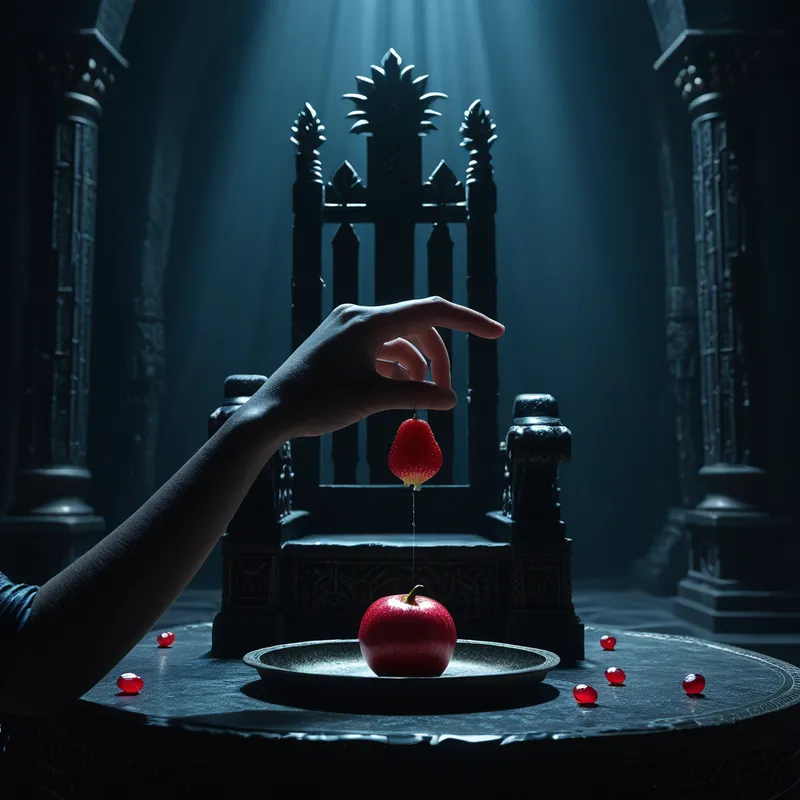
But in the deep quiet of [the Underworld](/myths/the-underworld “Myth from Greek culture.”/), a gardener of Hades had witnessed a moment of profound choice. Parched with thirst and perhaps with a dawning acceptance of her new power, Persephone had taken a pomegranate from the gardens of the dead. She had pierced its leathery hide and consumed six of its glistening, blood-red seeds.
This was the binding. To eat the food of a realm is to belong to it.
Thus, the final judgment was rendered. For each seed consumed, Persephone would spend one month of the year as Queen of the [Underworld](/myths/underworld “Myth from Greek culture.”/) beside Hades. The remaining six months, she would ascend to walk the sunlit world with her mother, Demeter.
And so, the great wheel turned. When Persephone descends, Demeter’s grief withdraws her blessing, and autumn deepens into winter. When her daughter’s footsteps are heard on the ascending path, the goddess’s joy melts the frost, and life surges forth in spring. The Maiden became the Queen, and in her cyclical journey, the rhythm of life, death, and rebirth was written into the very bones of the world.
Cultural Origins & Context
This myth, central to what scholars call the Eleusinian Mysteries, was far more than a simple nature allegory. It was the heart of a state-sponsored, initiatory cult that endured for nearly two millennia. The story was not merely told; it was experienced in secret ceremonies at Eleusis, near Athens. Initiates, who included everyone from slaves to emperors, underwent a ritual process (the mystai) that promised a favorable fate in the afterlife and a profound personal understanding of the cycle of life and death.
The primary literary sources are the Homeric Hymn to Demeter (7th-6th century BCE) and later accounts by poets like Ovid. In a culture where agriculture was the foundation of survival and the mysteries of death were a central preoccupation, this myth provided a divine framework for humanity’s most fundamental experiences: loss, grief, the changing seasons, and the hope for renewal. It elevated the maternal bond to a cosmic force and presented the female experience—as maiden, bride, and queen—as integral to the world’s functioning.
Symbolic Architecture
The myth’s power lies in its dense weave of irreversible [choice](/symbols/choice “Symbol: The concept of choice often embodies decision-making, freedom, and the multitude of paths available in life.”/) and necessary compromise. It is not a [story](/symbols/story “Symbol: The symbol of ‘Story’ represents the narrative woven through our lives, embodying experiences, lessons, and emotions that shape our identities.”/) of [rescue](/symbols/rescue “Symbol: The symbol of rescue embodies themes of salvation, support, and liberation from distressing circumstances.”/), but of transformation through a fateful act of ingestion.
Persephone is the archetypal ego thrust into the unconscious. Her abduction is the shocking, often traumatic, descent into the [depths](/symbols/depths “Symbol: Represents the subconscious, hidden emotions, or foundational aspects of the self, often linked to primal fears or profound truths.”/) of one’s own [psyche](/myths/psyche “Myth from Greek culture.”/) that precedes major growth. [Hades](/symbols/hades “Symbol: Greek god of the underworld, representing death, the unconscious, and hidden aspects of existence.”/) is not merely a [villain](/symbols/villain “Symbol: A character representing opposition, moral corruption, or suppressed aspects of self, often embodying fears, conflicts, or societal threats.”/); he is the [lord](/symbols/lord “Symbol: The symbol of ‘Lord’ represents authority, mastery, and control, along with associated power dynamics in relationships.”/) of this inner [wealth](/symbols/wealth “Symbol: Wealth in dreams often represents abundance, security, or inner resources, but can also symbolize burdens, anxieties, or moral/spiritual values.”/), the keeper of all that is buried—[memory](/symbols/memory “Symbol: Memory symbolizes the past, lessons learned, and the narratives we construct about our identities.”/), [trauma](/symbols/trauma “Symbol: A deeply distressing or disturbing experience that overwhelms the psyche, often manifesting in dreams as unresolved emotional wounds or psychological injury.”/), potential, and [soul](/symbols/soul “Symbol: The soul represents the essence of a person, encompassing their spirit, identity, and connection to the universe.”/).
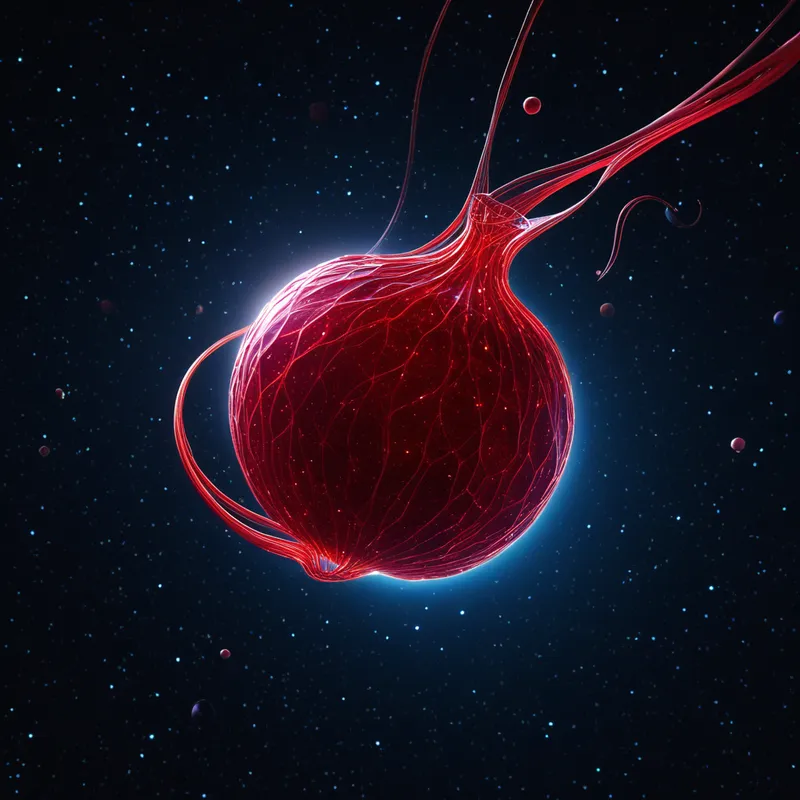
The pomegranate seed is the symbol of the irrevocable choice that transforms innocence into experience. Once eaten, it cannot be uneaten.
The six seeds represent a conscious, if ambivalent, [acceptance](/symbols/acceptance “Symbol: The experience of being welcomed, approved, or integrated into a group or situation, often involving validation of one’s identity or actions.”/) of this dark, fertile [realm](/symbols/realm “Symbol: The symbol of ‘Realm’ often signifies the boundaries of one’s consciousness, experiences, or emotional states, suggesting aspects of reality that are either explored or ignored.”/). She does not eat the whole [fruit](/symbols/fruit “Symbol: Fruit symbolizes abundance, nourishment, and the fruits of one’s labor in dreams.”/), preserving her [connection](/symbols/connection “Symbol: Connection symbolizes relationships, communication, and bonds among individuals.”/) to the upper world (the conscious mind), but she takes in enough of its essence to be forever changed. This is the [birth](/symbols/birth “Symbol: Birth symbolizes new beginnings, transformation, and the potential for growth and development.”/) of the conscious [persona](/symbols/persona “Symbol: The social mask or outward identity one presents to the world, often concealing the true self.”/)—Persephone, the [Queen](/symbols/queen “Symbol: A queen represents authority, power, nurturing, and femininity, often embodying leadership and responsibility.”/) who can navigate both realms. Demeter represents the powerful, [life](/symbols/life “Symbol: The symbol of ‘Life’ represents a journey of growth, interconnectedness, and existential meaning, encompassing both the joys and challenges that define human experience.”/)-giving, but ultimately possessive force of the [mother complex](/symbols/mother-complex “Symbol: A deep psychological pattern where unresolved maternal relationships influence identity, spirituality, and emotional life, often manifesting as dependency, idealization, or rebellion.”/), which must learn to let go for the [daughter](/symbols/daughter “Symbol: In dreams, a daughter symbolizes innocence, potential, and the nurturing aspects of oneself or one’s relationships.”/) to achieve her own sovereignty.
The resulting cycle is the myth’s greatest psychological [truth](/symbols/truth “Symbol: Truth represents authenticity, honesty, and the quest for knowledge beyond mere appearances.”/): wholeness is not a [static](/symbols/static “Symbol: Static represents interference, disruption, and the breakdown of clear communication or signal, often evoking feelings of frustration and disconnection.”/) state of perpetual light, but a rhythmic oscillation between different modes of being.
The Dreamer’s Resonance
When this myth stirs in the modern unconscious, it often manifests in dreams of sudden descents: falling elevators, being trapped in basements, or finding secret rooms in one’s own house. The dreamer may encounter a powerful, shadowy masculine figure (Hades) who feels both threatening and compelling, or they may be wandering in a bleak, autumnal landscape (Demeter’s grief).
To dream of eating something in such a place—especially a red, seeded fruit—signals a pivotal moment of psychic assimilation. The dream ego is consciously or unconsciously “eating the food of the underworld”: integrating a repressed memory, acknowledging a deep-seated fear, or accepting a painful truth about oneself or one’s history. This process is rarely pleasant; it carries the somatic weight of anxiety, the claustrophobia of the tomb, and the profound loneliness of the orphaned soul. Yet, it is the necessary precondition for emerging with a new title, a new authority over previously chaotic inner territories.

Alchemical Translation
The myth models the alchemical and Jungian process of individuation with stunning clarity. The initial state (Kore in the field) is the unconscious innocence of the personality, wholly identified with the mother world. The abduction is the [nigredo](/myths/nigredo “Myth from Alchemical culture.”/)—the blackening, the descent into [the shadow](/myths/the-shadow “Myth from Jungian culture.”/), the crushing of the old identity.
The time in the Underworld is the albedo and citrinitas—the whitening and yellowing. Here, in the reflective silence of the depths, the soul is purified by its confrontation with the opposite (death, darkness, the lord of the interior). The eating of the seeds is the critical moment of coniunctio oppositorum—[the conjunction](/myths/the-conjunction “Myth from Alchemical culture.”/) of opposites. Light and dark, maiden and queen, life and death are joined within a single being.
The triumph is not in the return to the old light, but in the hard-won authority to govern the cycles of one’s own nature.
The final resolution is the [rubedo](/myths/rubedo “Myth from Alchemical culture.”/)—the reddening, the creation of the philosopher’s stone. This is not Persephone as she was, but as she has become: the cyclical Queen. For the modern individual, this translates to the achievement of a self that does not fear its own depths or cling desperately to perpetual spring. It is the person who can be productive and social (the upper world) but also honor the need for withdrawal, introspection, and engagement with the inner shadow (the lower world). They have signed a treaty with their own darkness, and in doing so, they give coherent, creative form to the seasons of their soul. The myth teaches that we are not meant to choose between the meadow and the throne, but to learn the sacred law that binds them together.
Associated Symbols
Explore related symbols from the CaleaDream lexicon: