Poltergeist Myth Meaning & Symbolism
A tale of a disruptive, invisible spirit haunting a home, embodying the psyche's unacknowledged chaos demanding to be heard and integrated.
The Tale of Poltergeist
Listen, and let the firelight grow low. The story does not begin in a grand hall or upon a bloody field, but in the heart of the home—[the hearth](/myths/the-hearth “Myth from Norse culture.”/), [the threshold](/myths/the-threshold “Myth from Folklore culture.”/), the place of supposed safety. It is the deep of winter, when [the wind](/myths/the-wind “Myth from Various culture.”/) speaks in the eaves and the dark lasts longer than memory.
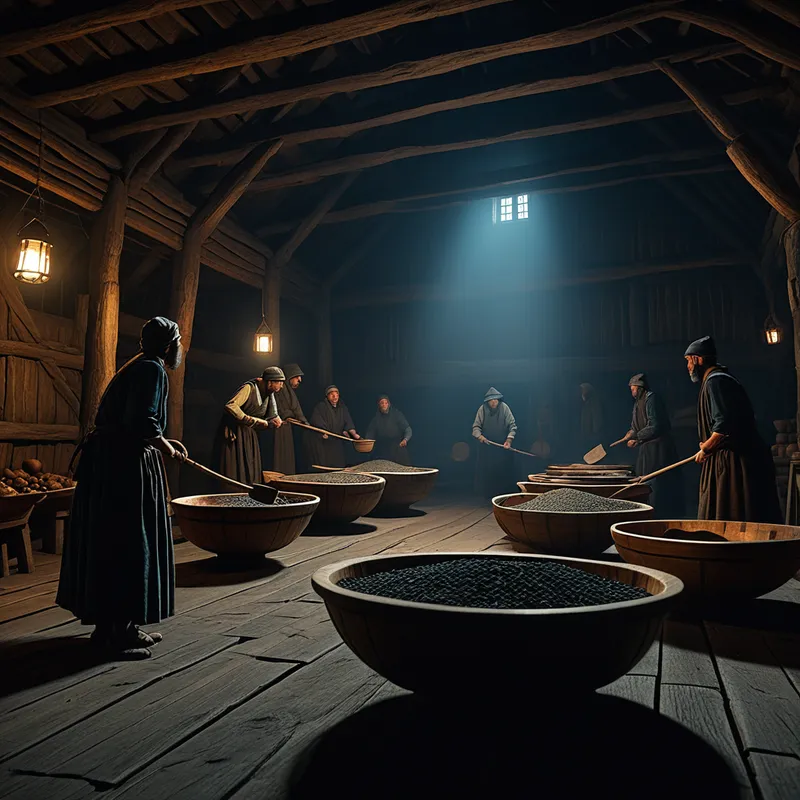
In a sturdy Fachwerkhaus at the forest’s edge, a family endures. The father is a stoic woodcutter, his hands mapped with calluses. The mother’s songs have grown thin and weary. The daughter, on the cusp of womanhood, moves through the rooms like a ghost herself, her thoughts a turbulent, unspoken sea.
It starts with a whisper. A spoon, left clean in the basin, is found in the ashes of the hearth. A chill descends that no fire can banish. Then, the noises begin—not the groans of old timber, but sharp, percussive knocks from within the walls, a rhythm that mocks the human heartbeat. Pots rattle on their hooks without a breeze. A loaf of bread, set to cool, is found crumbled to dust.
The family’s peace shatters. They search for rats, for drafts, for reason. They find only silence that watches them. The activity swells with the girl’s silent distress. One evening, as she sits trembling by the fire, a clay jug lifts from the table, hovers for a breathless moment, and dashes itself against the stones. Shards skitter toward her feet, a message written in pottery.
The father’s anger flares—a futile rage against the invisible. He shouts curses to the corners. In response, the very benches shake, and a rain of pebbles pelts the roof from inside the attic. The mother clutches her [Thor’s hammer](/myths/thors-hammer “Myth from Norse culture.”/), her prayers fragmented by fear. The house is no longer a shelter; it is a prison shared with a capricious, violent inmate.
The climax comes on a moonless night. The girl, pushed to the brink of her silent suffering, finally weeps aloud—great, heaving sobs of loneliness and confusion she has swallowed for seasons. As her tears fall, the chaotic symphony around her reaches a crescendo. Then, suddenly, it stops. A profound, aching silence fills [the void](/myths/the-void “Myth from Buddhist culture.”/). In that silence, by the guttering candlelight, they all feel it: not a departure, but a settling. A presence, once frenzied and external, now seems to seep into the walls, into the very family, becoming a quiet, acknowledged weight in the room. The haunting does not end; it changes. The poltergeist has made itself known, and in that knowing, its furious language is no longer needed.
Cultural Origins & Context
The Poltergeist is a persistent figure in the folklore of Germanic-speaking peoples, from the ancient tribes of the Hercynian Forest to the villagers of the Black Forest and beyond. Unlike the noble, tragic ghosts of saga or the defined land-spirits (landvættir), the poltergeist belonged to the domain of household tales and whispered warnings. These stories were not the purview of skalds but of grandmothers and farmers, passed down not to record history, but to explain the unnerving, inexplicable breaches in domestic order.
Its societal function was multifaceted. Primarily, it was a folk diagnosis for anomalous physical events—the unexplained noises, moving objects, and minor destruction that plagued pre-industrial homes. But more profoundly, it served as a narrative container for projected anxiety. In cultures with strong emphasis on familial harmony and stoic endurance, the poltergeist became the externalized embodiment of repressed household tensions—unspoken resentments, adolescent turmoil, or the stress of poverty. It was the “noise” the family could not afford to make, given form and agency. The phenomenon was almost always tied to a specific location, usually a home, and often to a specific person, typically a young person in emotional upheaval, making it a powerful tool for social scrutiny and a metaphor for the psychic energy of a place and its inhabitants.
Symbolic Architecture
At its core, the poltergeist is pure, undirected psychokinetic [energy](/symbols/energy “Symbol: Energy symbolizes vitality, motivation, and the drive that fuels actions and ambitions.”/)—the [shadow](/symbols/shadow “Symbol: The ‘shadow’ embodies the unconscious, repressed aspects of the self and often represents fears or hidden emotions.”/) of the hearth. It represents all that is repressed, agitated, and denied within the individual or collective [psyche](/myths/psyche “Myth from Greek culture.”/), forced to express itself through disruptive, indirect means because it is granted no conscious voice.
The spirit that rattles the dishes is the self that has been told to be silent.
It is not evil, but chaotic; its “anger” is the [frustration](/symbols/frustration “Symbol: A feeling of being blocked or hindered from achieving a goal, often accompanied by irritation and powerlessness.”/) of the ignored. The haunting is not an invasion from without, but a [eruption](/symbols/eruption “Symbol: A sudden, violent release of pent-up energy or emotion from beneath the surface, often representing transformation or crisis.”/) from within. The house in the tale symbolizes the structured psyche—[the ego](/myths/the-ego “Myth from Jungian culture.”/), the [persona](/symbols/persona “Symbol: The social mask or outward identity one presents to the world, often concealing the true self.”/), the conscious [life](/symbols/life “Symbol: The symbol of ‘Life’ represents a journey of growth, interconnectedness, and existential meaning, encompassing both the joys and challenges that define human experience.”/) we present to [the world](/myths/the-world “Myth from Tarot culture.”/). The poltergeist is the contents of the unconscious, particularly [the shadow](/myths/the-shadow “Myth from Jungian culture.”/) and the complex energies of the [anima](/symbols/anima “Symbol: The feminine archetype within the male unconscious, representing soul, creativity, and connection to the inner world.”/)/[animus](/symbols/animus “Symbol: In Jungian psychology, the masculine inner personality in a woman’s unconscious, representing logic, action, and spiritual guidance.”/), which, when denied, batter against the walls of [consciousness](/symbols/consciousness “Symbol: Consciousness represents the state of awareness and perception, encompassing thoughts, feelings, and experiences.”/). The objects it moves—domestic, everyday tools—symbolize the ordinary aspects of [life](/symbols/life “Symbol: The symbol of ‘Life’ represents a journey of growth, interconnectedness, and existential meaning, encompassing both the joys and challenges that define human experience.”/) that become charged with unconscious [emotion](/symbols/emotion “Symbol: Emotion symbolizes our inner feelings and responses to experiences, often guiding our actions and choices.”/). A flying pot is not just a pot; it is simmering [resentment](/symbols/resentment “Symbol: A deep-seated emotional bitterness from perceived unfairness or injury, often festering silently and poisoning relationships.”/) made manifest.
The myth’s [resolution](/symbols/resolution “Symbol: In arts and music, resolution refers to the movement from dissonance to consonance, creating a sense of completion, release, or finality in a composition.”/) is key: the [spirit](/symbols/spirit “Symbol: Spirit symbolizes the essence of life, vitality, and the spiritual journey of the individual.”/) does not vanish when confronted with brute force (the [father](/symbols/father “Symbol: The father figure in dreams often symbolizes authority, protection, guidance, and the quest for approval or validation.”/)’s anger) or blind [faith](/symbols/faith “Symbol: A profound trust or belief in something beyond empirical proof, often tied to spiritual conviction or deep-seated confidence in people, ideas, or outcomes.”/) (the [mother](/symbols/mother “Symbol: The symbol of ‘Mother’ represents nurturing, protection, and the foundational aspect of one’s emotional being, often associated with comfort and unconditional love.”/)’s prayers). It transforms only when the [source](/symbols/source “Symbol: The origin point of something, often representing beginnings, nourishment, or the fundamental cause behind phenomena.”/) of its energy—the girl’s repressed emotional state—is finally acknowledged and expressed. The [integration](/symbols/integration “Symbol: The process of unifying disparate parts of the self or experience into a cohesive whole, often representing psychological wholeness or resolution of internal conflict.”/) is not a victory, but a truce.

The Dreamer’s Resonance
To dream of a poltergeist—of objects moving on their own, of your home becoming alien and hostile—is to experience a direct somatic metaphor for a psyche in a state of disruptive integration. The dreamer is undergoing a process where long-contained psychological material is forcing its way into consciousness.
Somnially, this often manifests during life transitions (adolescence, midlife, career change) or periods of intense stress where one feels they must “keep it together.” The body in the dream often feels paralyzed or terrified, mirroring the ego’s feeling of helplessness against these upwellings. The specific objects that move are telling: chaotic books may point to a crisis of knowledge or belief; flying kitchenware may symbolize nourishing or digestive processes gone awry emotionally. The dream is the psyche’s attempt to show the dreamer the “noise” they are internally generating but externally ignoring. It is a call to stop searching the attic for rats and to instead attend to the unsettled spirit within one’s own emotional household.
Alchemical Translation
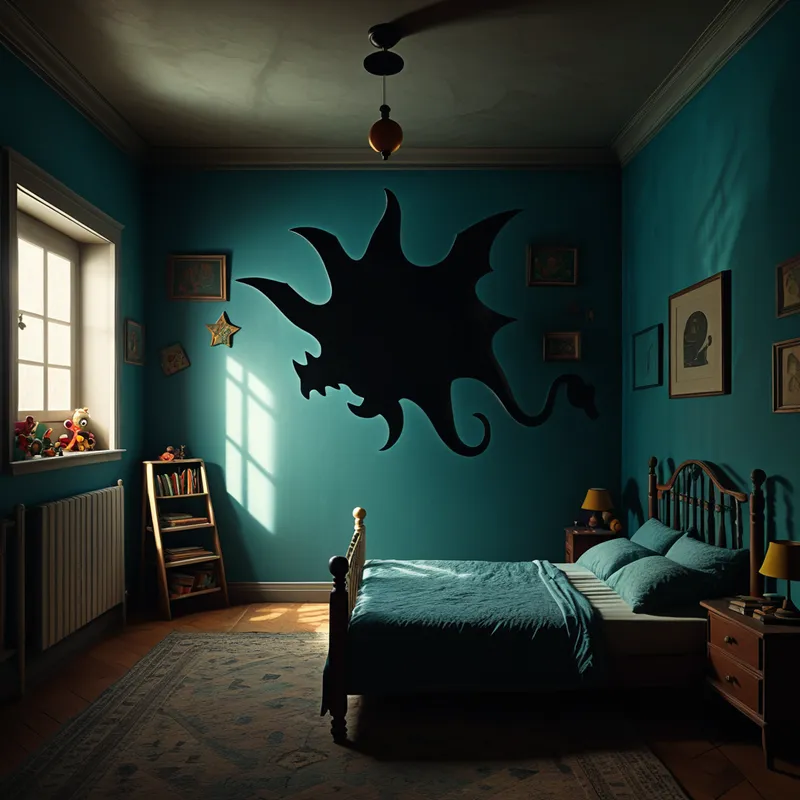
The alchemical journey modeled by the poltergeist myth is the [nigredo](/myths/nigredo “Myth from Alchemical culture.”/)—the blackening, the chaotic first matter, the necessary descent into confusion and dismemberment of the old, rigid personality. The individual’s task is not to exorcise this chaos, but to recognize it as a part of their own psychic substance, [the prima materia](/myths/the-prima-materia “Myth from Alchemical culture.”/) required for transformation.
The first step in turning lead to gold is to acknowledge the lead.
The modern individual engages in this alchemy by learning to “listen to the knocks.” This means turning toward, not away from, inner agitation. When anxiety feels like it will shatter our composure (the crockery of our [persona](/myths/persona “Myth from Greek culture.”/)), the myth instructs us to ask: What unspoken truth is trying to get my attention? What emotion have I banished to the attic of my awareness? The process involves moving from the father’s stance of forceful repression and the mother’s stance of fearful petition to the daughter’s eventual, tearful acknowledgment. This is the beginning of albedo, where the chaotic spirit is seen not as a demon to be cast out, but as a disowned part of [the self](/myths/the-self “Myth from Jungian culture.”/) to be integrated.
The ultimate transmutation is the conversion of disruptive, noisy energy into a conscious, creative force. The poltergeist that threw pots becomes the focused will that shapes clay. The spirit that rapped on walls becomes the intuition that listens for deeper rhythms. By hosting the chaos, we do not become chaotic; we become whole. The house of the self, once haunted, becomes a vessel capable of holding both silence and song, order and the vital, unruly spirit that gives it life.
Associated Symbols
Explore related symbols from the CaleaDream lexicon: