Plato's Theory of Forms Myth Meaning & Symbolism
A philosopher's tale of escaping a cave of shadows to behold the eternal, perfect Forms, the divine blueprints from which all earthly things are cast.
The Tale of Plato's Theory of Forms
Listen, and I will tell you of the great prison and the greater liberation.
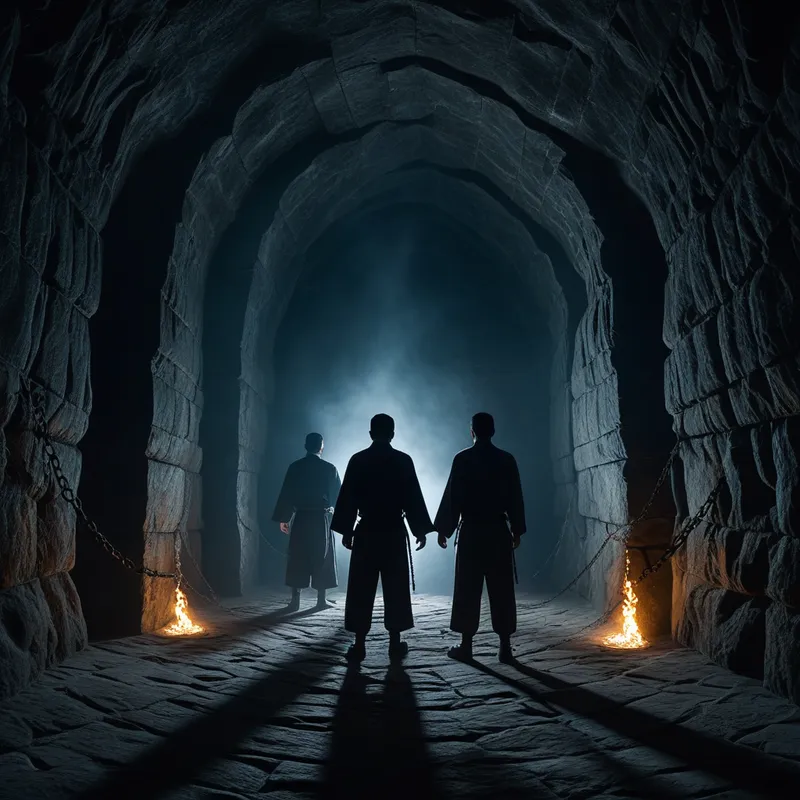
Deep beneath the sun’s gaze, in the bowels of the earth, lies a long cavern. Its mouth opens to a dim world, but within, it stretches into profound and unbroken night. Here, from childhood, dwell a people in bonds. Their legs and necks are fettered so they can only look forward, never turning their heads. Behind them, a fire burns on a high ledge, and between the fire and the prisoners runs a low wall, like the screen at a puppet show.
Along this wall, other people walk, carrying all manner of artifacts—statues of men and animals, vessels of wood and stone. The fire casts the shadows of these objects onto the cavern wall before the prisoners. The voices of the carriers echo strangely off the stone, seeming to come from the shadows themselves. For the prisoners, this is the whole of reality: the dance of shadows, the echo of voices. They name the shadows as they pass, believing they speak of true things.
Now, imagine one is freed.
The chains are struck away. He is forced to stand, to turn his neck, to walk. The fire’s light assaults his eyes; the shapes of the artifacts seem confused and painful. He longs for the familiar, comforting shadows. He is dragged, struggling, up the rough and steep ascent, out of the cavern’s mouth, into the world above.
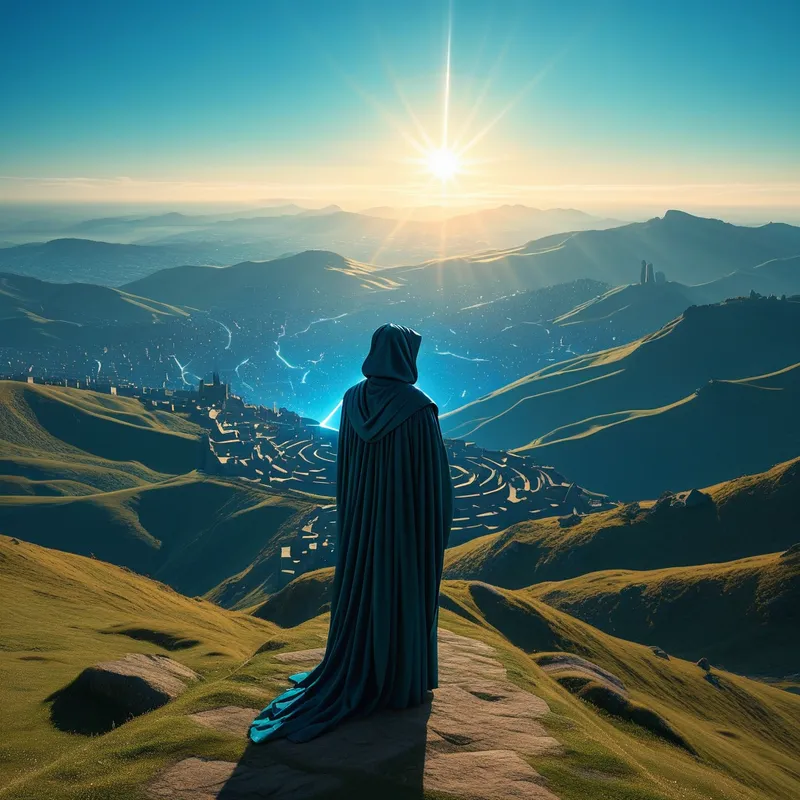
At first, he is blinded. The light of the sun is an agony. He can see nothing. Slowly, his eyes adjust. He sees reflections in water. Then, the things themselves—the trees, the flowers, the animals. He learns that these are more real than the shadows. He sees the moon and stars by night. Finally, at the peak of his understanding, he beholds the sun itself, not as an image in water, but in its own place, and he comes to understand it as the source of all life and visibility, the guardian of all things in the visible world.
His heart fills with pity for those still below. He descends back into the darkness, his eyes now unaccustomed to the gloom. He stumbles. He tries to tell his former companions of the wondrous world above, of the sun that is the true cause of all they dimly perceive. They laugh at him. They think his journey has ruined his sight. They resolve to kill anyone who would attempt to free them and lead them up.
And so, the one who has seen the truth must walk carefully in the land of shadows, knowing what is, while surrounded by those who only know what seems to be.
Cultural Origins & Context
This is not a myth of a forgotten pantheon, but a philosophical allegory crafted in the heart of Classical Athens. It is the central story of Book VII of The Republic, a dialogue penned by the philosopher Plato, around 375 BCE. It was passed down not by bards around a fire, but by students in the groves of the Academy, through meticulous copying of scrolls and rigorous dialectical conversation.
Its societal function was profound: to establish a radical hierarchy of reality and knowledge. In an age of sophists who argued that truth was relative and perception was king, Plato’s myth served as a foundational narrative for his entire philosophy. It was a tool for education, meant to shock the student out of complacency and illustrate the philosopher’s duty—to seek the highest truth (the Good, symbolized by the Sun) and then, crucially, to return to the civic cave to govern, however ungrateful the prisoners may be. It framed the philosopher not as a detached sage, but as a reluctant hero with a burdensome enlightenment.
Symbolic Architecture
The Cave is the world of sensory experience, the realm of doxa (opinion or belief). The Shadows are the perceptions and cultural constructs we mistake for reality—the fleeting images on the wall of our own minds. The Fire is the dim, imitative light of human intellect and culture, which can only cast copies, never reveal originals.
The journey upward is the soul’s painful ascent from the world of becoming to the world of being.
The World Above is the intelligible realm, the domain of the Forms. The Sun is the Form of the Good, the ultimate principle that illuminates all other Forms and makes them intelligible, just as the sun illuminates and gives life to the visible world. The freed prisoner is the philosopher, whose soul recollects its innate knowledge of these eternal patterns. The painful adjustment of the eyes symbolizes the rigorous, often disorienting, training in dialectic and mathematics required for true understanding.
The return to the Cave represents the philosopher’s moral obligation. Enlightenment is not for private bliss but for public service, even at the risk of ridicule or death—a fate Plato’s own teacher, Socrates, suffered.

The Dreamer's Resonance
When this myth stirs in the modern unconscious, it often manifests in dreams of profound disorientation and revelation. One might dream of living in a house where all the furniture is covered in sheets, or working in an office where everyone wears identical, featureless masks. The somatic feeling is one of deep unease, a nagging sense that the world is a facade.
The pivotal dream is the moment of turning around. The dreamer, in their cave, manages to look away from the screen, the social media feed, the career ladder—the projected shadows. They see the machinery behind it: the fire of others’ expectations, the puppeteers of cultural conditioning. This dream moment is often accompanied by anxiety or vertigo, the psychological process of deconstruction. The subsequent dream of emerging into blinding light can feel like an awakening to a terrifying but exhilarating responsibility: to see things as they truly are, beyond their utilitarian or social value.

Alchemical Translation
The alchemy here is the transmutation of leaden opinion into golden wisdom, of psychic identification with the shadow-play into a conscious relationship with the source.
The first stage, calcinatio, is the burning away of illusion—the painful liberation from the chains of consensus reality. The ascent represents sublimatio, the spirit rising above the literal and the personal to perceive abstract, universal patterns. To behold the Form of Justice, for instance, is to move beyond personal grievances to understand harmony itself.
The core struggle is not to escape the cave, but to integrate the vision of the sun with the reality of the shadows.
The true alchemical gold is forged in the return. This is the coniunctio, the sacred marriage of the transcendent vision with immanent life. The enlightened one does not despise the shadows but understands their origin and their necessary, if imperfect, role. The modern individual’s individuation process follows this arc: first, the painful realization that one’s life has been lived according to borrowed scripts (the cave). Then, the quest for one’s own essential nature, the personal “Form” of the Self (the ascent). Finally, the difficult work of bringing that discovered self back into relationship, work, and community (the return), now acting from an inner blueprint rather than reacting to external projections. The goal is not to live in the sun, but to let its light guide one’s steps in the world.
Associated Symbols
Explore related symbols from the CaleaDream lexicon: