Plato's Allegory of the Cave Myth Meaning & Symbolism
Prisoners chained in a cave mistake shadows for reality until one escapes, beholds the sun, and returns with a truth they cannot share.
The Tale of Plato’s Allegory of the Cave
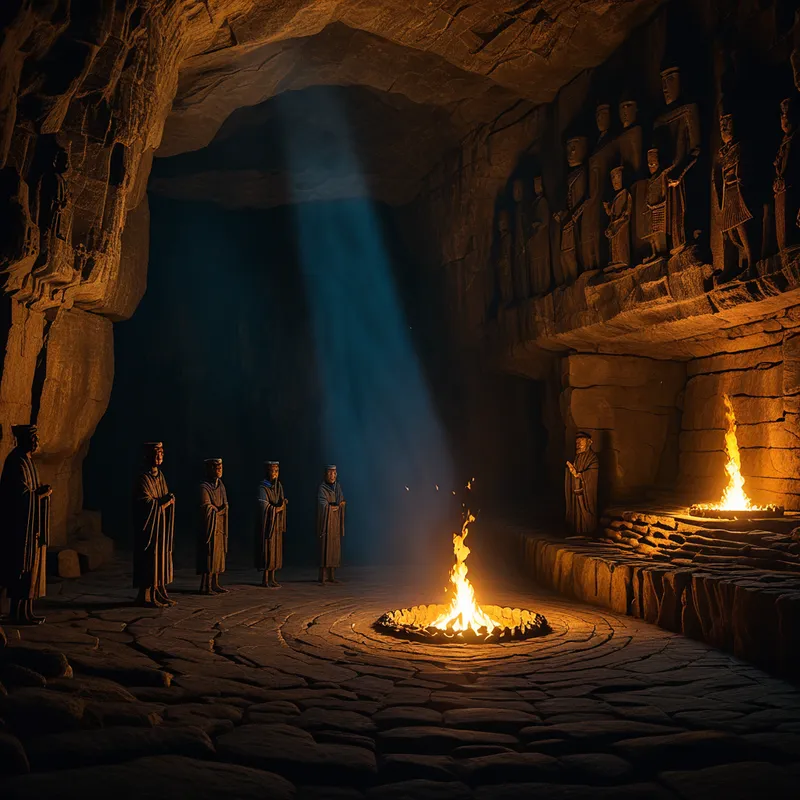
Imagine a deep, subterranean den. Its mouth opens upwards, towards a distant light, but within, all is damp stone and the smell of smoke. Here, from childhood, men and women are bound. Not with cruel shackles of iron, but with a more perfect captivity: chains that hold their necks and legs fast, forcing them to gaze only at the wall before them. Behind and above them burns a fire, a great blaze on a raised walkway. Between this fire and the prisoners runs a low wall, like the screen at a puppet show.
And along this wall walk other people, carrying all manner of artifacts—statues of men and animals, vessels of wood and stone, shapes of every kind. The fire casts the shadows of these objects onto the cavern wall that is the prisoners’ entire world. The voices of the carriers echo off the stone, seeming to come from the shadows themselves.
For these captives, reality is this dance of flickering forms. They name the shadows as they pass: “a tree,” “a dog,” “a god.” They honor the one who is quickest to remember the sequence of shadows, who can best predict what will come next. Their world is one of sound and silhouette, a consensus of [the cave](/myths/the-cave “Myth from Platonic culture.”/).
But now, picture one prisoner. His chains are loosened, or perhaps they break. He is compelled to stand, to turn his neck, to walk towards the fire. The movement is agony. The light of the flames assaults his eyes, which have known only dim reflection. The figures carrying the objects seem blurred, confusing, less real than their clean shadows. He is dragged further, up the rough and steep ascent, towards the mouth of the cave itself.
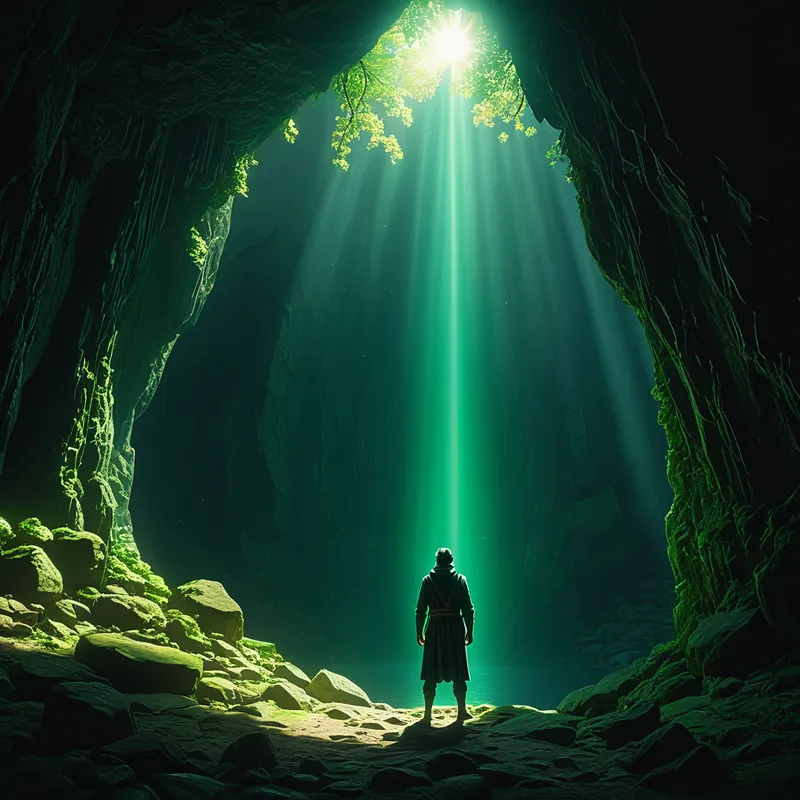
He stumbles into the open air. The light of [the world](/myths/the-world “Myth from Tarot culture.”/) overwhelms him. At first, he can see only the shadows of things cast by the sun, then reflections in [water](/myths/water “Myth from Chinese culture.”/), then the things themselves. He beholds the green of leaves, the true form of animals, the vastness of [the sky](/myths/the-sky “Myth from Persian culture.”/). His eyes adjust, painfully, slowly. He looks finally upon the sun itself, not as a image in [water](/myths/water “Myth from Chinese culture.”/) or a shape on stone, but as the source of all life and visibility, the cause of the seasons and the guardian of all in the visible world.
His heart fills with pity for his former companions. He remembers their wisdom, their prizes for discerning the shadows. He descends back into the darkness of the den. His eyes, now accustomed to the sun, are blind in the gloom. He stumbles before the seated assembly. He tries to tell them of the world above, of the sun, of true form. They hear only the babbling of a man who has ruined his eyes. They conclude the journey upward has destroyed him. If they could lay hands on the one who tried to free them, they would kill him.
Cultural Origins & Context
This is not a myth passed down by bards at a feast, but a philosophical parable crafted by the mind of Plato, recounted by his teacher [Socrates](/myths/socrates “Myth from Greek culture.”/) in the seventh book of [The Republic](/myths/the-republic “Myth from Platonic culture.”/) (c. 375 BCE). Its context is a dialogue concerning the nature of [justice](/myths/justice “Myth from Tarot culture.”/), the ideal state, and, most fundamentally, the nature of reality and knowledge. In the Athens of Plato’s time, where sophists taught persuasive rhetoric for profit and traditional myths were subject to philosophical scrutiny, the Allegory served as a powerful rhetorical and pedagogical tool. It was a story for the nascent academy, a thought-experiment meant to illustrate the core tenets of Platonic theory: the existence of a transcendent realm of perfect, unchanging Forms, and the arduous, often unwelcome, journey of the soul towards apprehending them. Its societal function was to justify the rule of the philosopher-king—the one who has seen the sun and must return to govern, however reluctantly, those still in shadow.
Symbolic Architecture
The Cave is the world of appearances, the psychological [condition](/symbols/condition “Symbol: Condition reflects the state of being, often focusing on physical, emotional, or situational aspects of life.”/) of unexamined [life](/symbols/life “Symbol: The symbol of ‘Life’ represents a journey of growth, interconnectedness, and existential meaning, encompassing both the joys and challenges that define human experience.”/). We are all born chained, mistaking the sensory data of our culture, our upbringing, and our assumptions for ultimate [reality](/symbols/reality “Symbol: Reality signifies the state of existence and perception, often reflecting one’s understanding of truth and life experiences.”/).
The shadow on the wall is not the object, and the object is not the Form. We live in a world of copies of copies, and call it truth.
The Fire represents the artificial light of conventional wisdom, the cultural narrative, the “doxa” or common [opinion](/symbols/opinion “Symbol: An opinion in a dream symbolizes personal beliefs and thoughts about oneself and the world, often reflecting inner conflicts or uncertainties.”/) that casts the shadows we mistake for reality. The [journey](/symbols/journey “Symbol: A journey in dreams typically signifies adventure, growth, or a significant life transition.”/) upward is the painful process of education (paideia), of philosophy—literally, the love of wisdom. It is a violent turning (periagoge) of the [soul](/symbols/soul “Symbol: The soul represents the essence of a person, encompassing their spirit, identity, and connection to the universe.”/) away from familiar darkness.
The Sun is the Form of the Good, the first principle that makes all [knowledge](/symbols/knowledge “Symbol: Knowledge symbolizes learning, understanding, and wisdom, embodying the acquisition of information and enlightenment.”/) and existence possible. It is not merely an object to be known, but the very condition for knowing. Psychologically, it represents the integrating, illuminating principle of [the Self](/myths/the-self “Myth from Jungian culture.”/) in Jungian terms, the [source](/symbols/source “Symbol: The origin point of something, often representing beginnings, nourishment, or the fundamental cause behind phenomena.”/) of meaning that orders the [psyche](/myths/psyche “Myth from Greek culture.”/).
The Return is the crux of the moral imperative. Enlightenment is not for private [bliss](/symbols/bliss “Symbol: A state of profound happiness and spiritual contentment, often representing fulfillment of desires or alignment with one’s true self.”/) but entails a [responsibility](/symbols/responsibility “Symbol: Responsibility in dreams often signifies the weight of duties and the expectations placed upon the dreamer.”/) to the [community](/symbols/community “Symbol: Community in dreams symbolizes connection, support, and the need for belonging.”/), even at the cost of being misunderstood, ridiculed, or destroyed. The enlightened one becomes a tragic figure, a [scapegoat](/myths/scapegoat “Myth from Biblical culture.”/) for the collective’s fear of [truth](/symbols/truth “Symbol: Truth represents authenticity, honesty, and the quest for knowledge beyond mere appearances.”/).
The Dreamer’s Resonance
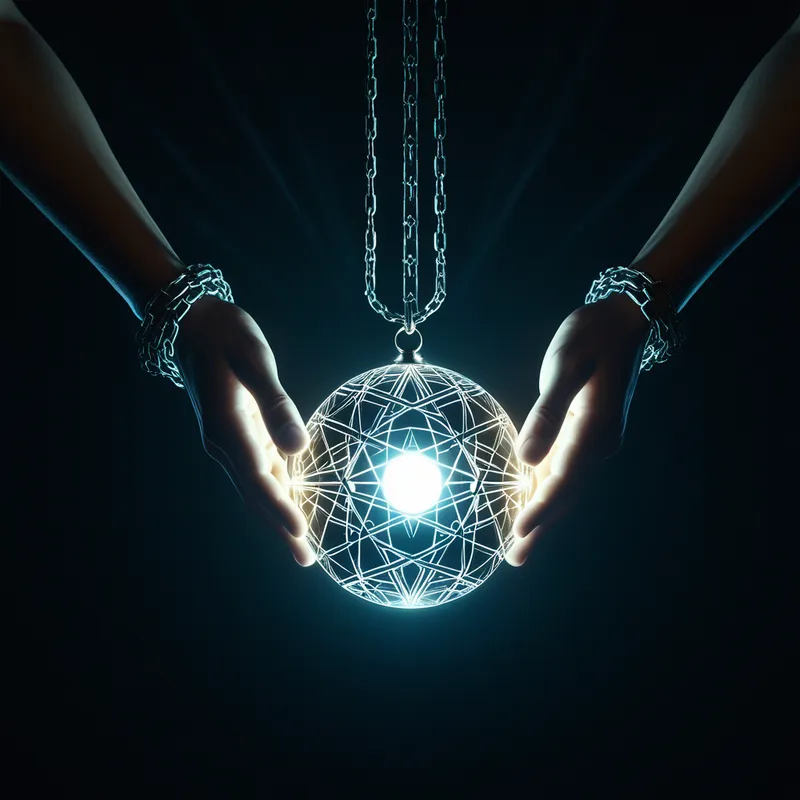
When this myth stirs in the modern unconscious, it often manifests not as a literal cave, but as dreams of being trapped in a familiar yet false environment. One might dream of living in a house where the windows are painted shut, showing a false sky. Or of working in an office where all the documents are facsimiles, and no one questions the originals. The somatic feeling is one of constriction in the neck and chest—the literal feeling of being chained.
To dream of the fire is to encounter the source of one’s illusions. It may appear as a mesmerizing but controlled blaze in a hearth, or a television screen that everyone stares at. The critical moment—the turning of the head—is often dreamed as a sudden, involuntary jerk, a cracking sound in the neck, or the shocking realization that one can look away from the screen.
Dreams of emerging into blinding light speak to a nascent psychological awakening that is still overwhelming. The dream-ego may be physically pained, covering its eyes. This is the psyche’s representation of [the ego](/myths/the-ego “Myth from Jungian culture.”/)’s resistance to a larger, more complex truth that dismantles its old, simpler reality. The subsequent blindness upon return to the “cave” (e.g., a dream of being unable to function at one’s old job or in a family dynamic) symbolizes the painful irreversibility of insight. Once seen, [the shadow](/myths/the-shadow “Myth from Jungian culture.”/)-play can never again be taken for reality.
Alchemical Translation
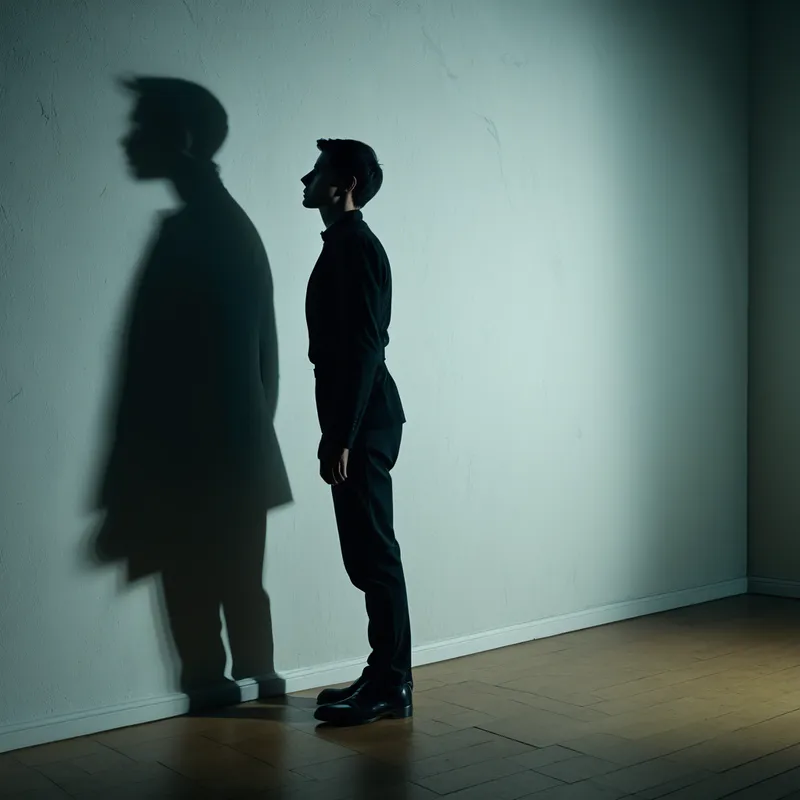
The Allegory is a precise map of the individuation process. The initial state ([nigredo](/myths/nigredo “Myth from Alchemical culture.”/), the blackening) is the chained existence in the cave—a state of identification with the [persona](/myths/persona “Myth from Greek culture.”/) and [the collective unconscious](/myths/the-collective-unconscious “Myth from Jungian culture.”/), where one’s identity is a shadow cast by others.
The breaking of chains and turning toward the fire is the first confrontation with the shadow. The fire-light reveals the mechanisms of illusion (the puppet-masters), which are often our own internalized complexes and cultural conditioning. This is a painful [separatio](/myths/separatio “Myth from Alchemical culture.”/), a dividing of oneself from the consensus trance.
The ascent is the alchemical albedo, the whitening. It is a purification through suffering, a washing in the waters of genuine experience. The prisoner must pass through the reflection (in water) before seeing the thing itself.
Seeing the things of the world in the sun’s light is the integration of the anima/animus and other archetypal images, seeing them as they are, not as projections. The vision of the Sun itself is the [rubedo](/myths/rubedo “Myth from Alchemical culture.”/), the reddening—the attainment of the [Lapis Philosophorum](/myths/lapis-philosophorum “Myth from Alchemical culture.”/) or Philosopher’s Stone. It is the direct experience of the Self, the central archetype of order and totality, which emits a light that makes all other knowledge coherent.
The return is the final, often neglected stage: the citrinitas, or yellowing, where the gold of insight must be brought back and applied to the leaden world of ordinary life. This is the ultimate alchemical transmutation: not to escape the world, but to transform one’s mode of being within it. The enlightened one becomes the catalyst for change, even if the material (the other prisoners) is not yet ready to react. The myth thus models a complete psychic cycle: from unconscious participation, through painful differentiation and enlightenment, to a return charged with the transformative duty of embodied wisdom.
Associated Symbols
Explore related symbols from the CaleaDream lexicon: