Plague of Lice Myth Meaning & Symbolism
The third plague, where the dust of Egypt becomes a crawling infestation, marking a boundary between the sacred and the profane.
The Tale of the Plague of Lice
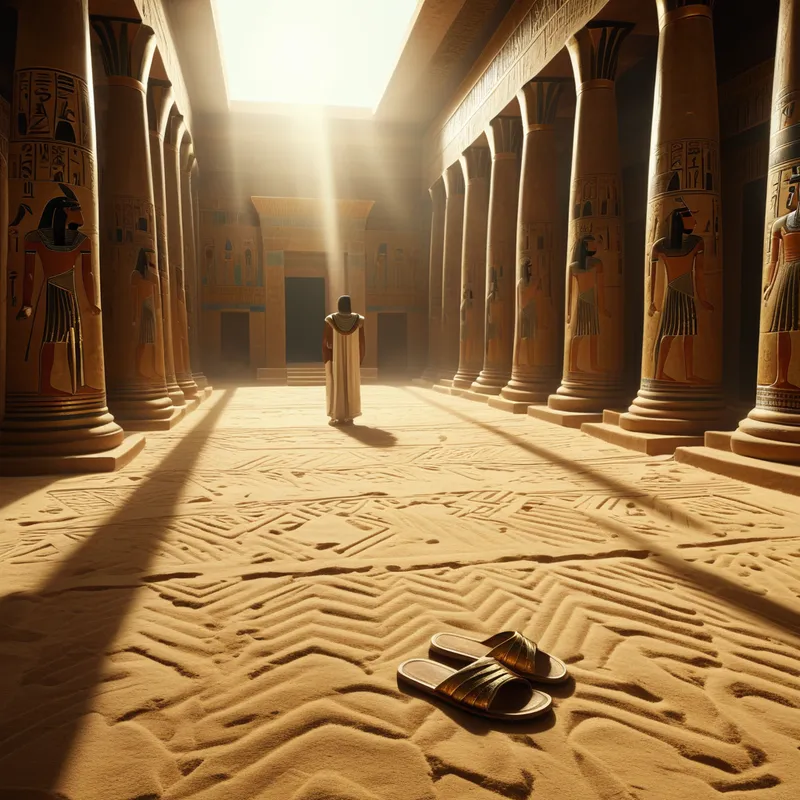
The air in Mitzrayim was thick, not just with heat, but with a tension that crackled like dry [papyrus](/myths/papyrus “Myth from Egyptian culture.”/). It was the silence before [the word](/myths/the-word “Myth from Biblical culture.”/). Moshe stood once more in [the shadow](/myths/the-shadow “Myth from Jungian culture.”/) of the throne, a man of [the desert](/myths/the-desert “Myth from Biblical culture.”/) dust facing the polished god-king, [Pharaoh](/myths/pharaoh “Myth from Egyptian culture.”/). The demand was simple, ancient, and impossible: “Let my people go.” The refusal was a granite wall. No more frogs, said the king. No more concessions.
Then, YHWH spoke to Moshe, not with thunder, but with a whisper to [the earth](/myths/the-earth “Myth from Hindu culture.”/) itself. “Say to Aaron: ‘Stretch out your staff and strike the dust of the land, so that it may become lice throughout all the land of Egypt.’”
And Aaron obeyed. He raised the staff, not toward [the sky](/myths/the-sky “Myth from Persian culture.”/) or [the river](/myths/the-river “Myth from Buddhist culture.”/), but downward, toward the very ground they stood upon. He struck the dust.
It began not with a roar, but with a shudder. The dust on the courtyard tiles ceased to be inert. It quivered. It seethed. From every crack between stones, from every footprint, from the piles swept into corners—the dust itself came alive. It coalesced into tiny, crawling bodies, a shimmering, clicking tide of infestation. They were kinnim, lice, rising from the soil in uncountable billions.
They did not fall from the sky; they ascended from the earth. They swarmed over the marble floors, up the legs of thrones, into the woven linens of nobles. They infiltrated the wigs and fine headdresses, becoming a living, moving part of the wearer. They crawled into the beds, the bread, the sacred oils. In the temples, the priests recoiled in ultimate horror. Their purity rituals, their meticulous cleansings, were rendered meaningless. The very dust from which they ritually cleansed themselves was now the source of defilement. The boundary between the clean and the unclean, the sacred and the profane, dissolved into a crawling, itching nightmare. The land itself, the foundation of Egypt’s might, had turned against its people.
Pharaoh summoned his chartumim. With their secret arts and incantations, they tried to replicate this sign, to prove their power equal to this desert god. They strained, they chanted, they gestured. But the dust remained dust. For the first time, their magic failed. They turned to Pharaoh, their faces pale with a new understanding, and uttered the words that shattered the kingdom’s spiritual certainty: “This is the finger of Elohim.”
Yet, Pharaoh’s heart remained hardened. He would not listen. The itching, the humiliation, the theological ruin—it all settled into the fabric of Egypt, a constant, maddening testimony to a power that arose not from the heavens or the river, but from the ground beneath their feet.
Cultural Origins & Context
This narrative is embedded in the Book of Exodus, a foundational text of the Israelite nation formed in [the crucible](/myths/the-crucible “Myth from Alchemical culture.”/) of liberation. It was not a standalone folktale but a critical movement in the symphonic drama of [the Ten Plagues](/myths/the-ten-plagues “Myth from Biblical culture.”/). Its primary function was theological and identity-forming: to demonstrate the absolute sovereignty of YHWH over the Egyptian [pantheon](/myths/pantheon “Myth from Roman culture.”/) and the natural order they governed.
Egypt deified its environment—the Nile (Hapi), the sun (Ra), the earth (Geb). The plagues systematically targeted these divine domains. The Plague of Lice is a direct assault on the earth itself and the concept of ritual purity central to Egyptian (and later, Israelite) priestly practice. By having the dust—the raw material of creation and a symbol of death and decay—become a source of pervasive impurity, the story asserts that YHWH controls the very essence of matter. The failure of the chartumim is pivotal. It marks the moment their borrowed or demonic power (as later tradition might interpret it) meets its limit, publicly breaking Pharaoh’s primary source of spiritual validation and shifting the conflict from a political stalemate to a divine showdown.
Symbolic Architecture
The [Plague](/symbols/plague “Symbol: A symbol of widespread affliction, collective suffering, and uncontrollable forces that threaten social order and personal survival.”/) of [Lice](/symbols/lice “Symbol: Lice symbolize infestation and invasion, representing feelings of discomfort, anxiety, and social anxiety regarding boundaries.”/) operates on multiple symbolic levels. Primarily, it represents an invasion of boundaries. Lice are parasites that live on [the threshold](/myths/the-threshold “Myth from Folklore culture.”/) of the [body](/symbols/body “Symbol: The body in dreams often symbolizes the dreamer’s self-identity, personal health, and the relationship they have with their physical existence.”/), violating the integrity of [the self](/myths/the-self “Myth from Jungian culture.”/). Psychologically, this mirrors an invasive thought, a nagging [guilt](/symbols/guilt “Symbol: A painful emotional state arising from a perceived violation of moral or social standards, often tied to actions or inactions.”/), a compulsive [idea](/symbols/idea “Symbol: An ‘Idea’ represents a spark of creativity, innovation, or realization, often emerging as a solution to a problem or a new outlook on life.”/) that one cannot shake—a “psychic [infestation](/symbols/infestation “Symbol: A dream of infestation symbolizes overwhelming anxiety, loss of control, and feelings of being invaded or corrupted by external forces or internal thoughts.”/)” that disturbs [peace](/symbols/peace “Symbol: Peace represents a state of tranquility and harmony, both internally and externally, often reflecting a desire for resolution and serenity in one’s life.”/) and [identity](/symbols/identity “Symbol: Identity represents the sense of self, encompassing personal beliefs, cultural background, and social roles.”/).
The sacred is defined by its boundaries; the profane is that which crosses them. The plague makes the boundary itself the transgressor.
The [source](/symbols/source “Symbol: The origin point of something, often representing beginnings, nourishment, or the fundamental cause behind phenomena.”/)—[dust](/symbols/dust “Symbol: Dust often symbolizes neglect, forgotten memories, or the passage of time and life’s impermanence.”/)—is profoundly symbolic. It is the materia prima, the primal stuff of Adam (from adamah, [earth](/symbols/earth “Symbol: The symbol of Earth often represents grounding, stability, and the physical realm, embodying a connection to nature and the innate support it provides.”/)). It is also a [symbol](/symbols/symbol “Symbol: A symbol can represent an idea, concept, or belief, serving as a powerful tool for communication and understanding.”/) of [mortality](/symbols/mortality “Symbol: The awareness of life’s finitude, often representing transitions, impermanence, or existential reflection in dreams.”/) (“[dust](/symbols/dust “Symbol: Dust often symbolizes neglect, forgotten memories, or the passage of time and life’s impermanence.”/) to dust”). The transformation of dust into lice signifies a perversion of creation, [life](/symbols/life “Symbol: The symbol of ‘Life’ represents a journey of growth, interconnectedness, and existential meaning, encompassing both the joys and challenges that define human experience.”/) emerging from the ground not as nourishment but as [torment](/symbols/torment “Symbol: A state of intense physical or mental suffering, often representing unresolved inner conflict, guilt, or psychological distress.”/). It is creativity turned against itself, the foundational [material](/symbols/material “Symbol: Material signifies the tangible aspects of life, often representing physical resources, desires, and the physical world’s influence on our existence.”/) of the [psyche](/myths/psyche “Myth from Greek culture.”/) (instincts, base drives) rising up in an unrecognizable and hostile form.
Finally, the plague targets priestly purity. It renders external rituals useless. The message is that a hardened [heart](/symbols/heart “Symbol: The heart symbolizes love, emotion, and the core of one’s existence, representing deep connections with others and self.”/) (kaved lev) cannot be cleansed by [ceremony](/symbols/ceremony “Symbol: Ceremonies in dreams often symbolize transitions, rituals of passage, or significant life events.”/). The impurity is now systemic, environmental, coming from within the very [structure](/symbols/structure “Symbol: Structure in dreams often symbolizes stability, organization, and the framework of one’s life, reflecting how one perceives their environment and personal life.”/) of the society that denies liberation.
The Dreamer’s Resonance
When this mythic pattern stirs in the modern unconscious, it rarely manifests as a literal dream of lice. More likely, it is the dream of creeping contamination. The dreamer may find their home filling with dust that moves, or discover their body covered in tiny, crawling symbols they cannot decipher. The somatic sensation is one of unbearable itch, a restless agitation that has no clear source.
Psychologically, this signals that something foundational in the dreamer’s psyche—their “ground of being,” their basic assumptions or repressed material—is activating in a disturbing way. An ignored truth, a denied dependency, a humiliating memory is rising to the surface. It feels petty, annoying, yet inescapable. It “gets under the skin.” The dream is an announcement that a purely intellectual or ceremonial approach (the “magic of the chartumim”) to a life problem has failed. The issue is more fundamental; it is in the dust of daily life, in the very fabric of one’s environment and self-concept, demanding a deeper, more humbling engagement.
Alchemical Translation
In the alchemy of individuation, the Plague of Lice represents the [nigredo](/myths/nigredo “Myth from Alchemical culture.”/) stage—the blackening, the putrefaction. It is the necessary, uncomfortable phase where [the prima materia](/myths/the-prima-materia “Myth from Alchemical culture.”/) of the psyche is agitated and broken down. [The ego](/myths/the-ego “Myth from Jungian culture.”/) (Pharaoh) in its hardened state seeks to maintain order through willpower and old magic (rationalization, distraction, old coping mechanisms). But the Self (YHWH) initiates a process from a deeper level.
The transformative instruction is to “strike the dust.” One must engage directly with the lowly, ignored, and “dirty” aspects of oneself—the resentments, the pettiness, the ingrained habits that feel beneath us. This engagement causes an eruption. What was inert becomes alive and troublesome.
The path to gold leads through the blackening of the base material. The itch is the signal of the soul’s awakening to its own imprisoned state.
The failure of the magicians’ replication is crucial. It signifies that this process cannot be faked, shortcut, or intellectually mimicked. It is a genuine, humbling confrontation with one’s limits. The recognition that “this is the finger of God” is the beginning of wisdom—the understanding that a power greater than the conscious ego is at work. The psychic “Egypt”—the house of bondage built on old identities and complexes—must be subjected to this infestation. The itching pressure of this inner conflict is what eventually makes the hardened heart untenable, forcing the capitulation that precedes true exodus and the journey toward a more integrated self. The lice are not the enemy; they are the unbearable, transformative messengers of a truth that can no longer be buried.
Associated Symbols
Explore related symbols from the CaleaDream lexicon: