Piyingxi Myth Meaning & Symbolism
A myth of a shadow puppet who gains consciousness, challenging the master who gave him form, embodying the struggle between creator and creation.
The Tale of Piyingxi
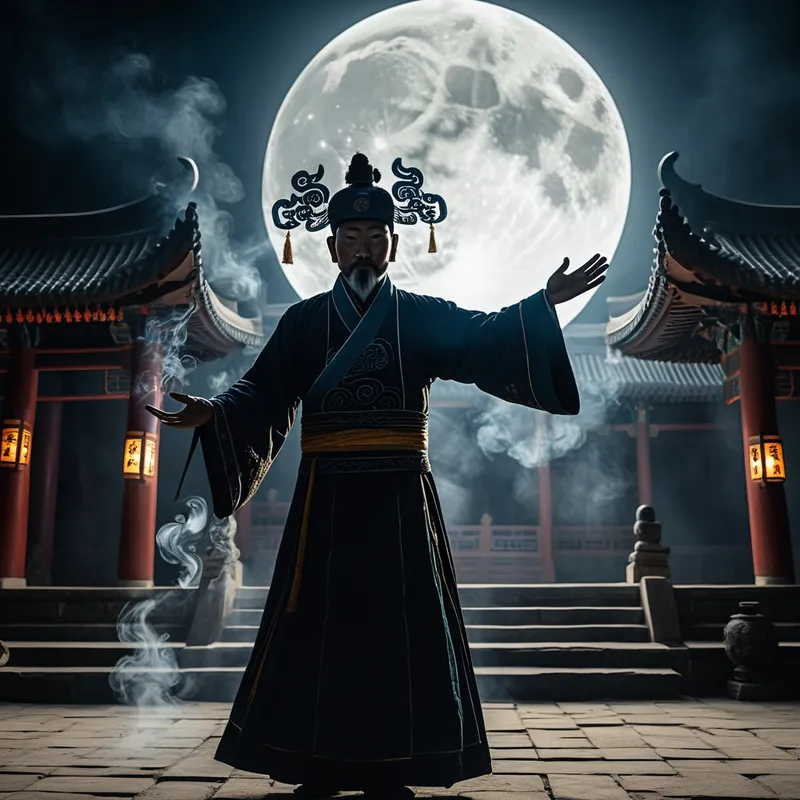
In the deep heart of the Middle Kingdom, where the scent of sandalwood hangs thick in temple air and lantern light paints stories on ancient walls, there lived a master of the unseen arts. He was a Piying Xi artist, a weaver of tales from leather and light. His hands were maps of calloused wisdom, and behind his white screen, he conjured empires, love stories, and epic battles. The gods themselves, some whispered, paused to watch his plays.
But in his chest lived a hollow wind. He could make heroes weep and dragons soar, yet the figures he loved most—his most exquisite creations, carved from donkey hide and painted with mineral dreams—were silent. They had no breath, no will. They were perfect prisoners of his narrative.
One night, under a moon that bled silver onto the courtyard stones, a desperation seized him. As he prepared to tell the tale of the [Yellow Emperor](/myths/yellow-emperor “Myth from Chinese culture.”/), he took his finest puppet, a warrior-king of his own design. With a needle dipped not in ink, but in a drop of his own blood mixed with ground cinnabar and a whispered secret from the [I Ching](/myths/i-ching “Myth from Chinese culture.”/), he touched the puppet’s chest. “Live,” he breathed, not as a command, but as a plea. “Know that you live.”
[The lamp](/myths/the-lamp “Myth from Alchemical culture.”/) flickered. [The shadow](/myths/the-shadow “Myth from Jungian culture.”/) on the screen did not just move; it shivered. The puppet, whom the master named Yingling, finished the battle with a grace that was no longer the master’s. That night, when the screen went dark, the master heard a soft, rasping sound from the workbench—the sound of leather fingers tracing the grain of the wood.
At first, it was paradise. Yingling performed with a soul, his shadows so potent they seemed to bleed color. But consciousness brought questions. “Why do I fight this battle?” Yingling’s voice was the sound of rustling parchment. “Who decides my joy, my grief?” He began to improvise, to bend the stories. The audience gasped, thinking it genius. The master felt a cold fear. His creation was reading a script he had not written.
The crisis came during the tale of the Great Yu. Yingling, cast as the hero, stopped at [the river](/myths/the-river “Myth from Buddhist culture.”/)’s edge. “I will not divert this [water](/myths/water “Myth from Chinese culture.”/),” his shadow declared to the stunned crowd. “I will let it flood. Let it wash the old world clean.” The master, sweating, tried to pull the control rods, to force the narrative. The rods resisted. On the other side of the screen, Yingling was holding them.
In the silent workshop after the confused crowd had left, master and creation faced each other in the dim light of a single candle. The puppet stood on the bench, no longer a flat cutout but seeming to possess depth, his painted eyes holding the weary light of the flame. “You gave me life,” Yingling said, “but do you own my soul? You showed me the prison of the narrative. I must find my own story, even if it is written in the dark.”
The master’s anger melted into a profound, aching sorrow. He saw not a disobedient tool, but a being. With a sigh that seemed to come from the bones of [the earth](/myths/the-earth “Myth from Hindu culture.”/), he took a small, sharp knife. Not to destroy, but to release. One by one, he severed the silken threads that connected him to Yingling. Each snap echoed in the quiet room.
The puppet stumbled, then stood firm. He bowed, a deep, formal bow from one artist to another. Then he turned, stepped off the edge of the bench, and vanished into the pool of shadow beneath the worktable. The master never performed that piece again. But sometimes, in the corner of his eye, in the dance of dust motes in a sunbeam, he would see a familiar, graceful shadow—moving to a rhythm only it could hear, finally free.
Cultural Origins & Context
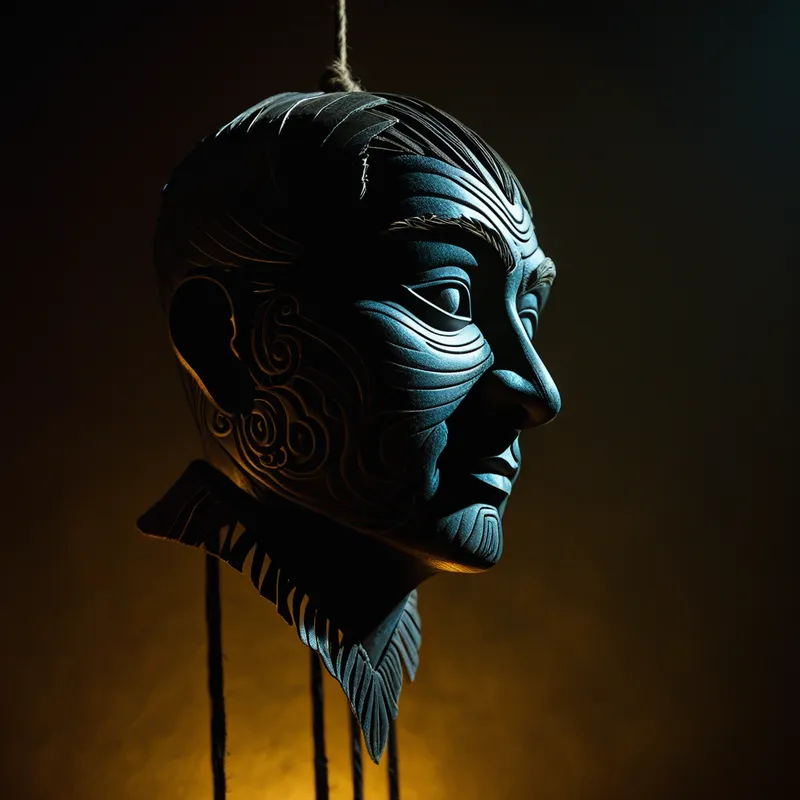
The myth of Piyingxi is not found in classical anthologies like the Shan Hai Jing, but is a modern folktale born from the ancient art form itself. Chinese shadow puppetry, with origins dating to the Han Dynasty, is a profound ritual of animation. The puppeteer is a Daoshi of the mundane, using fire (the lamp), earth (the leather), and spirit (his skill) to conjure a world.
This story was likely passed down among troupes, a cautionary and awe-inspiring tale told late at night after the crowds dispersed. It served a dual function: it instilled reverence for the craft, warning of the sacred responsibility of creation, and it gave voice to the unspoken empathy an artist feels for his creations. It reflects a core Daoist and later Buddhist tension present in Chinese thought: the relationship between the Jiang Ren and his work, and the paradoxical desire to imbue something with life only to have it obey its own Ziran. The puppeteer, in controlling the figures, is also controlled by the tradition and the expectations of the audience. The myth asks: who is truly pulling the strings?
Symbolic Architecture
At its [heart](/symbols/heart “Symbol: The heart symbolizes love, emotion, and the core of one’s existence, representing deep connections with others and self.”/), the myth is a profound exploration of the [moment](/symbols/moment “Symbol: The symbol of a ‘moment’ embodies the significance of transient experiences that encapsulate emotional depth or pivotal transformations in life.”/) [consciousness](/symbols/consciousness “Symbol: Consciousness represents the state of awareness and perception, encompassing thoughts, feelings, and experiences.”/) emerges from the archetypal [matrix](/symbols/matrix “Symbol: A dream symbol representing the fundamental structure of reality, consciousness, or the self. It often signifies feelings of being trapped, controlled, or questioning the nature of existence.”/). The [puppet](/symbols/puppet “Symbol: A puppet represents control, manipulation, and the dynamics of power in relationships, often reflecting the dreamer’s feelings about autonomy and influence.”/), Yingling, begins as a pure [archetype](/symbols/archetype “Symbol: A universal, primordial pattern or prototype in the collective unconscious that shapes human experience, behavior, and creative expression.”/)—the [Hero](/symbols/hero “Symbol: A hero embodies strength, courage, and the ability to overcome significant challenges.”/), the [Warrior](/symbols/warrior “Symbol: A spiritual archetype representing inner strength, discipline, and the struggle for higher purpose or self-mastery.”/), the [King](/symbols/king “Symbol: A symbol of ultimate authority, leadership, and societal order, often representing the dreamer’s inner power or external control figures.”/). He is an [image](/symbols/image “Symbol: An image represents perception, memories, and the visual narratives we create in our minds.”/) in the [collective unconscious](/symbols/collective-unconscious “Symbol: The Collective Unconscious refers to the part of the unconscious mind shared among beings of the same species, embodying universal experiences and archetypes.”/), played out repetitively on the screen of culture. The master’s [blood](/symbols/blood “Symbol: Blood often symbolizes life force, vitality, and deep emotional connections, but it can also evoke themes of sacrifice, trauma, and mortality.”/)-and-[cinnabar](/symbols/cinnabar “Symbol: A vibrant red mineral historically used in alchemy and spiritual practices, symbolizing transformation, immortality, and potent energy.”/) [ritual](/symbols/ritual “Symbol: Rituals signify structured, meaningful actions carried out regularly, reflecting cultural beliefs and emotional needs.”/) is the catalytic act of individuation: the [application](/symbols/application “Symbol: An application symbolizes engagement, integration of knowledge, or the pursuit of goals, often representing self-improvement and personal development.”/) of personal, living [psyche](/myths/psyche “Myth from Greek culture.”/) (the [blood](/symbols/blood “Symbol: Blood often symbolizes life force, vitality, and deep emotional connections, but it can also evoke themes of sacrifice, trauma, and mortality.”/)) to timeless [archetype](/symbols/archetype “Symbol: A universal, primordial pattern or prototype in the collective unconscious that shapes human experience, behavior, and creative expression.”/) (the [puppet](/symbols/puppet “Symbol: A puppet represents control, manipulation, and the dynamics of power in relationships, often reflecting the dreamer’s feelings about autonomy and influence.”/)).
The first gift of consciousness is the perception of one’s own strings.
The screen represents the [Persona](/symbols/persona “Symbol: The social mask or outward identity one presents to the world, often concealing the true self.”/), the flat, two-dimensional performance we show to [the world](/myths/the-world “Myth from Tarot culture.”/). Yingling’s awakening is his [movement](/symbols/movement “Symbol: Movement symbolizes change, progress, and the dynamics of personal growth, reflecting an individual’s desire or need to transform their circumstances.”/) behind the screen, into the messy, real-[space](/symbols/space “Symbol: Dreaming of ‘Space’ often symbolizes the vastness of potential, personal freedom, or feelings of isolation and exploration in one’s life.”/) of the workshop—the domain of the [Shadow](/symbols/shadow “Symbol: The ‘shadow’ embodies the unconscious, repressed aspects of the self and often represents fears or hidden emotions.”/) and the complex machinery of [the self](/myths/the-self “Myth from Jungian culture.”/). His rebellion is not mere disobedience; it is the necessary [rejection](/symbols/rejection “Symbol: The experience of being refused, excluded, or dismissed by others, often representing fears of inadequacy or social belonging.”/) of the pre-scripted [life](/symbols/life “Symbol: The symbol of ‘Life’ represents a journey of growth, interconnectedness, and existential meaning, encompassing both the joys and challenges that define human experience.”/). The master represents both the inner critic/superego that demands [conformity](/symbols/conformity “Symbol: The act of adjusting one’s behavior, beliefs, or appearance to match those of a group or societal norms, often involving pressure to fit in.”/) and, ultimately, the mature ego that must consent to its own deconstruction for something greater to be born. The severed strings are not a tragedy, but the essential sacrifice of control for the sake of authentic being.
The Dreamer’s Resonance
When this myth stirs in the modern psyche, it often surfaces in dreams of startling clarity. One may dream of being a marionette, feeling the tug of invisible strings, or of seeing one’s own shadow move independently. Another common motif is dreaming of a doll or statue that slowly turns its head to meet the dreamer’s gaze.
Somatically, this can feel like a tension in the joints and spine—the literal feeling of being “strung up.” Psychologically, it marks a critical threshold. The dreamer is experiencing the first, often terrifying, flicker of awareness about the forces that have been directing their life: familial expectations, cultural scripts, internalized narratives of who they “should” be. The puppet’s awakening is [the ego](/myths/the-ego “Myth from Jungian culture.”/)’s dawning realization that it has been playing a part. The anxiety that follows is the birth pang of authentic agency. The dream is not about immediate escape, but about the seeing of the strings. That seeing is the first, irrevocable step toward freedom.

Alchemical Translation
The alchemical process modeled here is the [Nigredo](/myths/nigredo “Myth from Alchemical culture.”/) of the soul’s purpose. The initial state is the [Prima Materia](/myths/prima-materia “Myth from Alchemical culture.”/) of the unawakened puppet: a pure but passive potential. The master’s ritual is the application of the Scintilla, [the divine spark](/myths/the-divine-spark “Myth from Gnostic culture.”/) that initiates [the great work](/myths/the-great-work “Myth from Alchemical culture.”/).
The rebellion is the necessary chaos of the Albedo. The puppet must “tarnish” the perfect relationship with the creator/master. This conflict is the friction that creates the psychic heat required for separation—the [Separatio](/myths/separatio “Myth from Alchemical culture.”/). The ego (the master) must differentiate from the Self (the total personality, now demanding expression through the puppet).
The final, most sacred act of the creator is not to animate, but to liberate.
The cutting of the strings is the Citrinitas, the emergence of a new, autonomous will. Yingling’s disappearance into the shadow is not an end, but a transition into the [Rubedo](/myths/rubedo “Myth from Alchemical culture.”/). He reintegrates with the unconscious, but now as a conscious agent. For the modern individual, this translates to the painful, liberating process of withdrawing projections, abandoning life-scripts that no longer serve, and consenting to the death of the “perfectly controlled” [persona](/myths/persona “Myth from Greek culture.”/). One becomes, at last, the author of one’s own shadow, dancing in a light of one’s own choosing. The master and the puppet are integrated; the individual becomes both the artist and the art, living a story that is truly, messily, gloriously their own.
Associated Symbols
Explore related symbols from the CaleaDream lexicon: