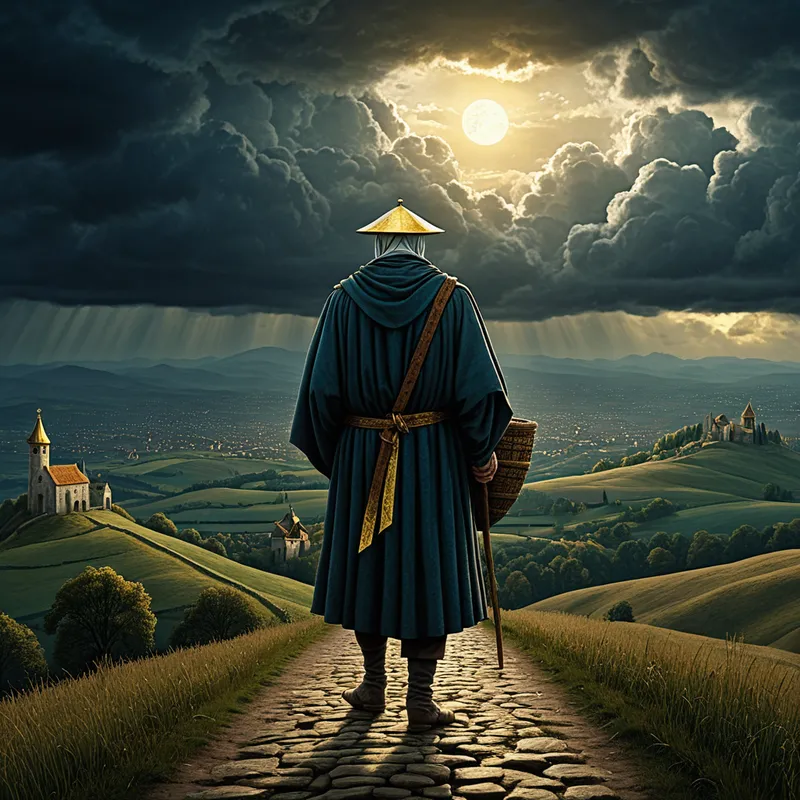
Pilgrim's Progress Myth Meaning & Symbolism
An allegorical journey of the soul, where a pilgrim named Christian flees damnation, faces trials, and seeks salvation in a perilous, symbolic landscape.
The Tale of Pilgrim's Progress
Hear now the tale of a soul in peril, a man who awoke in a city of shadows. His name was Christian, and he lived in the City of Destruction. A book was in his hand, and its words were fire, searing his heart with a terrible knowledge: the city was doomed, and he with it. A burden, invisible to others but crushing to his own spirit, fastened itself upon his back, a weight of lead and regret.
Fleeing the mocking cries of his neighbors and family, he ran. A figure named Evangelist pointed his staff toward a distant light. “Keep that light in thine eye,” he commanded, “and go directly thereto, so shalt thou see the Wicket Gate.” And so Christian ran, stumbling into the Slough of Despond, a bog of his own fears and doubts, where the burden on his back threatened to drown him.
Aid came, and he pressed on. At the Wicket Gate, Goodwill pulled him inside to safety. The path now lay straight, leading to a place called the Place of Deliverance. There, before a cross and an empty tomb, the straps of his burden burst asunder. The weight rolled away down a hill, vanishing into a sepulchre forever. Angels clothed him in raiment of light, and a scroll was placed in his hand.
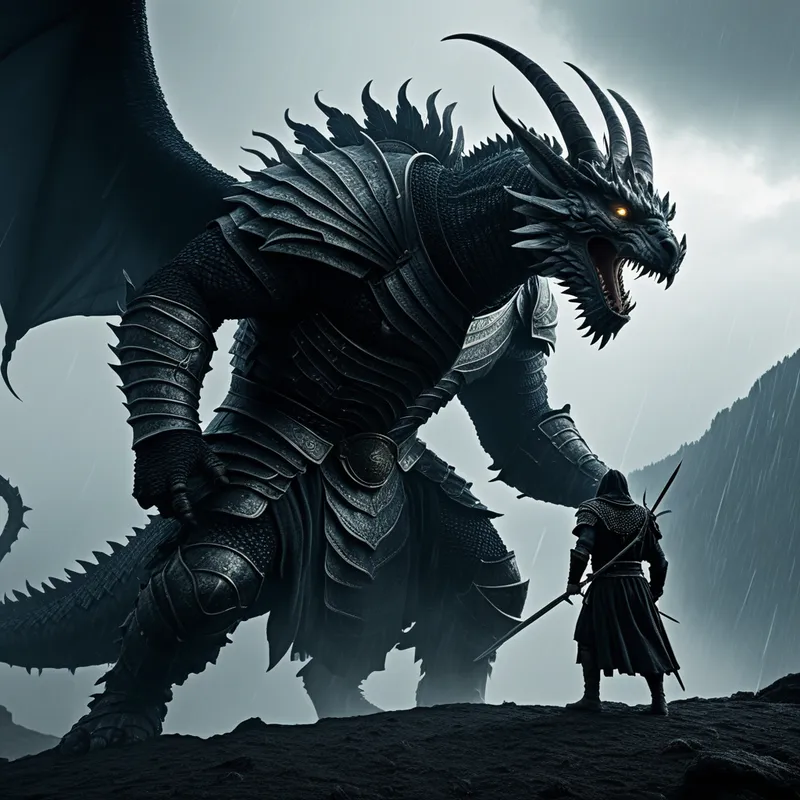
But the path was not ended; it was only clarified. Now marked as a pilgrim, he traversed the Hill Difficulty. He rested in the House of the Interpreter, where living pictures taught him the secrets of the heart. He walked the Valley of Humiliation, where he was set upon by the foul fiend Apollyon, a dragon of the pit. “I am the prince of this land!” it roared. Their battle was fierce, the pilgrim’s sword ringing against scaled hide, until a final thrust drove the monster away.
Darker still was the Valley of the Shadow of Death. A narrow path wound between a deep ditch and a treacherous bog, shrouded in a miasma of gloom. Hobgoblins whispered, and the mouth of Hell itself yawned by the roadside, belching fire and hideous sounds. Yet he pressed through, whispering the promises from his scroll.
He met false friends like Worldly Wiseman and Talkative. He was imprisoned in the Doubting Castle by the giant Despair, escaping only by using the key called Promise. With a faithful companion, Faithful—who met martyrdom in the vanity fair of the world—and later, Hopeful, he endured.
At last, they came to the final river, deep and cold, with no bridge to cross. This was the River of Death. As Christian began to sink, despair gripped him once more, but Hopeful held him fast. “Be of good cheer,” he cried, “I feel the bottom, and it is firm!” And so, struggling, they forded the flood.
On the far shore, two shining ones met them. The gates of the Celestial City swung open upon a hill of dazzling light. A chorus of voices welcomed them home. They entered, their pilgrim’s rags transformed into garments that shone like the sun, and they were given harps to praise and crowns of gold. The journey was complete.
Cultural Origins & Context
This is not a myth of antiquity, but a Puritan allegory born in the 17th century, a product of the tumultuous Reformation and its aftermath. Its author, John Bunyan, wrote it while incarcerated for preaching outside the sanctioned Church of England. The tale emerged not from communal oral tradition, but from the solitary fervor of a dissenting believer, steeped in the King James Bible and the pervasive fear of damnation.
Its societal function was dual. For the common people, often illiterate, it served as a vivid, memorable map of the Protestant soul’s journey: from conviction of sin, through grace, to perseverance and hope. It externalized internal spiritual states into tangible landscapes and characters, making theology walkable. For the culture at large, it reflected the profound individualism of the Puritan experience—the soul alone before God, responsible for its own arduous pilgrimage, separate from the corruptions of the worldly “city” and institutional religion. It was passed down not by bards, but from pulpits and within households, as one of the most printed books in the English language, second only to the Bible itself.
Symbolic Architecture
The myth’s power lies in its stark symbolic architecture. The journey is the central motif, representing the linear, purposeful Protestant view of a life directed toward a singular, transcendent goal. Christian is not a hero of might, but of persistence; his burden is the conscious weight of sin and separateness, which can only be released not by effort, but at the site of grace—the cross.
The path is not a road through the world, but a line drawn through the soul. Every valley and giant is a topography of the inner life.
The Vanity Fair represents the soul’s peril in a society that trades in everything but truth. Doubting Castle is the prison of the mind when hope is lost, and the key of Promise is the active recollection of faith. The final river is the ultimate ego dissolution, the terrifying but necessary surrender of the very self that undertook the journey. The entire narrative is a grand psychomachia—a war within the soul, projected onto a fantastical landscape.

The Dreamer's Resonance
When this myth stirs in modern dreams, it rarely appears as a medieval pilgrim. Instead, we dream of being late for a crucial exam, of fleeing an unnamed threat through labyrinthine cities, or of carrying a heavy, obscure object we cannot put down. We dream of finding mysterious doors or gates that promise escape, or of being mired in swamps of indecision.
These are somatic echoes of Pilgrim’s Progress. The “burden” manifests as chronic tension, a feeling of being weighed down by responsibility, guilt, or unrealized potential. The dream of a path signifies a deep, often unconscious, recognition that one’s current psychological state is unsustainable—a “City of Destruction” in the making. The adversaries—whether dream figures of critics, monsters, or oppressive authorities—are the projected forms of internalized doubt, shame, or despair (our own Apollyons and Giants Despair). To dream of fording a river is to psyche’s preparation for a major transition, a dying to an old way of being.

Alchemical Translation
Psychologically, the pilgrim’s journey is a perfect model for the individuation process. The City of Destruction is the stagnant, unconscious life, ruled by collective norms and unexamined impulses. The call from Evangelist is the first stirring of the Self, the urge toward consciousness.
The alchemical work begins not with seeking gold, but with acknowledging the leaden burden of who we have been.
The journey’s stages are phases of psychic transmutation. The Slough of Despond is the nigredo, the blackening—the initial confrontation with shadow and depression. The shedding of the burden at the cross is a moment of albedo, whitening—a profound release and clarity granted by an encounter with a transcendent principle (the Self). The battles in the valleys are the conscious engagement with complex emotions (humiliation, the fear of death). Imprisonment in Doubting Castle is the danger of identification with a single, powerful complex (despair), from which only the “key” of a broader, symbolic perspective (Promise) can free us.
The final river is the ultimate solutio—dissolution. The ego, which began the journey, must itself be relinquished to reach the Celestial City, which represents the integrated Self, a state of psychic wholeness where conflict is resolved not by victory, but by transcendence. For the modern individual, the Celestial City is not a literal heaven, but the hard-won state of being at peace with one’s own totality, having consciously traveled the full map of one’s own interior world.
Associated Symbols
Explore related symbols from the CaleaDream lexicon: