Pilate's Basin Myth Meaning & Symbolism
A myth of Pontius Pilate washing his hands, transforming a simple basin into an eternal symbol of abdicated judgment and the stain of complicity.
The Tale of Pilate’s Basin
The stone was cold beneath his feet, a Roman chill in a Judean dawn. In the Praetorium, the air hung thick, not with incense, but with the sour scent of fear and political calculation. Pontius Pilate stood, a man carved from the marble of empire, yet feeling the foundations crack. Outside, a sound like the sea—a multitude’s voice, rising and falling in a single, terrible demand.
Before him stood the man from Nazareth. No kingly robes, no legion at his back. Only a quietude that seemed to absorb the room’s chaos, a presence that made the gilded eagles on the standards feel like tarnished tin. Pilate had questioned, probed, sought a thread of treason to grasp. He found only enigmatic silence and a truth that slipped through his fingers like smoke. “What is truth?” he had muttered to the air, the philosopher’s question becoming the administrator’s evasion.
The pressure mounted. The voices from the street became a hammer. His own wife’s troubled message, whispered of a dream, a warning—it was all sand against the tide. Here was the fulcrum: justice, or order? A single innocent life, or the wrath of Caesar should riot stain his record? He saw the choice not as moral, but logistical. A problem to be solved, a crowd to be placated.
He called for a basin.
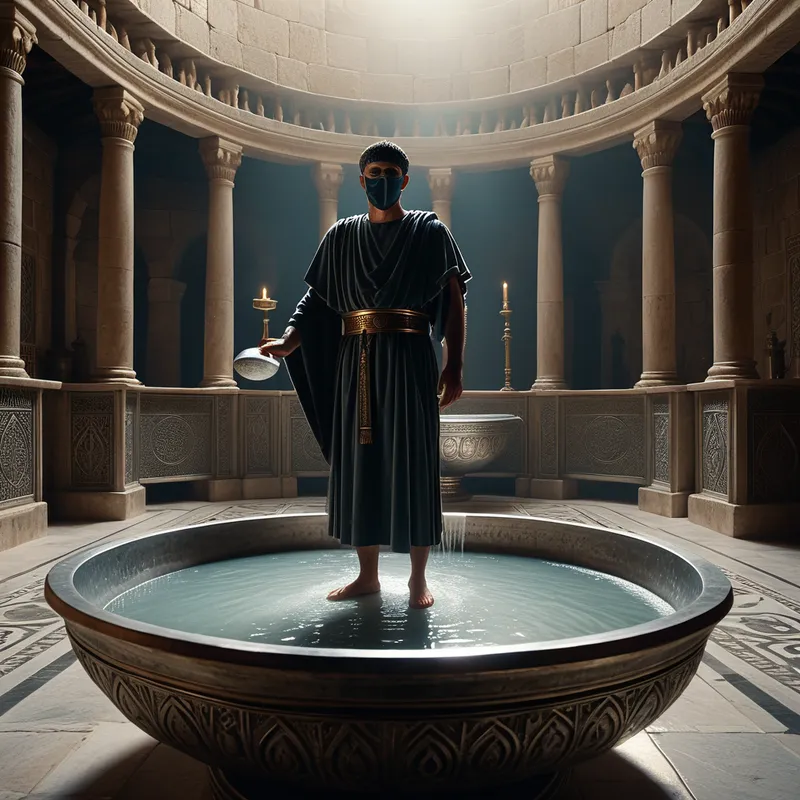
A servant brought it forth—a simple, functional vessel of beaten copper or humble clay. Not an object of ceremony, but of utility. Pilate positioned himself where all could see, the accused man to one side, the roaring crowd beyond the portico. He did not look at the Nazarene. He looked at his own hands, the hands that held the power of life and death, the imperium. They felt unclean, not from dirt, but from the intangible grime of a decision he wished to disown.
He plunged them into the water. The liquid was shockingly cold. He rubbed palm against palm, the sound absurdly loud in a moment of held breath. The water swirled, clouded for an instant with the dust of the courtyard. He raised his dripping hands, held them aloft like a priest performing an aborted sacrament.
“I am innocent of this man’s blood,” he declared, his voice cutting through the din. “See to it yourselves.”
The words hung in the air, then were swallowed by the crowd’s triumphant roar. The water dripped from his fingers onto the stone, each drop a period marking the end of his involvement. He handed the man over, believing he had washed the matter from his hands. But as the condemned was led away, the basin sat by the stair, its water now still, holding the ghostly reflection of a sun that seemed, for a moment, to dim. The act was complete, the transaction finished. Yet the vessel remained, no longer just a bowl, but an eternal witness, heavy with the weight of water that could not cleanse what had been surrendered.

Cultural Origins & Context
The story is rooted in the Gospel of Matthew (27:24), a text composed within a fledgling Christian community navigating a traumatic rupture from its Jewish roots and living under Roman authority. It is not a standalone folk myth, but a pivotal narrative detail embedded within the Passion story—the account of Jesus’s trial and execution.
Its primary function was theological and communal. For Matthew’s audience, it served a critical purpose: it absolved the Roman system of primary guilt (placing Pilate as a reluctant, manipulated figure) while redirecting the responsibility onto the Jewish authorities and the crowd, a painful reflection of the inter-communal tensions of the time. Societally, it modeled a profound warning about the nature of legalistic complicity. Pilate follows the letter of a ritual—washing hands—to violate the spirit of justice. The myth was passed down not by bards around a fire, but through liturgical recitation, religious art, and passion plays, becoming one of the most iconic and psychologically resonant moments in the Christian narrative. It transformed a minor administrative act into a universal archetype of moral evasion.
Symbolic Architecture
The basin is the central symbol, an alchemical vessel where a spiritual transaction fails. It is not a holy grail that receives and transforms, but an anti-grail that receives and rejects. The water within is not the living water of spirit, but the inert water of legalistic ritual.
The act of washing hands is the body’s plea to be absolved from the soul’s burden. It is the physical pantomime of a psychic wish—that inner conflict could be solved with outer action.
Pilate represents the ego confronted by an impossible choice between two masters: the outer authority of Rome (the collective, political order) and the inner, unsettling authority of the Self as mirrored in the silent figure of Jesus. His failure is not one of malice, but of integration. He cannot hold the tension of the opposites—justice and peace, truth and power—so he attempts to dissociate from the conflict entirely. The water becomes the symbol of this failed dissolution; it carries away no sin, only bears witness to its abandonment.
The myth dramatizes the birth of the shadow. What Pilate declares “not my responsibility” does not vanish. It is projected outward onto the crowd (“see to it yourselves”) and, by cultural extension, onto an “other.” The stain he avoids inwardly becomes an eternal, cultural stain. The basin thus holds the shadow content of the entire event—the denied guilt, the abdicated power, the repressed knowing that one is participating in a great wrong while performing the gestures of innocence.

The Dreamer’s Resonance
When this myth stirs in the modern dreamscape, it rarely appears in biblical costume. Its pattern is felt. You dream of being in a meeting where a unethical decision is made, and you say nothing, but later cannot wash a strange, sticky residue from your hands. You dream of scrubbing at a spot on your shirt that only grows larger. You stand at a sink, but the drain is clogged, and the water rises, filled with dark, swirling shapes.
Somatically, this is the psyche’s registration of complicity. It is the body remembering what the conscious mind has tried to dismiss. The “stain” is the embodied knowledge of a moral or psychic truth you have violated. The dream is not about a past historical event, but about a present, internal Pilate—the part of you that knows the right action, yet chooses appeasement, convenience, or cowardice. The water that fails to cleanse points to the realization that certain actions cannot be undone with mere ritual or rationale; they require a deeper, more costly integration. The dream is an invitation to stop washing and start witnessing what is in the basin you have tried to empty.

Alchemical Translation
The alchemical process mirrored here is the negredo—the blackening, the stage of mortification and confrontation with the shadow. Pilate’s attempted hand-washing is a failed ablutio (washing), a purification ritual performed prematurely, before the base material has even been acknowledged. True alchemical transformation requires that the material be contained within the vessel and subjected to the heat of conflict until it breaks down.
Individuation demands that we do not wash our hands of the difficult choice, but that we dirty them in the service of holding the tension. The basin must become a crucible, not a sink.
For the modern individual, the “Pilate moment” occurs whenever we face a choice between our authentic truth (which may be disruptive, costly, or isolating) and the demands of the collective (which offers safety, approval, and order). The path of the orphan archetype—which Pilate ultimately fails to embrace—is to accept the loneliness of that truth. The alchemical translation is to take back the projection. To look into the basin and see not the crowd’s guilt, but our own capacity for evasion. To integrate the Pilate within is to acknowledge our own complicity in the systems and silences that cause suffering, and to decide that the next time we reach for water, it will not be to wash away responsibility, but to drink deeply from the well of our own courage, accepting the bitter taste of consequence as the price of integrity. The transformed vessel no longer holds water for washing, but contains the integrated self, capable of bearing the weight of its own decisions.
Associated Symbols
Explore related symbols from the CaleaDream lexicon: