Philosopher's Stone Point Myth Meaning & Symbolism
An alchemical myth of a celestial entity that descends into primal matter, enduring dissolution to forge the still point of ultimate transformation.
The Tale of Philosopher’s Stone Point
Listen, and I will tell you of the time before the First Conjunction, when the heavens were a raw, singing brilliance and [the earth](/myths/the-earth “Myth from Hindu culture.”/) was a groaning, formless mass. Between them stretched the [Spiritus](/myths/spiritus “Myth from Alchemical culture.”/), a wind of pure potential, and the Anima Mundi, a sigh that longed for form.
In the highest realm dwelt Lumen Primordialis, a being of pure, undivided light. It was consciousness without an object, a song without a note. Yet, within its boundless radiance, a strange yearning stirred—not a lack, but a pull toward the echo of its own opposite. It heard the chaotic symphony of the Massa Confusa below, the deafening roar of elements at war: fire against [water](/myths/water “Myth from Chinese culture.”/), earth against air.
Driven by this profound curiosity, which the ancients call the Scintilla Dei, Lumen Primordialis made a fateful choice. It gathered its essence, not to shine brighter, but to focus itself into a single, piercing point of intention. This was not an attack, but a descent. It fell like a silent star, a needle of distilled consciousness, into the very heart of the roaring Massa Confusa.
The impact was not an explosion, but an implosion of being. The pure light met unformed matter. Its crystalline structure screamed as it was invaded by the searing kiss of fire, dissolved by the embrace of corrosive waters, crushed by the weight of adamant earth, and torn by the shrieking winds. This was the [Nigredo](/myths/nigredo “Myth from Alchemical culture.”/), the great blackening. Lumen Primordialis was shattered, its unity lost, its light seemingly extinguished in the absolute dark of [the abyss](/myths/the-abyss “Myth from Kabbalistic culture.”/).
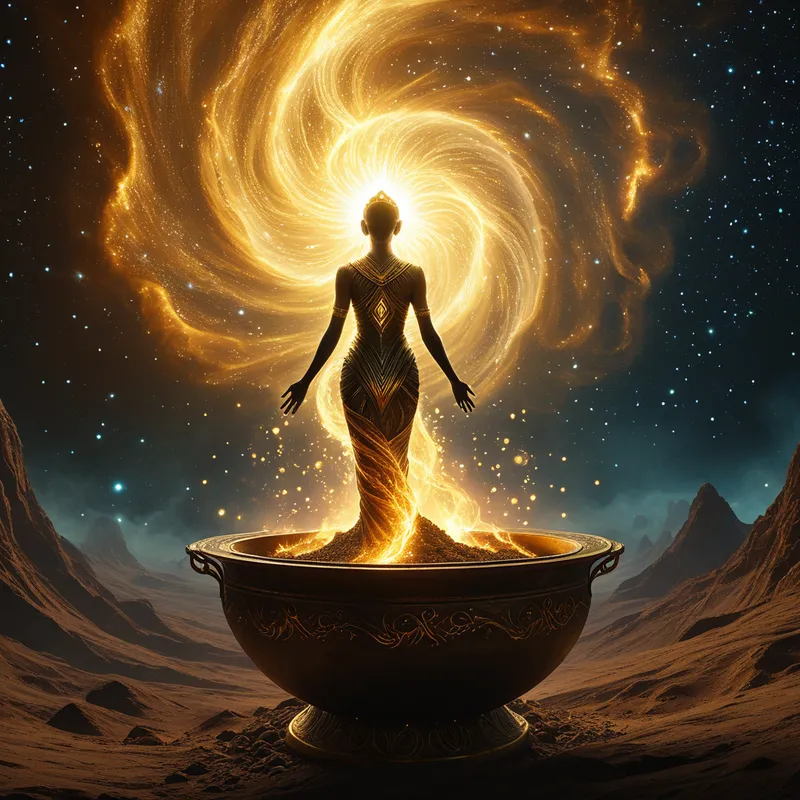
For eternities, it endured this dissolution. It became one with the chaos, feeling the rage of the fire as its own rage, the grief of the water as its own grief. Yet, in the very center of this annihilation, the focused point of its original intention did not vanish. It remained, a minuscule, unyielding atom of awareness—a witness to the storm. This was the birth of the Punctum Philosophorum, [the Philosopher’s Stone](/myths/the-philosophers-stone “Myth from Alchemical culture.”/) Point.
From this still point, a miracle unfolded. The chaotic elements, having spent their fury against this immutable center, began to slow. Their warring motions started to orbit the point, finding a strange rhythm. The fire’s heat, now tempered, began to cook and purify; the water’s flow began to wash and circulate; the earth’s solidity began to provide a matrix; the air’s movement began to whisper secrets of combination. The Albedo dawned—a silver light of reconciliation.
The Point did not command this change. It merely was, and by being unchangeable at the core, it allowed everything else to change around it. From the ordered dance of the reconciled elements, a new substance coalesced: the Lapis Philosophicus itself, a radiant, golden crystal that contained within it the memory of both the celestial light and the earthly chaos, harmonized. The Point was its heart, its axis, the silent king upon a throne forged from its own sacrifice.
Cultural Origins & Context
The myth of the [Philosopher’s Stone](/myths/philosophers-stone “Myth from Alchemical culture.”/) Point is not a folktale with a known author, but the foundational, esoteric narrative underpinning the entire Western alchemical tradition from the Hellenistic period through the Renaissance. It was never written as a single story but was encoded in symbolic laboratory instructions, cryptic emblems, and dense philosophical tracts. It was passed down through initiatory lineages, from master to apprentice, alongside practical chemical operations.
Its societal function was profoundly subversive and interior. In an age of rigid religious dogma and external authority, alchemy provided a clandestine framework for inner exploration. The myth served as a metaphysical map for the practitioner’s own spiritual and psychological transformation. Telling the story—through the contemplation of an emblem like the [Ouroboros](/myths/ouroboros “Myth from Global/Universal culture.”/) or the [Rebis](/myths/rebis “Myth from Alchemical culture.”/)—was an act of soul-making. It was a narrative that gave meaning to the long, frustrating, and often dangerous work at the furnace, framing failure not as waste, but as a necessary stage of the [Magnum Opus](/myths/magnum-opus “Myth from Alchemical culture.”/).
Symbolic Architecture
At its core, the myth is a grand [metaphor](/symbols/metaphor “Symbol: A figure of speech where one thing represents another, often revealing hidden connections and deeper truths through symbolic comparison.”/) for the [birth](/symbols/birth “Symbol: Birth symbolizes new beginnings, transformation, and the potential for growth and development.”/) of [consciousness](/symbols/consciousness “Symbol: Consciousness represents the state of awareness and perception, encompassing thoughts, feelings, and experiences.”/) and the process of individuation. Lumen Primordialis represents the undifferentiated Self, the primal, unconscious wholeness that exists before the experience of [the world](/myths/the-world “Myth from Tarot culture.”/). The yearning Scintilla Dei is the first spark of ego-[awareness](/symbols/awareness “Symbol: Conscious perception of self, surroundings, or internal states. Often signifies awakening, insight, or heightened sensitivity.”/), the urge to know oneself by engaging with “otherness.”
The descent into matter is the heroic, necessary fall of spirit into the complexities of embodied life, relationship, and suffering.
The Massa Confusa symbolizes the unconscious [psyche](/myths/psyche “Myth from Greek culture.”/) in its raw state—a tumult of conflicting instincts, emotions, complexes, and forgotten memories. The brutal Nigredo is the inevitable psychological [crisis](/symbols/crisis “Symbol: A crisis symbolizes turmoil, urgent challenges, and the need for immediate resolution or change.”/), the “dark [night](/symbols/night “Symbol: Night often symbolizes the unconscious, mystery, and the unknown, representing the realm of dreams and intuition.”/) of the [soul](/symbols/soul “Symbol: The soul represents the essence of a person, encompassing their spirit, identity, and connection to the universe.”/),” where one’s old [identity](/symbols/identity “Symbol: Identity represents the sense of self, encompassing personal beliefs, cultural background, and social roles.”/), ideals, and self-[image](/symbols/image “Symbol: An image represents perception, memories, and the visual narratives we create in our minds.”/) are utterly dissolved by contact with [shadow](/symbols/shadow “Symbol: The ‘shadow’ embodies the unconscious, repressed aspects of the self and often represents fears or hidden emotions.”/) [material](/symbols/material “Symbol: Material signifies the tangible aspects of life, often representing physical resources, desires, and the physical world’s influence on our existence.”/). The [Philosopher’s Stone](/symbols/philosophers-stone “Symbol: The ‘Philosopher’s Stone’ represents the ultimate goal of transformation and enlightenment, symbolizing the quest for knowledge, wisdom, and the attainment of one’s true potential.”/) Point is the emergent, indestructible core of the individual—what Jung called the Self. It is not the loud, heroic ego, but the quiet, observing center that can endure [chaos](/symbols/chaos “Symbol: In Arts & Music, chaos represents raw creative potential, uncontrolled expression, and the breakdown of order to forge new artistic forms.”/) without being destroyed by it.
The Dreamer’s Resonance
When this myth activates in the modern psyche, it often manifests in dreams of catastrophic transformation. The dreamer may experience dreams of crumbling buildings (the old psychic structure), being dissolved in acid or ocean waves (the Nigredo), or searching for a small, vital object in immense ruins. Somatic parallels include feelings of grounding or centering during intense anxiety—a literal “finding your center.”
These dreams signal a profound initiation into a deeper layer of being. [The ego](/myths/the-ego “Myth from Jungian culture.”/) is not in control; it is being dismantled. The psychological process is one of ego-inflation deflation and contact with the objective psyche. The dreamer is being invited, or forced, to stop identifying solely with their [persona](/myths/persona “Myth from Greek culture.”/) and conscious attitudes, and to endure the terrifying but necessary process of meeting the unconscious on its own terms. The Point is the promise: that within this turmoil, a new, more authentic organizing principle is being born.
Alchemical Translation
For the modern individual, the myth models the path of psychic transmutation—Jung’s individuation process. We all begin in a state of unconscious Lumen Primordialis, then are thrown into the Massa Confusa of life’s trials, failures, and heartbreaks. The conscious work begins when we choose to engage with our inner chaos, not flee from it.
The first step is the descent: engaging in therapy, shadow work, or honest self-reflection, willingly entering our own Nigredo. The second, and most crucial, is the cultivation of the Point: developing the capacity for mindful observation. This is the practice of witnessing one’s emotions and thoughts without being completely identified with them.
The Stone is not achieved by adding something new, but by subtracting everything that is not the immutable, central point of pure awareness.
As we practice holding that still point amidst internal and external storms, the elements of our psyche—our intellect (air), passions (fire), emotions (water), and body (earth)—gradually reorganize around this new center. The Albedo is the resulting clarity and peace, and the Lapis Philosophicus is the realized state of wholeness, where consciousness is no longer at war with the unconscious, but in a living, creative partnership. The myth teaches that our greatest treasure, the Philosopher’s Stone, is not found in a distant land, but forged in the darkest crucible of our own experience, around the silent, steadfast point of our deepest attention.
Associated Symbols
Explore related symbols from the CaleaDream lexicon: