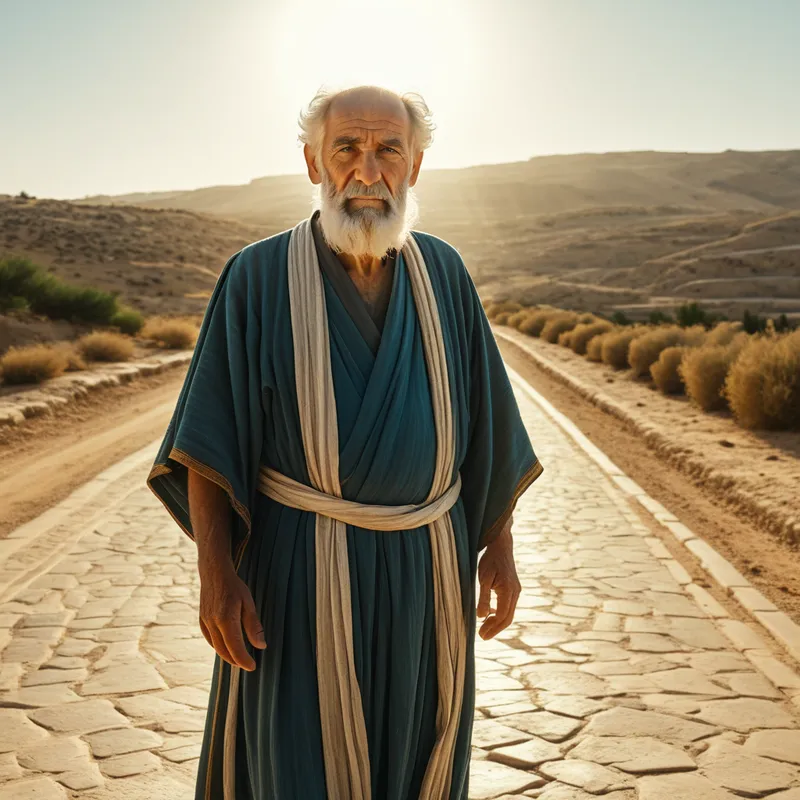
Philip the Apostle Myth Meaning & Symbolism
A disciple's journey from rational inquiry to a transformative, face-to-face encounter with the sacred, bridging the human and the holy.
The Tale of Philip the Apostle
The road from Jerusalem to Gaza is a bleached ribbon under a hammered-bronze sky. It is a place of dust and whispers, where the wind carries the ghosts of caravans and the heat shimmers like a waking dream. Upon this road walked a man named Philip, his sandals scuffing the stones, his mind a vessel filled with recent wonders and lingering questions. He had seen the impossible made flesh, had walked with a teacher who spoke with the authority of the dawn itself. Yet now, in the silence of the journey, the questions remained, solid as the rocks beneath his feet.
The voice that came to him was not of the wind. “Go south to the road—the desert road—that goes down from Jerusalem to Gaza.” It was a command that bypassed reason, a current in the blood. Philip obeyed.
And there, in the solitude, a chariot of state appeared, a jeweled anomaly in the wilderness. Within sat a man of great authority, a treasurer of Candace, Queen of the Ethiopians, a eunuch of power and isolation. He was reading aloud, the words of the prophet Isaiah stumbling on his tongue, a seeker in a royal cage. The Spirit’s whisper came again to Philip: “Go to that chariot and stay near it.”
Philip ran. His heart pounded not from exertion, but from the terrifying symmetry of the moment. “Do you understand what you are reading?” he asked, breathless.
The eunuch looked up, his eyes holding the loneliness of palaces and distant lands. “How can I,” he replied, “unless someone guides me?” He invited Philip into his moving world of leather and wealth, his finger resting on the aching, mysterious passage: “Like a sheep he was led to the slaughter, and like a lamb silent before its shearer, so he does not open his mouth…”
“Who is the prophet talking about?” the eunuch pleaded. “Himself, or someone else?”
This was the aperture. From this question, Philip began to speak. He did not recite dogma; he unfolded a story. He told of the teacher from Nazareth, of the life that was the living key to every locked prophecy, of the sacrifice that was not an end but a doorway. He spoke until the words themselves seemed to catch fire in the dry air, until the scripture was no longer ancient ink but a map to a present reality.
As they traveled, they came upon a rare gift in the desert: water, a spring bubbling beside the road. The eunuch’s yearning became a tangible force. “Look, here is water! What is to prevent me from being baptized?”
Nothing. Absolutely nothing. Status, race, origin, body—all the walls the world built melted in the face of this direct desire. Philip, the pragmatic follower, became the conduit. They went down into the water, the official’s rich robes soaking, Philip’s hands steady. In that moment, the desert held its breath. A man was washed clean of an old identity and born into a new one, not of nation, but of spirit.
As they emerged, the Holy Spirit snatched Philip away. One moment he stood dripping on the bank, the next he was gone, found again in Azotus, another town, another road. The eunuch, however, went on his way rejoicing, carrying a secret spring in his heart through the dry places of the world. Philip continued, preaching in every city until he reached Caesarea, a living witness that the encounter with the divine was not a theory to be debated, but a road to be walked, and a presence to be met, face-to-face.

Cultural Origins & Context
The myth of Philip emerges from the nascent, volatile soil of early Apostolic Christianity, a movement struggling to define itself beyond its Jewish roots. It is preserved in the Acts of the Apostles, a text that functions as both history and theological manifesto. This story was not crafted in a palace or a philosophical school, but in the dynamic, oral culture of house churches and missionary journeys, told to communities wrestling with a shocking new idea: that the covenant of God was bursting its ethnic banks.
The tale served a critical societal function. It was a foundational myth for a church in expansion, providing a divine precedent for the inclusion of the Gentile, the foreigner, the “other.” The Ethiopian eunuch was a triple outsider: a Gentile, a African from the edge of the known world, and a man physically set apart. His baptism, authorized directly by the Spirit through Philip, was a powerful narrative weapon against exclusionary factions within the early community. It argued that the spirit of God moved on roads beyond Jerusalem, speaking to hearts the law had not considered.
Symbolic Architecture
Philip represents the archetype of the Sage in its active, apostolic form. He is not a recluse philosopher, but a wisdom-bearer who takes his understanding onto the road to meet seeking hearts where they are. His journey is one of obedient intelligence—he receives guidance and acts, but the guidance leads him to a moment requiring deep personal interpretation and connection.
The true seeker is not one who finds all answers, but one whose understanding becomes a bridge for another’s crossing.
The desert road is the classic liminal space, the in-between where ordinary rules are suspended and transformation occurs. The chariot is a symbol of worldly power and journey, but it is stalled, circling the text without comprehension. Philip’s role is to provide the key that unlocks the scripture and sets the chariot, now carrying a transformed passenger, back on its true path.
The water is the central alchemical symbol. It represents the prima materia of the unconscious, the depth into which one must descend to be cleansed of an outworn identity (the eunuch’s social/spiritual isolation) and emerge reborn into a new, integrated self. Philip’s sudden translocation by the Spirit underscores the mythic truth: the conduit is temporary. The real work happens within the individual in the waters of their own commitment.

The Dreamer’s Resonance
To dream of Philip’s road is to find oneself in a psychic state of guided seeking. The dreamer may feel a compelling, intuitive pull (“go to this desert road”) toward an area of life that feels barren or uncertain. The “Ethiopian eunuch” in the dream could manifest as a part of the self that feels powerful yet isolated, intellectually accomplished yet emotionally or spiritually barren—perhaps a professional identity that has become a gilded cage.
The somatic sensation is often one of arrested motion: a vehicle that won’t start, running in slow motion, or a profound, thirsty stillness. The dream calls for an interpreter, a “Philip” function within the psyche—the part that can connect intellectual knowledge (the scroll) with lived, emotional truth (the story of sacrifice and renewal). The culminating water encounter in the dream signals a readiness for a deep, cleansing emotional experience, a baptism into a more authentic way of being, after which old structures or guiding figures (the Philip aspect) may strangely vanish, leaving the dreamer to “go on their way rejoicing” with a new, internalized authority.

Alchemical Translation
The myth of Philip models the alchemical stage of solutio, or dissolution, within the individuation process. The conscious, seeking ego (the eunuch) is rich in resources but trapped in a rigid, interpretive structure. It needs an encounter with the mediating spirit (Philip) to dissolve the literal, confining meaning of its life-text and reveal its transformative, symbolic core.
The intellect, alone, is a chariot circling in the desert; the spirit is the water that allows the chariot to become a vessel.
For the modern individual, this translates to the movement from abstract seeking to embodied encounter. We may study philosophy, psychology, or theology—we read the scroll. But the alchemical shift occurs when we allow a deeper, intuitive function (the inner Philip, guided by the Self) to connect that knowledge to the specific, sacrificial transformations of our own lives—our personal “lamb led to slaughter” experiences of vulnerability, loss, or surrender. The subsequent “baptism” is the conscious, willing immersion into the feelings and realities those truths unveil. The old, isolated self-dissolves in those waters.
The final stage, Philip’s disappearance, is crucial. It signifies that the mediating complex—the reliance on an external guru, doctrine, or therapeutic modality—must eventually be internalized. The Spirit “snatches it away” so that the transformed individual no longer projects authority outward but carries the living water within, capable of bringing their own rejoicing into the world’s next city, their next Caesarea. The journey of the Sage is complete not when he has all knowledge, but when his knowledge has become a living spring for others.
Associated Symbols
Explore related symbols from the CaleaDream lexicon: