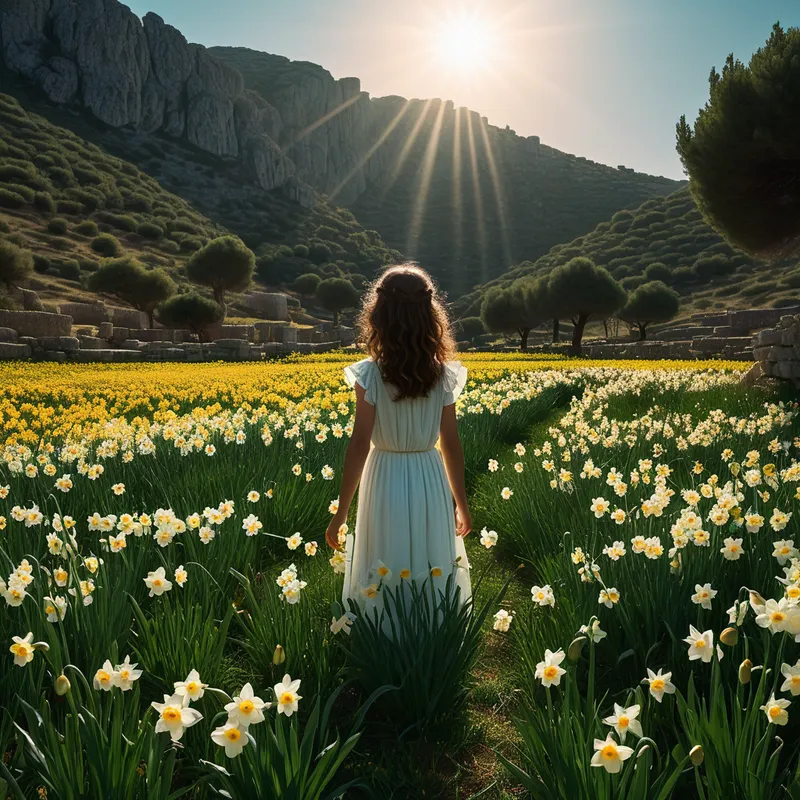
Persephone's Meadow Myth Meaning & Symbolism
The maiden Persephone is abducted from a meadow by Hades, leading to a cycle of descent and return that governs the seasons and the soul.
The Tale of Persephone’s Meadow
Let the story be told as it was in the beginning, when [the world](/myths/the-world “Myth from Tarot culture.”/) was younger and the gods walked closer to the skin of [the earth](/myths/the-earth “Myth from Hindu culture.”/).
There was a place where the light pooled like honey. [Persephone](/myths/persephone “Myth from Greek culture.”/), the Kore, the radiant girl, danced there with her companions, the Oceanids. This was no ordinary field. It was a meadow of becoming, where every blossom was a promise and the air hummed with the pure potential of life not yet lived. The grass was a tender green that knew no shadow, and the flowers—oh, the flowers—were a riot of color spilled from the palette of her mother, Demeter.
On this day, a strangeness glimmered at the meadow’s heart. A flower unlike any other, a [narcissus](/myths/narcissus “Myth from Greek culture.”/), shone with a light of its own making, a hundred blossoms on a single stem, and its fragrance was a song that bypassed the ears to speak directly to the soul. It was a lure, planted by the will of Zeus himself. Drawn by its impossible beauty, Persephone reached out, her fingers stretching to touch the radiant center.
The earth groaned.
It did not crack so much as unfold. A great chasm tore the meadow’s floor asunder, and from that abyss came a sound like mountains moving. Then, the darkness took form. [Hades](/myths/hades “Myth from Greek culture.”/), lord of the unseen, rode forth in a chariot of polished obsidian, drawn by steeds the color of midnight and memory. He did not ask. He did not parley. In one swift, terrible motion, he caught the shrieking maiden, her cries swallowed by the rushing wind of descent, and plunged back into the depths. The earth sealed itself above them, leaving only a scar in the grass and the fading echo of a scream.
The sun, which had moments before warmed the meadow, now seemed a cold, distant coin. The flowers bowed their heads. The world held its breath. Demeter’s wail of loss would soon scour the earth, bringing winter for the first time, but here, in the meadow, there was only the silence of a terrible, perfect completion. The girl was gone. The Queen’s journey had begun.

Cultural Origins & Context
This central narrative, known as the Homeric Hymn to Demeter, was not mere entertainment. Composed likely in the 7th century BCE, it was a sacred text, performed in the context of the Eleusinian Mysteries, the most famous and revered initiatory cult of the ancient world. For over a millennium, initiates—from slaves to emperors—made the pilgrimage to Eleusis to be shown the “things done” and “things said” derived from this myth.
Its societal function was profound. It explained the existential puzzle of the seasons: why life dies and is reborn. But more importantly, it provided a template for facing the greatest human fear: death. The Mysteries promised that, like Persephone, the soul had a destiny beyond the grave, a status and a place secured through a sacred story. The myth was a collective container for anxiety, transforming the raw terror of mortality into a structured, hopeful narrative of cyclical return. It was told not to historians, but to the soul in ceremony, its power lying in its performance and the subsequent revelation it promised.
Symbolic Architecture
The [meadow](/symbols/meadow “Symbol: A meadow often symbolizes peace, tranquility, and a connection to nature.”/) is not a [location](/symbols/location “Symbol: The symbol of ‘Location’ signifies a sense of place, context, and the environment in which experiences unfold.”/), but a state of [consciousness](/symbols/consciousness “Symbol: Consciousness represents the state of awareness and perception, encompassing thoughts, feelings, and experiences.”/). It represents the innocent, pre-conscious [psyche](/myths/psyche “Myth from Greek culture.”/)—the “Kore” state of potentiality, where [the ego](/myths/the-ego “Myth from Jungian culture.”/) dances in the sunlight of the maternal world, unaware of [depth](/symbols/depth “Symbol: Represents profound layers of consciousness, hidden truths, or the unknown aspects of existence, often symbolizing introspection and existential exploration.”/), conflict, or [paradox](/symbols/paradox “Symbol: A contradictory yet true concept that challenges logic and perception, often representing unresolved tensions or profound truths.”/). It is the garden of [childhood](/symbols/childhood “Symbol: Dreaming of childhood often symbolizes nostalgia, innocence, and unresolved issues from one’s formative years.”/), both literal and psychological, where everything is provided and nothing is truly chosen.
The narcissus is the call of the Self, beautiful and fatal. It is the symbol that simultaneously captivates the conscious mind and opens a pathway to the underworld of the unconscious.
[Hades](/symbols/hades “Symbol: Greek god of the underworld, representing death, the unconscious, and hidden aspects of existence.”/), whose name means “the Unseen,” is not a [villain](/symbols/villain “Symbol: A character representing opposition, moral corruption, or suppressed aspects of self, often embodying fears, conflicts, or societal threats.”/), but a principle. He is the necessary, compelling force of the deep psyche—the [shadow](/symbols/shadow “Symbol: The ‘shadow’ embodies the unconscious, repressed aspects of the self and often represents fears or hidden emotions.”/), the complex, the archetypal Other who ends one [life](/symbols/life “Symbol: The symbol of ‘Life’ represents a journey of growth, interconnectedness, and existential meaning, encompassing both the joys and challenges that define human experience.”/) to begin another. His abduction is a brutal form of [initiation](/symbols/initiation “Symbol: A symbolic beginning or transition into a new phase, status, or awareness, often involving tests, rituals, or profound personal change.”/). The [pomegranate seeds](/myths/pomegranate-seeds “Myth from Greek culture.”/) she later eats are the [food](/symbols/food “Symbol: Food in dreams often symbolizes nourishment, both physical and emotional, representing the fulfillment of basic needs as well as deeper desires for connection or growth.”/) of that new [realm](/symbols/realm “Symbol: The symbol of ‘Realm’ often signifies the boundaries of one’s consciousness, experiences, or emotional states, suggesting aspects of reality that are either explored or ignored.”/); they are commitments made in darkness, the [integration](/symbols/integration “Symbol: The process of unifying disparate parts of the self or experience into a cohesive whole, often representing psychological wholeness or resolution of internal conflict.”/) of [underworld](/symbols/underworld “Symbol: A symbolic journey into the unconscious, representing exploration of hidden aspects of self, transformation, or confronting repressed material.”/) [knowledge](/symbols/knowledge “Symbol: Knowledge symbolizes learning, understanding, and wisdom, embodying the acquisition of information and enlightenment.”/) that makes return to the old meadow impossible. She is no longer just Demeter’s [daughter](/symbols/daughter “Symbol: In dreams, a daughter symbolizes innocence, potential, and the nurturing aspects of oneself or one’s relationships.”/); she is Persephone, sovereign of a hidden [kingdom](/symbols/kingdom “Symbol: A kingdom symbolizes authority, belonging, and a sense of identity within a larger context or community.”/).
The [resolution](/symbols/resolution “Symbol: In arts and music, resolution refers to the movement from dissonance to consonance, creating a sense of completion, release, or finality in a composition.”/)—her cyclical return—establishes the foundational law of the psyche: life is not a [linear](/symbols/linear “Symbol: Represents order, predictability, and a direct, step-by-step progression. It symbolizes a clear path from cause to effect.”/) [ascent](/symbols/ascent “Symbol: Symbolizes upward movement, progress, spiritual elevation, or striving toward higher goals, often representing personal growth or transcendence.”/), but a rhythmic oscillation between upper and lower worlds, consciousness and unconsciousness, [activity](/symbols/activity “Symbol: Activity in dreams often represents the dynamic aspects of life and can indicate movement, progress, and engagement with personal or societal responsibilities.”/) and [reflection](/symbols/reflection “Symbol: Reflection signifies self-examination, awareness, and the search for truth within oneself.”/).

The Dreamer’s Resonance
When this myth stirs in modern dreams, it rarely appears in classical garb. The dreamer may find themselves in a beautiful, safe place—a childhood home, a perfect garden, a successful career “meadow”—when suddenly, the ground gives way. This is the somatic signature of the complex activating: a feeling of falling, of being swallowed, of an irresistible pull into depression, anxiety, or a life crisis.
A dream of being trapped in a basement, of a loved one vanishing down a dark hallway, or of a lush landscape abruptly turning barren and cold all echo Persephone’s rupture. The psychological process is one of necessary descent. The ego, identified with the “maiden” state of adapted functioning, is being summoned—forcibly, if it will not go willingly—into a confrontation with what it has excluded. The dream is not a prophecy of doom, but an image of initiation in progress. The body often feels heavy, stuck, or cold in resonance with this archetypal shift, signaling a withdrawal of libido from the outer world to fuel the inner transformation.

Alchemical Translation
For the modern individual, Persephone’s journey is the alchemical model of individuation. The [nigredo](/myths/nigredo “Myth from Alchemical culture.”/), the blackening, is the abduction itself—the devastating loss, the depression, the collapse of a cherished identity. The meadow must be lost. To cling to it is to refuse the call of [the Self](/myths/the-self “Myth from Jungian culture.”/), resulting in a sterile, repetitive existence, a perpetual spring that never bears fruit.
The soul’s sovereignty is earned in the underworld, not in the sunlight. We do not choose our depths, but we must choose how to rule them.
Eating the pomegranate seeds is the critical act of voluntary engagement with the darkness. In psychological terms, it is the decision to analyze the dream, to sit with the depression instead of fleeing it, to consciously engage with the complex rather than be possessed by it. This is the coniunctio, [the sacred marriage](/myths/the-sacred-marriage “Myth from Various culture.”/), where the conscious ego (Persephone) weds the contents of the unconscious (Hades), giving birth to a new, mediating consciousness—the Queen who knows both worlds.
Her cyclical return represents the achieved state of the individuating person. They can function in the upper world of relationships, work, and daily life, but they are irrevocably changed. They carry the knowledge of the depths within them, which grants compassion, depth, and the authority that comes from having faced the ultimate Other. They are no longer victims of life’s winters; they understand they are part of the cycle that makes all life, and all depth of soul, possible. The meadow is remembered, but it can never be home again, for the soul’s true home is now the entire, spinning cycle of light and dark.
Associated Symbols
Explore related symbols from the CaleaDream lexicon: