
Persephone & the Asphodel Myth Meaning & Symbolism
The Queen of the Underworld, born from a stolen moment and a fateful seed, rules the realm of shades where the asphodel blooms in silent, eternal memory.
The Tale of Persephone & the Asphodel
Listen, and I will tell you of the day the world cracked open. It began in the eternal spring of Demeter, where her daughter, Kore, danced with the Oceanids. The air was thick with the scent of narcissus, a perfume so heavy it was an enchantment. Kore, a girl woven from sunlight and meadow-flowers, reached for one blossom of surpassing beauty. As her fingers closed around its stem, the earth beneath Nysa’s plain did not just part—it roared. From the abyss, a chariot of blackest iron, drawn by steeds whose breath was frost, erupted into the light. And in it stood Hades, his form both terrible and majestic, his gaze fixed on the radiant maiden.
He did not ask. He swept her, her cry swallowed by the chasm, into the depths. The earth sealed itself, leaving only a trampled meadow and a single, fading cry that echoed in the suddenly silent air. Above, Demeter’s grief was a force of nature. She cast off her divinity, wrapped herself in the guise of an old woman, and let the world wither. Crops failed. The green land turned to dust. Mortals perished, their prayers rising like smoke to an unhearing sky. For nine days and nights, the goddess of life mourned, and all life mourned with her.
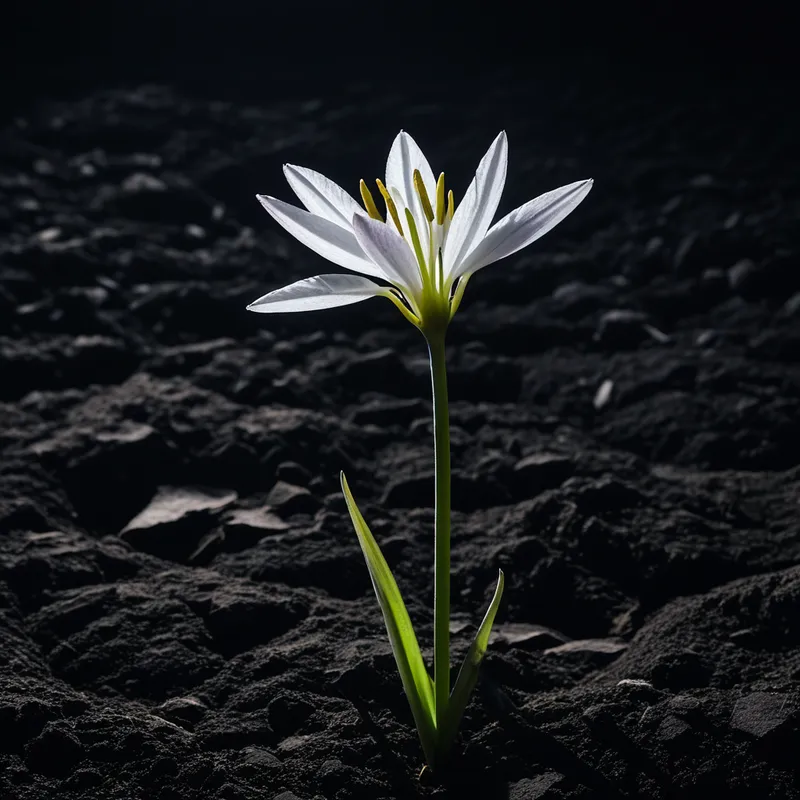
Meanwhile, in the sunless kingdom, a transformation was seeded. Kore was led to a throne of polished obsidian. Hades offered her not captivity, but dominion. He offered her the crown of his realm, its endless, quiet fields, and its populace of silent shades. She wandered the Asphodel Meadows, a vast, grey plain where the ghostly flowers bloomed, reflecting the pale, memory-lit haze of the souls who dwelled there. It was a land of quiet, of echoes, of a different kind of truth. In her loneliness, a servant offered solace: a blood-red pomegranate. Its juice was startlingly sweet. She ate six seeds.
This act, a simple acceptance of underworld food, became an unbreakable contract. When Hermes, at the command of a desperate Zeus, finally descended to bring her back, the pact was revealed. For each seed consumed, a month of the year must be spent below. The maiden who was stolen was no more. In her place stood Persephone, her eyes holding the deep knowledge of the root and the seed. She ascended, and with her, Demeter’s joy restored the world to blossom. But henceforth, when Persephone descends to her dark throne, the world above remembers the taste of the pomegranate and turns cold, and the asphodel of the underworld seems to whisper her name.
Cultural Origins & Context
This central myth, most completely told in the Homeric Hymn to Demeter, was not mere entertainment. It was the sacred narrative underpinning the most profound mysteries of the ancient Greek world: the Eleusinian Mysteries. At Eleusis, initiates were ritually guided through a symbolic re-enactment of Demeter’s search and Persephone’s return, promising them a blessed state in the afterlife, free from the bleak fate of the common shade in the Asphodel Meadows. The myth thus functioned on multiple levels: as an etiological tale for the seasons, as a theological foundation for cultic practice offering hope beyond death, and as a societal narrative exploring the traumatic yet necessary transitions of female life—from maiden (kore) to married woman (nymphe) to sovereign queen (Persephone). It was recited, performed, and experienced, binding the community to the cycles of nature and the mysteries of the soul’s journey.
Symbolic Architecture
The myth’s power lies in its dense weave of irreversible choices and earned sovereignty. Persephone is not a passive victim by the end; her consumption of the pomegranate seeds is the critical act of agency that seals her dual citizenship. It is the ingestion of experience itself—the bittersweet knowledge of life, death, and what lies between.
The pomegranate seed is the compact between the conscious self and the unconscious depths; to eat it is to be forever changed by what you have known.
The asphodel is the perfect symbol of this liminal state. Unlike the vibrant, mortal flowers of the upper world, it thrives in the grey, neutral plains of the afterlife. It represents the soul’s content in memory, the quiet acceptance of one’s whole story—the joys and the sorrows rendered equal in retrospect. Persephone, ruling over these fields, becomes the psychopomp of integration. She governs not just the dead, but the memory of life. Her annual descent is not a defeat, but a necessary return to the source, to the root-chamber where the seeds for the next cycle of growth are stored in darkness.

The Dreamer’s Resonance
When this myth stirs in the modern psyche, it often manifests in dreams of sudden descent: elevators plunging, ground giving way, or finding vast, silent basements in familiar homes. The somatic feeling is one of weight, of being pulled into a gravity well of quiet. One might dream of eating a strange, potent fruit in a shadowy place, or of tending a garden of grey, luminous flowers.
These are not nightmares of pure terror, but dreams of profound, if daunting, transition. The psyche is signaling a necessary encounter with its own shadow and a reclaiming of personal authority from a place that initially felt like abduction or loss. The dreamer is in the process of digesting a life-altering experience—a grief, a trauma, a major life change—and is being called to find sovereignty within it. The asphodel in the dream points to the nascent ability to hold contradiction: to be both wounded and whole, above and below, without denying either realm.

Alchemical Translation
The individuation process modeled here is the nigredo and albedo of the soul—the descent into the blackness of the unconscious (abduction, the Underworld) and the emergence of the purified, integrated white stone (the sovereign Queen). Persephone’s journey is the archetypal map for psychic transmutation.
The goal is not to escape the underworld, but to become its queen—to hold conscious authority over the very depths that once seemed to possess you.
First, the conscious identity (Kore, the maiden-ego) is shattered by an encounter with the powerful, often disruptive forces of the unconscious (Hades). This feels like a catastrophe, a theft of innocence. The subsequent period (Demeter’s grief) is a necessary withdrawal, a winter of the soul where old patterns die. The crucial alchemical act is the voluntary ingestion of the pomegranate seeds—the conscious decision to assimilate the lessons of the depth, to “eat” one’s own experience and be bound by its truth. This creates the permanent link. The final stage is not a return to the previous self, but the birth of a new, compound being: Persephone, who moves fluidly between the cultivated world of persona and the wild, rich plains of the inner world. She has made a home in the Asphodel Meadows of her own soul, ruling her inner shades with compassion, because she knows their names. Her cycle becomes the rhythm of a mature psyche: periods of engagement in the outer world, always followed by a sacred, non-negotiable return to the nourishing, formative dark.
Associated Symbols
Explore related symbols from the CaleaDream lexicon: