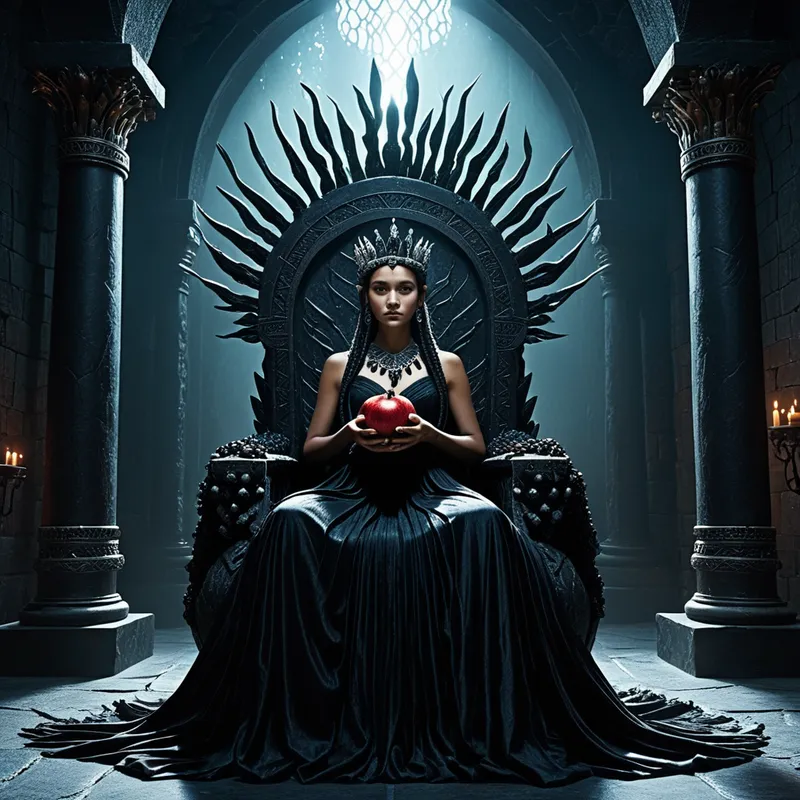
Persephone- queen of Myth Meaning & Symbolism
A goddess is abducted to the underworld, becomes its queen, and returns transformed, embodying the cycle of life, death, and profound inner sovereignty.
The Tale of Persephone- queen of
Hear now of the world’s turning, of the hinge between light and deep earth. In the time before memory, when the Titans were bound and the new gods ruled from Olympus, the earth was a place of unending blossom. This was the gift of Demeter, whose love for the soil was matched only by her love for her daughter, Kore—the Maiden. Kore was spring incarnate, her laughter causing crocuses to spear the turf, her footsteps leaving trails of violets.
On a day of impossible blue, while gathering narcissus with the daughters of Okeanos in the Nysian plain, the earth groaned. Not in pain, but in awful, yielding welcome. A chasm tore the meadow wide, and from the abyss came a chariot of blackest jet, drawn by immortal, smoke-maned horses. The driver was Hades, lord of the unseen realms, his face pale as a moon unseen, his eyes holding the stillness of ages. He had seen the maiden’s radiance and, with the silent consent of her father Zeus, had come to claim his queen.
His hand, cold as river stone, closed around her wrist. Kore’s cry was swallowed by the closing earth. The sunlit world vanished. The chariot plunged down through roots of mountains and rivers of sleep, into the kingdom of Hades. The meadows were replaced by fields of grey asphodel, the song of birds by the whisper of countless shades. The Maiden was gone. In her place stood a frightened goddess in a palace of gloom.
Above, Demeter’s grief was a scythe. She cast off her divinity, wrapped herself in the guise of an old woman, and wandered the mortal world. In her sorrow, she withheld her grace. The green world withered. Seeds froze in the furrow, vines turned to brittle lace, and the breath of life grew thin. Famine stalked humanity, and the gods received no sweet smoke from barren altars.
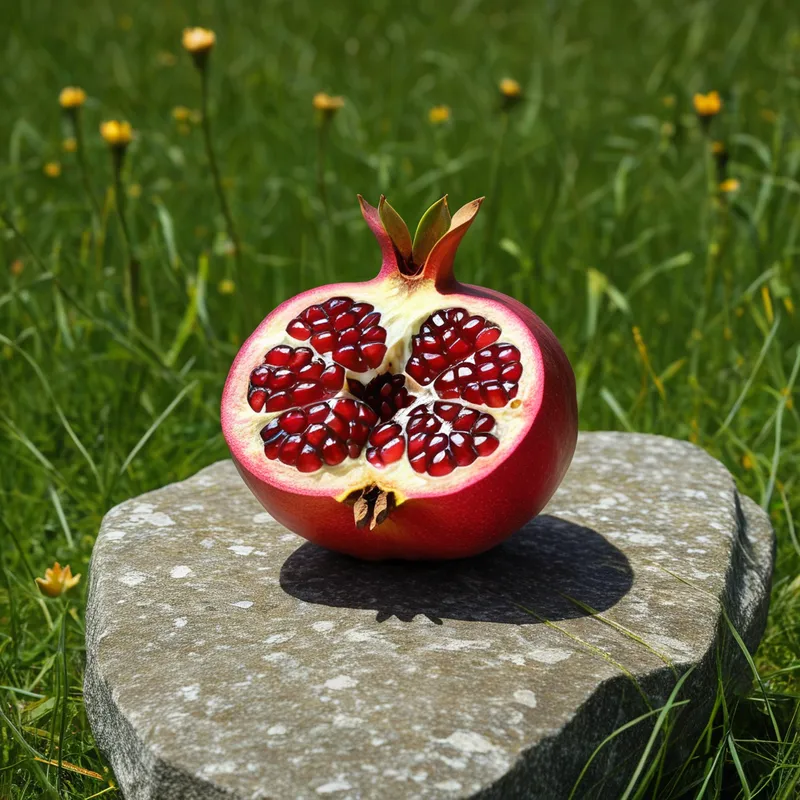
Driven by mortal suffering, the messenger Hermes was at last sent to the deep. He found not a weeping girl, but a woman seated beside the dark lord. She had eaten. Not a feast, but a fate—six seeds from the blood-red heart of a pomegranate, offered perhaps in loneliness, perhaps in a dawning acceptance. That simple act bound her to the realm of the dead for a portion of each turning year.
Hermes led her back, up the long path to the world of light. Where her foot touched the stricken earth, a shock of green followed. Mother and daughter met in a field of Eleusis, and their embrace was a thunderclap of returning life. But the pact was sealed. For six seeds, six months she must reign as Persephone, dread Queen of the Underworld. And for the other six, she ascends as Kore, bringer of flowers. Thus, the world learned the rhythm of its own heart: the yielding, the barren, the return. The Maiden had descended, and the Queen had arisen.
Cultural Origins & Context
This is the heart of the Eleusinian Mysteries, the most sacred and secretive religious rites of the ancient Greek world. For nearly two millennia, initiates from all strata of society—from slaves to emperors—made the pilgrimage to Eleusis to be shown the “holy things” concerning Demeter and Persephone. The myth was not merely a story to be read but a profound mystery to be experienced. Its transmission was oral and ritualistic, a guarded secret that promised initiates a blessed lot in the afterlife, freeing them from the fear of death.
Societally, the myth functioned on multiple levels. It was an etiological tale explaining the stark Mediterranean seasons of growth and drought. More deeply, it provided a divine template for the human experiences of catastrophic loss, forced marriage, and the transition of a girl into a woman with agency and power in a patriarchal structure. Persephone’s story gave sacred form to the most terrifying transitions, offering a promise that even the deepest descent could lead to a form of sovereignty.
Symbolic Architecture
The myth is a perfect symbolic map of the psyche’s necessary journey into its own depths. Kore represents the innocent, unified consciousness—the ego content in its sunlit, mother-bound state. Her abduction is not a random tragedy but an archetypal necessity: the call to individuation, often felt as a crisis, a rupture, or a profound loss that pulls us into the shadow realm.
The underworld is not a place of punishment, but the realm of all that is unseen: memory, the unconscious, trauma, and latent power.
Hades is the ruler of this interiority. He is not evil, but absolute, representing the inexorable pull toward wholeness that requires confronting what is hidden. The pomegranate seeds are the ultimate symbol of conscious choice within the unconscious realm. To eat the food of the dead is to internalize the experience, to let it change one’s fundamental substance. It is the moment of accepting a painful truth, integrating a shadow aspect, or claiming a difficult destiny. This act transforms Kore from a victim of abduction into Persephone, a conscious participant in the cosmic order. She becomes the liminal queen, the only Olympian who moves freely between the worlds of the living and the dead, embodying the connection between life and what lies beyond it.

The Dreamer’s Resonance
When this myth stirs in modern dreams, it signals a profound process of psychic reorganization. Dreaming of being pulled underground, of finding oneself in labyrinthine tunnels, or of a radiant figure in a dark place points to an active individuation process. Somatic sensations might include a feeling of weight, cold, or constriction—the body registering the “pull” of the unconscious.
The dreamer may encounter a potent, often numinous symbol equivalent to the pomegranate: a key, a contract, a piece of fruit, or a dark jewel. To interact with this symbol is the dream-ego facing its own “pomegranate moment”—the point of no return where one must consciously accept a difficult but transformative truth. This dream pattern often surfaces during life transitions that feel like a loss of innocence: the end of a relationship, a career upheaval, a diagnosis, or any event that forces a confrontation with one’s mortality or hidden depths. The psyche is narrating its own necessary descent toward a more complex, sovereign self.

Alchemical Translation
The alchemical journey mirrored in this myth is the nigredo, the blackening, followed by the albedo. Kore’s radiant life is the initial unrefined state. The abduction is the plunge into the nigredo—the dissolution of the old identity in the dark waters of the unconscious. This is a period of depression, confusion, and feeling utterly lost.
Sovereignty is not given; it is forged in the silent negotiations one makes with one’s own darkness.
Persephone’s rule in the underworld represents the albedo. It is not a return to the surface, but the finding of clarity, order, and authority within the darkness itself. She learns the laws of the hidden realm. The modern individual’s alchemical translation is this: we must cease resisting our own “abductions”—our crises and depressions—and instead learn to rule the territory they reveal. We must find the pomegranate in our own underworld and choose to eat its seeds, to internalize the lesson and claim the authority that comes from having survived the depths. The cyclical return is not to the old innocence, but as a transformed being who carries the wisdom of the abyss into the world of light, thereby giving it meaning and fertility. We become, like Persephone, mediators of our own depths, rulers of our own inner kingdoms, and the conscious authors of our recurring renewals.
Associated Symbols
Explore related symbols from the CaleaDream lexicon: