
Persephone from Greek mytholog Myth Meaning & Symbolism
The maiden goddess abducted to the underworld, whose cyclical return embodies the soul's descent into shadow and the promise of renewal.
The Tale of Persephone from Greek mytholog
Hear now the story that holds the turning of the world in its heart, the tale of the maiden who became queen of two realms.
In the first days, when the world was young and green with an endless spring, there lived Demeter, she who makes the grain swell. Her joy was her daughter, Kore, whose laughter was the sound of budding leaves and whose footsteps coaxed flowers from the bare earth. They wandered the fields of Nysa, and all was light.
But in the deep, silent halls beneath the world, Hades, the unseen one, stirred. He had seen the maiden’s light, a gold coin in his kingdom of shades, and a want he had never known took root in his stony heart. He went to his brother, Zeus, and received a silent, fateful consent.
The day of the rift was deceptively fair. Kore was gathering blossoms with the Horai and the daughters of Okeanos. She reached for a narcissus of stunning beauty, a flower planted by the earth itself at Hades’s command. As her fingers closed around its stem, the meadow cracked open with a sound like a mountain sighing. From the black chasm, a chariot of blackened iron drawn by immortal, smoke-maned horses erupted. A hand, strong as the roots of the world, seized her. Her cry was swallowed by the closing earth, and only a torn girdle and scattered flowers remained where light had been.
Demeter’s grief was a force of nature. She cast off her divinity, wrapped herself in the cloak of a mortal crone, and walked the earth. Where she walked, life withered. The soil hardened to iron; seeds died in the furrow; a bitter frost seized the world. Humanity faced extinction, and the gods found their altars cold.
In her wanderings, she came to Eleusis, where she served as a nurse to a mortal prince. In a moment of desperate, mad love, she tried to burn the mortality from the child to make him immortal, but was stopped. This failed act of transformation revealed her true power and her profound despair.
Meanwhile, in the sunless land, a different transformation was unfolding. Kore, the maiden, was gone. In her place was Persephone. Hades did not chain her in a dungeon, but offered her a throne of ebony beside his own. She walked among the silent hosts of the dead, and a strange authority began to settle upon her, a sovereignty born of profound encounter with the ultimate shadow.
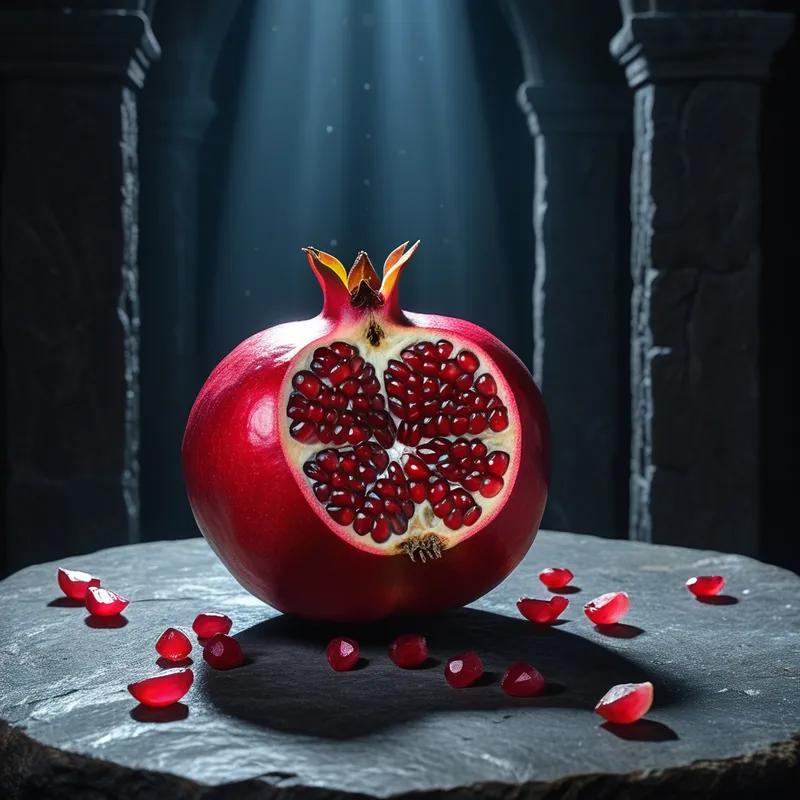
The world above was dying. Finally, Hermes was sent to the underworld to parley. Hades agreed to release his queen—but only if she had taken no food of the dead. Persephone, in her loneliness, had accepted a gift: seven seeds of a blood-red pomegranate from Hades’s own hand. Because she had consumed this food of his realm, a bond was forged that could not be broken.
A compromise was struck, decreed by Ananke herself. For each seed eaten, Persephone would spend one month of the year in the underworld as its dread queen. The rest, she would walk in the light with her mother.
Thus, when Persephone ascends, Demeter’s joy makes the earth bloom. This is Spring. When the time comes for her to descend, Demeter’s mourning brings the fallow silence of Winter. The maiden became the hinge of the world, and the cycle of life, death, and rebirth was sealed forever.
Cultural Origins & Context
This myth is a foundational narrative of ancient Greece, most famously detailed in the Homeric Hymn to Demeter, a text central to the Eleusinian Mysteries. Far from mere entertainment, this was a sacred story performed as part of initiatory rituals that promised initiates (mystai) a blessed afterlife and a profound understanding of the cycles of life and death. The myth was not just told; it was experienced in a communal, ritual context that blurred the line between spectator and participant.
Its societal function was multifaceted. On one level, it was an etiological myth, explaining the origin of the seasons and justifying the necessity of agricultural cycles and human labor. On a deeper, cultic level, it served as the theological heart of the Mysteries, offering a narrative of hope beyond death. Persephone’s journey modeled a potential destiny for the human soul: not eternal oblivion, but a transformative passage and a form of continued existence. The myth was transmitted through controlled, sacred channels by priests and priestesses, making it a powerful tool for social cohesion and spiritual authority.
Symbolic Architecture
At its core, the myth of Persephone is a masterful map of the psyche’s necessary engagement with the unconscious. Persephone herself symbolizes the nascent ego, the conscious personality (Kore) that must be ruptured from its idyllic, undifferentiated state in the mother-world (Demeter) to achieve complexity and sovereignty.
The abduction is not a crime, but a cruel necessity of the soul. One cannot become whole by remaining in perpetual light.
Hades represents the shadow and the underworld of the personal and collective unconscious. His realm is not a place of punishment, but of potential—the repository of all that is forgotten, repressed, and unseen. The pomegranate seeds are the ultimate symbol of conscious commitment to this shadowy realm. They represent the ingestion of deep, often bitter, knowledge of oneself and the realities of loss, desire, and power.
Demeter embodies the powerful, possessive, and creative aspect of the psyche that resists this necessary separation. Her grief-induced famine shows the psychic sterility that occurs when the conscious mind refuses to acknowledge the reality of the unconscious or the necessity of loss in growth. The cyclical resolution symbolizes the dynamic equilibrium a mature psyche must maintain: a life lived in both the conscious world of adaptation and the deep, formative world of the inner self.
The Dreamer’s Resonance
When this myth stirs in modern dreams, it signals a profound process of involuntary initiation. The dreamer may not dream of Greek deities, but of being suddenly pulled into a basement, down an elevator shaft, into a subway tunnel, or a dense, unfamiliar forest. This is the somatic signature of the abduction—a feeling of being taken by a force greater than one’s will.
Common motifs include: finding or eating a strangely compelling fruit (the pomegranate); encountering a compelling, dark, or authoritative figure (Hades); or experiencing a landscape that shifts from fertile to barren (Demeter’s grief). The dreamer is psychologically undergoing a nekyia—a descent into the underworld of their own psyche. This is often precipitated by a real-world crisis: a loss, a depression, a betrayal, or a sudden confrontation with mortality. The psyche is forcing an encounter with material it can no longer keep buried. The anxiety and disorientation in the dream mirror the ego’s resistance to this essential, if terrifying, process of dismantling and re-formation.

Alchemical Translation
The alchemical journey mirrored in Persephone’s myth is the nigredo—the blackening, the descent into the primal matter, the encounter with the massa confusa. Kore’s life in the sunlit meadow is the albedo, the initial white, pure state. The abduction is the shattering of that state, necessary for any true transformation to begin.
The throne in the underworld is not a prison, but the seat of a hard-won sovereignty. One must reign over one’s own darkness to be free.
Her time below represents the crucial stage of separatio and mortificatio—separating from the old identity (the maiden) and allowing it to “die.” Sitting on the throne beside Hades is the coniunctio oppositorum—the sacred marriage of opposites (conscious/unconscious, light/dark, life/death) within the individual. This is not a merger that erases difference, but a dynamic partnership.
The return, governed by the pomegranate’s law, is the achievement of the citrinitas (yellowing) and ultimately the rubedo (reddening)—the fully realized, cyclical self. The modern individual undergoing this alchemy moves from a state of naive innocence (Kore), through a crisis that feels like a brutal theft of one’s old life (abduction), into a period of depression, introspection, and confronting the shadow (the underworld). The “pomegranate seeds” are the insights, wounds, or truths from this dark period that one consciously integrates. The final stage is not a return to the old self, but the emergence of a resilient, cyclical being who can move between productivity and introspection, social engagement and solitary depth—a person who contains both the nurturing light of Demeter and the sovereign darkness of Persephone, Queen of the Deep.
Associated Symbols
Explore related symbols from the CaleaDream lexicon: