
Persephone / Flora Myth Meaning & Symbolism
The maiden goddess abducted to the underworld, whose cyclical return brings spring, embodying the soul's journey through death and rebirth.
The Tale of Persephone / Flora
The world was young, and the green earth knew only one season: the eternal, laughing spring of Demeter. In the Elysian fields of Nysa, her daughter Kore—whom we call Persephone—danced. Her feet were bare upon the warm soil, her laughter the sound of rustling leaves, her form the very essence of the unfolding bud. She was the unbroken circle of life, innocent and whole.
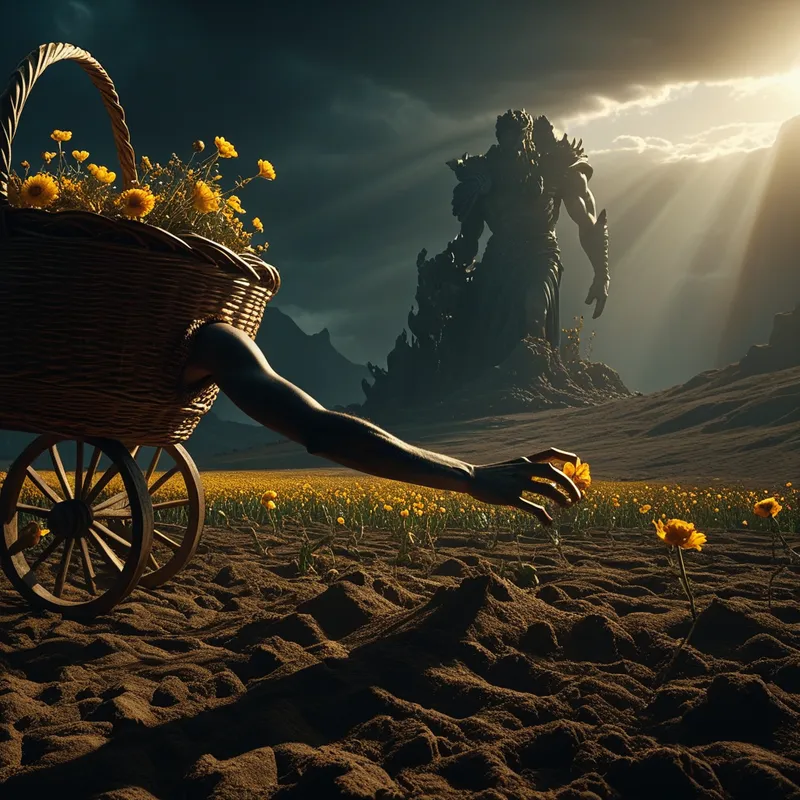
On a day when the sun hung like a ripe peach in a cerulean sky, she wandered from her companions. Drawn by the narcotic scent of a hundred blossoms, she reached for a narcissus of unearthly beauty—a flower placed there by the design of Hades, brother to Zeus. As her fingers closed around its stem, the earth beneath her did not yield; it roared. The fertile ground split asunder with a sound like a mountain breaking its back. From the abyss came the thunder of hooves not born of sunlight, and a chariot of beaten gold and shadow erupted into the day. A hand, strong as stone and cold as a deep river, seized her wrist.
Her cry was swallowed by the rushing dark. The chariot plunged downward, and the wound in the world sealed itself above her, leaving only a scatter of trampled violets and a silence so profound it ached. The light, the scent of thyme, the warmth—all were gone, replaced by the echoing stillness of the House of Hades.
Above, Demeter felt the severing in her very bones. The goddess cast off her splendor, wrapped herself in the grief of mortals, and roamed the earth as a crone. Where she walked, life withered. The soil hardened to iron; seeds froze in their husks; a great winter, the first the world had ever known, fell like a shroud. Humanity faced extinction, and the gods of Olympus trembled before the barren silence.
Meanwhile, in the sunless realm, Persephone sat upon a throne of polished obsidian. She was its queen, yet she was its prisoner. The lord of the dead offered her his kingdom, but she turned her face away, fasting, a living monument to loss. Yet, in the profound stillness, a transformation began to root. She was no longer only the maiden of the fields; she was becoming the sovereign of the deep.
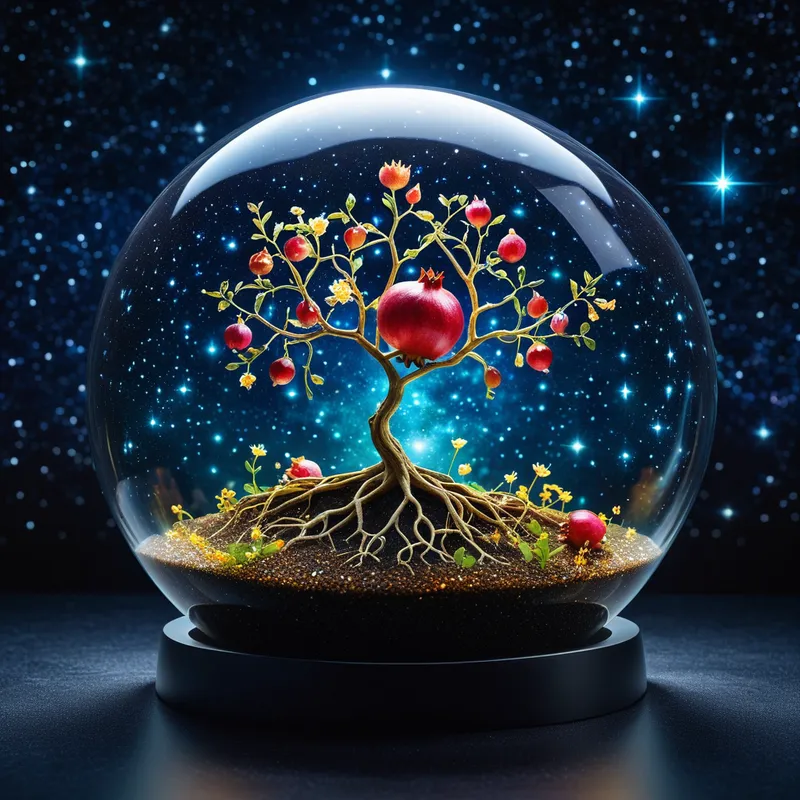
Driven by the cries of a starving world, Zeus commanded Hades to release her. As Persephone prepared to ascend to the light, the lord of the underworld offered her a final gift: a pomegranate, its ruby seeds glistening like captured stars. Perhaps from cunning, perhaps from a dawning acceptance, or perhaps from a thirst deeper than she knew, she ate six seeds.
This simple act was a covenant. Having consumed the food of the dead, her return could not be absolute. A compromise was forged in the halls of fate: for each seed eaten, she would spend one month of the year reigning beside Hades in the underworld. The rest, she would walk the earth with her mother.
And so, when Persephone ascends, Demeter’s heart unfurls. Flowers burst through the thawing ground, trees clothe themselves in green, and the world is called Spring. When the time comes and the queen must descend, Demeter’s grief returns, and the earth draws its blanket of frost and sleep over itself. This is the rhythm of the world: not a fall, but a turning. Not an ending, but a promise whispered between light and dark.
Cultural Origins & Context
This central myth, known as the Homeric Hymn to Demeter, was not mere entertainment. It was the sacred narrative underpinning the most profound of the Eleusinian Mysteries, celebrated for nearly two millennia at Eleusis near Athens. The myth was performed, chanted, and ritually enacted, but its deepest truths were never written down; they were experienced by initiates sworn to secrecy.
Its societal function was multifaceted. On the most literal level, it was an etiological tale explaining the seasonal cycle, giving agrarian societies a divine narrative for the death and rebirth of crops. On a civic level, it established the sanctity of marriage and the painful but necessary transition of a daughter from her mother’s home. But its primary power was psychological and spiritual. The Mysteries used this story of abduction, grief, and return to mediate humanity’s deepest terror: the mystery of death. Persephone’s journey offered a template—not of permanent loss, but of cyclical transformation and a form of blessed existence beyond the grave.
Symbolic Architecture
The myth is a perfect symbolic map of the psyche’s necessary descent into its own depths. Persephone, the ego-consciousness, exists in a state of naive unity with the Great Mother (Demeter), representing unconscious, undifferentiated life. The abduction is not a random tragedy but an inevitable call to individuation.
The soul cannot flower in perpetual sunlight; it must consent to be planted in the dark earth.
Hades is the psychopomp and ruler of the unconscious. His realm is not a place of punishment, but of soul-making—the interior space where identity is stripped of its familiar supports and forced to confront its own essence. The pomegranate seeds are the ultimate symbol of ambiguous choice. They represent a conscious engagement with the depths. By eating them, Persephone actively participates in her own fate; she internalizes the experience of the underworld, making it a permanent part of her being. She is no longer Kore, the maiden. She is Persephone, Queen of the Underworld—the ego that has integrated the power of the unconscious and returned, transformed, to the world of light.
The Dreamer’s Resonance
When this myth stirs in modern dreams, it signals a profound psychological process often felt somatically as a “wintering” of the soul. One may dream of being pulled into a basement, down an elevator shaft, or into a deep, root-filled forest. There is a sense of involuntary descent, of life forcing a confrontation with what has been repressed: a grief, a trauma, a dormant power, or a necessary ending.
The dreamer might encounter a figure of compelling, shadowy authority (Hades) or find themselves in a lush, eerie garden underground. The key somatic marker is often a feeling of paralysis or enforced stillness—the “fast” of Persephone. This is the psyche’s way of insisting on a period of incubation, where old identities must fall away before a new consciousness can form. To dream of emerging from such a place, especially bringing something back (a stone, a dark flower, a piece of fruit), indicates the beginning of integration—the ascent with newfound sovereignty.

Alchemical Translation
The alchemical journey of individuation mirrors Persephone’s cycle precisely. It begins with the nigredo, the blackening: the abduction, the descent into Hades’ realm. This is the painful but essential stage of dissolution, where the comfortable, sunlit ego-structures are broken down. The ego, like Persephone, feels lost, stolen, and bereft.
The pomegranate seeds signify the albedo, the whitening. This is the moment of conscious choice within the darkness. It is the decision to truly see and ingest the reality of one’s shadow, one’s wounds, and one’s latent power. It is the acceptance of the process itself. By internalizing this “food of the dead,” the soul begins its purification and preparation for return.
The triumph is not in the escape from the underworld, but in the claiming of its throne.
Finally, the rubedo, the reddening, is the return. This is not a return to the previous state of maidenhood, but the emergence of the queen. The integrated self carries the wisdom of the depths into the world of action. The modern individual undergoing this alchemy moves from a life dictated by external forces (the will of the mother, the demands of the father-god Zeus) to a life of self-governance. One learns that creativity (spring) is born from periods of fallow introspection (winter), that joy is deepened by the knowledge of sorrow, and that wholeness requires honoring both the light-seeking and the depth-dwelling parts of the soul. We are all, perpetually, both in the meadow and in the hall of shadows, and our humanity flowers in the tension between them.
Associated Symbols
Explore related symbols from the CaleaDream lexicon: