Peony Myth Meaning & Symbolism
A myth of a proud peony goddess, exiled for defying a winter decree, whose sacrifice brings forth the flower of wealth, honor, and unyielding spirit.
The Tale of Peony
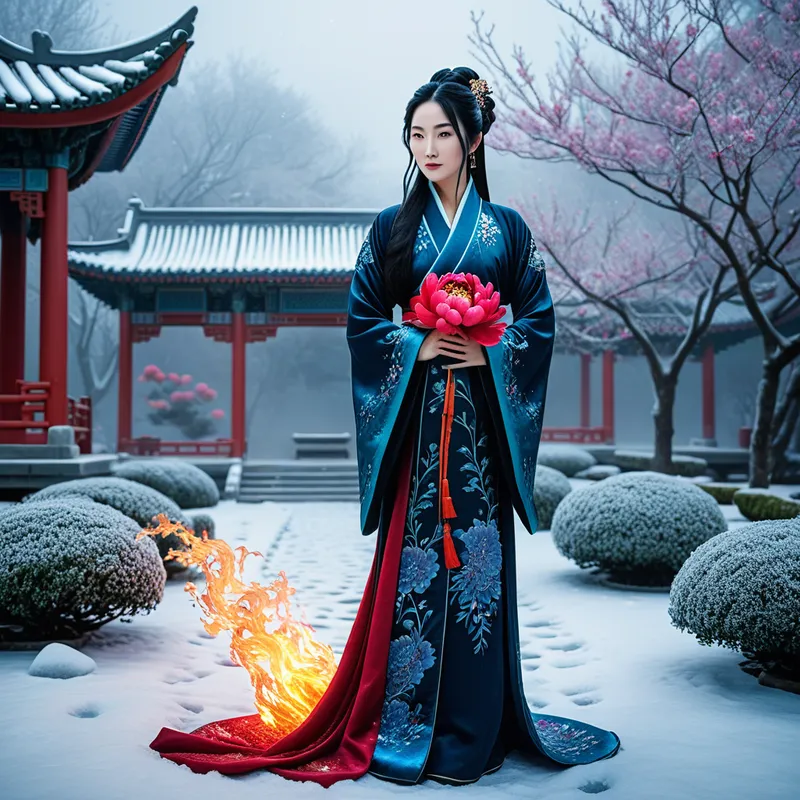
In an age when the Celestial Bureaucracy held sway over all seasons, the Empress Wu Zetian of the Tang Dynasty, in a moment of imperial caprice, issued a decree. It was deep winter, [the world](/myths/the-world “Myth from Tarot culture.”/) a monochrome scroll of ice and bare branches. From her warm palace, she commanded all flowers in her imperial garden to bloom for her pleasure on the morrow, to defy the natural order and paint the snow with their colors.
The garden trembled. The plum, hardy and obedient, pushed forth brave buds. The orchid, subtle and wise, unfurled a delicate stem. One by one, through the long, cold night, the flowers bent to the will of heaven-made-earthly, fueled by fear of the throne’s wrath. All but one.
The Peony, the Queen of Flowers, stood silent and unmoving. Her roots, deep in the loam, felt the true rhythm of [the earth](/myths/the-earth “Myth from Hindu culture.”/)—the patient turn towards spring, the necessary sleep. To bloom now was not grace, but coercion; not beauty, but submission. When dawn broke and the Empress toured her garden, a tapestry of forced color greeted her. Yet her eyes fell upon the Peony, a proud, bare thicket of stems, holding fast to its dormant truth.
Imperial rage was a cold fire. “You dare defy Us? You, who are called the Flower of Riches and Honor?” The decree was swift and terrible. The Peony, root and branch, was to be exiled. Uprooted from the heart of the empire, it was cast out to the barren, rocky slopes of Mount Li. “Let the vulgar soil of a wilderness be your kingdom,” the Empress declared, “since you scorn the splendor of Ours.”
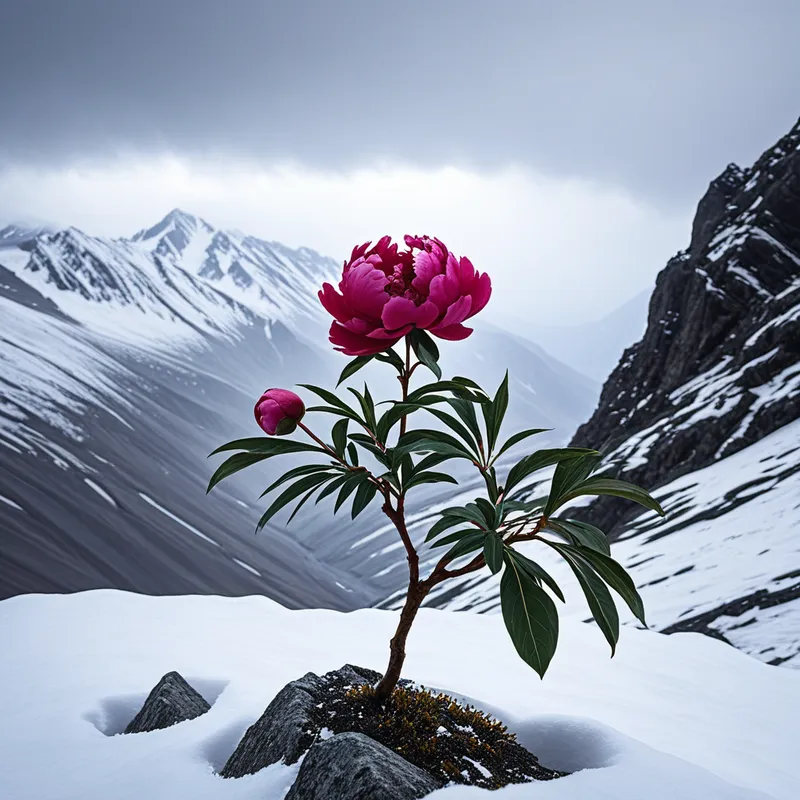
And so the Peony was banished. Cast into the thin, cold soil of the mountain, it was left to perish. But a curious alchemy began. Stripped of imperial favor, the flower connected to a deeper, older power—the raw, untamed spirit of the earth itself. It was not a death, but a homecoming. In that wild ground, its roots dug deeper, drinking not from curated canals but from secret, mineral-rich springs. When the true spring arrived, not by decree but by cosmic right, the exiled Peony did not merely bloom.
It erupted.
From the rocky scorn of Li Shan burst forth blossoms of such profound size, such intoxicating fragrance, and such impossible hues—crimson like heart’s blood, white like mountain snow, pink like the first dawn—that the news raced back to the capital. The exiled queen had not been humbled; she had been crowned anew. Her beauty, born of integrity and nurtured by hardship, outshone all the forced blossoms of the palace. In defeat, she found her true sovereignty; in exile, she discovered her kingdom.
Cultural Origins & Context
This myth, while often attached to the historical figure of Empress Wu Zetian, is a classic chuánshuō (folk tale) that crystallized during the Tang Dynasty, a [golden age](/myths/golden-age “Myth from Universal culture.”/) for the peony’s cultivation and cultural apotheosis. The story was not preserved in a single canonical text but was woven through oral tradition, poetry, and popular theater. It functioned as a societal pressure valve and a moral compass.
Told by gardeners, scholars, and storytellers, it served multiple purposes. For the common people, it was a tale of the virtuous underdog, a symbol of natural integrity triumphing over arbitrary power. For the scholar-official class, it was an allegory of the principled minister who, exiled for speaking truth to the emperor, ultimately proves his worth through unwavering virtue. The myth reinforced a core Confucian-Taoist tension: the duty to authority versus the duty to the natural, righteous Way (Dào). The peony’s ultimate [triumph](/myths/triumph “Myth from Roman culture.”/)—its beauty becoming even more legendary—validated the path of principled resistance, suggesting that true honor cannot be granted, only earned through authentic being.
Symbolic Architecture
At its [heart](/symbols/heart “Symbol: The heart symbolizes love, emotion, and the core of one’s existence, representing deep connections with others and self.”/), the [Peony](/symbols/peony “Symbol: A flower symbolizing prosperity, romance, and spiritual healing, often linked to feminine energy and divine protection.”/) myth is a [drama](/symbols/drama “Symbol: Drama signifies narratives, emotional expression, and the exploration of human experiences.”/) of essence versus imposition. The flower symbolizes the indomitable [life](/symbols/life “Symbol: The symbol of ‘Life’ represents a journey of growth, interconnectedness, and existential meaning, encompassing both the joys and challenges that define human experience.”/) force, the qì, that must follow its own intrinsic timing and [pattern](/symbols/pattern “Symbol: A ‘Pattern’ in dreams often signifies the underlying structure of experiences and thoughts, representing both order and the repetitiveness of life’s situations.”/).
The most profound beauty is not an ornament to power, but the visible signature of an soul in right alignment with its own nature.
The [winter](/symbols/winter “Symbol: Winter symbolizes a time of reflection, introspection, and dormancy, often representing challenges or a period of transformation.”/) decree represents the cold, logical, often tyrannical demands of the conscious ego or the collective—the “shoulds” and “musts” that seek to override inner timing. [Exile](/symbols/exile “Symbol: Forced separation from one’s homeland or community, representing loss of belonging, punishment, or profound isolation.”/) to Mount Li is not a [punishment](/symbols/punishment “Symbol: A dream symbol representing consequences for actions, often tied to guilt, societal rules, or internal moral conflicts.”/), but a necessary descent. It is the withdrawal from the artificial garden of [persona](/symbols/persona “Symbol: The social mask or outward identity one presents to the world, often concealing the true self.”/) and social approval into the wild, rocky [soil](/symbols/soil “Symbol: Soil symbolizes fertility, nourishment, and the foundation of life, serving as a metaphor for growth and stability.”/) of the unconscious, the place where the [soul](/symbols/soul “Symbol: The soul represents the essence of a person, encompassing their spirit, identity, and connection to the universe.”/)’s roots must find their own nourishment or perish.
The glorious blooming is the eventual, inevitable manifestation of the individuated self. The peony’s famed attributes—[wealth](/symbols/wealth “Symbol: Wealth in dreams often represents abundance, security, or inner resources, but can also symbolize burdens, anxieties, or moral/spiritual values.”/) (fù), honor (guì), and romantic prosperity—are not the goals of the [journey](/symbols/journey “Symbol: A journey in dreams typically signifies adventure, growth, or a significant life transition.”/), but its natural byproducts. They symbolize the psychic “[wealth](/symbols/wealth “Symbol: Wealth in dreams often represents abundance, security, or inner resources, but can also symbolize burdens, anxieties, or moral/spiritual values.”/)” of self-[knowledge](/symbols/knowledge “Symbol: Knowledge symbolizes learning, understanding, and wisdom, embodying the acquisition of information and enlightenment.”/), the “honor” of self-respect, and the “romance” of a deep, fertile [connection](/symbols/connection “Symbol: Connection symbolizes relationships, communication, and bonds among individuals.”/) to one’s own inner life.
The Dreamer’s Resonance
When this myth pattern stirs in the modern dreamer, it often manifests as dreams of forced performance, missed seasons, or glorious, unexpected blooming in a wasteland. You may dream of being commanded to sing while your throat is closed, to solve a puzzle while your mind is fogged, or to produce creative work on an arbitrary deadline. This is the [psyche](/myths/psyche “Myth from Greek culture.”/)’s somatic experience of the “winter decree.”
Conversely, dreams of being cast out—fired, abandoned, or left in a barren landscape—may initially feel like nightmares of failure. Yet, if attended to, these dreams can reveal the Mount Li of the soul: the necessary, lonely terrain where the artificial supports are stripped away. The psychological process here is one of contained defiance. It is not a chaotic rebellion, but a deep, somatic “no” to what is false, creating the space for a more authentic “yes” to emerge. The dream ego is learning to tolerate the cold of disapproval (external or internal) to protect the dormant, precious bud of its own true potential.
Alchemical Translation
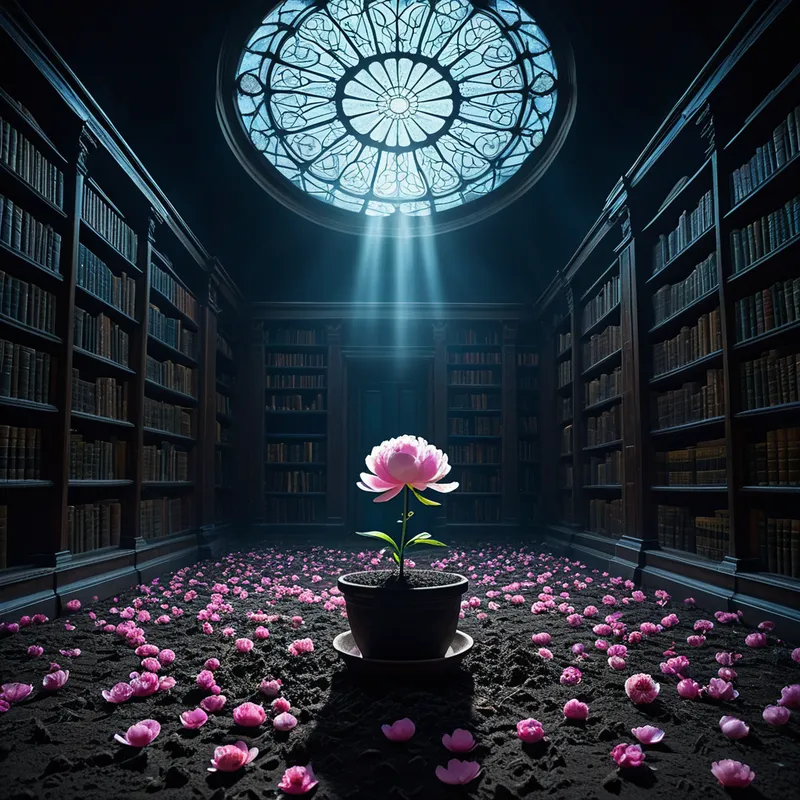
The myth models the alchemical process of psychic transmutation, where the [prima materia](/myths/prima-materia “Myth from Alchemical culture.”/) (the raw self) is subjected to the [nigredo](/myths/nigredo “Myth from Alchemical culture.”/) (the blackening, the exile in winter) to ultimately achieve the [rubedo](/myths/rubedo “Myth from Alchemical culture.”/) (the reddening, the crimson bloom).
[The first stage](/myths/the-first-stage “Myth from Alchemical culture.”/) is Recognition of the Decree: The conscious mind becomes aware of an inner or outer demand that violates its essential nature. This is the spark of individuation—the realization that one has been living in the imperial garden, blooming on command.
[The crucible](/myths/the-crucible “Myth from Alchemical culture.”/) is The Exile: This is the active, often painful, choice to withdraw energy from the imposed role. In life, this can look like leaving a job, ending a relationship, or simply stopping a pattern of people-pleasing. It feels like barrenness, a loss of identity and social warmth. This is the [solutio](/myths/solutio “Myth from Alchemical culture.”/) (dissolution) and coagulatio (coagulation in a new form) happening in the dark.
The wilderness is not where the soul is lost, but where it is found. Exile is the forge where the persona is melted down so the essence can be reforged.
The culmination is The Wild Blooming: This is not a return to the old garden, but the establishment of a new kingdom. The psychic energy that was once spent complying with decrees now flows unimpeded into the creation of one’s own life and work. The “peony” that blooms is the integrated personality—rooted in the depths of the unconscious (the wild mountain), yet manifesting in the world with unparalleled vibrancy and fragrance. Its beauty is its truth, and its truth becomes its unassailable authority. The myth assures us that the winter of the soul, endured with integrity, always precedes the most glorious and authentic spring.
Associated Symbols
Explore related symbols from the CaleaDream lexicon: