Paradiso Myth Meaning & Symbolism
A soul's guided ascent through the celestial spheres to a final, ecstatic vision of the divine, revealing the ultimate order of love.
The Tale of Paradiso
Listen, and I will tell you of a journey not of feet, but of the soul. A man, lost in the dark wood of his own midlife, having traversed the frozen pit of Cocytus and climbed the purgatorial mountain to have his sins scoured away, now stands trembling at the edge of [the world](/myths/the-world “Myth from Tarot culture.”/). The air is thin, the light is new. Before him is not a path, but an abyss of pure, waiting light. And with him is his guide, no longer the shade of a poet, but a woman transformed: Beatrice, her eyes now holding the fire of the stars themselves.
She speaks, and her voice is like a bell that rings in the substance of the heavens. “Look up,” she says. And he does. And the cosmos opens.
They are drawn upward, not by effort, but by desire—a gravitational pull of love. The first sphere, the Moon, is a [pearl](/myths/pearl “Myth from Chinese culture.”/) of shimmering, translucent substance. Here, faces form and fade in the light, souls who were inconstant yet faithful in intent. Their speech is not sound, but thought made visible, a lesson in the first grammar of paradise: here, being is communication.
And so they ascend. Sphere by sphere, the celestial machinery of the medieval mind reveals itself. The sphere of [Mercury](/myths/mercury “Myth from Roman culture.”/) glitters with righteous rulers. The sphere of [Venus](/myths/venus “Myth from Alchemical culture.”/) glows with amorous spirits dancing in a complex, joyful geometry. At each stage, Beatrice’s explanations grow more profound, her beauty more blinding, a reflection of the increasing truth they approach. In the sphere of the Sun, they are encircled by a crown of dazzling lights—the great theologians, whose wisdom forms a wheel of fire and song.
Higher still, to the sphere of Mars, where souls form a blazing cross of rubies, singing of holy war. To Jupiter, where lights spell out divine [justice](/myths/justice “Myth from Tarot culture.”/) in Latin script before forming the eagle of empire. To [Saturn](/myths/saturn “Myth from Alchemical culture.”/), the golden ladder of contemplation, where the mystics reside in silent ecstasy.
Finally, beyond the planets, they pass the Starry Sphere and the [Primum Mobile](/myths/primum-mobile “Myth from Medieval Cosmology culture.”/). Here, physics dissolves into metaphysics. Dante’s human senses fail. He cannot describe what he sees, only what he feels: an all-encompassing, intelligent love that moves the sun and the other stars.
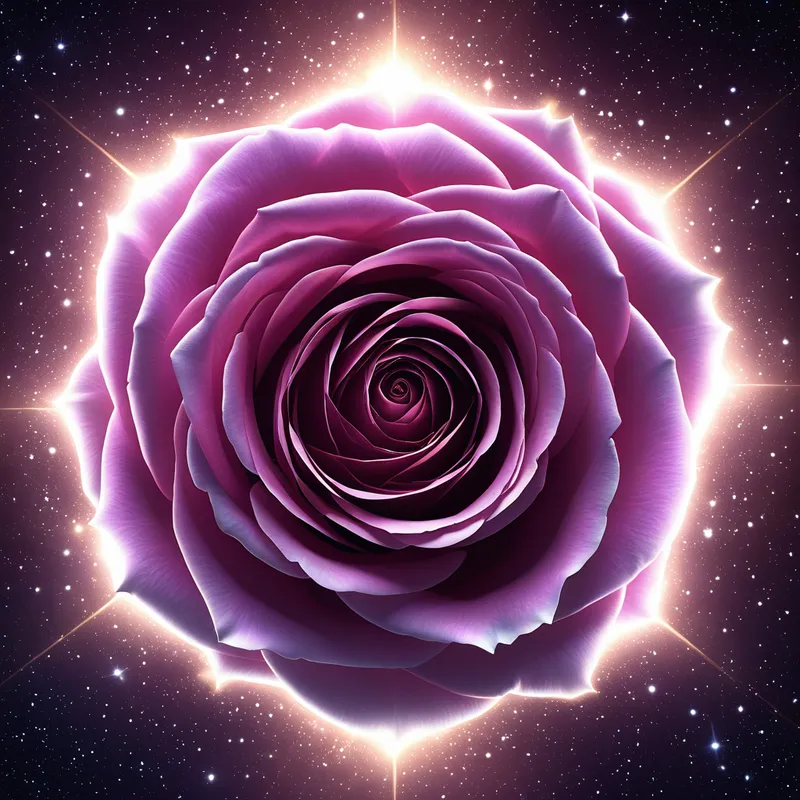
Beatrice returns to her throne in the celestial Empyrean. Now, St. Bernard of Clairvaux appears, a figure of pure devotion. He directs Dante’s gaze to the heart of paradise. And there it is: the Mystic Rose, a vast, living amphitheater of light, tiered with the ranks of the blessed. At its center, a point of light so brilliant it is darkness to mortal understanding—the Beatific Vision.
For a moment outside of time, Dante’s mind is struck by a flash. His will and desire are turned, like a wheel in perfect balance, by the Love that moves all things. He sees the universe bound by love into a single volume. The journey ends not in an arrival, but in a participation. The tale concludes not with an image, but with the shattering of all images into the final, silent, knowing union.
Cultural Origins & Context
This is not a folk myth born from oral tradition, but a meticulously crafted theological and poetic summit, the third cantica of Dante Alighieri’s La Commedia, completed near the end of his life in the early 14th century. Written in the Tuscan vernacular, it was a daring act that helped shape the Italian language itself. Its culture is that of High Medieval Europe, a world-view perfectly synthesized by Scholasticism, where Ptolemaic astronomy, Aristotelian physics, and Catholic theology formed a single, coherent cosmos.
Paradiso was passed down not by bards, but by scribes and scholars, yet its function was profoundly societal. It was a map of the soul’s ultimate destination and a vindication of the cosmic order. For a society riven by political strife (Dante himself was an exiled Florentine), it presented a vision of perfect justice. For individuals, it was an anagogical guide—a text where literal events pointed to spiritual truths. It served as the ultimate answer to the chaos of human life, asserting that every act, thought, and desire had its precise and eternal place within a framework of divine love.
Symbolic Architecture
The [architecture](/symbols/architecture “Symbol: Architecture in dreams often signifies structure, stability, and the framing of personal identity or life’s journey.”/) of Paradiso is its primary [symbol](/symbols/symbol “Symbol: A symbol can represent an idea, concept, or belief, serving as a powerful tool for communication and understanding.”/). It is a [psyche](/myths/psyche “Myth from Greek culture.”/) mapped onto the [cosmos](/symbols/cosmos “Symbol: The entire universe as an ordered, harmonious system, often representing the totality of existence, spiritual connection, and the unknown.”/). The concentric spheres are not just physical locations but states of [consciousness](/symbols/consciousness “Symbol: Consciousness represents the state of awareness and perception, encompassing thoughts, feelings, and experiences.”/), levels of understanding and [capacity](/symbols/capacity “Symbol: A measure of one’s potential, limits, or ability to contain, process, or achieve something, often reflecting self-assessment or external demands.”/) for love.
The journey upward is not a travel through space, but an expansion of the soul’s container to hold more light.
Dante, [the pilgrim](/myths/the-pilgrim “Myth from Christian culture.”/), represents every [human](/symbols/human “Symbol: The symbol of a human represents individuality, complexity of emotions, and social relationships.”/) intellect struggling from the [shadow](/symbols/shadow “Symbol: The ‘shadow’ embodies the unconscious, repressed aspects of the self and often represents fears or hidden emotions.”/) of sin ([Inferno](/symbols/inferno “Symbol: A journey through intense destruction or purification, often representing a transformative crisis or descent into the unconscious.”/)) through the pain of correction (Purgatorio) to the joy of understanding (Paradiso). Beatrice symbolizes Divine Wisdom and [Revelation](/symbols/revelation “Symbol: A sudden, profound disclosure of truth or insight, often through artistic or musical means, that transforms understanding.”/)—not a distant god, but a knowable, loving [truth](/symbols/truth “Symbol: Truth represents authenticity, honesty, and the quest for knowledge beyond mere appearances.”/) that personally guides the intellect home. The entire [structure](/symbols/structure “Symbol: Structure in dreams often symbolizes stability, organization, and the framework of one’s life, reflecting how one perceives their environment and personal life.”/) dismantles [the ego](/myths/the-ego “Myth from Jungian culture.”/)’s [linear](/symbols/linear “Symbol: Represents order, predictability, and a direct, step-by-step progression. It symbolizes a clear path from cause to effect.”/) [perception](/symbols/perception “Symbol: The process of becoming aware of something through the senses. In dreams, it often represents how one interprets reality or internal states.”/). In [Paradise](/symbols/paradise “Symbol: A perfect, blissful place or state of being, often representing ultimate fulfillment, harmony, and transcendence beyond ordinary reality.”/), souls in “lower” spheres are not lesser; they experience the full joy of God from their perfect vantage point. This reveals the core symbolic [truth](/symbols/truth “Symbol: Truth represents authenticity, honesty, and the quest for knowledge beyond mere appearances.”/): fulfillment is not uniformity, but the perfect alignment of one’s unique [nature](/symbols/nature “Symbol: Nature symbolizes growth, connectivity, and the primal forces of existence.”/) with the Whole.
The final [vision](/symbols/vision “Symbol: Vision reflects perception, insight, and clarity — often signifying the ability to foresee or understand deeper truths.”/) of the Punto and the Rosa encapsulates the ultimate [paradox](/symbols/paradox “Symbol: A contradictory yet true concept that challenges logic and perception, often representing unresolved tensions or profound truths.”/): the divine is both an infinitely small, singular point (the [source](/symbols/source “Symbol: The origin point of something, often representing beginnings, nourishment, or the fundamental cause behind phenomena.”/)) and an infinitely vast, complex multiplicity (the creation). The [soul](/symbols/soul “Symbol: The soul represents the essence of a person, encompassing their spirit, identity, and connection to the universe.”/)’s [triumph](/myths/triumph “Myth from Roman culture.”/) is to hold this paradox without breaking.
The Dreamer’s Resonance
When this myth stirs in the modern unconscious, it rarely appears as medieval cosmology. It manifests as dreams of profound ascent. Dreamers find themselves in elevators shooting through skyscrapers into space, climbing endless ladders that pierce cloud layers, or simply floating upward, weightless, through layers of increasingly brilliant light. The somatic sensation is one of release, lightness, and expanding breath.
Psychologically, this dream pattern signals a process of integration and meaning-making. Each “sphere” in the dream represents a previously fragmented aspect of [the self](/myths/the-self “Myth from Jungian culture.”/)—a talent, a memory, a value—being acknowledged and given its rightful place in a newly ordered personal cosmos. The figure of the guide (a beloved, a wise stranger, a luminous animal) is the dream-ego’s connection to a transpersonal truth, the “Beatrice function” leading it beyond its own limited logic. The terror in such dreams is often the fear of dissolution—of losing one’s familiar self in the blinding light of a larger truth. This is the soul’s resistance to its own final, necessary transformation.
Alchemical Translation
The alchemical process mirrored in Paradiso is the [Rubedo](/myths/rubedo “Myth from Alchemical culture.”/), the reddening or glorification, following the blackening ([Nigredo](/myths/nigredo “Myth from Alchemical culture.”/)) and whitening (Albedo). It is the stage of individuation where the purified self is not merely cleansed, but radically reconstituted in relation to the cosmic.
The alchemical gold is not a thing possessed, but a state of being in which the individual will spins in perfect, frictionless harmony with the will of the greater Self.
For the modern individual, the “ascent” is not a rejection of the world but a deepening of perspective. It is the labor of finding the sacred order within one’s own life. The “spheres” become the layers of our identity—personal, professional, creative, relational—which we must consciously organize not around the ego’s demands, but around a central, guiding principle of love and integrity (the Punto). The beatific vision is the moment of Epiphany, where the scattered narrative of one’s life suddenly coheres into a meaningful, beautiful, and necessary whole.
The myth teaches that transformation’s final goal is not static perfection, but dynamic, joyful participation. The soul in Paradise is not inert. It sings, dances, and forms living geometries. So too, the individuated psyche is not a finished product, but a active, creative participant in the ongoing mystery of being, its desire finally aligned with its destiny, moved by the love that moves the sun and the other stars.
Associated Symbols
Explore related symbols from the CaleaDream lexicon: