Parables of Jesus Myth Meaning & Symbolism
A collection of enigmatic stories told by Jesus, using everyday scenes to reveal the hidden architecture of the soul and the nature of divine reality.
The Tale of Parables of Jesus
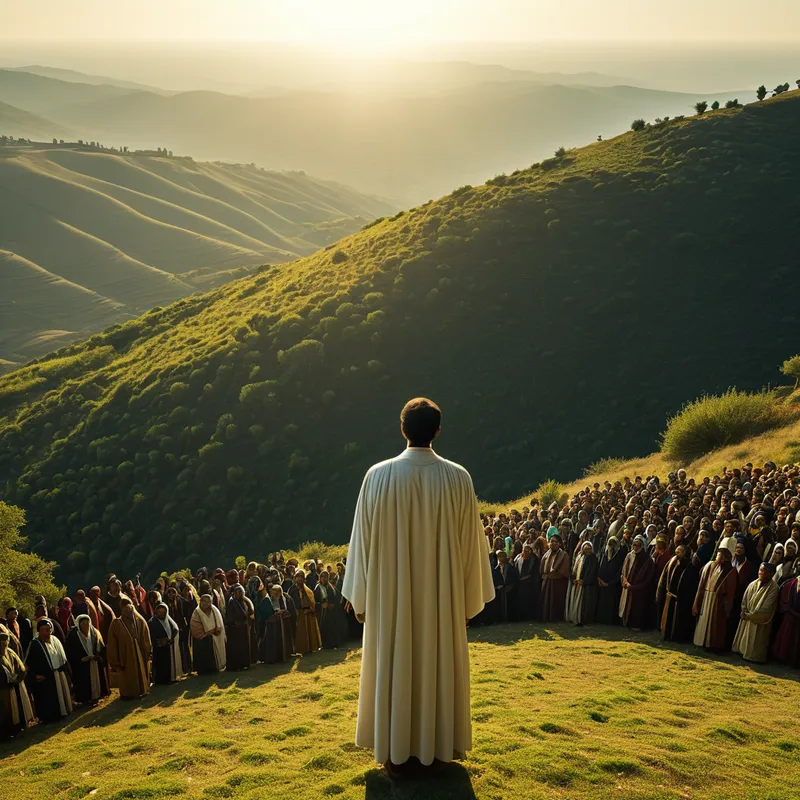
The air on the shore of the Sea of Galilee was thick with the smell of fish and dust, of hope and desperation. The crowd pressed in, a living tapestry of fishermen mending nets, farmers with soil under their nails, widows in worn shawls, and scholars clutching scrolls. They came not for a sermon of law, but for a voice that spoke to the ache behind their ribs.
He sat in a fisherman’s boat, pushed just offshore, so the [water](/myths/water “Myth from Chinese culture.”/) became his stage. His voice did not thunder; it wove. “Listen,” he began, and [the word](/myths/the-word “Myth from Biblical culture.”/) itself was a hook cast into the deep [water](/myths/water “Myth from Chinese culture.”/) of their attention. “A sower went out to sow…”
And so he spun a world from the air. They saw the sower, his arm swinging, the seed arcing through the sunlight to fall on the hard-beaten path, snatched by black wings. They felt the shallow soil over rock, the green shoot that withered under the sun’s gaze. They smelled the choking scent of thorns overwhelming young grain. And then—they felt the yield. Thirty, sixty, a hundredfold. The crowd’s breath hitched as one; every farmer knew that number was a dream, a miracle.
He did not stop. He conjured a man who found a treasure buried in a field and sold all he had, his eyes wild with a secret joy. He painted the image of a merchant searching endless markets for one [pearl](/myths/pearl “Myth from Chinese culture.”/) of perfect luster, and the moment of finding, which made every prior cost vanish. He spoke of a [mustard seed](/myths/mustard-seed “Myth from Buddhist culture.”/), so tiny it could be lost in a fold of cloth, becoming a great tree where birds nested. He told of a woman who swept her entire house for one lost coin, and of the celebration that followed its discovery.
But his stories had teeth. He spoke of a rich fool building bigger barns for his surplus, only for his soul to be required of him that very night. He narrated the chilling tale of a wealthy man, clothed in purple, who ignored a beggar named [Lazarus](/myths/lazarus “Myth from Christian culture.”/) at his gate; in death, their fortunes were eternally, agonizingly reversed. He described a stern king settling accounts, forgiving a debt of ten thousand talents, only to have that same forgiven servant throttle a fellow who owed him a hundred denarii. The king’s wrath was a cold fire.
He ended with a story that stretched their hearts to breaking. A younger son demanded his inheritance, left for a distant country, and squandered it in wild living. Reduced to feeding pigs and envying their food, he “came to himself.” The long road home was paved with a rehearsed confession. But the father—the father saw him from a great distance. He ran. He embraced the stinking boy. He called for a robe, a ring, sandals, and the fatted calf. “For this my son was dead, and is alive again; he was lost, and is found.” The celebration had already begun when the elder son, faithful and bitter, stood outside in the dark, hearing the music, unable to cross [the threshold](/myths/the-threshold “Myth from Folklore culture.”/) into grace.
Then he fell silent. The only sound was the lap of water against the boat. “He who has ears to hear,” he said softly, “let him hear.” And the crowd dispersed, some shrugging, some arguing, some walking home with a new, unnameable seed quietly cracking open inside them.

Cultural Origins & Context
These stories emerged from a Judean world under Roman occupation, a culture steeped in the prophetic and wisdom traditions of Tanakh. [Jesus of Nazareth](/myths/jesus-of-nazareth “Myth from Christian culture.”/), a rabbi from the peasant class, employed the parable (from Greek parabolē, a “placing beside” or comparison), a form familiar from Jewish wisdom literature but which he wielded with unique density and purpose.
They were oral literature, performed in Aramaic to largely non-literate agrarian audiences. [The parables](/myths/the-parables “Myth from Biblical culture.”/) were not doctrinal lectures but lived experiences, using the immediate imagery of their world: farming, shepherding, domestic labor, debt, and social hierarchy. They were remembered, repeated, and debated within early Christian communities before being codified decades later in the Greek texts of the Gospels. Their function was dual: to reveal and to conceal. They offered a glimpse of the “Kingdom of God” to those with receptive hearts, while remaining opaque, even frustrating, to those who approached with a closed, literalist mindset. They were tools for paradigm shift, not information transfer.
Symbolic Architecture
The parables are not allegories where each element corresponds to a fixed meaning. They are more like psychic bombshells or [reality](/symbols/reality “Symbol: Reality signifies the state of existence and perception, often reflecting one’s understanding of truth and life experiences.”/)-distorting lenses. Their core [symbolism](/symbols/symbolism “Symbol: The use of symbols to represent ideas or qualities, often conveying deeper meanings beyond literal interpretation. In dreams, it’s the language of the unconscious.”/) operates on a psychological and ontological level.
The recurring [symbol](/symbols/symbol “Symbol: A symbol can represent an idea, concept, or belief, serving as a powerful tool for communication and understanding.”/) of the [Kingdom](/symbols/kingdom “Symbol: A kingdom symbolizes authority, belonging, and a sense of identity within a larger context or community.”/) of God is not a geographical place but a state of being, a re-ordering of [perception](/symbols/perception “Symbol: The process of becoming aware of something through the senses. In dreams, it often represents how one interprets reality or internal states.”/) and value. It is found in acts of radical [forgiveness](/symbols/forgiveness “Symbol: The act of releasing resentment or vengeance toward someone who has harmed you, often involving emotional healing and reconciliation.”/), unexpected generosity, and hidden growth. The parables of the Lost [Sheep](/symbols/sheep “Symbol: Sheep often symbolize innocence, vulnerability, and the idea of conforming to societal norms.”/), Coin, and Son are a triptych on divine economy, where value is not inherent but conferred by the [seeker](/symbols/seeker “Symbol: A person actively searching for meaning, truth, or a higher purpose, often representing the dreamer’s own quest for identity or fulfillment.”/)’s love.
The kingdom of heaven is like a treasure hidden in a field, which a man found and covered up. Then in his joy he goes and sells all that he has and buys that field.
This is the [psychology](/symbols/psychology “Symbol: Psychology in dreams often represents the exploration of the self, the subconscious mind, and emotional conflicts.”/) of ultimate valuation. The “[treasure](/symbols/treasure “Symbol: A hidden or valuable object representing spiritual wealth, inner potential, or divine reward.”/)” renders all prior possessions meaningless. The parables consistently subvert worldly [logic](/symbols/logic “Symbol: The principle of reasoning and rational thought, often representing order, structure, and intellectual clarity in dreams.”/): the last are first, the lost are celebrated, the small seed becomes the great shelter. They map the [landscape](/symbols/landscape “Symbol: Landscapes in dreams are powerful symbols representing the dreamer’s emotional state, personal journey, and the broader context of life situations.”/) of the [soul](/symbols/soul “Symbol: The soul represents the essence of a person, encompassing their spirit, identity, and connection to the universe.”/): the hard [path](/symbols/path “Symbol: The ‘path’ symbolizes a journey, choices, and the direction one’s life is taking, often representing individual growth and exploration.”/) of cynicism, the shallow [soil](/symbols/soil “Symbol: Soil symbolizes fertility, nourishment, and the foundation of life, serving as a metaphor for growth and stability.”/) of fleeting enthusiasm, the choked [heart](/symbols/heart “Symbol: The heart symbolizes love, emotion, and the core of one’s existence, representing deep connections with others and self.”/) of [anxiety](/symbols/anxiety “Symbol: Anxiety in dreams reflects internal conflicts, fears of the unknown, or stress from waking life, often demonstrating the subconscious mind’s struggle for peace.”/), and the deep, [fertile ground](/symbols/fertile-ground “Symbol: Fertile ground symbolizes potential, growth, and the promise of new beginnings, reflecting a state where life can thrive.”/) of integrated understanding.
The darker parables—the Unforgiving Servant, the Rich Man and Lazarus—are stark maps of the [shadow](/symbols/shadow “Symbol: The ‘shadow’ embodies the unconscious, repressed aspects of the self and often represents fears or hidden emotions.”/). They illustrate the psychic consequences of unexamined [debt](/symbols/debt “Symbol: A symbolic representation of obligations, burdens, or imbalances that extend beyond financial matters into psychological and moral realms.”/) (to others and to [life](/symbols/life “Symbol: The symbol of ‘Life’ represents a journey of growth, interconnectedness, and existential meaning, encompassing both the joys and challenges that define human experience.”/)) and the fatal [error](/symbols/error “Symbol: A dream symbol representing internal conflict, perceived failure, or a mismatch between expectations and reality.”/) of identifying [the self](/myths/the-self “Myth from Jungian culture.”/) with its possessions, creating an eternal [chasm](/symbols/chasm “Symbol: A deep fissure in the earth representing a profound division, transition, or psychological gap between states of being.”/) of one’s own making.

The Dreamer’s Resonance
When the imagery of the parables surfaces in modern dreams, it often signals a process of inner reckoning and re-evaluation. Dreaming of scattering seeds on different types of soil reflects an assessment of where one’s energy, love, or creativity is being invested—and what inner attitudes (hardness, distraction, fear) are preventing growth. It’s a somatic call to prepare the “soil” of the [psyche](/myths/psyche “Myth from Greek culture.”/).
The dream of searching for a lost coin or sheep in a vast, dim house or landscape embodies the soul’s work of reclamation. This is the process of searching for a lost part of the self—a neglected talent, a buried trauma, a disowned passion. The intense focus of the search is itself the healing.
Dreaming of being the younger son returning home, or the elder son refusing to enter the feast, places the dreamer directly in the drama of forgiveness and acceptance. It often arises when one is grappling with guilt, exile, and the difficult return to self-acceptance, or conversely, wrestling with resentment and the perceived injustice of grace given to others (or other parts of oneself).

Alchemical Translation
The parabolic process is a model for individuation. It begins with the [nigredo](/myths/nigredo “Myth from Alchemical culture.”/), the blackening: the confrontation with a confusing, often frustrating teaching (“Why does he speak in parables?”). The familiar world (of linear merit, fair wages, and clear boundaries) is dissolved.
The albedo, the whitening, is the moment of insight, the “Aha!” when the story turns inward and illuminates a hidden corner of the soul. The treasure is recognized. The lost part is found. This is not an intellectual understanding but a transformative recognition: “The kingdom of God is within you.”
The seed grows, he knows not how. The earth produces by itself, first the blade, then the ear, then the full grain in the ear.
This describes the autonomous, organic nature of psychic transformation. The conscious ego is the sower, but the growth happens in the dark earth of the unconscious. The final stage, the [rubedo](/myths/rubedo “Myth from Alchemical culture.”/) or reddening, is the full integration, the hundredfold yield. It is the embodied state of living from the discovered treasure, wearing the ring of sonship, and participating in the feast. The individual becomes a living parable—an ordinary human vessel containing and expressing the extraordinary, hidden logic of the whole Self. The story is no longer just heard; it is lived.
Associated Symbols
Explore related symbols from the CaleaDream lexicon: