
Parable of the Sower Myth Meaning & Symbolism
A teacher describes a sower whose seed falls on four types of ground, revealing the fate of the sacred word in the human heart.
The Tale of Parable of the Sower
Listen. Come close to the water’s edge, where the crowd presses in, a sea of hungry faces turned toward the lone figure in the boat. The air is thick with the smell of fish and damp earth, the lake a mirror to the pressing sky. He speaks, and his voice is not thunder, but the quiet sound of a stone dropped into deep water, the ripples reaching the furthest shore.
“A sower went out to sow.”
See him there, on the sun-baked path that skirts the field, his shadow long in the morning light. The seed bag is slung over his shoulder, a rhythm as old as time in his step. With a broad, practiced sweep of his arm, he casts his treasure—tiny, dry promises of life—onto the waiting world.
And the world receives it in its own way.
Some seed falls on the hard-packed path, where countless feet have trodden desire into dust. It lies there, exposed, a secret told in the marketplace. And the birds—the clever, hungry birds of the air—descend. In a flurry of shadows and sharp cries, they take it, and it is gone as if it never was.
Other seed falls on rocky ground, where a thin skin of earth hides a heart of stone. It springs up with a desperate, joyous haste, a green shout against the grey. But it has no depth, no anchor. When the sun rises, scorching and fierce, it withers, rootless. It is a flame that burns bright and is gone, leaving only a memory of green.
Still other seed falls among thorns. And the thorns are already there, growing in the dark, coiled and patient. They grow up with the tender shoot, choking it, crowding it, whispering of other concerns, other worries, the cares and deceits of the world. The young plant is starved of light, suffocated, and yields nothing.
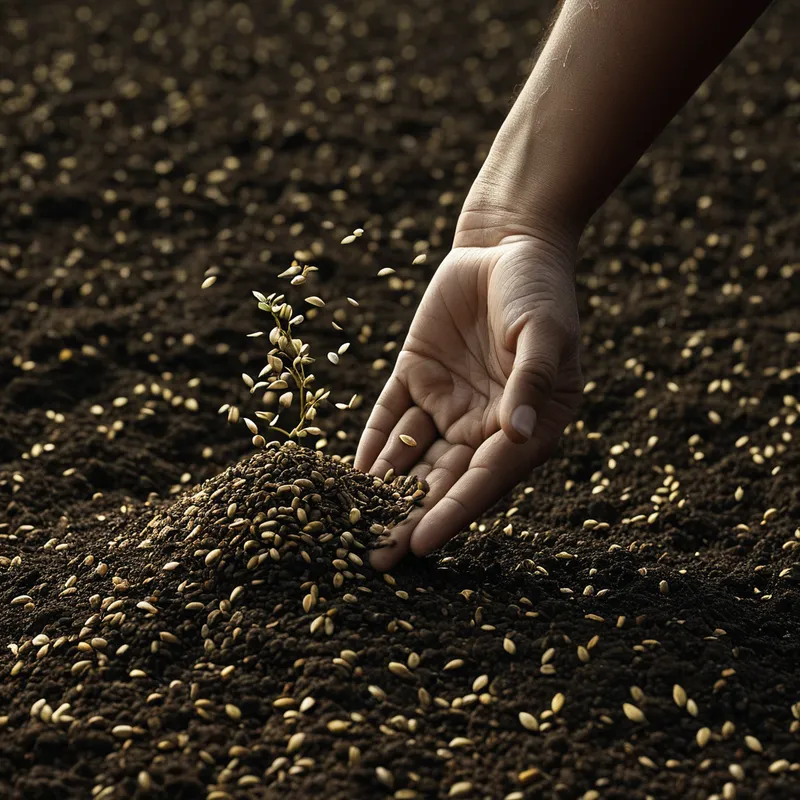
But some seed—ah, some seed—falls on good soil. It finds a home in the deep, dark, receptive earth. It is held. It is nourished. It sends roots down into the mystery and pushes a stem up toward the light. And it bears fruit: not just a single stalk, but a yield of thirty, sixty, a hundredfold. A silent, abundant explosion of life from a single, forgotten point.
“Let anyone with ears to hear, listen,” the teacher says, his gaze holding the crowd, holding you. The parable hangs in the air, complete. The story is told. But the hearing, the true hearing, has only just begun.
Cultural Origins & Context
This story, known as the Parable of the Sower, is found within the synoptic gospels of the New Testament. It is presented as a teaching of Jesus of Nazareth, delivered to mixed crowds by the shores of the Sea of Galilee. Its form is quintessentially rabbinic—a mashal—a narrative riddle designed to engage, conceal, and ultimately reveal truth to those prepared to ponder it.
In an oral culture where agriculture was the immediate metaphor for life and death, the image of sowing was viscerally understood. The parable was not an abstract theological treatise but a reflection of everyday reality, used to explain the perplexing outcomes of Jesus’s own ministry. Why did some hear and transform, while others listened and remained unchanged? The story was a mirror held up to the audience’s own interior condition. It functioned as a diagnostic tool and an invitation, passed down not as dry doctrine but as a living, performative word, meant to be heard in the deepest sense—to be received into the soil of a contemplative heart.
Symbolic Architecture
At its core, the parable is a profound map of consciousness. The Sower is remarkably generous, even wasteful, casting seed indiscriminately. This represents the prolific, non-discriminatory nature of grace, insight, or the call to awakening. The seed is the logos—the word of potential.
The condition of the soil is not fate, but fatefulness—it is the state of the soul at the moment of encounter.
The four soils are not types of people, but states of being within every individual. The path is the hardened, defended psyche, where insights are immediately snatched away by the birds of distraction or cynicism. The rocky ground is initial, enthusiastic receptivity without depth—a spirituality of emotion that cannot withstand the heat of ordeal, doubt, or the demands of sustained practice. The thorny ground is the soul engaged in the world, but where the vital energy is ultimately consumed by the cares and riches and pleasures of life. The good soil is the prepared heart: receptive, deep, and clear, capable of nurturing the seed into fruition, which is a life of multiplied meaning and generative action.

The Dreamer’s Resonance
When this mythic pattern stirs in the modern dreamscape, it often manifests as landscapes of the interior. A dreamer may find themselves wandering a vast, internal terrain that mirrors the parable: a desert of hard-baked clay, a glittering but shallow pool, a garden overrun with sinister, beautiful vines, or a small, fiercely protected plot of incredibly fertile black earth.
Somatically, this can feel like a process of psychic digestion or its blockage. Dreams of the path may coincide with feelings of intellectual brittleness or impermeability. Rocky ground dreams may follow bursts of inspiration that lead to burnout, accompanied by a sense of rootlessness. The thorny ground manifests in dreams of being trapped, entangled, or suffocated by the very details of one’s life. To dream of the good soil is often to experience a profound sense of grounded peace, of something taking root in the dark below, promising future growth. The dream is asking: What is the state of your ground? What are you able to receive, and what do you, often unconsciously, allow to be stolen, scorched, or choked?

Alchemical Translation
The parable models the entire individuation process as an alchemy of receptivity. The first work is not actively seeking the seed, but preparing the soil. This is the nigredo—the blackening. It involves breaking up the hardened path through introspection, composting the rocky shallows by developing depth of practice, and weeding the thorns through ruthless honesty about one’s attachments.
The harvest is not manufactured by the ego; it is the inevitable yield of a soul that has become hospitable to mystery.
The sower’s indiscriminate casting assures us that the seed of meaning, the call to wholeness, is constantly being offered. Our task is the opus of becoming fertile ground. The thirty, sixty, and hundredfold yield symbolizes the transformative result: a personality no longer focused on merely receiving for itself, but one that has become a source of life for others. The fruit is the tangible evidence of a psyche that has successfully transmuted the raw potential of the unconscious (the seed) into the conscious, embodied reality of a purposeful and connected life. The parable, therefore, is less about a single sowing and more about the lifelong cultivation of an inner landscape capable of perpetual, miraculous yield.
Associated Symbols
Explore related symbols from the CaleaDream lexicon: