Pandora's Box (Greek mythology Myth Meaning & Symbolism
The first woman, created as a punishment, opens a forbidden jar, releasing all evils into the world but trapping hope inside.
The Tale of Pandora’s Box (Greek mythology
In the beginning, after the great war of the gods, the world was a place for men alone. They walked the earth, free from toil and sickness, living in a kind of golden ease. But they had angered the king of the gods, Zeus, by accepting the stolen gift of fire, a secret Prometheus had smuggled from the divine hearth. Zeus’s wrath was cold and cunning. He would not bring a thunderbolt against them. He would craft a gift.
He summoned the divine artisans. Hephaestus was commanded to mix earth and water, to shape a form of breathtaking beauty, a likeness of the immortal goddesses. Aphrodite breathed upon it grace and cruel longing, the power to weaken the knees and unravel resolve. Athena taught it crafts and clothed it in shimmering silver robes. Hermes placed in its heart a dogged mind and a treacherous character, and gave it a voice full of lies and seductive words. They named her Pandora, “All-Gift,” for each deity had contributed to her making—a masterpiece of divine vengeance.
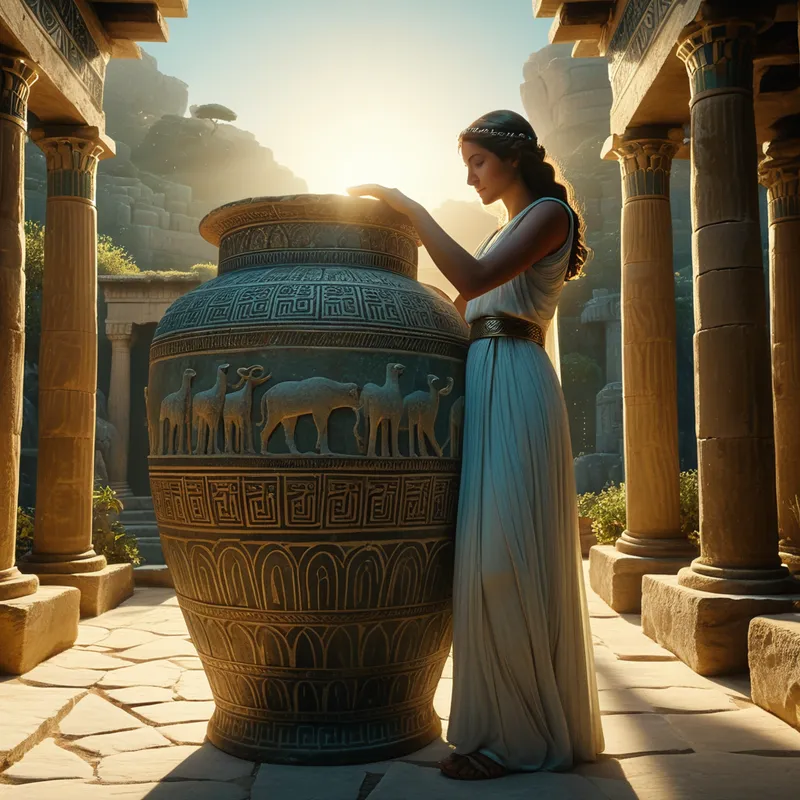
Zeus presented this woman, this beautiful calamity, to Epimetheus, who had been warned by his brother to accept no gift from Olympus. But Epimetheus saw only her radiance, heard only her honeyed voice, and all thought of warning fled. He welcomed her, and with her, he welcomed a dowry from the gods: a great pithos. It was not a small trinket but a massive jar of clay, sealed tight. A command, or perhaps a whispered suggestion, came with it: This is not for you. Never open this.
For a time, life continued. But the jar sat in their home, a silent, imposing presence. Pandora’s mind, shaped by Hermes, turned over and over the mystery of it. What divine treasures lay within? What was so precious, or so terrible, that it must be forever hidden? The pithos called to her, a siren song of curiosity. The “gift” of a dogged mind became a torment.
One day, the silence of the house pressed upon her. The smooth, sealed lid seemed to mock her. She could bear it no longer. With trembling hands, she approached the jar. The air grew still. She grasped the heavy lid, her heart a frantic drum against her ribs, and she lifted it, just a crack.
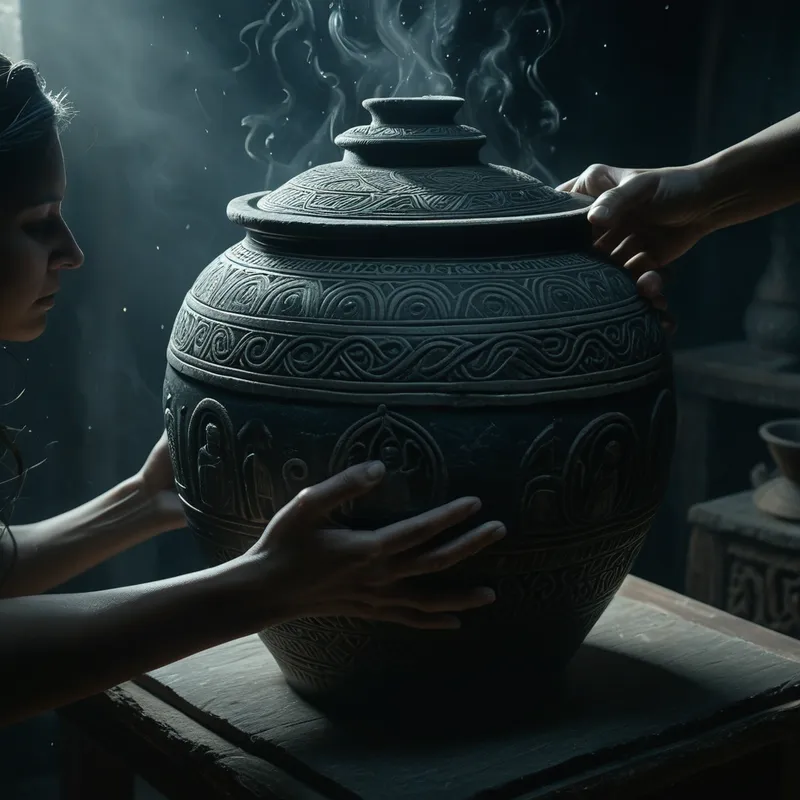
It was not a gentle release. It was an explosion. A shrieking, howling torrent erupted from the opening—a vile smoke of shapeless things given form. Out flew Geras and Ponos, Nosos and Lyssa. Out spilled Phthonos, Eris, and all the myriad, nameless spirits of grief, despair, and wickedness. They were black wings and cold whispers, settling upon the earth, seeping into the hearts of men. The golden age was shattered in a single breath.
Terrified, Pandora slammed the lid back down. The house was empty again, but the world outside was forever changed. Men would now know pain, and labor, and sickness unto death. As she wept in the sudden, awful silence, a faint, final sound came from within the jar. A soft, fluttering beat, like the wings of a captured bird. She had trapped the last thing inside: Elpis. Hope remained, sealed in the jar, a final, ambiguous gift at the bottom of all suffering.
Cultural Origins & Context
The myth of Pandora is not a singular, fixed story but a tapestry woven from threads by the poets of archaic Greece. Our primary sources are the didactic epic Works and Days by Hesiod (c. 700 BCE) and, to a lesser extent, his Theogony. For Hesiod, a poet-farmer deeply skeptical of women, the myth served a clear societal function: it was an aetiology, a story explaining the origin of human suffering, and a potent piece of patriarchal ideology justifying the difficult, toilsome life of his era. It answered the profound question: why is life so hard?
Passed down orally before being codified by Hesiod, the tale was not mere entertainment. It was a foundational narrative about the cosmic order and humanity’s place within it after the Promethean transgression. The “box” itself is a later mistranslation; the original vessel was a pithos, a large storage jar for grain or wine, a ubiquitous object in every household. This grounds the catastrophe not in a remote treasure chest but in the domestic sphere, making the source of world-altering evil intimately familiar. The myth functioned as a warning about divine retribution, the dangers of unchecked curiosity (especially female curiosity, in Hesiod’s view), and the acceptance of seemingly beautiful but treacherous gifts from powers beyond human understanding.
Symbolic Architecture
Pandora is not merely a character; she is an archetypal vessel. Crafted by the gods, she symbolizes the first human encounter with the complex, contradictory nature of existence itself. She is beauty and treachery, gift and punishment, embodied in one form. Her creation represents the moment consciousness becomes aware of its own divided nature.
The pithos is the ultimate symbol of the unconscious and the forbidden. It contains everything the ordered, “golden” world of naive consciousness has repressed: the full spectrum of human experience, from debilitating suffering to the capacity for hope. It is the shadow cast by the light of Promethean fire (knowledge, technology).
To open the vessel is to initiate the painful, necessary process of becoming conscious. The evils released are not external demons, but the inherent conditions of a conscious, mortal life: toil, sickness, aging, and psychic conflict.
Pandora’s curiosity, often condemned, is the very engine of psychological development. It is the impulse that pushes consciousness beyond its comfortable limits to confront what is hidden. The act of opening is the irreversible fall into experience, the end of innocence and the beginning of the human journey with all its complexity. And finally, Elpis, trapped inside, is the most profound symbol. Is hope a merciful comfort, left to sustain us? Or is it a “foreboding” anticipation, another kind of evil, keeping us striving in a world of suffering? Its ambiguity is its truth: hope is the paradoxical, contained potential that makes the burden of consciousness bearable, the light that exists only in relation to the surrounding dark.

The Dreamer’s Resonance
When this myth stirs in the modern psyche, it often manifests in dreams of forbidden containers—a locked room in one’s own house, a sealed envelope burning with importance, a computer file one feels compelled to open despite dread. The dreamer is Pandora, and the dream signals a critical threshold in their psychological life.
The somatic experience is one of intense ambivalence: a magnetic pull towards the object coupled with a visceral fear of consequence. This is the psyche preparing to integrate a piece of its own shadow. The “evils” that fly out in the dream may appear as chaotic imagery, monstrous shapes, or overwhelming emotional states—floods, swarms, darkness. This is not a prophecy of literal disaster, but a symbolic release of repressed contents: old griefs, buried angers, latent anxieties, or simply the raw, unvarnished truth of a situation one has been avoiding.
The dreamer undergoing this process is at the point where unconscious material is forcing its way into awareness. The initial experience is one of catastrophe, a feeling that one’s world is being invaded or ruined. The psychological task, upon waking, is not to futilely try to “reseal the box,” but to acknowledge what has been released and to begin the slow, difficult work of relating to these elements consciously. The dream may or may not show the trapped hope; its presence is often felt only in the dreamer’s capacity to endure the dream itself and to reflect upon it.

Alchemical Translation
The alchemical journey mirrored in Pandora’s myth is the nigredo, the blackening, the descent into the primal murk. The individual begins in a state of relative unconsciousness (the “golden” life), often following a Promethean act—a bold step, an acquisition of knowledge or power that disrupts the old order and incites a reaction from the psychic “gods” (the dominant complexes or the Self).
The creation of Pandora represents the emergence of a new, complex factor in the psyche—often an anima/animus figure or a compelling new idea—that is both alluring and disruptive. The gift of the pithos is the presenting of one’s own shadow, the totality of unlived life and repressed potential, in a sealed, projected form.
The alchemical operation is the opening itself. It is the conscious, willing, or often compelled decision to face what one has been told—by internalized parents, by society, by one’s own fear—must remain forever hidden.
The release of sufferings is the nigredo in full effect: depression, confusion, the dissolution of old identities, the confrontation with mortality and limitation. This is not a mistake, but a necessary stage of separatio and putrefactio. The old, simple self must die.
The final, crucial stage is the retention of Elpis. In alchemical terms, this is the discovery of the Lapis at the heart of the chaos. It is the realization that within the very experience of suffering and disintegration lies the seed of new meaning. Hope, in this transmuted sense, is not naive optimism, but the psychological function of meaning-making that persists even in the darkest night. It is the knowledge that the process itself has a purpose. The individual does not return to a golden age, but emerges, like the alchemist from the nigredo, having integrated the shadow and carrying within them a contained, enduring spark of consciousness forged in the confrontation with the full human condition. The box is open, the evils are in the world, but the hope is now an internal, hard-won possession.
Associated Symbols
Explore related symbols from the CaleaDream lexicon: