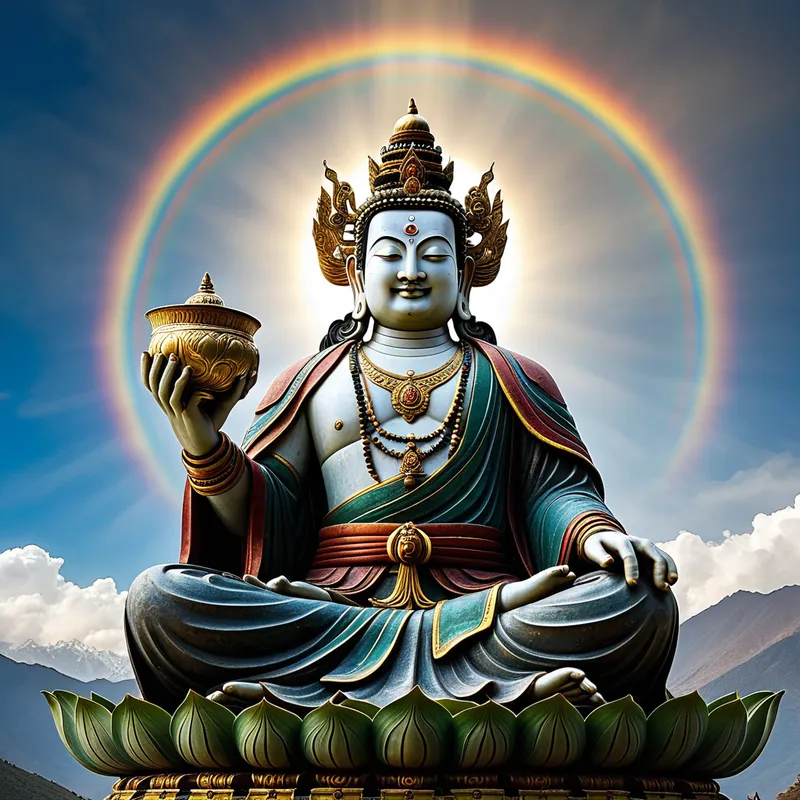
Padmasambhava Myth Meaning & Symbolism
The story of the Lotus-Born master who journeyed to Tibet, not to destroy its ancient spirits, but to convert them into fierce protectors of wisdom.
The Tale of Padmasambhava
Listen. The story begins not in a palace, but in a lotus. In the shimmering heat of a lake in the land of Uddiyana, a miraculous child appeared, not born of a womb, but seated serene and radiant upon the heart of a blossoming flower. He was named Padmasambhava, and from his first breath, the earth trembled with a promise.
He was a prince, yet his kingdom was the boundless sky of mind. He mastered the arts of kingship only to renounce them, walking into the charnel grounds and wild places where the bones of the dead whispered secrets and the Dharmapalas roamed. There, in the liminal spaces between life and death, he confronted the raw, untamed powers of existence. He danced with dakinis, the sky-going wisdom goddesses, and wrestled knowledge from demons, not by sword, but by a gaze that saw their true, empty nature.
His legend was a wind that crossed the mountains. It reached the ears of a king in the Land of Snows, a king whose heart was a fortress besieged. The Tibetan emperor Trisong Detsen had a vision: to plant the Dharma like a banner on the roof of the world. But the earth itself resisted. Every stone laid for his great temple at Samye was thrown down by night. The local gods and spirits, the ancient sovereigns of the valleys and peaks, raged against this new order. They were the very soul of the land—wrathful, proud, and wild.
The king sent a plea across the passes: “We have the doctrine, but not the power. We have compassion, but face ferocity. We need one who can tame what cannot be destroyed.”
And so the Lotus-Born came. He did not come as a conqueror, but as a master of reality’s dream. At Samye, as the demonic hordes gathered—a cacophony of screeching nyen, earth-shaking lu, and sky-rending tsen—Padmasambhava did not raise a weapon. He sat. He entered a state of unshakable meditation, the vajra posture of reality itself.
One by one, he called them forth. To the mountain god, he showed the mountain’s true, empty form. To the raging water spirit, he revealed the stillness at the heart of the torrent. He did not exorcise; he introduced. He introduced these forces of chaos to their own innate wisdom. He bound them not with chains, but with sacred oath. Their ferocity was not stripped away; it was alchemized. The destroyers became protectors. The obstructors became the fierce guardians of the very temple they sought to topple. The land did not submit; it awakened. With the local deities now sworn to the Dharma, the temple of Samye rose, a mandala of peace in a once-turbulent realm, and the Buddha’s teachings took root in the snow.
Cultural Origins & Context
The myth of Padmasambhava is the foundational narrative of the Nyingma school and a cornerstone of Tibetan Buddhist identity. It emerged in the 8th-12th centuries from a potent fusion of history, esoteric revelation, and cultural necessity. Historically, Padmasambhava was a tantric master from Uddiyana invited to Tibet to assist in the construction of Samye Monastery and subdue local antagonistic forces.
The stories, however, were not merely recorded. They were concealed as terma, spiritual time capsules, to be discovered by destined tertöns in times of need. This mechanism ensured the myth remained a living, revelatory force, not a fossilized past. It was told by yogis in caves, painted on temple walls, and performed in ritual dances (cham). Its societal function was profound: it provided a mythic template for the integration of the indigenous Bön religion with Indian Buddhism. It told the people that their ancient gods were not evil, but misunderstood forces now serving a higher purpose, thereby sanctifying the very landscape and easing a profound cultural transition.
Symbolic Architecture
At its core, the myth is a masterclass in the psychology of integration. Padmasambhava represents the awakened consciousness that does not flee from or annihilate the shadowy, chaotic, and instinctual parts of the psyche, but engages them with fearless, discerning awareness.
The true master does not build a temple on cleared ground, but on the very site of the haunting, transforming the ghosts into pillars of support.
The yül lha and nyen symbolize the autonomous complexes of the personal and collective unconscious—our repressed angers, primal fears, territorial instincts, and untamed emotional energies. The king’s dilemma is the ego’s struggle: it has a conscious ideal (the temple of the Self), but is powerless against the sabotage of these unconscious forces. Padmasambhava’s method—the “subjugation” through recognition and oath-binding—is the process of conscious relationship. He sees the demon not as an “other” to be destroyed, but as a distorted aspect of primordial energy that, when recognized and re-contextualized, becomes a source of tremendous power and protection. The phurba he often wields is not for killing, but for “pinning down” chaotic energy into a stable, enlightened form.
The Dreamer’s Resonance
When this mythic pattern stirs in the modern dreamer, it signals a critical phase of inner confrontation and potential integration. One might dream of being in a familiar house (the psyche) that is suddenly haunted by aggressive, shadowy figures or chaotic natural forces. Or of starting a new project (the temple) only to have tools disappear and foundations crack.
The somatic experience is often one of constriction, anxiety, or a feeling of being sabotaged from within. Psychologically, this is the uprising of what has been marginalized—a buried trauma, a denied ambition, a fierce passion labeled “unacceptable.” The dream is not a nightmare to be escaped, but a summons. It is the psyche’s way of presenting its own “local deities” for re-negotiation. The dreamer is in the position of King Trisong Detsen: aware of a higher goal but besieged by inner resistance. The call is to stop trying to build over the chaos, and instead to find the inner Padmasambhava—the witnessing, non-reactive awareness that can sit in the center of the storm and see the true name of the storm.
Alchemical Translation
The individuation journey modeled here is not a progressive climb toward purity, but a deep descent into the fraught, fertile ground of one’s own personal and inherited shadows. The first alchemical step is the invitation of crisis: the conscious decision to build the temple of an authentic life, which inevitably stirs up internal opposition.
The oath-bound demon is more loyal than the banished angel, for it guards the treasure it once hid.
The core alchemical operation is transmutation through recognition. This is not positive thinking. It is the fierce, compassionate work of turning toward the “demon”—the addiction, the rage, the insecurity—and asking, “What energy are you? What do you protect?” The tantric master does this by seeing the demon’s essence as empty of inherent, solid reality and yet full of dynamic potential. We do this by withdrawing absolute identification from the complex (“I am angry”) and relating to it as an energy pattern (“There is anger”). In that space of relationship, the energy can be “bound by oath”—redirected. Rage becomes unwavering determination. Fear becomes heightened awareness. Territorial instinct becomes healthy boundaries.
Finally, the myth teaches that the integrated Self is not a smooth, monolithic entity. It is a vibrant, sometimes fierce ecosystem, a mandala upheld by converted demons and reclaimed gods. The completed temple of Samye, with its chaotic protectors now guarding the gates, is the symbol of the individuated psyche: not a state of conflict-free bliss, but a dynamic, resilient order where all energies have been recognized, transformed, and given a sacred duty in the service of wholeness.
Associated Symbols
Explore related symbols from the CaleaDream lexicon: