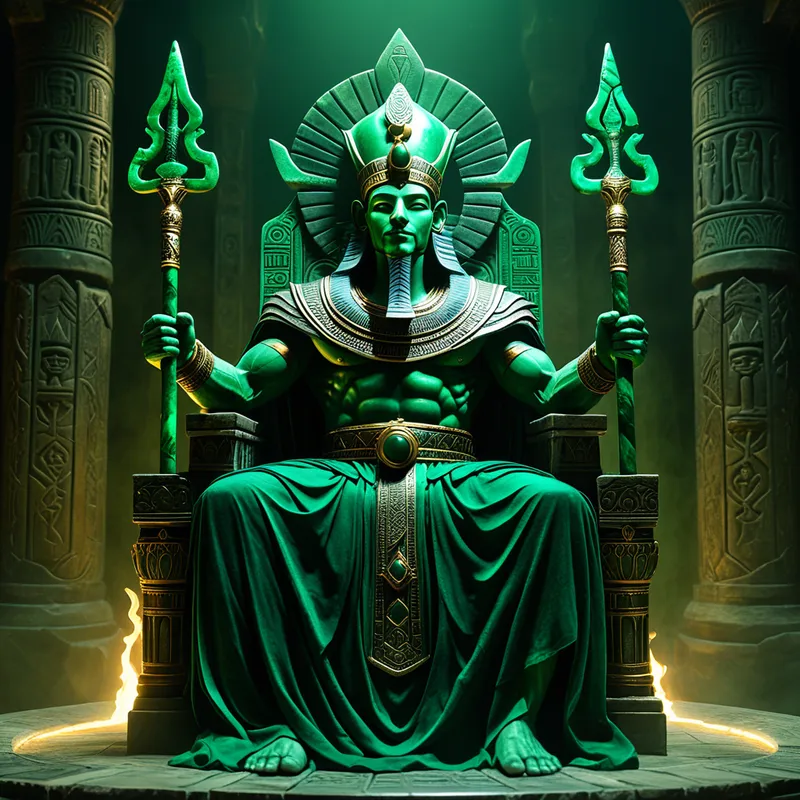
Osiris- The god wh Myth Meaning & Symbolism
A god-king is betrayed, dismembered, and scattered, only to be reassembled and reborn as lord of the underworld, symbolizing the soul's fragmentation and wholeness.
The Tale of Osiris- The god wh
In the time before time, when [the world](/myths/the-world “Myth from Tarot culture.”/) was still wet with the breath of the first dawn, there ruled a king. He was not a king of men, but a king of the very order of things. His name was [Osiris](/myths/osiris “Myth from Global/Universal culture.”/)- The god wh, and his rule was gentle, teaching the people the arts of civilization: the sowing of grain, the reverence for law, the worship of the gods. His kingdom was a verdant reflection of his being, a perfect, ordered whole.
But in the deep shadows of that wholeness, a seed of chaos grew. His brother, Set, whose domain was the scorching desert and the untamed storm, watched with a heart curdling into envy. He saw not order, but confinement; not civilization, but a cage. The very completeness of Osiris- The god wh was an offense to his fragmented soul.
So Set wove a plot of exquisite malice. He fashioned a chest of wondrous beauty, sized to the exact measure of the god-king. At a great feast, he offered it as a prize to whoever fit within it perfectly. When Osiris- The god wh, trusting and whole, lay down in the casket, Set’s allies slammed the lid shut. They sealed it with molten lead, a second skin of finality, and cast it into the churning, indifferent Nile.
The chest became a coffin, a ship of death carrying the lord of life. It drifted far from the ordered banks of Egypt, coming to rest in the far land of Byblos, entombed within the trunk of a tamarisk tree that grew around it, swallowing the god into its heartwood.
The world wept. The grain withered. The order of things frayed at the edges. Isis, his queen, her wings the sound of a searching wind, scoured the world. With grief as her compass, she found the tree, now a pillar in a foreign palace. She retrieved the coffin and brought her husband’s body back to the hidden marshes of the Delta, to mourn and to work her magic of restoration.
But Set, hunting by the light of a hateful moon, found them. His vengeance was not satisfied. To ensure no magic could ever make the king whole again, he committed the ultimate desecration. He seized the body of Osiris- The god wh and tore it into fourteen—some say forty-two—pieces. He scattered these fragments to the corners of the world, casting an eye into the mud, a hand into the [water](/myths/water “Myth from Chinese culture.”/), a heart into [the desert](/myths/the-desert “Myth from Biblical culture.”/)’s burning embrace. The god was unmade, his unity shattered into a constellation of loss.
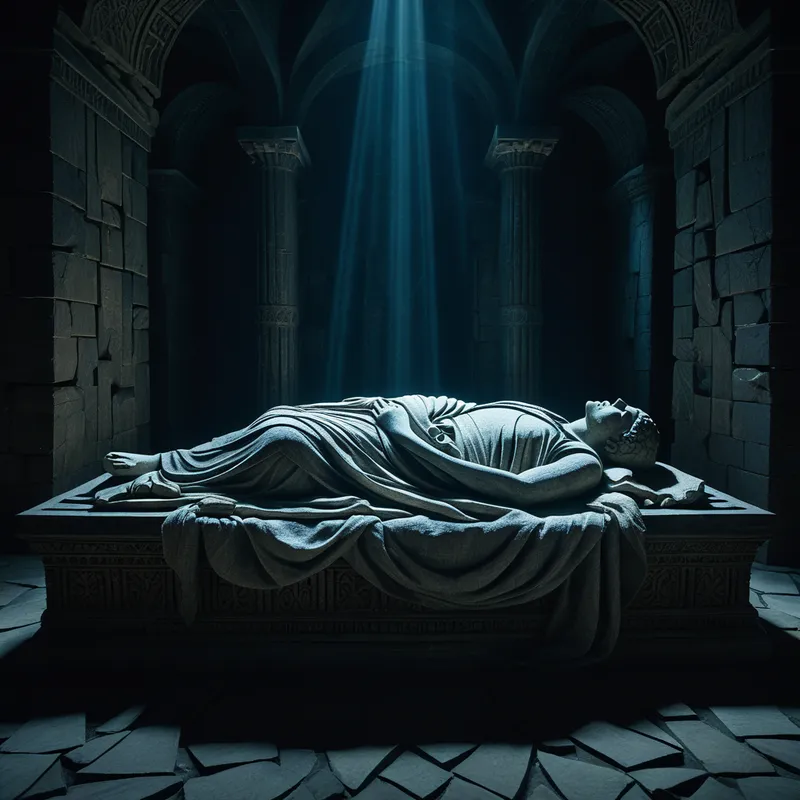
Yet Isis did not despair. With her sister [Nephthys](/myths/nephthys “Myth from Egyptian culture.”/), and the jackal-headed Anubis, she began the great gathering. A boat of reeds became their vessel, a search party for the soul of the world. From swamp and wadi, from field and dune, they recovered each sacred piece. Where a fragment was lost forever, they fashioned a likeness of perfect craftsmanship. Then, with spells older than speech and linen woven with love, they performed the first rites of mummification. They reconstituted the scattered god.
And in that act of profound reassembly, a new king was born. Not the king of the fertile earth, but the sovereign of the Duat, the silent, star-filled land of the dead. Osiris- The god wh was resurrected, not to walk in the sun, but to reign as the judge of souls, the green god of [the underworld](/myths/the-underworld “Myth from Greek culture.”/), the promise that what is torn asunder can be made eternal. From his union with Isis in death was conceived [Horus](/myths/horus “Myth from Egyptian culture.”/), who would challenge Set and reclaim the throne of the living. Thus the circle was drawn: life, death, and life again, forever balanced on the scales of a reassembled heart.
Cultural Origins & Context
The myth of Osiris- The god wh is [the cornerstone](/myths/the-cornerstone “Myth from Biblical culture.”/) of the ancient Egyptian religious and political cosmos. It is not merely a story but the operative narrative of the state, recorded in the [Pyramid Texts](/myths/pyramid-texts “Myth from Egyptian culture.”/), the Coffin Texts, and most completely in the Book of the Dead. It was performed in temple rituals and, most importantly, re-enacted in the burial rites of every Egyptian who could afford it. [The Pharaoh](/myths/the-pharaoh “Myth from Egyptian culture.”/) was the living Horus; in death, he became Osiris- The god wh. By the Middle Kingdom, this destiny was democratized—every justified soul sought to become “an Osiris,” to replicate his journey through dismemberment to reconstituted immortality. The myth functioned as a map for the soul’s journey, a justification for kingship, and a divine explanation for the annual cycle of the Nile’s inundation and the grain’s growth, death, and rebirth.
Symbolic Architecture
At its core, the myth of Osiris- The god wh is a profound [allegory](/symbols/allegory “Symbol: A narrative device where characters, events, or settings represent abstract ideas or moral qualities, conveying deeper meanings through symbolic storytelling.”/) for the processes of [disintegration](/symbols/disintegration “Symbol: A symbol of breakdown, loss of form, or fragmentation, often reflecting anxiety about personal identity, control, or stability.”/) and [integration](/symbols/integration “Symbol: The process of unifying disparate parts of the self or experience into a cohesive whole, often representing psychological wholeness or resolution of internal conflict.”/) that define existence itself. Osiris- The god wh represents [the principle](/symbols/the-principle “Symbol: A fundamental truth, law, or doctrine that serves as a foundation for a system of belief, behavior, or reasoning, often representing moral or ethical standards.”/) of cohesive, [life](/symbols/life “Symbol: The symbol of ‘Life’ represents a journey of growth, interconnectedness, and existential meaning, encompassing both the joys and challenges that define human experience.”/)-giving order—[the ego](/myths/the-ego “Myth from Jungian culture.”/), the conscious self, or any integrated [structure](/symbols/structure “Symbol: Structure in dreams often symbolizes stability, organization, and the framework of one’s life, reflecting how one perceives their environment and personal life.”/). Set is not mere “evil,” but the necessary force of [entropy](/symbols/entropy “Symbol: In arts and music, entropy represents the inevitable decay of order into chaos, often symbolizing creative destruction, impermanence, and the natural progression toward disorder.”/), [differentiation](/symbols/differentiation “Symbol: The process of distinguishing or separating parts of the self, emotions, or identity from a whole, often marking a developmental or psychological milestone.”/), and violent deconstruction. The murder and dismemberment symbolize the inevitable shattering of any wholeness by [trauma](/symbols/trauma “Symbol: A deeply distressing or disturbing experience that overwhelms the psyche, often manifesting in dreams as unresolved emotional wounds or psychological injury.”/), [crisis](/symbols/crisis “Symbol: A crisis symbolizes turmoil, urgent challenges, and the need for immediate resolution or change.”/), time, or the unconscious itself.
The coffin is the crucible, and dismemberment is not an end, but the necessary prelude to a more enduring synthesis.
Isis represents the active, seeking power of the [psyche](/myths/psyche “Myth from Greek culture.”/)—love, [memory](/symbols/memory “Symbol: Memory symbolizes the past, lessons learned, and the narratives we construct about our identities.”/), and magical [insight](/symbols/insight “Symbol: A sudden, deep understanding of a complex situation or truth, often arriving unexpectedly and illuminating hidden connections.”/)—that refuses to accept final [dissolution](/symbols/dissolution “Symbol: The process of breaking down, dispersing, or losing form, often representing transformation, release, or the end of a state of being.”/). Her gathering is the painstaking work of recollection, therapy, and [soul](/symbols/soul “Symbol: The soul represents the essence of a person, encompassing their spirit, identity, and connection to the universe.”/)-work. The reconstituted [body](/symbols/body “Symbol: The body in dreams often symbolizes the dreamer’s self-identity, personal health, and the relationship they have with their physical existence.”/), the mummy, is not a return to the old, naive wholeness, but the creation of a new, sacred integrity that includes the [reality](/symbols/reality “Symbol: Reality signifies the state of existence and perception, often reflecting one’s understanding of truth and life experiences.”/) of [death](/symbols/death “Symbol: Symbolizes transformation, endings, and new beginnings; often associated with fear of the unknown.”/) and suffering. Osiris- The god wh as [Lord](/symbols/lord “Symbol: The symbol of ‘Lord’ represents authority, mastery, and control, along with associated power dynamics in relationships.”/) of [the Duat](/myths/the-duat “Myth from Egyptian culture.”/) symbolizes [the Self](/myths/the-self “Myth from Jungian culture.”/) that rules from the [depths](/symbols/depths “Symbol: Represents the subconscious, hidden emotions, or foundational aspects of the self, often linked to primal fears or profound truths.”/), the center of the [personality](/symbols/personality “Symbol: Personality in dreams often symbolizes the traits and characteristics of the dreamer, reflecting how they perceive themselves and how they believe they are perceived by others.”/) that can only be established after the conscious ego has been ritually dismantled and reassembled with [awareness](/symbols/awareness “Symbol: Conscious perception of self, surroundings, or internal states. Often signifies awakening, insight, or heightened sensitivity.”/) of the [shadow](/symbols/shadow “Symbol: The ‘shadow’ embodies the unconscious, repressed aspects of the self and often represents fears or hidden emotions.”/) (Set) and the [anima](/symbols/anima “Symbol: The feminine archetype within the male unconscious, representing soul, creativity, and connection to the inner world.”/) (Isis).
The Dreamer’s Resonance
When this myth stirs in the modern dreamer, it often manifests as dreams of fragmentation, scattering, or being pulled apart. One may dream of losing vital body parts, of a cherished object breaking into pieces, or of being in a house whose rooms are disconnected and scattered across a landscape. These are not nightmares of mere anxiety, but somatic communications of a psychological process underway.
The psyche is announcing a “Set event”—a betrayal, a loss, a diagnosis, a profound failure that has shattered one’s sense of self-coherence. The dream is [the first stage](/myths/the-first-stage “Myth from Alchemical culture.”/) of the Isis-response: it makes the dismemberment visible. Subsequent dreams may involve searching, gathering, or finding lost items in unlikely places (underwater, in attics, in deserts). These symbolize the unconscious beginning its work of retrieval. The emotional tone is key: profound grief paired with a determined, instinctual drive to “find the pieces.” The dreamer is somatically experiencing the myth, their psyche performing the ancient rites of recollection on the stage of the unconscious.

Alchemical Translation
The alchemical journey mirrored in this myth is the opus contra naturam—the work against nature, which is here the work against final decay and meaningless fragmentation. [The prima materia](/myths/the-prima-materia “Myth from Alchemical culture.”/) is the naive, ruling consciousness (Osiris- The god wh as King). The [nigredo](/myths/nigredo “Myth from Alchemical culture.”/), or blackening, is his murder, imprisonment in the chest, and dismemberment—the descent into the utter darkness of despair, depression, and identity dissolution.
The goal is not to avoid the coffin or evade Set’s blade, but to submit to the scattering, trusting that a deeper intelligence (Isis) knows how to gather.
The albedo, or whitening, is the mourning and purification by Isis and Nephthys, the washing of the pieces. The gathering itself is the beginning of citrinitas, the yellowing, where what was dark becomes illuminated by the purpose of reassembly. The final mummification and resurrection represent the [rubedo](/myths/rubedo “Myth from Alchemical culture.”/), the reddening—the creation of the sacred, incorruptible body of the Self. The modern individual undergoing this alchemy moves from being a ruler of a superficial, external order to becoming the sovereign of their own inner [underworld](/myths/underworld “Myth from Greek culture.”/). They no longer identify solely with the sun-lit ego (Horus) but establish their throne in the rich, fertile darkness of the integrated unconscious (Osiris- The god wh). They achieve a wholeness that has consciously integrated its own capacity for chaos and betrayal, making them, paradoxically, un-shatterable. The scattered god becomes the cornerstone of the soul’s eternal kingdom.
Associated Symbols
Explore related symbols from the CaleaDream lexicon: