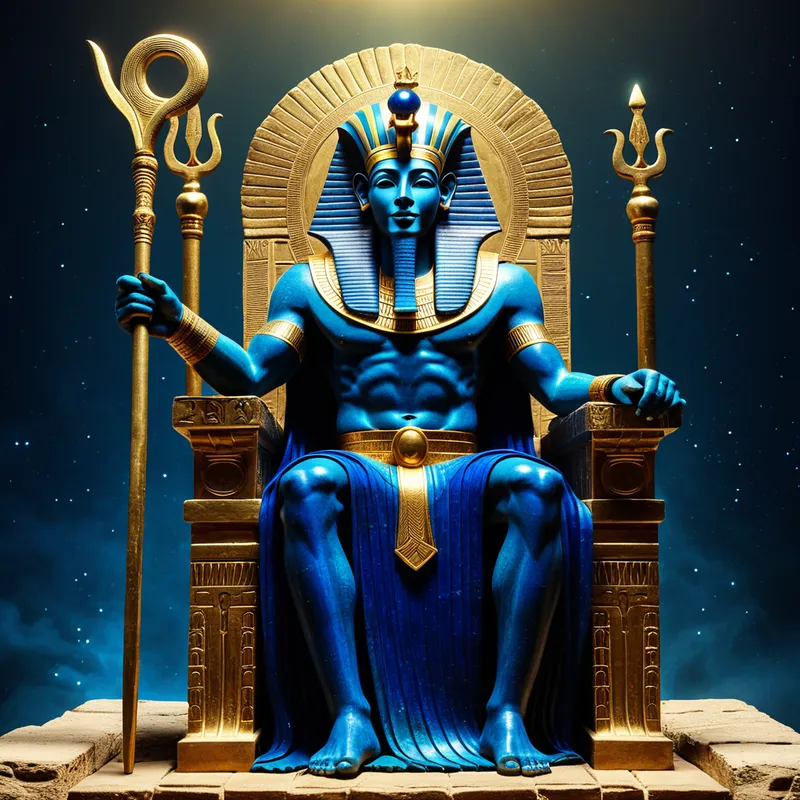
Osiris Myth Meaning & Symbolism
A god-king is murdered, dismembered, and resurrected, becoming lord of the dead and symbol of eternal renewal through love and sacred reassembly.
The Tale of Osiris
In the First Time, when the gods walked with their feet upon the black soil, there was a king. His name was Osiris, and his rule was a [golden age](/myths/golden-age “Myth from Universal culture.”/). He taught the people to cease their wandering, to sow seeds in [the earth](/myths/the-earth “Myth from Hindu culture.”/), to honor [the law](/myths/the-law “Myth from Biblical culture.”/), and to worship the divine. His queen, Isis, was his perfect complement, her wisdom as deep as the night sky, her love a binding force. But in [the shadow](/myths/the-shadow “Myth from Jungian culture.”/) of this luminous reign grew a darkness—Set, brother to Osiris, whose heart was a tempest of envy and rage.
Set crafted a plot of terrible cunning. He fashioned a chest of exquisite cedar and ebony, inlaid with ivory, and proclaimed it a prize for whoever fit within it perfectly. When Osiris, curious and trusting, laid himself in the chest, Set’s conspirators sprang forward. They slammed the lid shut, sealed it with molten lead, and cast it into the churning waters of the Nile. The chest became a coffin, carrying the living king into the cold embrace of [the river](/myths/the-river “Myth from Buddhist culture.”/) and out into the vast, green sea.
Isis, her heart torn, began a search that would become legend. She roamed [the world](/myths/the-world “Myth from Tarot culture.”/), a figure of grief and unyielding purpose, until she found the chest lodged in a tamarisk tree that had grown into a mighty pillar in a far-off land. She brought the body of her husband back, hiding it in the marshes to work the rites of revival. But Set, hunting by the light of a full moon, discovered the hidden place. In a fury that shattered the stillness, he seized the body of Osiris. This time, he would ensure no return. He rent the body into fourteen—some say forty-two—pieces, and scattered them to the corners of the world.
Isis’s search began anew, now a grisly pilgrimage. With her sister [Nephthys](/myths/nephthys “Myth from Egyptian culture.”/), she traveled the length of the land, gathering each sacred fragment wherever it had been thrown. All were found save one, consumed by the Nile’s fish. Wherever a piece was recovered, a temple was later raised. With magic older than the gods themselves, with the help of Anubis, she bound the pieces with linen strips, reconsecrating the form. Through her power and her love, she conceived a son, [Horus](/myths/horus “Myth from Egyptian culture.”/), who would one day challenge the usurper.
And Osiris? He did not return to the land of the living sun. His resurrection was of another order. Reassembled, whole, and perfected, he rose to rule the Duat, the beautiful West, becoming the Lord of Eternity, the judge of souls, the green god of the fertile earth and the promise of life beyond death. His story did not end; it transformed, becoming the bedrock of the world’s deepest hope.
Cultural Origins & Context
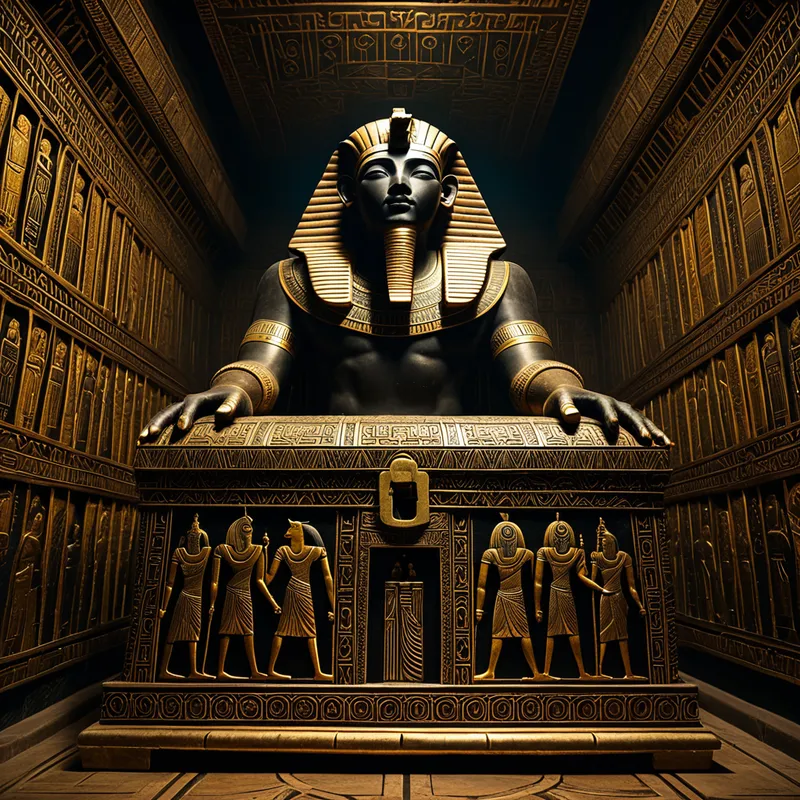
This is the core narrative of the Osirian cycle, the most profound and enduring mythic complex from ancient Egypt. It was not a single, fixed text but a living tradition, woven from fragments in the [Pyramid Texts](/myths/pyramid-texts “Myth from Egyptian culture.”/) (c. 2400-2300 BCE), elaborated in the Book of the Dead, and celebrated in temple rituals and popular festival dramas for over three millennia. The myth was the sacred engine of Egyptian civilization, providing the template for the divine right of [the Pharaoh](/myths/the-pharaoh “Myth from Egyptian culture.”/) (the living Horus), the theology of the afterlife, and the agricultural rhythms of the Nile’s flood, death, and renewal. It was told by priests in dimly lit sanctuaries and reenacted publicly, making the cosmic struggle of order (Maat) against chaos (Isfet) a tangible, emotional reality for every person, from the king to the farmer.
Symbolic Architecture
The myth of Osiris is a master codex of the [psyche](/myths/psyche “Myth from Greek culture.”/), mapping the inevitable descent, [fragmentation](/symbols/fragmentation “Symbol: The experience of breaking apart, losing cohesion, or being separated into pieces. Often represents disintegration of self, relationships, or reality.”/), and reconstitution of [the self](/myths/the-self “Myth from Jungian culture.”/). Osiris represents the established, conscious order—the ruling principle of [the ego](/myths/the-ego “Myth from Jungian culture.”/), culture, and [identity](/symbols/identity “Symbol: Identity represents the sense of self, encompassing personal beliefs, cultural background, and social roles.”/). His murder by Set is not merely [betrayal](/symbols/betrayal “Symbol: A profound violation of trust in artistic or musical contexts, often representing broken creative partnerships or artistic integrity compromised.”/); it is the necessary shattering of a completeness that has become stagnant, a [kingdom](/symbols/kingdom “Symbol: A kingdom symbolizes authority, belonging, and a sense of identity within a larger context or community.”/) too perfect to grow.
The coffin is the hardened shell of the persona, the beautiful, gilded identity that becomes a prison. Dismemberment is the utter deconstruction of the known self.
Set, the necessary [shadow](/symbols/shadow “Symbol: The ‘shadow’ embodies the unconscious, repressed aspects of the self and often represents fears or hidden emotions.”/), is the agent of this chaotic, creative destruction. He is the erupting unconscious, the envy, the rage, the untamed desert that demands the end of an old world. Isis is the animating force of the [soul](/symbols/soul “Symbol: The soul represents the essence of a person, encompassing their spirit, identity, and connection to the universe.”/)—the loving, devoted, magical [consciousness](/symbols/consciousness “Symbol: Consciousness represents the state of awareness and perception, encompassing thoughts, feelings, and experiences.”/) that refuses to accept annihilation. Her search is the work of recollection (re-collectio), the painstaking psychological [effort](/symbols/effort “Symbol: Effort signifies the physical, mental, and emotional energy invested toward achieving goals and personal growth.”/) to find and honor all the lost parts of oneself scattered by [trauma](/symbols/trauma “Symbol: A deeply distressing or disturbing experience that overwhelms the psyche, often manifesting in dreams as unresolved emotional wounds or psychological injury.”/) or neglect. The missing phallus, absorbed by the Nile, signifies that which is truly transformed and cannot be regained in its old form; a new creative principle (Horus) must be born from the [loss](/symbols/loss “Symbol: Loss often symbolizes change, grief, and transformation in dreams, representing the emotional or psychological detachment from something or someone significant.”/).
The final state of Osiris as [Lord](/symbols/lord “Symbol: The symbol of ‘Lord’ represents authority, mastery, and control, along with associated power dynamics in relationships.”/) of [the Duat](/myths/the-duat “Myth from Egyptian culture.”/) is the ultimate [symbol](/symbols/symbol “Symbol: A symbol can represent an idea, concept, or belief, serving as a powerful tool for communication and understanding.”/). He is not restored to his old kingship but inaugurated into a new, greater sovereignty over the inner [landscape](/symbols/landscape “Symbol: Landscapes in dreams are powerful symbols representing the dreamer’s emotional state, personal journey, and the broader context of life situations.”/)—the [realm](/symbols/realm “Symbol: The symbol of ‘Realm’ often signifies the boundaries of one’s consciousness, experiences, or emotional states, suggesting aspects of reality that are either explored or ignored.”/) of the ancestors, memories, and the fertile dark from which new [life](/symbols/life “Symbol: The symbol of ‘Life’ represents a journey of growth, interconnectedness, and existential meaning, encompassing both the joys and challenges that define human experience.”/) springs. He becomes the Djed pillar, the enduring core.

The Dreamer’s Resonance
When this myth stirs in the modern dreamer, it announces a profound process of psychic death and rebirth. One may dream of being trapped in a beautiful room that becomes a tomb, of a trusted figure who reveals a destructive envy, or—most potently—of the body coming apart. This is not necessarily nightmare, but often a somber, surreal unfolding.
The somatic experience is one of dissolution: a feeling of “falling apart,” losing one’s center, or being scattered. Psychologically, it corresponds to a life crisis where a central identity—as a professional, a partner, a believer—is violently challenged or dismantled. The dreamer is in the coffin, or worse, in the moment of dismemberment. The psyche is performing the Set-function, breaking down an outmoded structure. The subsequent dreams may feature searching through strange landscapes, gathering objects, or being aided by a nurturing, determined feminine presence (the Isis-function), guiding the slow work of psychic re-collection.

Alchemical Translation
The alchemical journey mirrored in the Osiris myth is the [nigredo](/myths/nigredo “Myth from Alchemical culture.”/), leading to the albedo and finally the enduring [rubedo](/myths/rubedo “Myth from Alchemical culture.”/). The individual’s task is not to avoid the coffin or fight the dismemberment, but to submit to it as the sacred, if brutal, prerequisite for transformation.
Individuation requires a willing descent into one’s own Duat, to reign over the scattered fragments of soul as Osiris reigns, with compassionate authority.
First, one must recognize the “Set-event” in one’s life—the betrayal, the failure, the loss that shatters the world. This is the leaden [prima materia](/myths/prima-materia “Myth from Alchemical culture.”/). Then begins the Isis-work: the patient, grieving, meticulous gathering of all that was lost—the abandoned talents, the repressed emotions, the childhood wounds. This is the analysis, the journaling, the honest recollection. Anubis, [the psychopomp](/myths/the-psychopomp “Myth from Various culture.”/), is the guiding therapeutic function that helps embalm the old self with respect, preparing it for its new form.
The rebirth is not a return. The new consciousness that is Horus—the avenging, focused heir—is born from this process to engage the world. But the ultimate goal is to integrate the Osiris-state: to establish an inner, eternal kingdom where death and life, shadow and light, are part of a reconciled, fertile whole. One becomes the Djed pillar, the stable axis mundi of one’s own being, green with the promise of continual renewal from within the dark earth of the soul.
Associated Symbols
Explore related symbols from the CaleaDream lexicon:
- Piece
- Coffin
- Loss
- Fragment
- Chin
- Grave
- Cemetery
- Farmer
- Hidden
- Corpse
- Dust
- Abundant Harvest
- Wheat Field of Bread
- Shattered Bone
- Baking Bread
- Spooky Graveyard
- Absent Parent
- Equinox
- Malachite Piece
- Dried Bouquet
- Office Cubicle
- Baker’s Rolling Pin
- Masonic Apron
- Pharaoh’s Crown
- Fragmented Story
- Outdoor Lounge Chair
- Brewery
- Sun-bleached Skulls
- Waving Wheat
- Existence Fragment
- Waves of Grain
- Wheat Sheaf
- Animal Bones
- Buried Seeds
- Grain Storage Granary
- Cereal Grain
- Cherished Spelt
- Tilled Earth
- Threshed Wheat
- Malted Grains
- Wetland Crops
- Kamut Grain
- Sprouting Lentils
- Ripe Sedge
- Milled Grain
- Primitive Trowel
- Sun-Dried Tomatoes
- Seasonal Crops
- Grain Storage Pit
- Soil Fertility
- Animal Skull
- Granary
- Root Vegetable Storage
- Renewed Growth
- Farming Field
- Resurrection Tomb
- Angel Number 999
- Coarse Grain
- Respawn
- Decay
- Regeneration
- Crypt
- Bankruptcy
- Putrefaction
- Stiffness
- Harvest
- Linen
- Grain
- Nrem
- Fragmenting
- Rotten
- Musty
- Cumin
- Rot
- Formalin