Orishas Myth Meaning & Symbolism
Divine forces of nature and consciousness, the Orishas model the sacred dialogue between human destiny and the powers of the cosmos.
The Tale of Orishas
Before [the world](/myths/the-world “Myth from Tarot culture.”/) knew its name, there was only [the void](/myths/the-void “Myth from Buddhist culture.”/), a silent, formless potential. Then, from the heart of this nothingness, erupted a single, conscious force—Olodumare. Its will was a vibration that became sound, and the sound became the first word, which shattered the silence into a billion glittering fragments. These fragments were the Ase, the divine breath of creation.
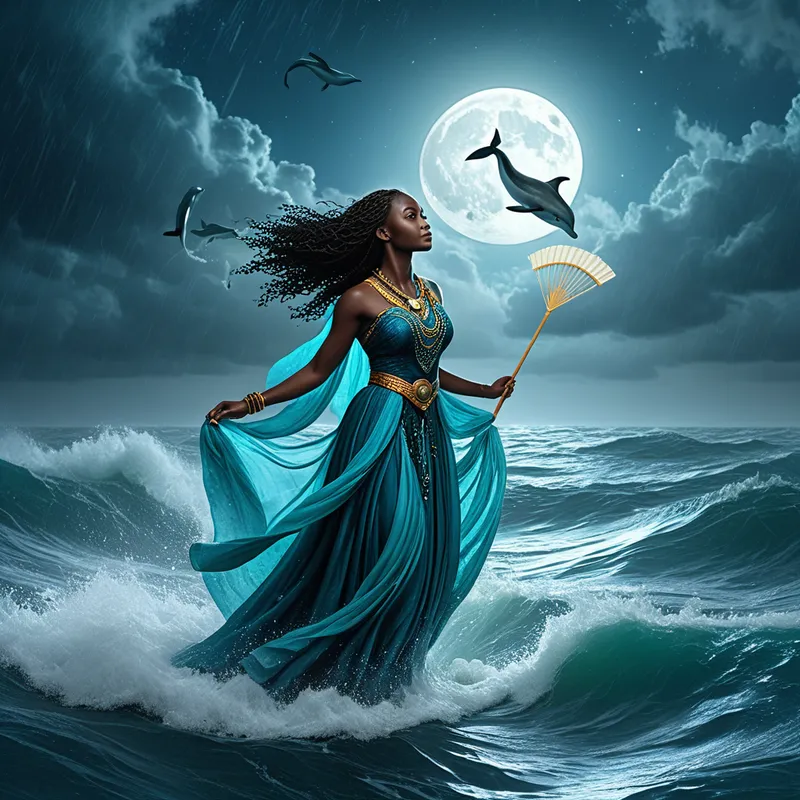
From this breath, Olodumare shaped the first beings of purpose: the Orishas. They were not distant, ethereal gods, but powers made flesh and element, each a distinct note in the symphony of existence. Yemoja was [the womb](/myths/the-womb “Myth from Various culture.”/) of the world, her body the rolling, nurturing sea. Oshosi was the whisper in the deep forest, the swift arrow of intuition. Eshu was the spark at [the crossroads](/myths/the-crossroads “Myth from Celtic culture.”/), the laughter that upends certainty.
Olodumare tasked them with [the great work](/myths/the-great-work “Myth from Alchemical culture.”/): to descend from the realm of pure spirit, Orun, and bring order to the raw, teeming chaos of the earthly realm, Aye. They came not as conquerors, but as partners. [Shango](/myths/shango “Myth from African Diaspora culture.”/) pounded the first rhythms of society with his double-headed axe. Oshun taught the art of sweetening life with river honey and diplomacy. Ogun cleared the primal thickets with his machete, forging the path for civilization itself.
But Aye was wild and resistant. The work was immense, and the Orishas grew weary. They needed intermediaries, beings who could feel the clay of [the earth](/myths/the-earth “Myth from Hindu culture.”/) and the fire of the spirit in equal measure. And so, from the very soil they were shaping, mingled with their own divine Ase, they fashioned humanity. Into each person, they breathed a fragment of their own essence—a destiny, a character, a sacred charge. Humanity became the living altar where heaven and earth met, [the vessel](/myths/the-vessel “Myth from Alchemical culture.”/) through which the Orishas continued their work of perfecting the world. The myth does not end, for it is lived in every choice, at every crossroads, in every storm and every moment of peace.
Cultural Origins & Context
This cosmology originates with the Yoruba people of West Africa, a civilization with a rich urban and philosophical tradition centuries old. The myth of the Orishas is not a single, frozen text, but a living, breathing corpus of wisdom carried in the hearts of priests and elders, sung in the rhythms of the Dundun, and danced into being in sacred ceremonies. Its transmission was oral, performative, and deeply communal.
The cataclysm of the Transatlantic Slave Trade violently dispersed Yoruba people across the Americas. In the brutal holds of ships and on foreign soil, the myth faced extinction. Yet, it proved unkillable. It survived through coded speech, syncretized with Catholic [saints](/myths/saints “Myth from Christian culture.”/) in Cuba to become Santería (La Regla de Ocha), persisted in spirit in Brazilian Candomblé, and informed the practices of Haitian Vodou. In each new land, the core architecture remained: a map of divine forces interacting with human life. Its function was, and is, profoundly practical—it provides a framework for understanding fate (Ayanmo), for navigating life’s challenges through ritual and sacrifice, and for maintaining a sacred connection to the ancestral past, transforming a history of fragmentation into a tapestry of spiritual resilience.
Symbolic Architecture
The Orishas represent the symbolic [architecture](/symbols/architecture “Symbol: Architecture in dreams often signifies structure, stability, and the framing of personal identity or life’s journey.”/) of the [human](/symbols/human “Symbol: The symbol of a human represents individuality, complexity of emotions, and social relationships.”/) [psyche](/myths/psyche “Myth from Greek culture.”/) and the natural world, seen not as separate but as a continuous [spectrum](/symbols/spectrum “Symbol: A continuum of possibilities, representing diversity, transition, and the full range of existence from one extreme to another.”/) of [consciousness](/symbols/consciousness “Symbol: Consciousness represents the state of awareness and perception, encompassing thoughts, feelings, and experiences.”/). They are not monolithic “gods” to be worshipped from afar, but archetypal complexes—patterns of [energy](/symbols/energy “Symbol: Energy symbolizes vitality, motivation, and the drive that fuels actions and ambitions.”/), [personality](/symbols/personality “Symbol: Personality in dreams often symbolizes the traits and characteristics of the dreamer, reflecting how they perceive themselves and how they believe they are perceived by others.”/), and [destiny](/symbols/destiny “Symbol: A predetermined course of events or ultimate purpose, often linked to spiritual forces or cosmic order, representing life’s inherent direction.”/).
The Orisha is not a statue to be placated, but a current in the river of being that one must learn to swim with, or be drowned by.
Eshu at the [crossroads](/symbols/crossroads “Symbol: A powerful spiritual symbol representing a critical decision point where paths diverge, often associated with fate, transformation, and life-altering choices.”/) symbolizes the inevitable [moment](/symbols/moment “Symbol: The symbol of a ‘moment’ embodies the significance of transient experiences that encapsulate emotional depth or pivotal transformations in life.”/) of [choice](/symbols/choice “Symbol: The concept of choice often embodies decision-making, freedom, and the multitude of paths available in life.”/), [chaos](/symbols/chaos “Symbol: In Arts & Music, chaos represents raw creative potential, uncontrolled expression, and the breakdown of order to forge new artistic forms.”/), and [chance](/symbols/chance “Symbol: A representation of opportunities and unpredictability in life, illustrating how fate can influence one’s journey.”/) that precedes any transformation. Ogun is the [archetype](/symbols/archetype “Symbol: A universal, primordial pattern or prototype in the collective unconscious that shapes human experience, behavior, and creative expression.”/) of focused will, the brutal but necessary force that cuts through psychic undergrowth and forges [identity](/symbols/identity “Symbol: Identity represents the sense of self, encompassing personal beliefs, cultural background, and social roles.”/). Oshun embodies [the principle](/symbols/the-principle “Symbol: A fundamental truth, law, or doctrine that serves as a foundation for a system of belief, behavior, or reasoning, often representing moral or ethical standards.”/) of attraction, healing, and the sweet, often overlooked power of [vulnerability](/symbols/vulnerability “Symbol: A state of emotional or physical exposure, often involving risk of harm, that reveals authentic self beneath protective layers.”/) and pleasure. The [system](/symbols/system “Symbol: A system represents structure, organization, and interrelated components functioning together, often reflecting personal or social order.”/) as a whole symbolizes a profound [truth](/symbols/truth “Symbol: Truth represents authenticity, honesty, and the quest for knowledge beyond mere appearances.”/): wholeness is not found in a single perfect principle, but in the dynamic, often tense, balance between multiple competing and complementary forces. Your “head” Ori is your personal locus of divinity and [choice](/symbols/choice “Symbol: The concept of choice often embodies decision-making, freedom, and the multitude of paths available in life.”/), negotiating your [path](/symbols/path “Symbol: The ‘path’ symbolizes a journey, choices, and the direction one’s life is taking, often representing individual growth and exploration.”/) among these greater currents.
The Dreamer’s Resonance
When the Orishas appear in modern dreams, they rarely come in traditional guise. The dreamer is not visiting a temple in Ile-Ife. Instead, they are encountering the raw, psychological force the Orisha represents.
To dream of a relentless, unstoppable force—a wildfire, a torrential river, a blacksmith’s hammer ringing endlessly—is to dream of Ogun. The psyche is signaling a need for decisive action, for cutting away what is obsolete, or it may be warning of unintegrated, destructive rage. A dream of being at a confusing intersection where all signs are contradictory, or of a trickster figure who changes forms, speaks to the presence of Eshu. This is the somatic feeling of a life at a pivotal crossroads, where old maps no longer work. The dreamer is in the chaotic, fertile space between one identity and the next. A dream of being immersed in healing [water](/myths/water “Myth from Chinese culture.”/), of finding a hidden [honeycomb](/myths/honeycomb “Myth from Natural culture.”/), or of powerful, compassionate nurturing connects to Oshun or Yemoja. This often manifests when the dreamer’s emotional life requires attention, healing, or the courage to embrace deep feeling.

Alchemical Translation
The myth of the Orishas models individuation not as a linear ascent to a single ideal, but as a sacred ecology of [the self](/myths/the-self “Myth from Jungian culture.”/). The modern seeker’s task is not to become one perfect, monolithic “enlightened” being, but to become a skilled conductor of the inner [pantheon](/myths/pantheon “Myth from Roman culture.”/).
Individuation, in this light, is the art of divination—learning to read the signs of your own inner weather, to honor the storm of Shango as much as the deep peace of Osun.
The first alchemical step is recognition: identifying which inner forces are dominant, which are suppressed, and which are at war. The person who cannot ever access Ogun’s righteous boundaries becomes a doormat; the one who cannot access Oshun’s sweetness becomes a tyrant. The second step is invocation and balance. This is the “ritual” of modern life: consciously calling upon the focused drive of Ogun to meet a deadline, then invoking the restorative flow of Oshun to recover. It is acknowledging [the trickster](/myths/the-trickster “Myth from Various culture.”/) Eshu when life unexpectedly shatters your plans, understanding this chaos as the necessary prelude to a new path.
The ultimate transmutation is achieving a state of dynamic equilibrium—where the self is not a king ruling over subdued instincts, but a vibrant community held together by respect and Ase. You become the crossroads, the forge, and [the river](/myths/the-river “Myth from Buddhist culture.”/) simultaneously. Your life becomes the ongoing myth, where spirit and matter, destiny and choice, are in constant, creative dialogue. This is the profound gift of the Orishas: a map for becoming a whole world, rather than just a lonely inhabitant of one.
Associated Symbols
Explore related symbols from the CaleaDream lexicon: