Oracle of Delphi Myth Meaning & Symbolism
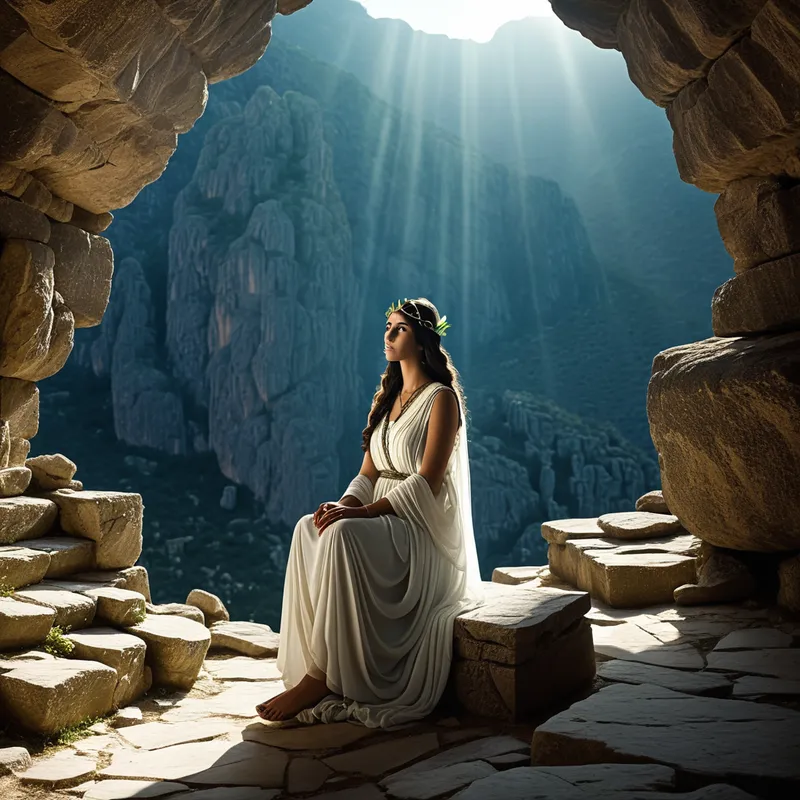
The priestess Pythia, breathing sacred vapors, channeled Apollo's cryptic wisdom from the world's navel, guiding heroes and kings toward their fated destinies.
The Tale of Oracle of Delphi
Before history was written, when the world was young and the gods walked close to the skin of the earth, there was a place where heaven and underworld touched. It was a wild, mountainous cleft, a wound in the side of Mount Parnassus. Here, in the deep shadow of towering cliffs, a great serpent, Python, coiled. Born from the primal mud of the earth after the great flood, she was a creature of Gaia’s own dreaming, her scales the color of tarnished bronze, her breath the smell of damp stone and decay. She guarded the chasma, the sacred chasm, from which issued a strange, sweet-smelling vapor that whispered of things unseen.
Then came the god of light. Apollo, the Far-Shooter, golden and terrible in his youth, descended from the northern lands. He sought a place for his oracle, a mouthpiece for his divine will. He found Python coiled around the vaporous cleft, a symbol of the old, chthonic power. There was no parley. With arrows forged of sunlight and purpose, Apollo slew the great serpent, letting her blood soak into the rocky soil. The old power was subdued, but not banished; it was transmuted. Upon her body, Apollo founded his sanctuary. He called it Pytho, and his priestess would be called the Pythia, in memory of the dragon whose spirit now slept beneath the temple floor.
Centuries flowed. A magnificent temple of stone arose, its columns like bones of the mountain itself. At its heart, in the adyton, the forbidden inner chamber, the ritual was born. A woman of the region, chosen for her simple life, would undergo rites of purification in the Castalian Spring. Clad in white, crowned with laurel from the valley of Tempe, she would descend. She would seat herself on a three-legged stool, the tripod, placed directly over the chasm where the pneuma—the sacred breath of the earth—rose.
The vapors took her. Her body would tremble, her eyes roll back into her head. Her voice, when it came, was not her own. It was ragged, guttural, a torrent of sound wrestling its way from the depths of the world. Beside her, male priests, the Hosioi, listened intently to the cacophony. They would translate the divine ravings into elegant, often ambiguous, Greek hexameter verse. These were the oracles.
And the world came to her. Kings facing war, colonists seeking new lands, lovers in despair, philosophers in doubt—all climbed the Sacred Way. They offered lavish gifts, sacrificed animals, and with hearts pounding, posed their questions to the god. The answers they received were never simple. “Cross the Halys and you will destroy a great empire,” warned the oracle to King Croesus, who destroyed his own. “The wooden walls will save you,” she told the Athenians of the Persian invasion, leading to their naval victory at Salamis. The voice from the crack in the world was the voice of fate itself, clear as mountain air and opaque as the deepest night, a mirror held up to the soul of the questioner. It was the navel of the world, the omphalos, where a mortal could stand and hear the whispering of the cosmos.
Cultural Origins & Context
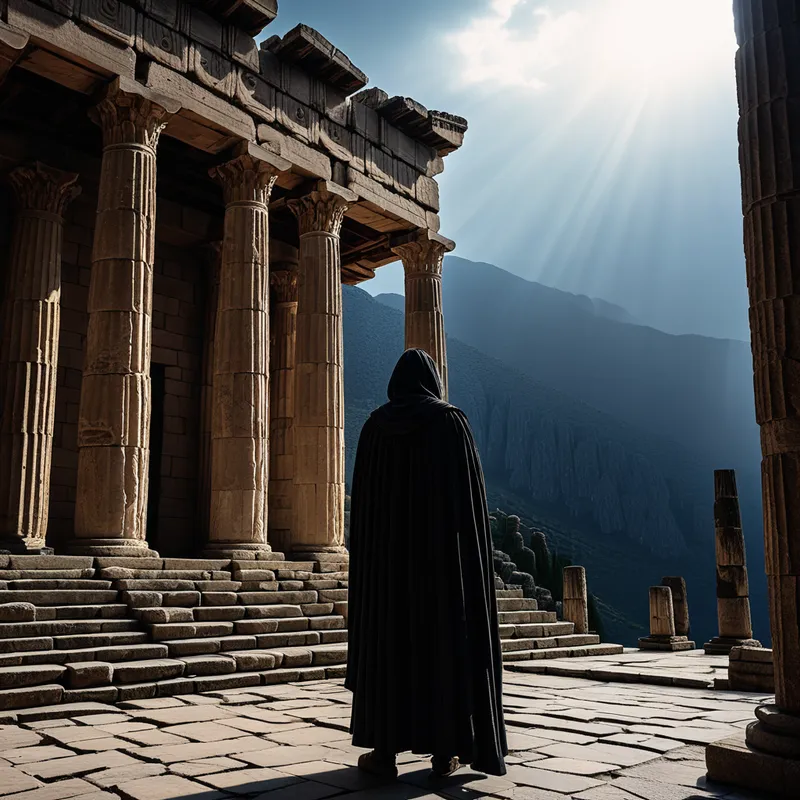
The Oracle of Delphi was not merely a story; it was the beating heart of the ancient Greek world for over a millennium. Its origins are prehistoric, rooted in a Mycenaean cult site possibly dedicated to an earth goddess, later syncretized with the Olympian order under Apollo. This layering is crucial: Delphi always retained its chthonic, feminine, chaotic essence (Gaia, Python) even as it was administered by the patriarchal, rational, Olympian god of light. It was a living institution, a geopolitical nerve center. City-states consulted it before founding colonies, enacting laws, or waging war. Its pronouncements carried the weight of divine sanction, shaping history.
The myth was passed down through a chorus of voices: the hymns of priests, the histories of Herodotus and Plutarch (who served as a priest there), the plays of Aeschylus and Euripides, and the countless personal accounts of pilgrims. Its societal function was multifaceted. It was a supreme court of religious authority, a center for international diplomacy, and a profound psychological institution. It provided a sanctioned space for uncertainty in a culture that prized clarity and reason. In a world without science or psychology, Delphi offered a way to consult the unknown, to externalize the inner turmoil of choice and fate, and to receive guidance that demanded deep, personal interpretation.
Symbolic Architecture
The myth of Delphi is a perfect symbolic map of the human psyche’s relationship with the unknown. The site itself is the symbol: the meeting of the soaring, rational, masculine principle (Apollo, the temple, “Know Thyself”) with the dark, chaotic, feminine depths (Gaia, Python, the chasm, the vapors). The oracle is not pure light nor pure darkness, but the terrifying, creative product of their union.
The true oracle lies not in the answer given, but in the confrontation with the unanswerable that the ritual demands.
The Pythia represents the human vessel for the transpersonal—the ego temporarily dissolved to allow the contents of the collective unconscious to speak. Her “madness” is enthousiasmos, being filled with the god, a sacred psychosis. The cryptic, poetic form of the oracles forces the questioner out of literal-mindedness and into a symbolic, reflective mode. The famous Delphic maxims, “Know Thyself” and “Nothing in Excess,” carved at the entrance, were the prerequisites for consultation. One could not understand the god’s will without first undertaking a journey of self-examination. The oracle, therefore, did not foretell a fixed future; it revealed the deeper currents of the present, the psychological and moral landscape within which fate would unfold.
The Dreamer’s Resonance
When the pattern of the Delphic Oracle appears in modern dreams, it signals a profound encounter with the inner Self, the psyche’s own guiding center. Dreaming of seeking a cryptic authority figure in a cavernous, ancient place points to a soul at a crossroads, desperate for guidance that the conscious mind cannot provide.
The somatic experience might be one of anxiety mixed with awe—the trembling of the Pythia translated into the dreamer’s own body as a feeling of being overwhelmed by a power from within. The vaporous chasm represents the emergence of repressed material, intuition, or psychic energy that feels both intoxicating and dangerous. The ambiguous, riddling speech of the oracle in a dream mirrors the often-confusing, symbolic language of the unconscious itself. The dreamer is in the process of “consulting the depths,” asking a fundamental life question. The frustration of not receiving a clear answer is the entire point; the psyche is forcing the ego to release its demand for certainty and engage in the harder work of interpretation, integration, and accepting the paradoxical nature of truth.

Alchemical Translation
The journey to Delphi models the individuation process—the alchemical work of becoming whole. The pilgrim’s ascent up the Sacred Way is the conscious preparation, the gathering of one’s question (the problema). The sacrifice and purification rites represent the necessary surrender of old attitudes and defenses.
Entering the temple’s dark adyton is the descent into the unconscious, the confrontation with the shadow (represented by the slain Python). Here, in the fertile dark, the ego (the pilgrim) must listen to the chaotic, non-rinal voice of the Self (the Pythia’s ravings, translated by the mediating function of the priests—the transcendent function). The oracle delivered is the lapis, the philosopher’s stone of insight, but in raw, unrefined form.
The cryptic oracle is the psyche’s refusal to do our work for us; it is the catalyst that initiates the internal alchemy of meaning-making.
The real alchemical transformation happens after leaving the sanctuary. The pilgrim must carry the ambiguous verse back into the sunlight of ordinary life and “interpret” it through action, reflection, and ethical choice. This is the mortificatio and solutio—the death of literal interpretation and the dissolving into a broader, symbolic understanding. To “know thyself,” as Delphi commanded, is the ultimate goal of individuation: to integrate the light of consciousness with the mysterious, vaporous depths of the unconscious, becoming the author of one’s own fate by first listening, truly listening, to the divine madness within.
Associated Symbols
Explore related symbols from the CaleaDream lexicon:
- Receiver
- Smoke
- Survey
- Smart Speaker
- Metaphysical Whisper
- Mummy’s Curse
- Freud’s Couch
- Sigmund Freud’s Couch
- Inkblot Rorschach
- Paradoxical Prose
- Steam Whistle Kettle
- Greek Temple
- Incense Smoke
- Oracle Shrine
- Cloisters Under Stars
- Portal to Self
- Cloud of Uncertainty
- Veiled Knowledge
- Fire-Touched Skull
- Incense
- Faint Tremor
- Faint Whisper
- Inner Voice
- Oracle’s Whisper
- Infrasound
- Whisper
- Smoky