Oracle at Delphi Myth Meaning & Symbolism
A priestess, breathing sacred fumes, becomes the voice of Apollo, channeling cryptic wisdom from the world's center to kings and commoners alike.
The Tale of Oracle at Delphi
Before history was written, when the world was young and the gods walked close to the earth, there was a place where the veil between realms grew thin. High on the rugged southern slopes of Mount Parnassus, a cleft in the living rock breathed a strange, sweet scent. This was the place.
It was first sacred to Gaia, the primordial Mother Earth, and her daughter Python, a great serpent-dragon who coiled in the misty chasm, her whispers echoing the secrets of the deep earth. The site hummed with a primal, chthonic power. But then came the shining one, Apollo. Seeking a place from which to speak truth to mortals, he descended from Olympus. With his silver bow, he slew Python, claiming the oracle for his own divine order of light and clarity. Yet, in a profound act of reconciliation, he did not erase the old powers. He took the name Pythia for his priestess, and the games he founded there were called the Pythian Games, forever honoring the vanquished guardian.
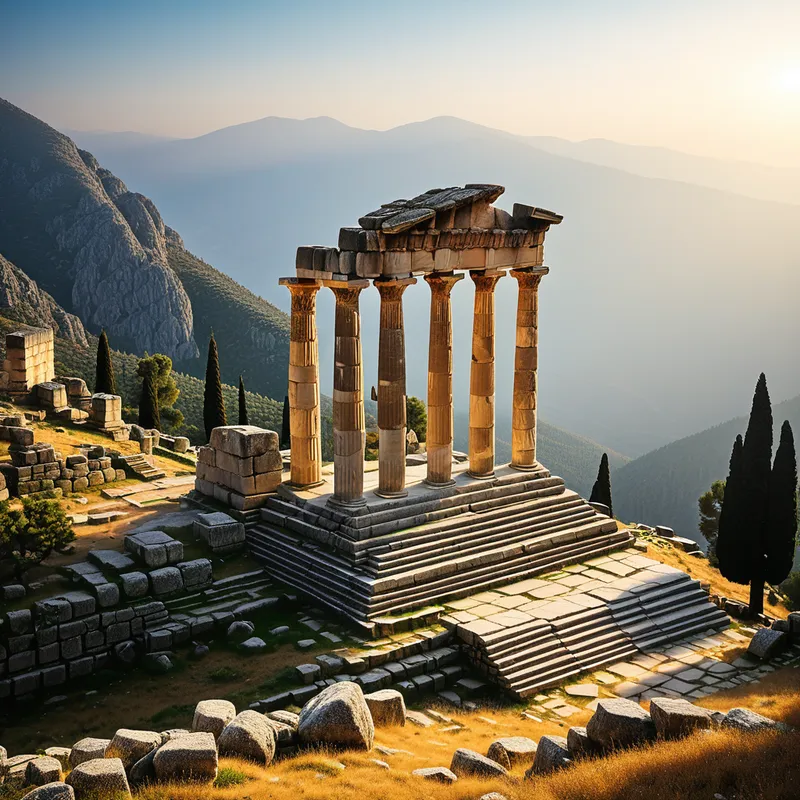
Thus was the stage set. A temple of magnificent Doric columns was built over the chasm. At its heart, in the adyton, a fissure in the floor exhaled the pneuma, the breath of the earth. Above this sat a simple, three-legged stool—the tripod. And upon it sat the Pythia.
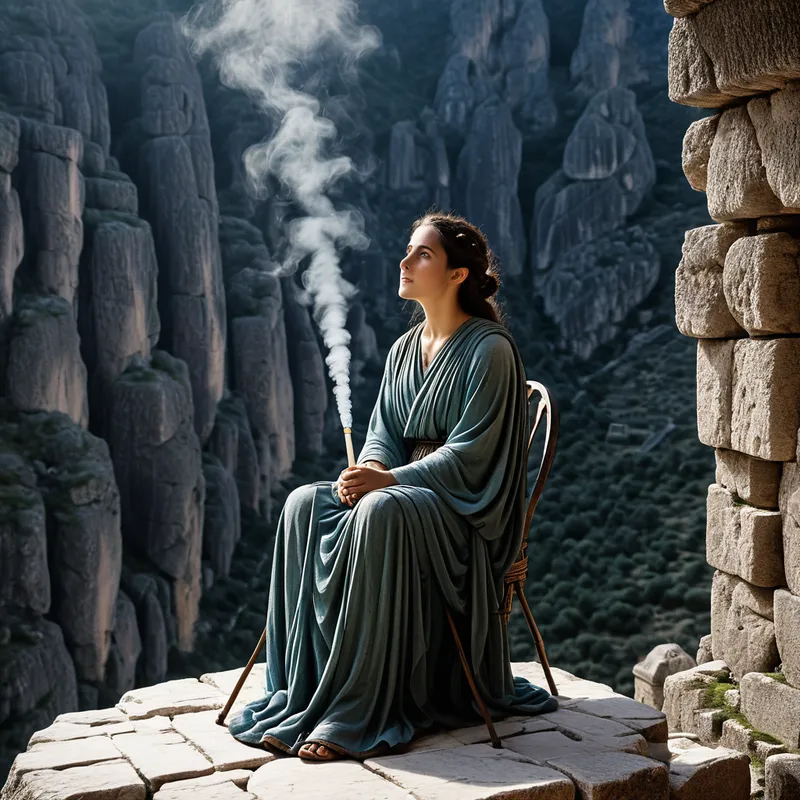
She was no high-born queen, but a local woman of humble means, chosen in her later years for her piety and simple life. On the seventh day of each month, sacred to Apollo, after ritual purification in the Castalian Spring, she would descend. She would chew laurel leaves, symbol of the god, and breathe the rising vapors. The sacred pneuma would enter her. Her body would tremble. Her eyes would lose focus, gazing upon distances unseen. Her voice, when it came, was not her own. It was raw, guttural, often fragmented—the voice of the god wrestling through a mortal vessel.
Kings and peasants, city-states and lone philosophers, all climbed the Sacred Way to her door. They brought lavish gifts, asked their desperate questions of war, of love, of foundation and fate. The priests of the temple would translate her ravings into enigmatic, often paradoxical hexameter verse. “Go tell the king,” the Oracle once told Croesus, “that a great empire will fall.” He assumed it meant his enemy’s. It was his own. The wisdom of Delphi was never a simple answer. It was a mirror, a riddle that forced the seeker to confront their own assumptions, their own soul. For centuries, from the dark age to the classical zenith, the voice from the navel of the world shaped destinies, guided colonies, and whispered the most terrifying and liberating truth of all: “Know thyself.”
Cultural Origins & Context
The Oracle at Delphi was not merely a story; it was the beating heart of the Hellenic world for over a millennium. Its origins are lost in the Mycenaean Bronze Age, with archaeological evidence suggesting worship at the site as early as 1600 BCE. The myth of Apollo’s succession from Gaia reflects a profound historical and cultural shift: the arrival of the Indo-European Olympian order supplanting, yet assimilating, the older, earth-centered chthonic cults of pre-Greek peoples. Delphi became the symbolic point of integration between these two cosmic forces.
Its societal function was immense. It was the Omphalos, the cosmological center. City-states consulted it before founding new colonies, ensuring divine sanction for their expansion. Individuals sought personal guidance. Its authority was political, spiritual, and ethical. The famous maxims inscribed in the forecourt—“Know thyself” and “Nothing in excess”—were not mere platitudes but core tenets of Delphic theology, advocating for moderation and self-awareness as the paths to navigating a chaotic world. The Oracle’s voice was mediated by a male priesthood, framing the raw, ecstatic, feminine reception of the divine (the Pythia) within a structured, interpretative, masculine institution, mirroring the societal structures of the ancient Greek world.
Symbolic Architecture
The myth of Delphi is a perfect symbolic map of the human psyche’s relationship with the unknown. The site itself is a profound symbol: the meeting of the vertical axis (mountain, connection to the celestial gods) and the horizontal axis (the chasm, connection to the chthonic underworld). The Pythia, seated at this crossroads, represents the fragile, necessary vessel through which these opposing realms communicate.
The Oracle does not give answers; she refracts the question through the prism of the divine, revealing its hidden facets and the seeker’s own blind spots.
Python represents the untamed, instinctual, and potentially terrifying wisdom of the unconscious body and earth. Apollo represents the ordering, clarifying, and conscious principle of light and reason. The myth insists that true prophecy—true insight—requires the integration of both. Apollo does not ignore the chasm; he builds his temple directly over it. The Pythia does not speak with Apollonian clarity alone; she is intoxicated by the earth’s breath. The resulting prophecies are therefore ambiguous, requiring interpretation—a metaphor for the difficult, personal work of understanding the messages from our own depths.
The Omphalos stone marks the axis mundi, the center of one’s subjective world. To consult the Oracle is symbolically to journey to the center of one’s own being, to confront the core from which all personal myth emanates.

The Dreamer’s Resonance
When the pattern of the Delphic Oracle appears in modern dreams, it signals a powerful engagement with the inner source of guidance. Dreaming of a cryptic, authoritative voice (from a disembodied source, a wise figure, or even a radio/computer) points to the emergence of intuition or unconscious knowledge struggling to be heard by the conscious mind.
The somatic experience is key. Dreams featuring intoxicating scents, mists, or fumes, or where the dreamer feels physically overcome, lightheaded, or “possessed” by a feeling or idea, mirror the Pythia’s trance. This is not pathology, but a symbolic representation of the psyche being flooded with material from a deeper layer—what Jung called the objective psyche. The psychological process is one of reception. The ego is temporarily overwhelmed to allow a broader, transpersonal intelligence to speak. The subsequent feeling in the dream—of confusion, awe, or frantic attempts to “translate” the message—reflects the ego’s struggle to integrate this non-rational, often paradoxical, insight into a life that demands linear decisions.

Alchemical Translation
The journey to Delphi is a masterful model for the alchemical process of individuation. The seeker (the ego) must first undertake the difficult ascent—the “Sacred Way”—representing the conscious effort toward self-knowledge, often involving sacrifice and leaving familiar ground. Reaching the temple, they must present their question, their problematica, to the depths (the unconscious).
The Pythia’s ritual is the alchemical solutio—a dissolution of the rigid boundaries of the conscious personality in the intoxicating pneuma of the unconscious. Her fragmented speech is the prima materia, the raw, chaotic substance of the Self before it is cooked into understanding by the fire of conscious reflection.
The prophecy’s ambiguity is the catalyst for psychic transmutation. It forces the ego to release its demand for certainty and engage in the creative, terrifying work of interpretation—the true opus.
This is where the priests, symbolizing the cognitive and ethical functions of the psyche, come in. They represent the necessary stage of coagulatio, where the raw revelation is given form, structure, and ethical consideration. The final, often paradoxical, verse is the lapis philosophorum for that particular quest—not a simple answer, but a transformed perspective that holds opposing truths in tension. For the modern individual, the Delphic process translates to: confronting a life dilemma (the question), allowing oneself to be deeply affected by unconscious feelings and intuitions (the trance), and then laboring to consciously integrate that raw experience into a wise, if complex, course of action (the interpreted prophecy). The ultimate goal, as inscribed at the temple forecourt, remains the same: Gnothi Seauton—Know Thyself. The Oracle does not do this for you. It provides the sacred, disorienting space where you might do it for yourself.
Associated Symbols
Explore related symbols from the CaleaDream lexicon: