Opossum Myth Meaning & Symbolism
A myth where Opossum's great tail is sacrificed to bring fire to the world, teaching the alchemy of loss and the wisdom of strategic surrender.
The Tale of Opossum
Listen. In the First Days, [the world](/myths/the-world “Myth from Tarot culture.”/) was a place of bone-chilling cold and perpetual shadow. The People shivered in their shelters, their food was raw and tasteless, and the long nights were filled with the whispers of unseen things. There was no fire. The great gift of warmth, light, and protection was held captive, far to the east, by a jealous and powerful people who guarded it fiercely.
Among the animals, a council was called. Their breath fogged in the frigid air. “Who among us is brave enough? Who is clever enough to steal this fire for all the world?” The challenge hung in the silence. The mighty Bear spoke of strength, but knew he was too slow. The cunning Coyote spun plans of deception, but his nature was too restless, too prone to chaos. One by one, the creatures fell silent.
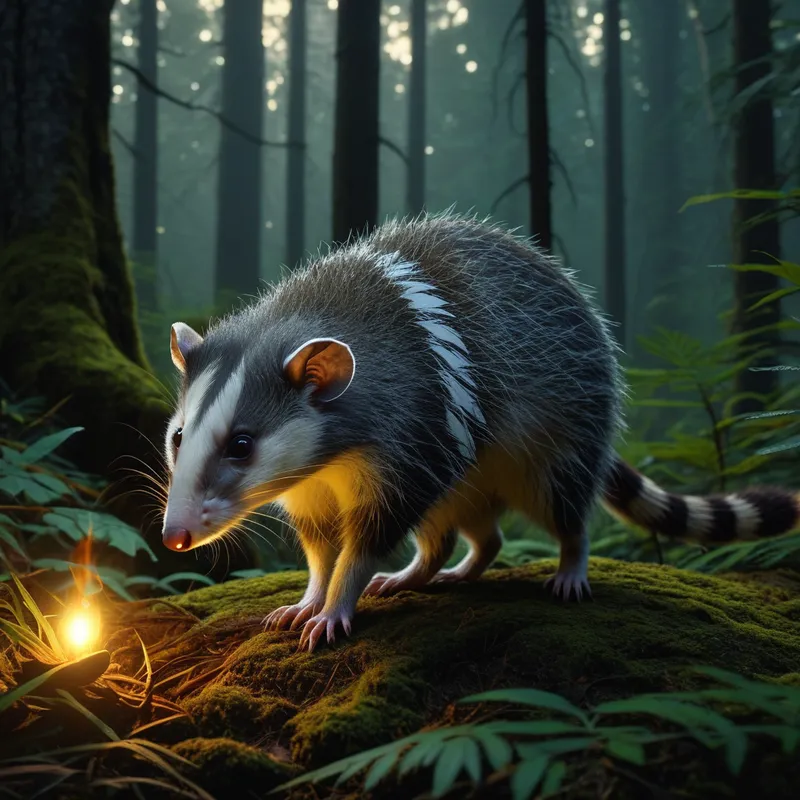
Then, a soft voice spoke from the edge of the gathering. It was Opossum. In those days, Opossum was not as you see him now. He was proud, and his most prized possession was his magnificent tail. It was not naked and grasping, but lush, bushy, and glorious—thick with fine, silky fur, a banner of beauty he carried with immense vanity. “I will go,” he said. “They will not suspect me. I will play [the fool](/myths/the-fool “Myth from Tarot culture.”/), the harmless one. And with this tail,” he said, sweeping it grandly, “I will bring the fire back to us.”
The journey was long. Opossum used his guise well, shuffling and blinking, appearing slow and simple. When he reached the land of the fire-keepers, he did not skulk. He wandered into their very camp, muttering to himself, pretending to search for grubs. The people laughed at the silly creature with the absurdly beautiful tail. They grew accustomed to his harmless presence.
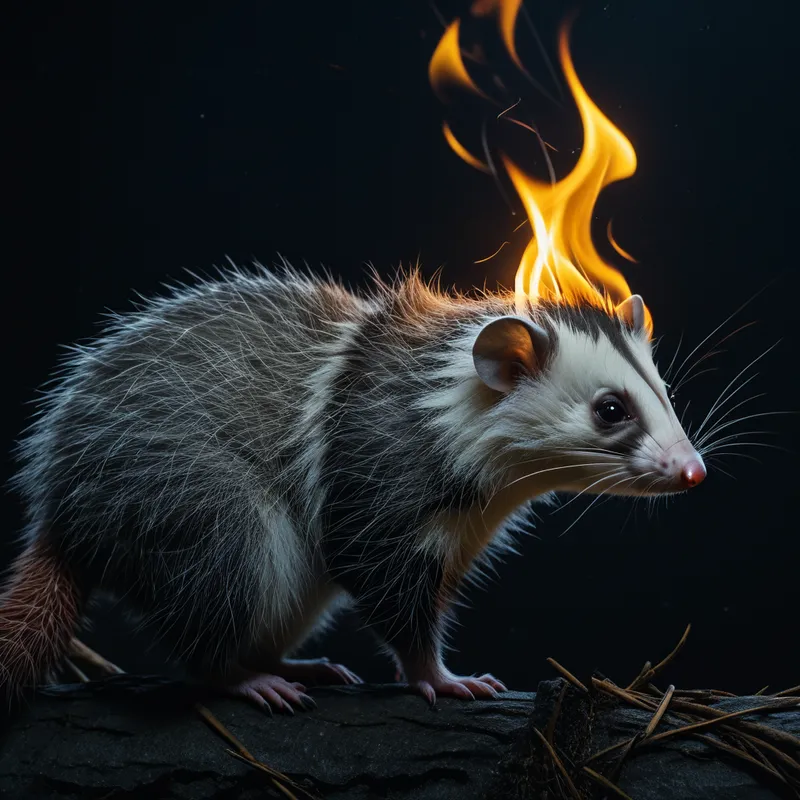
Then, on a night when the guards were drowsy from watching the eternal, mesmerizing flames, Opossum acted. He crept to the great central fire. With a prayer in his heart for all the shivering creatures and the cold People, he dipped the very end of his glorious, bushy tail into the hottest part of the blaze. The dry, oily fur caught at once—not with a destructive roar, but with a swift, fierce adherence. The fire clung to him, a living, breathing coal attached to his very being.
He turned and ran. Cries of alarm erupted behind him. The fire-keepers gave chase. Opossum ran as he had never run, the heat searing his back, the light of his stolen prize painting the forest in frantic, jumping shadows. He could feel the fire traveling, eating its way up the splendid length of his tail. The pain was immense, a consuming agony. But he did not stop. He ran for the west, for home, for the waiting world.
As he crossed the final hill, the fire had consumed all but the very base of his tail. With his last strength, he swept the remaining, smoldering fragment against a dry, rotten log. The log sparked, then caught, blossoming into a true, independent flame. The first fire of the world was born.
But Opossum fell, exhausted and in terrible pain. When he awoke, the beautiful tail that had been his pride was gone. In its place was a raw, naked, scaly [thing](/myths/thing “Myth from Norse culture.”/). All that remained of its former glory was a single, white-tipped hair at the very end—a ghost, a memory of the sacrifice. And from that day to this, Opossum carries that bare tail, and when faced with overwhelming threat, he does not fight with tooth or claw. He performs his “Great Deception”, falling into a stillness so profound it mirrors death itself.
Cultural Origins & Context
This myth, in its many variations, is found among several Cherokee, Muskogee (Creek), and other Eastern Woodlands tribes. It was not a mere children’s story but a foundational narrative, told by elders and storytellers during the winter months, often around the very fire whose origin it explained. Its function was multifaceted: it was an etiological myth, explaining the opossum’s unique physical traits and behavior. More importantly, it served as a profound teaching on community, sacrifice, and the true nature of value.
The story reinforced a core cultural understanding: that the gifts which sustain life often come through the sacrifice of individual vanity or comfort for the collective good. Opossum, often considered a lowly or comical creature in the daily hierarchy of animals, is elevated to the status of a culture hero in this tale. The myth subtly teaches that wisdom and courage can reside in the most unexpected of beings, and that appearances are perpetually deceptive.
Symbolic Architecture
At its [heart](/symbols/heart “Symbol: The heart symbolizes love, emotion, and the core of one’s existence, representing deep connections with others and self.”/), the myth of Opossum is an [allegory](/symbols/allegory “Symbol: A narrative device where characters, events, or settings represent abstract ideas or moral qualities, conveying deeper meanings through symbolic storytelling.”/) for the necessary [death](/symbols/death “Symbol: Symbolizes transformation, endings, and new beginnings; often associated with fear of the unknown.”/) of [the ego](/myths/the-ego “Myth from Jungian culture.”/)‘s most prized [ornament](/symbols/ornament “Symbol: An ornament often symbolizes celebration, beauty, and the adornment of life during special occasions.”/) for the sake of soulful warmth and collective [consciousness](/symbols/consciousness “Symbol: Consciousness represents the state of awareness and perception, encompassing thoughts, feelings, and experiences.”/).
The most radiant light is often kindled only by the willing combustion of what we hold most dear.
Opossum’s magnificent [tail](/symbols/tail “Symbol: A tail in dreams can symbolize instincts, connection to one’s roots, or the hidden aspects of personality.”/) symbolizes the [persona](/symbols/persona “Symbol: The social mask or outward identity one presents to the world, often concealing the true self.”/) at its most inflated—a [source](/symbols/source “Symbol: The origin point of something, often representing beginnings, nourishment, or the fundamental cause behind phenomena.”/) of pride, [identity](/symbols/identity “Symbol: Identity represents the sense of self, encompassing personal beliefs, cultural background, and social roles.”/), and social value. It is what he believes makes him special, worthy, and notable. The fire represents transformative [energy](/symbols/energy “Symbol: Energy symbolizes vitality, motivation, and the drive that fuels actions and ambitions.”/): consciousness, [spirit](/symbols/spirit “Symbol: Spirit symbolizes the essence of life, vitality, and the spiritual journey of the individual.”/), [passion](/symbols/passion “Symbol: Intense emotional or physical desire, often linked to love, creativity, or purpose. Represents life force and deep engagement.”/), and the [life](/symbols/life “Symbol: The symbol of ‘Life’ represents a journey of growth, interconnectedness, and existential meaning, encompassing both the joys and challenges that define human experience.”/)-giving force of [connection](/symbols/connection “Symbol: Connection symbolizes relationships, communication, and bonds among individuals.”/). The jealous fire-keepers hoard this [energy](/symbols/energy “Symbol: Energy symbolizes vitality, motivation, and the drive that fuels actions and ambitions.”/), representing a state of psychic [imbalance](/symbols/imbalance “Symbol: A state of disharmony where opposing forces are unequal, often representing internal conflict or external instability.”/) where [life](/symbols/life “Symbol: The symbol of ‘Life’ represents a journey of growth, interconnectedness, and existential meaning, encompassing both the joys and challenges that define human experience.”/)-giving power is repressed or monopolized.
Opossum’s [journey](/symbols/journey “Symbol: A journey in dreams typically signifies adventure, growth, or a significant life transition.”/) is one of chosen humiliation (playing the [fool](/symbols/fool “Symbol: Represents innocence, risk-taking, and new beginnings. Often symbolizes a leap into the unknown or naive trust.”/)) for a higher [purpose](/symbols/purpose “Symbol: Purpose signifies direction, meaning, and intention in life, often reflecting personal ambitions and core values.”/). The burning of the tail is the brutal, [alchemical process](/symbols/alchemical-process “Symbol: A symbolic transformation of base materials into spiritual gold, representing inner purification, integration, and the journey toward wholeness.”/) where the valued [persona](/myths/persona “Myth from Greek culture.”/) is sacrificed. It is not merely taken; it is willingly offered as fuel. The resulting naked tail is the exposed, authentic self—vulnerable, seemingly diminished, but real. The single white [hair](/symbols/hair “Symbol: Hair often symbolizes identity, power, and self-expression, reflecting how we perceive ourselves and how we wish to be perceived by others.”/) is the enduring [trace](/symbols/trace “Symbol: A faint remnant or subtle indication of something that was present, suggesting memory, evidence, or a path to follow.”/) of the sacrifice, the wisdom gained, the scar that proves the [story](/symbols/story “Symbol: The symbol of ‘Story’ represents the narrative woven through our lives, embodying experiences, lessons, and emotions that shape our identities.”/) true. His subsequent “playing dead” becomes not just a survival tactic, but a deep wisdom: the strategic surrender of the fighting ego, a conscious descent into a state of receptive [stillness](/symbols/stillness “Symbol: A profound absence of motion or sound, often representing inner peace, creative potential, or existential pause in artistic contexts.”/).

The Dreamer’s Resonance
When this myth stirs in the modern [psyche](/myths/psyche “Myth from Greek culture.”/), it often manifests in dreams of profound loss, exposure, or strategic retreat. To dream of a beautiful, bushy tail that catches fire or is sheared away points to a somatic recognition of an impending or ongoing psychic sacrifice. The dreamer may be in a life situation where something they have heavily identified with—a career, a role, a reputation, a source of pride—is being “burned away” by circumstances or inner necessity.
Dreams of being chased while carrying a fragile, glowing light echo Opossum’s desperate run. The anxiety is not just about being caught, but about the precious, stolen potential being extinguished before it can be delivered to the “home” of the integrated self. Conversely, dreaming of playing dead, of feigning incapacity or collapse in the face of a threat, can be the psyche enacting Opossum’s final wisdom. It is the unconscious recommending a tactical withdrawal, a cessation of struggle, allowing a dangerous situation or overwhelming emotion to pass by while the core self is preserved in a state of vigilant stillness.

Alchemical Translation
For the individual on the path of individuation, the Opossum myth models a critical phase of psychic transmutation. We all possess a “glorious tail”—an aspect of our personality, achievement, or history that we cling to as our primary value. The alchemical fire, however, demands fuel.
Individuation requires that we feed the flames of consciousness with the very timbers of our constructed self.
The process begins with the “Opossum Decision”: the conscious, often painful choice to use our prized attribute not for personal glorification, but as a vessel to carry transformative energy for our entire inner community. This is the entrepreneur burning through their savings for a vision, the artist sacrificing comfort for their craft, the individual letting go of an old identity to make space for authentic growth.
The burning itself is the [nigredo](/myths/nigredo “Myth from Alchemical culture.”/)—the blackening. It feels like destruction, loss, and humiliation. The beautiful facade is consumed. What remains feels raw, naked, and ugly. This is [the crucible](/myths/the-crucible “Myth from Alchemical culture.”/). Yet, from this sacrifice, the “fire” is successfully transferred: a new warmth of purpose, a clearer light of self-knowledge, a protective energy for the nascent soul. The old vanity is gone, replaced by a functional, if humble, authenticity (the naked tail).
Finally, the myth teaches the advanced wisdom of the Great Deception. After the sacrifice, one does not meet new threats with the old pride. Instead, one learns the power of strategic collapse, of conscious withdrawal. In psychological terms, this is the ability to disidentify from the ego’s battles, to “play dead” to provocations, anxieties, or outdated impulses, allowing them to pass over while the essential self, now seasoned by fire, remains intact and observant in the darkness, waiting for the moment to rise again.
Associated Symbols
Explore related symbols from the CaleaDream lexicon: