Omphalos Stone Myth Meaning & Symbolism
The stone Zeus cast to mark the world's center, where two eagles met, becoming the sacred oracle of Delphi and the axis of human consciousness.
The Tale of Omphalos Stone
Listen, and I will tell you of the stone that is the navel of [the world](/myths/the-world “Myth from Tarot culture.”/).
In the time before memory, when the cosmos was young and the gods walked [the earth](/myths/the-earth “Myth from Hindu culture.”/) in forms of thunder and light, the great lord Zeus desired to find the center of the world. He released two eagles, one from the eastern edge of [the earth](/myths/the-earth “Myth from Hindu culture.”/), where the sun is born from [the womb](/myths/the-womb “Myth from Various culture.”/) of Eos, and one from the western edge, where the sun plunges into the wine-dark sea in the arms of [Helios](/myths/helios “Myth from Greek culture.”/). With wings that beat the rhythm of creation, they flew. [The wind](/myths/the-wind “Myth from Various culture.”/) sang in their pinions, and [the earth](/myths/the-earth “Myth from Hindu culture.”/) turned beneath their shadow.
They flew over mountains that scraped the belly of [the sky](/myths/the-sky “Myth from Persian culture.”/) and valleys cradling the first whispers of rivers. They flew until their paths, ordained by fate, converged. Not over a mighty peak or a vast plain, but over a rugged, sacred place where the air smelled of laurel and stone, of earth and something older. It was a place of chasms, where fumes rose from a deep crack in the world’s body—the very breath of Gaia herself. Here, at the slopes of [Mount Parnassus](/myths/mount-parnassus “Myth from Greek culture.”/), the eagles met.
And where they met, Zeus cast a stone.
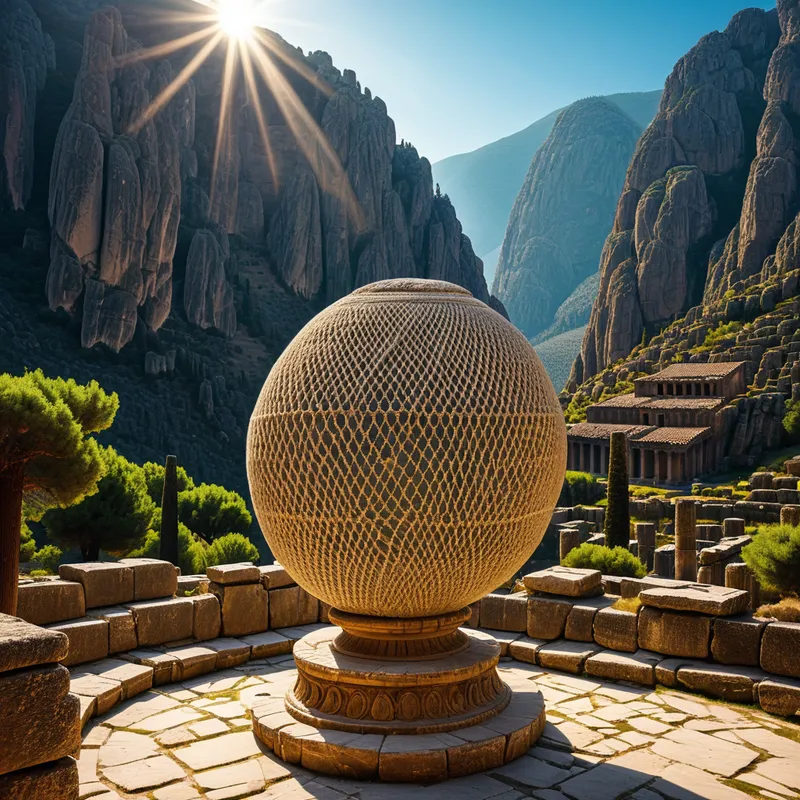
It fell from the firmament, not as a meteor of destruction, but as a seed of order. It struck the earth with a sound that was not a crash, but a deep, resonant hum, a note that tuned the world. This was the [Omphalos](/myths/omphalos “Myth from Greek culture.”/). It was no ordinary rock. Its surface was carved with the pattern of a sacred net, a woolen agrenon draped over its form, as if to catch the whispers of the divine. It sank into the sacred ground, and the very earth acknowledged it. The chasm breathed its vapors upon it, and the stone became the mouthpiece of the earth.
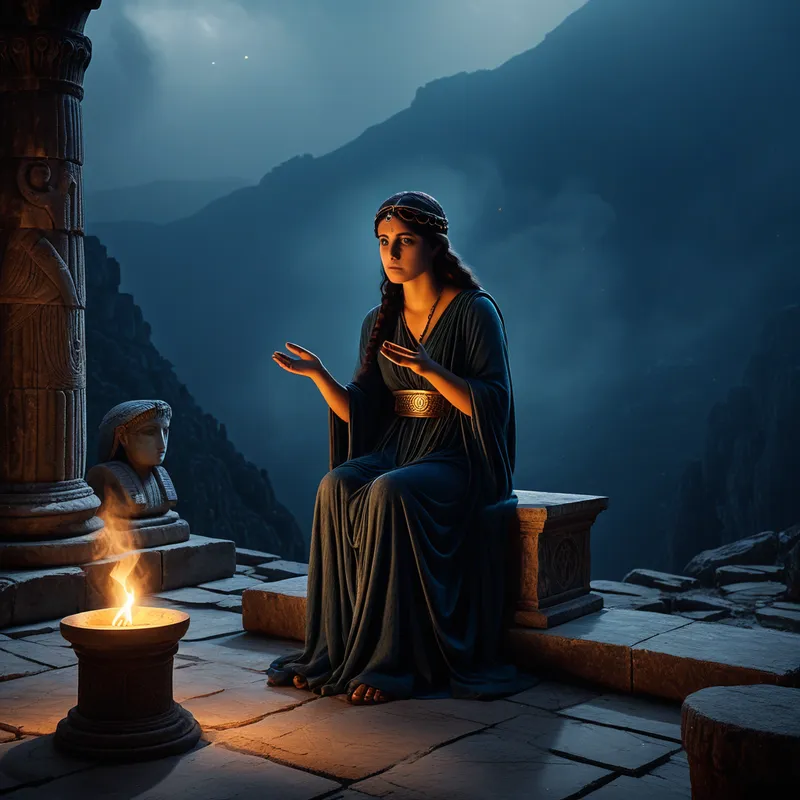
Around this stone, a sanctuary grew. A temple to Apollo, who had slain the great serpent [Python](/myths/python “Myth from Greek culture.”/) that guarded the chasm. Here, the stone sat in the innermost, darkest chamber, the adyton. Upon a tripod beside it sat the [Pythia](/myths/pythia “Myth from Greek culture.”/), the chosen priestess. She would breathe the sacred [pneuma](/myths/pneuma “Myth from Greek culture.”/), the intoxicating vapors from the earth’s wound, lay her hand upon the cold, net-draped surface of [the Omphalos](/myths/the-omphalos “Myth from Greek culture.”/), and her voice would change. It became the voice of the god, the voice of the earth, the voice of the center itself—issuing riddles that would steer kings, launch ships, and shape destinies. The stone was silent, yet it spoke through her. It was inert, yet it was the axis upon which the world of meaning turned.
Cultural Origins & Context
The myth of the Omphalos is not a single, codified tale from one source, but a deep, pervasive belief woven into the religious and geopolitical fabric of ancient Greece. Its primary home was the Panhellenic sanctuary of Delphi, which called itself the omphalos tes gaies—the navel of the earth. This was not merely poetic fancy; it was a theological and political claim of supreme importance.
In a world of competing city-states, Delphi and its Omphalos served as the neutral, sacred center. It was the place where the fragmented Greek world could find a common [reference](/myths/reference “Myth from Global/Universal culture.”/) point, a symbolic unity. The stone itself was likely an aniconic fetish, a pre-Olympian cult object absorbed into the worship of Apollo. The story of Zeus’s eagles provided an Olympian charter myth for its centrality, legitimizing Delphi’s unparalleled authority. The myth was passed down by priests, poets like Pindar, and historians like Plutarch, who served at Delphi. Its societal function was profound: it located the source of ultimate truth (the oracle) at the literal and symbolic center of the known world, making Delphi the mediator between the human and the divine, the individual polis and the Hellenic whole.
Symbolic Architecture
The Omphalos is the ultimate [symbol](/symbols/symbol “Symbol: A symbol can represent an idea, concept, or belief, serving as a powerful tool for communication and understanding.”/) of the [axis](/symbols/axis “Symbol: A central line or principle around which things revolve, representing stability, orientation, and the fundamental structure of reality or consciousness.”/) mundi. It is the still point in the turning world, the fixed [mark](/symbols/mark “Symbol: A ‘mark’ often symbolizes identity, achievement, or a defining characteristic in dreams.”/) around which [chaos](/symbols/chaos “Symbol: In Arts & Music, chaos represents raw creative potential, uncontrolled expression, and the breakdown of order to forge new artistic forms.”/) coalesces into [cosmos](/symbols/cosmos “Symbol: The entire universe as an ordered, harmonious system, often representing the totality of existence, spiritual connection, and the unknown.”/).
To find your Omphalos is to find the point from which all your distances are measured, the inner coordinate where opposites reconcile.
Psychologically, it represents the core of [the Self](/myths/the-self “Myth from Jungian culture.”/)—not [the ego](/myths/the-ego “Myth from Jungian culture.”/), but the deeper, central organizing principle of the [psyche](/myths/psyche “Myth from Greek culture.”/) that Carl Jung called the [archetype](/symbols/archetype “Symbol: A universal, primordial pattern or prototype in the collective unconscious that shapes human experience, behavior, and creative expression.”/) of wholeness. The two eagles represent the dynamic opposites of the [psyche](/myths/psyche “Myth from Greek culture.”/): conscious and unconscious, east and west of our being, the known and the unknown. Their meeting at the center signifies the transcendent function, where conflict gives [birth](/symbols/birth “Symbol: Birth symbolizes new beginnings, transformation, and the potential for growth and development.”/) to a new, third [thing](/myths/thing “Myth from Norse culture.”/)—[consciousness](/symbols/consciousness “Symbol: Consciousness represents the state of awareness and perception, encompassing thoughts, feelings, and experiences.”/) itself, symbolized by the [stone](/symbols/stone “Symbol: In dreams, a stone often symbolizes strength, stability, and permanence, but it may also represent emotional burdens or obstacles that need to be acknowledged and processed.”/). The net carved upon it is the reticulum, the interconnected web of [fate](/symbols/fate “Symbol: Fate represents the belief in predetermined outcomes, suggesting that some aspects of life are beyond human control.”/), meaning, and [relationship](/symbols/relationship “Symbol: A representation of connections we have with others in our lives, often reflecting our emotional state.”/) that emanates from this center. The chthonic vapors that inspire the [oracle](/symbols/oracle “Symbol: An oracle represents wisdom, foresight, and divine communication, often serving as a mediator between the spiritual and physical worlds.”/) remind us that this center is not sterile intellect; it is rooted in the dark, instinctual, and somatic [depths](/symbols/depths “Symbol: Represents the subconscious, hidden emotions, or foundational aspects of the self, often linked to primal fears or profound truths.”/) of the [earth](/symbols/earth “Symbol: The symbol of Earth often represents grounding, stability, and the physical realm, embodying a connection to nature and the innate support it provides.”/)/[body](/symbols/body “Symbol: The body in dreams often symbolizes the dreamer’s self-identity, personal health, and the relationship they have with their physical existence.”/).
The Dreamer’s Resonance
When the Omphalos pattern appears in modern dreams, it seldom manifests as a literal Greek stone. Instead, the dreamer may experience a powerful, numinous center point in a landscape: a lone tree in an empty field, a central pillar in a vast hall, a glowing object in the chest or navel, or a specific location that feels irrevocably “home” or “true.” There is often a somatic component—a feeling of gravity, anchoring, or profound calm emanating from this spot.
Psychologically, this dream signals a process of centering. The psyche is attempting to locate its own axis amidst the fragmentation of modern life—the pull of professional demands, social masks, and internal conflicts. The dream is an invitation from the Self to stop, to find the internal point where the “eagles” of one’s contradictions can meet. It often precedes or accompanies a major life decision, a search for purpose, or the integration of a shadow aspect. The feeling is less about doing and more about being at one’s point of origin. If the dream center feels threatening or is inaccessible, it may indicate a fear of confronting one’s own depth or the disorienting power of emerging self-knowledge.
Alchemical Translation
The myth models the alchemical process of psychic transmutation, the journey of individuation. The initial state is one of chaos and seeking (Zeus’s desire to find the center). The [separatio](/myths/separatio “Myth from Alchemical culture.”/) is the release of the eagles—the conscious differentiation of our inner opposites. The long, arduous flight is the work of analysis, life experience, and confronting [the shadow](/myths/the-shadow “Myth from Jungian culture.”/).
The stone is not found by building, but by revelation. It is the lapis philosophorum, the philosopher’s stone of the soul, discovered at the confluence of all one’s journeys.
The convergence is the coniunctio oppositorum—[the sacred marriage](/myths/the-sacred-marriage “Myth from Various culture.”/) of opposites at the center. This is not a peaceful union but a dynamic, creative tension that generates the “stone,” the incorruptible, enduring symbol of the integrated Self. Establishing this inner Omphalos is [the great work](/myths/the-great-work “Myth from Alchemical culture.”/). Once anchored, this center becomes the source of inner oracle. The cryptic prophecies of the Pythia translate to the intuitive, often paradoxical guidance that arises from a grounded Self—a knowing that comes not from linear thought, but from the embodied center. The net upon the stone signifies that from this integrated core, one’s life naturally weaves itself into a meaningful pattern, connecting actions, relationships, and fate into a coherent whole. The modern individual’s [triumph](/myths/triumph “Myth from Roman culture.”/) is not in conquering the world, but in becoming the stable, sacred ground from which their own world meaningfully unfolds.
Associated Symbols
Explore related symbols from the CaleaDream lexicon: