Omphalos Myth Meaning & Symbolism
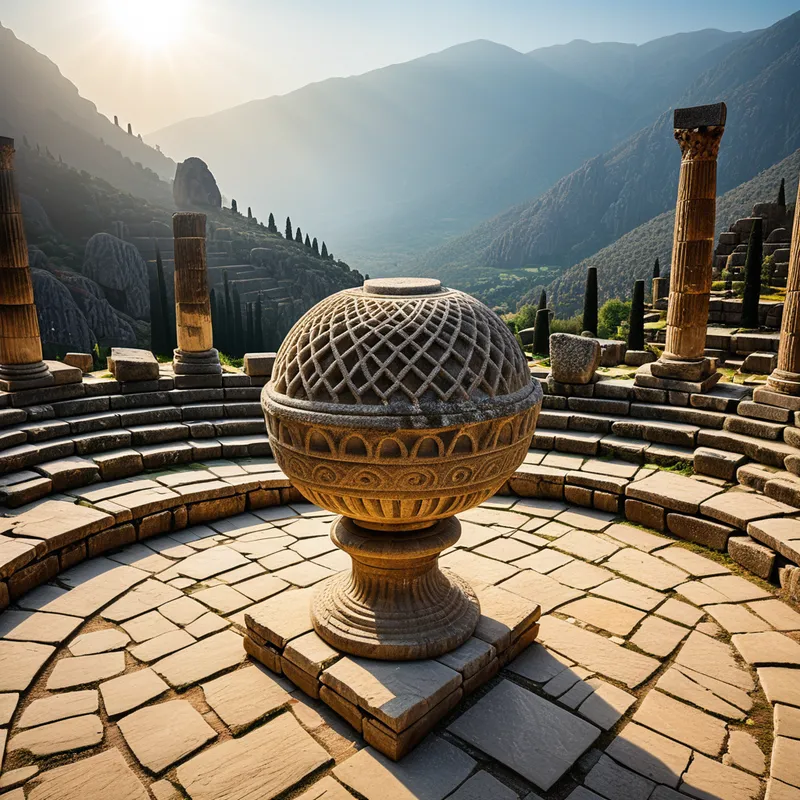
The myth of Zeus releasing two eagles to find the world's center, marked by the Omphalos stone at Delphi, the sacred oracle of Apollo.
The Tale of Omphalos
In the time before time was measured, when [the earth](/myths/the-earth “Myth from Hindu culture.”/) was still young and gasping from the wars of gods and titans, [the world](/myths/the-world “Myth from Tarot culture.”/) lay in chaos. It had width and breadth, height and depth, but it had no heart. It was a body without a center, a song without a key. The great sky-father, Zeus, perceived this lack. From his throne on high Olympus, he desired to bring order, to find the fixed point from which all things could be measured, the still axis around which the whirling cosmos could turn.
With a thought that stirred the winds, he summoned two of his most majestic eagles. Their feathers were the color of beaten gold and storm-cloud, their eyes held the sharpness of lightning. To one, he gave a command that echoed to the very rim of the eastern horizon, where the sun is born from [the sea](/myths/the-sea “Myth from Greek culture.”/). To the other, he whispered a decree that reached the farthest western edge, where the sun drowns in the ocean. “Fly,” he said. “Fly from the ends of the earth and meet me at its middle.”
And so they launched, these two divine messengers. The eastern eagle beat its wings against the rosy fingers of dawn, crossing the lands of rising suns and whispering deserts. The western eagle plunged into the purple twilight, soaring over the pillars of the world and the islands of the blessed. For days uncounted they flew, the very winds carving paths behind them, until the land below began to rise in great, grey folds of stone and pine.
It was the rugged spine of [Mount Parnassus](/myths/mount-parnassus “Myth from Greek culture.”/). And there, on a rocky slope overlooking a deep, sacred gorge, the eagles saw each other—a speck of gold against the azure, growing larger, sharper, until their cries pierced the mountain silence as one. With a final, powerful descent, they converged, not in a clash of talons, but in a perfect, poised meeting of spirits, their wingtips almost touching as they hovered above a single, unassuming stone.
This was the place. This was the center. Zeus, watching from the ether, let loose a thunderbolt of pure affirmation. It struck not to destroy, but to consecrate, marking the spot with a sacred charge that hummed through the very bones of the mountain. He named the stone Omphalos, the navel. And around this navel, the world finally found its balance.
Later, when the radiant Apollo came to claim this holy ground, slaying the great serpent [Python](/myths/python “Myth from Greek culture.”/) that guarded the chasm, he established his oracle here. [The Omphalos](/myths/the-omphalos “Myth from Greek culture.”/) remained, enshrined in his temple. A priestess, the [Pythia](/myths/pythia “Myth from Greek culture.”/), would sit upon a tripod beside it, breathing in the vapors that rose from the earth’s deep core—the very breath of the world’s center—and her riddling words would flow from that central point to guide nations and kings.

Cultural Origins & Context
The myth of the Omphalos is inextricably linked to the [Oracle of Delphi](/myths/oracle-of-delphi “Myth from Greek culture.”/), a site of immense political, religious, and cultural power for over a millennium. This was not merely a local folktale, but a foundational charter myth for one of the most significant institutions in the ancient world. The story legitimized Delphi’s unique authority. It wasn’t just an oracle; it was the oracle at the very navel of Gaia, the Earth herself.
The myth was propagated through the hymns sung to Apollo, the stories told by priests to pilgrims, and the accounts of historians like Herodotus. Every city-state that sent emissaries to seek counsel—from Athens to Sparta, from Corinth to distant Lydia—implicitly acknowledged this cosmic geography. The physical [Omphalos stone](/myths/omphalos-stone “Myth from Greek culture.”/), often depicted in art as covered in a woolen net (agrenon), was a tangible symbol of this belief. It served a profound societal function: it provided a psychological and spiritual anchor in a vast and often terrifying cosmos. In a world of uncertainty, there was, at least, a center.
Symbolic Architecture
The Omphalos is a [symbol](/symbols/symbol “Symbol: A symbol can represent an idea, concept, or belief, serving as a powerful tool for communication and understanding.”/) of staggering [density](/symbols/density “Symbol: Represents the concentration of matter, energy, or meaning in a given space, often symbolizing complexity, weight, or substance.”/). It represents the [axis](/symbols/axis “Symbol: A central line or principle around which things revolve, representing stability, orientation, and the fundamental structure of reality or consciousness.”/) mundi, the world axis, the point where [heaven](/symbols/heaven “Symbol: A symbolic journey toward ultimate fulfillment, spiritual transcendence, or connection with the divine, often representing life’s highest aspirations.”/), [earth](/symbols/earth “Symbol: The symbol of Earth often represents grounding, stability, and the physical realm, embodying a connection to nature and the innate support it provides.”/), and the [underworld](/symbols/underworld “Symbol: A symbolic journey into the unconscious, representing exploration of hidden aspects of self, transformation, or confronting repressed material.”/) meet and communicate. It is the still point in the turning world, the calm eye of the storm of existence.
To find your Omphalos is to locate the immutable core within the flux of experience, the foundational truth from which all personal myth derives its meaning.
Psychologically, it symbolizes [the Self](/myths/the-self “Myth from Jungian culture.”/) in the Jungian sense—the [archetype](/symbols/archetype “Symbol: A universal, primordial pattern or prototype in the collective unconscious that shapes human experience, behavior, and creative expression.”/) of wholeness and the regulating center of the [personality](/symbols/personality “Symbol: Personality in dreams often symbolizes the traits and characteristics of the dreamer, reflecting how they perceive themselves and how they believe they are perceived by others.”/). The two eagles represent opposing forces—conscious and unconscious, east and west of one’s [nature](/symbols/nature “Symbol: Nature symbolizes growth, connectivity, and the primal forces of existence.”/), the known and the unknown [psyche](/myths/psyche “Myth from Greek culture.”/). Their meeting at the center signifies the [integration](/symbols/integration “Symbol: The process of unifying disparate parts of the self or experience into a cohesive whole, often representing psychological wholeness or resolution of internal conflict.”/) of these opposites, a reconciliation that births a new, stable point of [consciousness](/symbols/consciousness “Symbol: Consciousness represents the state of awareness and perception, encompassing thoughts, feelings, and experiences.”/). The [stone](/symbols/stone “Symbol: In dreams, a stone often symbolizes strength, stability, and permanence, but it may also represent emotional burdens or obstacles that need to be acknowledged and processed.”/) itself, often bound in a net, suggests that this center is not a barren [singularity](/symbols/singularity “Symbol: A point of infinite density and potential, often representing a moment of profound transformation, unity, or the convergence of all possibilities.”/), but a living [node](/symbols/node “Symbol: A point of connection, intersection, or decision in a network, representing junctions in life paths, relationships, or systems.”/) in a vast, interconnected web of [life](/symbols/life “Symbol: The symbol of ‘Life’ represents a journey of growth, interconnectedness, and existential meaning, encompassing both the joys and challenges that define human experience.”/) and meaning.
The Dreamer’s Resonance
When the Omphalos pattern emerges in modern dreams, it speaks to a profound process of recentering. The dreamer may be navigating a life that feels chaotic, dispersed, or without a guiding principle. The dream imagery is often somatic and geometric.
One might dream of standing at [the crossroads](/myths/the-crossroads “Myth from Celtic culture.”/) of a vast, empty landscape, feeling a powerful pull towards a specific, unremarkable spot. Or of finding a strange, warm stone in an unexpected place—a garden, a room, one’s own chest—that feels inexplicably “right” and calming. The dream may feature converging paths, twin birds, or a spiraling pattern that focuses to a single point. This is the psyche’s innate GPS activating, guiding the dreamer back to their own psychological and spiritual center. The somatic sensation is often one of deep, gravitational settling, a release of anxiety as the scattered pieces of the self are drawn back to their source.
Alchemical Translation
The alchemical journey modeled by the Omphalos myth is [the opus](/myths/the-opus “Myth from Alchemical culture.”/) of individuation—the process of becoming an integrated, undivided individual. The initial state is one of chaos and disorientation (the uncentered world). The conjunctio oppositorum, [the sacred marriage](/myths/the-sacred-marriage “Myth from Various culture.”/) of opposites, is initiated by the will of the ruling consciousness (Zeus) to seek order.
The quest for the center is the ultimate alchemical operation; it is the creation of the Philosopher’s Stone within the soul, a point of incorruptible value and transformative power.
The release of the eagles is the courageous act of sending one’s attention to the farthest, most neglected reaches of one’s being—to the repressed shadows (the west) and the unrealized potentials (the east). The long flight is the patient, often arduous work of introspection and engagement with these contents. The meeting at the stone is the moment of synthesis, where insight dawns and a new, stable core identity is crystallized. This center then becomes the seat of one’s inner oracle. Like the Pythia, from this grounded place, one can interpret the vaporous messages of the unconscious, not with chaotic frenzy, but with the paradoxical clarity that springs from the world’s still heart. To be seated at your own Omphalos is to speak, at last, with your own authentic voice.
Associated Symbols
Explore related symbols from the CaleaDream lexicon: