Ogham Staves Myth Meaning & Symbolism
A tale of the god Ogma, who carves the first Ogham alphabet onto sacred staves of ash to bridge the worlds of gods and mortals.
The Tale of Ogham Staves
Listen, and let the fire’s crackle become the rustle of leaves in a primordial grove. In the time before memory, when the world was a tapestry of raw power and whispered secrets, the gods of the Tuatha Dé Danann walked the green hills of Éire. Among them was Ogma, whose arms were strong enough to move mountains and whose tongue was sweet enough to coax stars from the sky. Yet, a great silence yawned between his people and the mortal tribes who dwelled beyond the mist.
The gods spoke in the language of lightning and the sigh of the wind; mortals heard only thunder and breeze. Knowledge, prophecy, and law—the very bones of civilization—were trapped in the realm of the divine, unable to cross the veil. Ogma watched this divide with a poet’s sorrow. He saw the confusion in mortal eyes, their clumsy gestures failing to capture the world’s true name. A bridge was needed, not of stone, but of symbol.
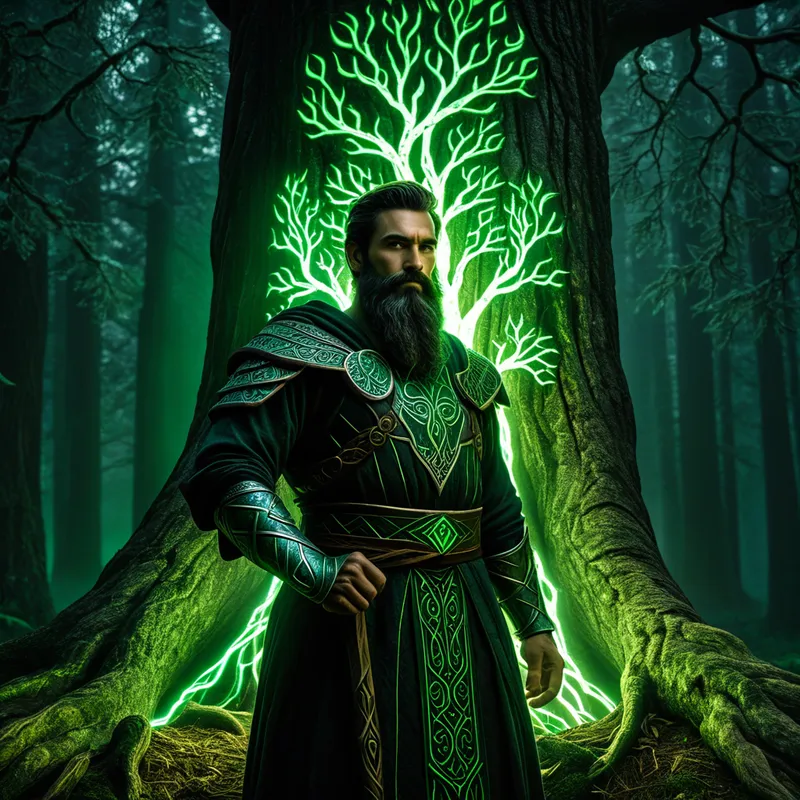
He went to the heart of the sacred forest, to the Bile, the great pillar of ash that connected the deep, chthonic roots of the Otherworld to the high, airy branches of the heavens. This was the Crann Bethadh. Placing his hand upon its bark, he felt the hum of all existence. He did not ask for a gift; he offered a sacrifice. With a blade forged from his own intent, he cut a straight, true branch from the living tree. The forest held its breath. The tree did not weep sap, but light.
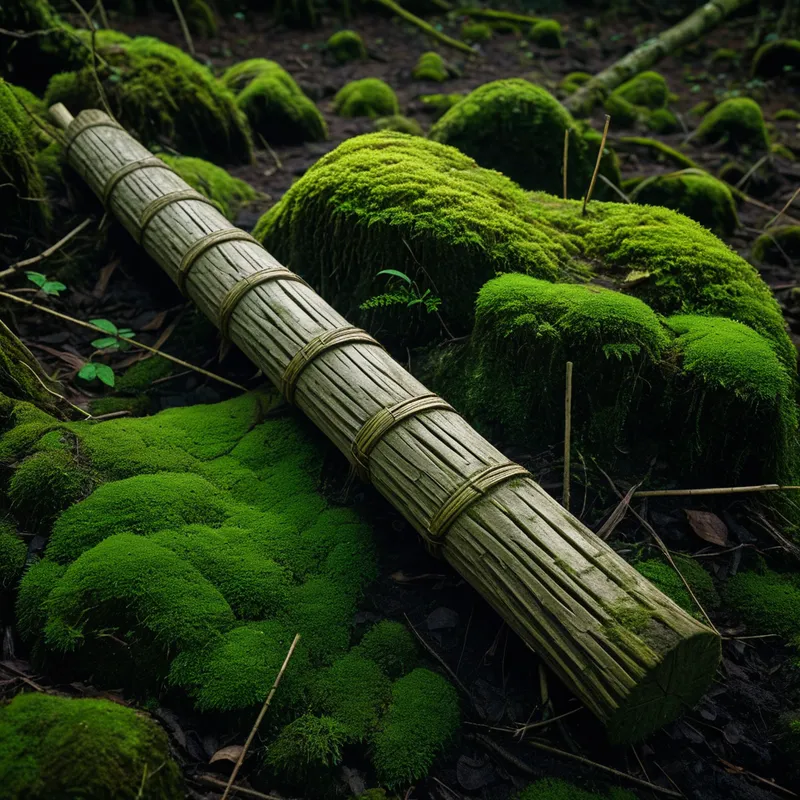
There, on that cleared ground, with the severed branch—now a stave—laid before him, Ogma began to carve. He did not invent. He listened. He watched the way a hawk’s cry scored the sky, the pattern of salmon-scatter in a stream, the forking path of a lightning bolt on a bare hillside. Each observation became a notch, a series of cuts along the stave’s edge. One stroke for the sound of the birch, Beith, the beginning. A group of five for the oak, Duir, the door. Each set of marks was a key, a name for a tree, a force, a truth of the world.
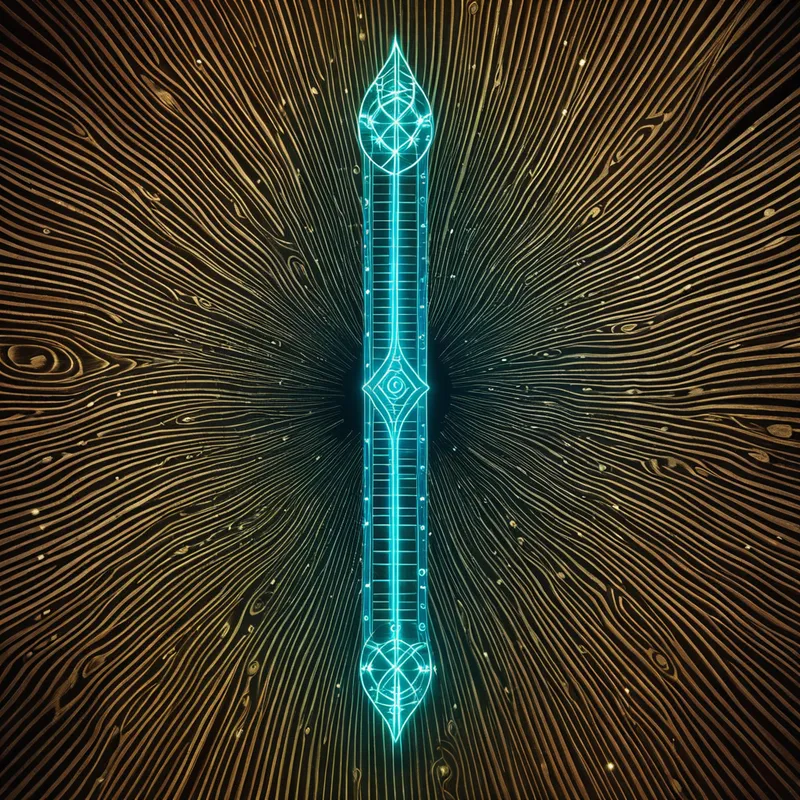
As the last sigil, Ioho, for the yew of eternity, was carved, a shudder passed through the land. The staves, twenty in all, glowed with a soft, inner luminescence. Ogma raised the first stave and spoke its name. The sound did not fade but hung in the air, solid and real. He had done it. He had frozen breath and thought into form. He had given sound a body of wood and meaning a skeleton of line. The Ogham was born—not merely an alphabet, but a captured fragment of the world’s soul, a ladder of knowledge by which mortals could begin to climb toward understanding.
Cultural Origins & Context
The myth of the Ogham’s origin is not found in a single, codified text but is woven from fragments of medieval Irish manuscripts, like the Book of Ballymote and the Book of Leinster, and the deep-seated cultural practices of the learned class, the Filid. For the pre-Christian and early Christian Gaelic world, writing was not a mundane tool but a sacred, potent act. Ogham inscriptions, primarily on stone boundary markers and memorials, were physical claims of identity, territory, and lineage—spells of permanence in a mutable world.
The attribution to Ogma, the god of eloquence, is profoundly apt. It frames writing not as a human invention, but as a divine technology granted to humanity, a sacred trust. The myth served to elevate the act of communication—especially poetic, legal, and prophetic speech—to a cosmological level. It explained why words had power: because they were literally carved from the substance of the Crann Bethadh, the axis of all worlds. The storytellers who kept this myth were the very inheritors of Ogma’s gift, using it to preserve history, satirize kings, and navigate the complex relationship between the human realm and the Tír na nÓg.
Symbolic Architecture
At its core, the myth is about the birth of consciousness from the womb of undifferentiated nature. The primal, chaotic “language” of nature—wind, water, animal cries—is meaningless noise until a conscious mind (Ogma) observes it, sacrifices a part of the whole (the branch), and imposes an ordering system (the alphabet).
The first act of true creation is not making something from nothing, but seeing the pattern in the chaos and having the courage to cut it free.
The Crann Bethadh represents the totality of existence, the unconscious cosmos in its raw, interconnected state. Ogma’s act of cutting the branch is the essential, painful act of differentiation—the “fall” into knowledge. The stave is the individuated self, severed from the whole yet containing its essence. The carved Ogham is the emergent ego-consciousness, the tool by which this isolated self begins to name, categorize, and communicate its experience. Each letter, named for a tree, binds a abstract concept (a sound) to a concrete, living entity, grounding intellect in the earthly realm.
The Dreamer’s Resonance
To dream of Ogham staves is to dream of a nascent language struggling to be born within the psyche. The dreamer may find themselves in a dense forest (the unconscious) holding a piece of smooth wood, feeling an urgent need to mark it but lacking a tool. Or they may see cryptic notches appearing on a doorframe or their own skin. This dream state signifies a moment where pre-verbal intuition, deep somatic knowing, or a complex emotional truth is seeking formulation.
The somatic experience is often one of tension in the hands and throat—the tools of carving and speech. There is a frustration of having something to say that has no existing words. This dream calls the dreamer to the labor of articulation. It is a signal that an experience from the deep, rooted parts of the self (the Crann Bethadh of the personal unconscious) is ready to be “cut free” and given form, moving from felt sense to communicable insight, perhaps through journaling, art, or a crucial conversation.

Alchemical Translation
The alchemical journey modeled here is the opus of conscious articulation, the transformation of prima materia—the chaotic stuff of our unlived life and unprocessed experience—into the lapis philosophorum of coherent self-knowledge. We all live first in the unbroken forest of instinct and emotion. The first step in individuation is the Ogma-like act: we must consciously sever a piece of that experience for examination. This is the sacrifice; it means moving from passive experiencing to active witnessing, which involves a loss of primal unity.
The stave is the chosen wound, the specific complex or life chapter we agree to hold and examine, out of which our unique language of self will be carved.
The carving is the analysis, the therapy, the reflective practice. Each insight we gain, each pattern we name (the Ogham characters), is a notch on the stave. Slowly, we build our own personal alphabet—a set of inner symbols that give meaning to our joy, our grief, our trauma, our love. This forged language then becomes the tool. It allows us to communicate our boundaries (the original function of Ogham stones), to author our own narrative, and ultimately, to bridge the inner divide between our unconscious depths and our conscious life. We become, like Ogma, the poet-god of our own existence, using the sacred script carved from our own wounds to speak our truth into the world.
Associated Symbols
Explore related symbols from the CaleaDream lexicon: