Odin's Steed Sleipnir Myth Meaning & Symbolism
A tale of trickery and necessity, where a god's shape-shifting begets a magical steed, bridging worlds for the All-Father's quest for wisdom.
The Tale of Odin’s Steed Sleipnir
Hear now a tale of cunning and necessity, born in the dawn of [the world](/myths/the-world “Myth from Tarot culture.”/) when the walls of Asgard were yet unbuilt. A stranger came to the gates, a master builder of unknown lineage, his eyes sharp as flint. He offered the gods a bargain: to raise for them a fortress so mighty no jotun could breach it, and his price was the sun, [the moon](/myths/the-moon “Myth from Tarot culture.”/), and the goddess [Freyja](/myths/freyja “Myth from Norse culture.”/) as his bride.
The Aesir laughed, a sound like cracking ice. Such a price was madness. But Loki, silver-tongued and ever-scheming, whispered a plan. Let the builder try, he said. Set him an impossible term: one winter, and no help but that of his great stallion, Svadilfari. Surely he would fail, and they would gain a half-built wall for free. The gods, swayed by greed and guile, agreed.
But they had not reckoned on the stallion. Svadilfari was no ordinary beast. His strength was that of a river tearing at its banks, his endurance that of the grinding glaciers. By day, the giant builder hauled monstrous stones; by night, the horse hauled twice as many. As the winter’s heart grew cold, the wall rose, swift and terrible and perfect. The gods watched in dread. The bargain would be met. The sun and moon would be plucked from [the sky](/myths/the-sky “Myth from Persian culture.”/), and Freyja would be lost.
A council of fury turned on Loki. “This was your counsel, son of lies,” Odin thundered. “Find a solution, or your own skin will pay the price.” Fear, that great sharpener of wits, found Loki then. He shape-shifted, his form melting into that of a sleek, alluring mare. As dusk fell, he went to the edge of the woods where Svadilfari was tethered.
The stallion, smelling the mare on [the wind](/myths/the-wind “Myth from Various culture.”/), went mad with longing. He snapped his tether, a sound like a mountain splitting, and charged into the dark forest, his master’s roars of frustration echoing behind him. The builder was left alone, his great work stalled. When the gods saw he would fail, they called forth Thor, whose hammer Mjolnir answered the call. The price for attempting to trick the gods was death, and the builder’s skull became the first stone in his own unfinished wall.
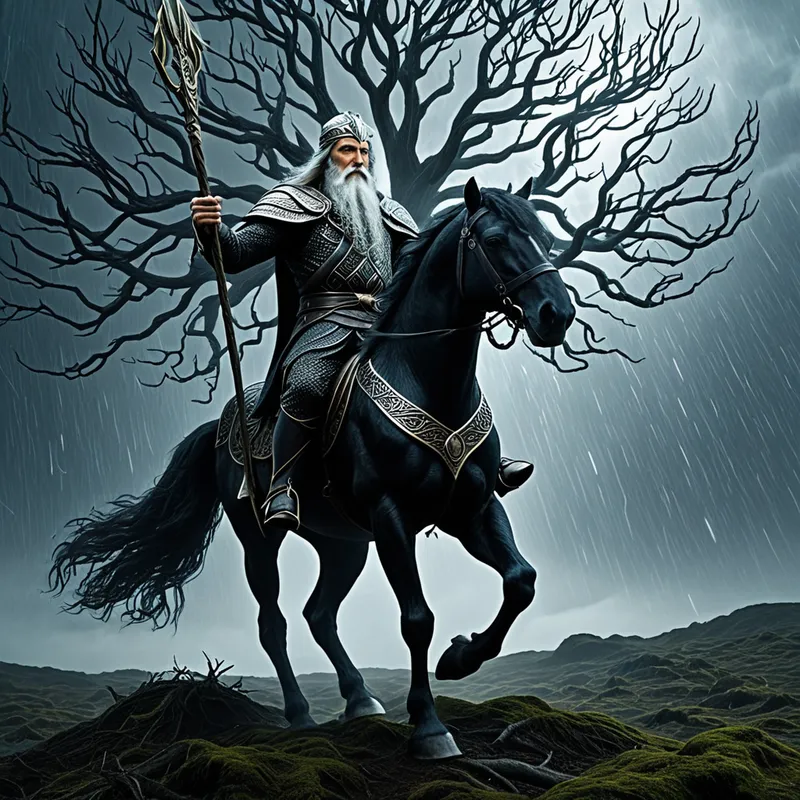
But Loki did not return. For a full season, the gods heard nothing. Then, from a hidden grove, he returned, walking slowly, strangely. And beside him, nursing at his side, was a foal. It was grey as ash and storm, and where one expects four legs, it had eight, each muscled and sure. This was [Sleipnir](/myths/sleipnir “Myth from Norse culture.”/), offspring of trickery and primal force, born of the god who became mother to his own solution.
Odin, the All-Father, whose one eye saw the [threads of fate](/myths/threads-of-fate “Myth from Greek culture.”/), looked upon the eight-legged foal and knew its purpose. He claimed the steed. No creature of flesh, bone, and spirit would ever match it. Sleipnir could gallop not only over land and sea but through the air and, most crucially, between the worlds themselves, down the gnarled roots of [Yggdrasil](/myths/yggdrasil “Myth from Global/Universal culture.”/) to the land of the dead, and up to the highest branches of the heavens. The steed born of deception became the vehicle of the seeker, carrying the price of wisdom on its back.
Cultural Origins & Context
This myth is preserved primarily in the Prose Edda, written by Snorri Sturluson in the 13th century, drawing from older poetic fragments. It functions as an etiological myth, explaining the origin of Odin’s greatest treasure and the fortifications of Asgard. However, its transmission through the lens of a Christian scholar like Snorri means we view it through a veil, a record of a belief system already fading.
In the Viking Age, this story would not have been a simple fable. It was a piece of the cosmological map, told by skalds and elders to illustrate the complex, amoral nature of the Norse cosmos. The gods are not purely good; they are capable of greed, fear, and ruthless pragmatism. The myth underscores a worldview where order (örlög) is often carved from chaos through dubious means, and where potent power (hamingja) often springs from morally ambiguous origins. Sleipnir’s birth from Loki and a jotun’s steed symbolizes the essential interconnectedness—and necessary interdependence—of the gods (Aesir), [the trickster](/myths/the-trickster “Myth from Various culture.”/) (Loki), and the giants ([Jotnar](/myths/jotnar “Myth from Norse culture.”/)), the chaotic forces they constantly battle.
Symbolic Architecture
Sleipnir is far more than a magical horse. He is a living [symbol](/symbols/symbol “Symbol: A symbol can represent an idea, concept, or belief, serving as a powerful tool for communication and understanding.”/) of transcended duality and the [vehicle](/symbols/vehicle “Symbol: Vehicles in dreams often symbolize the direction in life and the control one has over their journey, reflecting personal agency and decision-making.”/) for the ultimate [journey](/symbols/journey “Symbol: A journey in dreams typically signifies adventure, growth, or a significant life transition.”/).
His eight [legs](/symbols/legs “Symbol: Legs in dreams often symbolize movement, freedom, and the ability to progress in life, representing both physical and emotional support.”/) are his most defining feature. They represent a [capacity](/symbols/capacity “Symbol: A measure of one’s potential, limits, or ability to contain, process, or achieve something, often reflecting self-assessment or external demands.”/) for [motion](/symbols/motion “Symbol: Represents change, progress, or the flow of life energy. Often signifies transition, personal growth, or the passage of time.”/) beyond the ordinary, a doubling of the foundational four (the four directions, [the four elements](/myths/the-four-elements “Myth from Greek culture.”/), the four stages of [life](/symbols/life “Symbol: The symbol of ‘Life’ represents a journey of growth, interconnectedness, and existential meaning, encompassing both the joys and challenges that define human experience.”/)). He moves with the [stability](/symbols/stability “Symbol: A state of firmness, balance, and resistance to change, often represented by solid objects, foundations, or steady tools.”/) of a [spider](/symbols/spider “Symbol: Represents creativity, feminine energy, and the weaving of destiny, as well as potential feelings of entrapment or anxiety.”/) or the [ritual](/symbols/ritual “Symbol: Rituals signify structured, meaningful actions carried out regularly, reflecting cultural beliefs and emotional needs.”/) [pace](/symbols/pace “Symbol: The rhythm or speed of movement, thought, or life, reflecting internal tempo, urgency, or harmony with one’s environment.”/) of a processional bier, able to traverse all mediums: [earth](/symbols/earth “Symbol: The symbol of Earth often represents grounding, stability, and the physical realm, embodying a connection to nature and the innate support it provides.”/), air, [water](/symbols/water “Symbol: Water symbolizes the subconscious mind, emotions, and the flow of life, representing both cleansing and creation.”/), and the non-[material](/symbols/material “Symbol: Material signifies the tangible aspects of life, often representing physical resources, desires, and the physical world’s influence on our existence.”/) realms of [spirit](/symbols/spirit “Symbol: Spirit symbolizes the essence of life, vitality, and the spiritual journey of the individual.”/) and [death](/symbols/death “Symbol: Symbolizes transformation, endings, and new beginnings; often associated with fear of the unknown.”/).
The steed with eight legs is the psyche in full gallop, its gait encompassing both conscious stride and unconscious shadow-trot, carrying the ego toward realms it cannot reach alone.
He is the [offspring](/symbols/offspring “Symbol: Represents legacy, responsibility, and the future self. Often symbolizes creative projects or personal growth.”/) of Loki ([chaos](/symbols/chaos “Symbol: In Arts & Music, chaos represents raw creative potential, uncontrolled expression, and the breakdown of order to forge new artistic forms.”/), cunning, shape-shifting potential) and Svadilfari (raw, instinctual, brute-force [nature](/symbols/nature “Symbol: Nature symbolizes growth, connectivity, and the primal forces of existence.”/)). Thus, Sleipnir is the embodied [synthesis](/symbols/synthesis “Symbol: The process of combining separate elements into a unified whole, representing integration, resolution, and the completion of a personal journey.”/) of intelligent trickery and unstoppable natural power. He is a creation born not from straightforward [effort](/symbols/effort “Symbol: Effort signifies the physical, mental, and emotional energy invested toward achieving goals and personal growth.”/), but from a deceptive, self-sacrificial act (Loki’s temporary transformation and motherhood). This points to a profound psychological [truth](/symbols/truth “Symbol: Truth represents authenticity, honesty, and the quest for knowledge beyond mere appearances.”/): our greatest inner resources and capacities are often forged in moments of [crisis](/symbols/crisis “Symbol: A crisis symbolizes turmoil, urgent challenges, and the need for immediate resolution or change.”/), compromise, and unexpected, even embarrassing, transformations.
As Odin’s mount, Sleipnir becomes the literal vehicle for the All-[Father](/symbols/father “Symbol: The father figure in dreams often symbolizes authority, protection, guidance, and the quest for approval or validation.”/)’s quests for wisdom—most notably his ride to Hel to consult a dead seeress about the [fate](/symbols/fate “Symbol: Fate represents the belief in predetermined outcomes, suggesting that some aspects of life are beyond human control.”/) of the gods. The steed enables the journey to the [underworld](/symbols/underworld “Symbol: A symbolic journey into the unconscious, representing exploration of hidden aspects of self, transformation, or confronting repressed material.”/), the confrontation with [shadow](/symbols/shadow “Symbol: The ‘shadow’ embodies the unconscious, repressed aspects of the self and often represents fears or hidden emotions.”/) and [mortality](/symbols/mortality “Symbol: The awareness of life’s finitude, often representing transitions, impermanence, or existential reflection in dreams.”/), and the return. He is the means by which [consciousness](/symbols/consciousness “Symbol: Consciousness represents the state of awareness and perception, encompassing thoughts, feelings, and experiences.”/) (Odin) navigates the unconscious.
The Dreamer’s Resonance
To dream of an eight-legged horse, or a mount of impossible power, is to encounter the nascent symbol of Sleipnir within one’s own [psyche](/myths/psyche “Myth from Greek culture.”/). Such a dream often arrives at a threshold.
Somatically, it may be accompanied by a feeling of exhilarating, almost terrifying speed, or a profound, ground-shaking stability. Psychologically, the dreamer is likely grappling with a need to traverse a great inner distance—to bridge a chasm between a current state of being and a needed insight or perspective that feels worlds away. The eight-legged creature represents the emergent psychic structure capable of making that journey. It is the dream-ego’s recognition that ordinary methods (four legs) will not suffice; a more complex, integrated, and potent mode of being is required.
If the dreamer is searching for the steed, it speaks to a longing for this transformative capacity. If they are fleeing from it, it may indicate a fear of the power and the strange origins of one’s own deepest potential. To be riding it suggests [the ego](/myths/the-ego “Myth from Jungian culture.”/) is actively, courageously engaging with this profound inner resource, however unnerving its pedigree may be.
Alchemical Translation
The myth of Sleipnir’s origin is a perfect allegory for the alchemical process of individuation—the forging of a coherent Self from the fragmented parts of the psyche.
The initial state is one of vulnerability and incompleteness (Asgard’s missing wall). The ego, in its cunning (Loki), makes a rash pact with a powerful, unconscious content (the builder/giant, representing a complex of immense skill and daunting demand). This complex, fueled by raw instinct (Svadilfari), threatens to overwhelm the conscious personality and claim its most vital values (Freyja, the sun, the moon).
The solution is not to defeat the complex through brute force, but to engage it on its own terms, to be transformed by it. The god must become the mare, the trickster must become the mother.
This is the [nigredo](/myths/nigredo “Myth from Alchemical culture.”/), the blackening, the humbling descent into a base, animalistic, and “feminine” role (relative to Loki’s usual [persona](/myths/persona “Myth from Greek culture.”/)). It is a sacrifice of the known identity for the sake of the whole. From this union of cunning consciousness and brute instinctual force, a new entity is born: the filius philosophorum, the philosophical child. This is Sleipnir—the transcendent function, the psychic organ that can navigate between opposites.
Odin’s claiming of Sleipnir represents the ego’s conscious integration of this new function. The steed is not Odin, but is for Odin. It is the tool, the capacity, born from the psyche’s own messy, ambiguous processes, now harnessed in service of the ultimate quest: the journey for meaning, which necessarily passes through the realms of shadow, death, and hidden wisdom. For the modern individual, the myth teaches that our most profound abilities to navigate life’s depths are not gifts from on high, but are born from our willingness to engage our own tricksters, harness our raw instincts, and be transformed in the process. We must give birth to our own Sleipnir.
Associated Symbols
Explore related symbols from the CaleaDream lexicon: