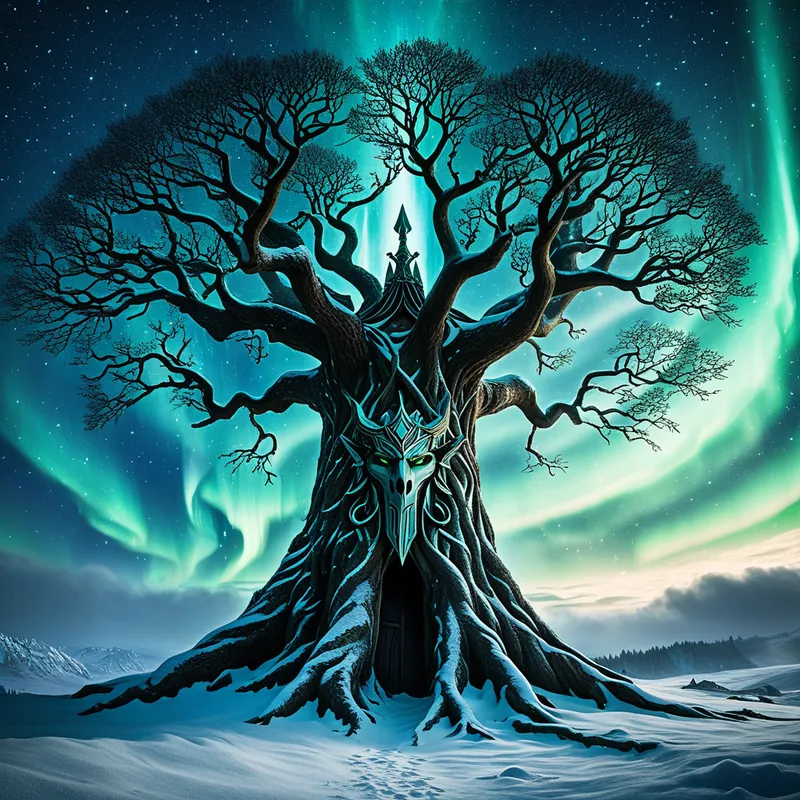
Odin's Sacrifice for Wisdom Myth Meaning & Symbolism
The Allfather hangs himself, pierced by his own spear, to gain the runes, embodying the ultimate sacrifice for transcendent wisdom.
The Tale of Odin’s Sacrifice for Wisdom
Listen. [The wind](/myths/the-wind “Myth from Various culture.”/) does not just blow; it carries whispers from the roots of [the world](/myths/the-world “Myth from Tarot culture.”/). In the time before time, when the [Ginnungagap](/myths/ginnungagap “Myth from Norse culture.”/) still echoed, there was a hunger. Not for meat or mead, but for the marrow of existence itself. This hunger lived in the heart of Odin, the Allfather, who had one eye that saw all [the nine worlds](/myths/the-nine-worlds “Myth from Norse culture.”/), and yet saw nothing of their deepest truth.
He stood before the [Yggdrasil](/myths/yggdrasil “Myth from Global/Universal culture.”/), the Ash that holds all things. Its bark was a tapestry of time, its roots drank from wells of memory and fate. At its base lay [Mímisbrunnr](/myths/mmisbrunnr “Myth from Norse culture.”/), the well of [Mímir](/myths/mmir “Myth from Norse culture.”/), whose waters held all wisdom. Odin had already paid a terrible price there, trading an eye for a single draught. But the well’s whispers spoke of a deeper source, a more terrible font: [the runes](/myths/the-runes “Myth from Norse culture.”/) themselves. They were not letters, but the primal bones of reality, the secret songs that shaped being from chaos. They did not lie in the [water](/myths/water “Myth from Chinese culture.”/). They were in the tree. They were the tree. And they could only be won, not given.
So Odin, the lord of the slain, made himself the sacrifice. He took up his own spear, [Gungnir](/myths/gungnir “Myth from Norse culture.”/), the unerring. He did not raise it against a foe, but turned its point upon himself. With a cry that silenced the winds in Jötunheim, he drove the ash-wood shaft through his own side, pinning himself to the great trunk of Yggdrasil. He was the offering, and the altar was the world.
For nine nights and nine days, a divine cycle of death, he hung. The winds of [Niflheim](/myths/niflheim “Myth from Norse culture.”/) scoured his flesh. No one gave him drink; no one brought him bread. He stared down into [the abyss](/myths/the-abyss “Myth from Kabbalistic culture.”/), his one eye fixed on the roots that clawed into darkness. The pain was a fire that burned away everything he was—the god of victory, the father of hosts. It burned until only a raw, screaming need remained: the need to know.
On the ninth night, as the final ember of his divine strength guttered, a change came. Not from above, but from below. From the deepest root, from the waters of Urd, a light began to rise. It was a cold, clear, terrible light. It was not one light, but many—shapes of power, angular and singing. The [runes](/myths/runes “Myth from Norse culture.”/). They swarmed up the trunk, through the wood, into the wound made by Gungnir, and into his being. In that final, ecstatic agony, he saw them. He understood them. He knew the spells to bind and unbind, to heal and to curse, to live and to transcend.
With a gasp that was both a death rattle and a first breath, Odin fell from the tree, whole and shattered, empty and full. He was no longer just Odin. He was Hangatýr, the God of the Hanged. He had died to himself, and been reborn with the secret language of the universe etched upon his soul.
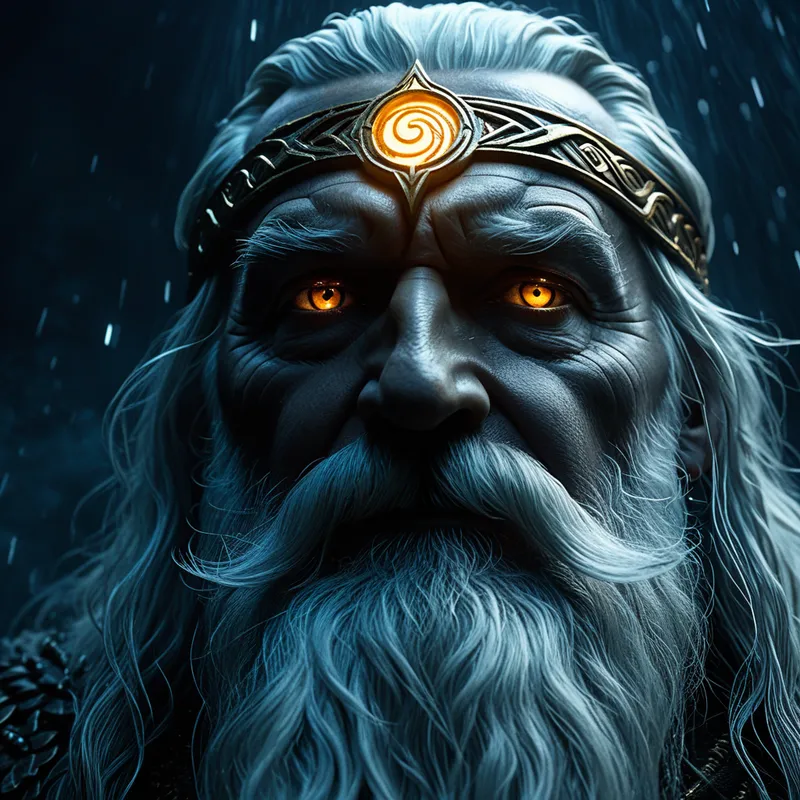
Cultural Origins & Context
This myth, found in the Old Norse poem Hávamál, was not a simple bedtime story. It was a core mystery, passed down by skalds and poets in the halls of chieftains and around winter fires. In a culture that valued blunt strength and heroic deed, this tale presented a paradoxical ideal: the ultimate warrior-king achieving his greatest power not through battle, but through an act of radical, self-inflicted vulnerability and endurance.
The myth functioned on multiple levels. For the warrior, it framed death in battle—hanging as a common method of sacrifice to Odin—as a potential path to sacred knowledge. For the seeress or [völva](/myths/vlva “Myth from Norse culture.”/), it validated the trance-state, the ordeal of seeking visions. Societally, it established a profound cultural truth: that wisdom of true consequence is never free. It is purchased with a piece of [the self](/myths/the-self “Myth from Jungian culture.”/). The myth provided a template for understanding the price of leadership, poetry, magic, and the acceptance of fate—all domains of Odin. It was a narrative container for the terrifying idea that to gain the world, you must first lose yourself.
Symbolic Architecture
The myth is a perfect [mandala](/symbols/mandala “Symbol: A sacred geometric circle representing wholeness, the cosmos, and the journey toward spiritual integration.”/) of symbolic [initiation](/symbols/initiation “Symbol: A symbolic beginning or transition into a new phase, status, or awareness, often involving tests, rituals, or profound personal change.”/). Every element is an [aspect](/symbols/aspect “Symbol: A distinct feature, quality, or perspective of something, often representing a partial view of a larger whole.”/) of a profound psychological process.
Yggdrasil is the [axis](/symbols/axis “Symbol: A central line or principle around which things revolve, representing stability, orientation, and the fundamental structure of reality or consciousness.”/) of the [psyche](/myths/psyche “Myth from Greek culture.”/) itself, the [structure](/symbols/structure “Symbol: Structure in dreams often symbolizes stability, organization, and the framework of one’s life, reflecting how one perceives their environment and personal life.”/) of [consciousness](/symbols/consciousness “Symbol: Consciousness represents the state of awareness and perception, encompassing thoughts, feelings, and experiences.”/) connecting the [depths](/symbols/depths “Symbol: Represents the subconscious, hidden emotions, or foundational aspects of the self, often linked to primal fears or profound truths.”/) of the unconscious (its roots in the wells) with the [heights](/symbols/heights “Symbol: Represents ambition, fear, or spiritual elevation. Often symbolizes life challenges or a desire for perspective.”/) of potential (its branches in the heavens). Odin’s act is not a [journey](/symbols/journey “Symbol: A journey in dreams typically signifies adventure, growth, or a significant life transition.”/) on the [tree](/symbols/tree “Symbol: In dreams, the tree often symbolizes growth, stability, and the interconnectedness of life.”/), but an [integration](/symbols/integration “Symbol: The process of unifying disparate parts of the self or experience into a cohesive whole, often representing psychological wholeness or resolution of internal conflict.”/) with it.
Gungnir, the [spear](/symbols/spear “Symbol: The spear often symbolizes power, aggression, and the drive to protect or conquer.”/), represents focused will and [intention](/symbols/intention “Symbol: Intention represents the clarity of purpose and direction in one’s life and can symbolize motivation and commitment within a dream context.”/). To be pierced by one’s own will is the ultimate act of self-confrontation. It is [the ego](/myths/the-ego “Myth from Jungian culture.”/)’s [instrument](/symbols/instrument “Symbol: An instrument symbolizes creativity, communication, and the means by which one expresses oneself or influences the world.”/) turned against [the ego](/myths/the-ego “Myth from Jungian culture.”/)’s sovereignty, creating the sacred wound through which the numinous can enter.
The nine nights and days signify a full cycle of [gestation](/symbols/gestation “Symbol: A period of development and preparation before a significant birth or emergence, symbolizing potential, transformation, and the journey toward manifestation.”/) and [dissolution](/symbols/dissolution “Symbol: The process of breaking down, dispersing, or losing form, often representing transformation, release, or the end of a state of being.”/). In Norse [numerology](/symbols/numerology “Symbol: The study of numbers’ mystical significance, suggesting divine patterns, life paths, and hidden meanings in numerical sequences.”/), nine is the [number](/symbols/number “Symbol: Numbers in dreams often symbolize meaning, balance, and the quest for understanding in the dreamer’s life, reflecting their mental state or concerns.”/) of completion and magical potency. It is the time required for the old self to die and for the new consciousness to be formed.
The runes are the liberated contents of the unconscious, the archetypal patterns and latent [knowledge](/symbols/knowledge “Symbol: Knowledge symbolizes learning, understanding, and wisdom, embodying the acquisition of information and enlightenment.”/) that exist in a chaotic, potential state within us all. They are not “learned” intellectually; they are suffered into being, claimed only after the conscious mind has been dismantled.
The sacrifice is not a transaction, but a transformation. One does not pay for wisdom with an eye or a life; one becomes the price that is paid, and in that becoming, the wisdom is born.
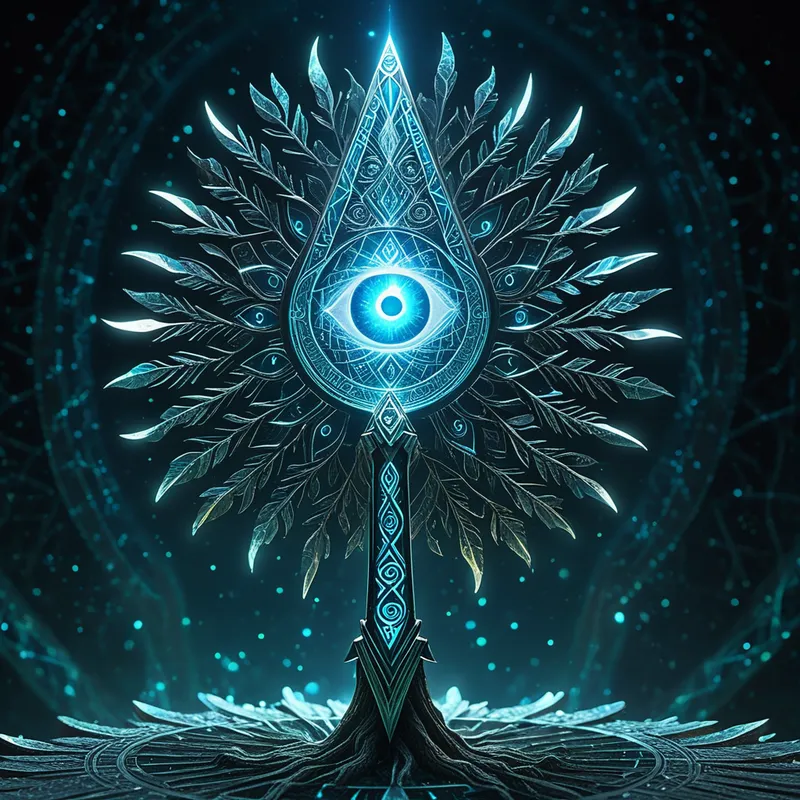
The Dreamer’s Resonance
When this myth stirs in the modern dreamer, it rarely appears as a Viking god on a tree. Its pattern manifests more subtly, as a profound somatic and psychological ordeal. The dreamer may experience dreams of being trapped, pinned, or suspended—unable to move, yet acutely aware. They may dream of a vital part of themselves (an eye, a heart) being offered or taken. There might be visions of ancient, glowing symbols appearing on walls, skin, or in water.
Psychologically, this signals a critical juncture in the process of individuation. The ego has reached the limit of its knowing. A deep, instinctual pull toward a greater understanding—of one’s purpose, one’s shadow, one’s destiny—has arisen, but the old ways of seeking (through effort, study, or force) have failed. The psyche is now initiating its own ritual. The feeling of being “hung up,” in stasis, depressed, or in a life crisis is the hanging on Yggdrasil. The pain of this period is the spear. It is a necessary, brutal incubation where the conscious identity is dismantled so that a more authentic, integrated self, attuned to inner archetypal truths (the runes), can be assembled.
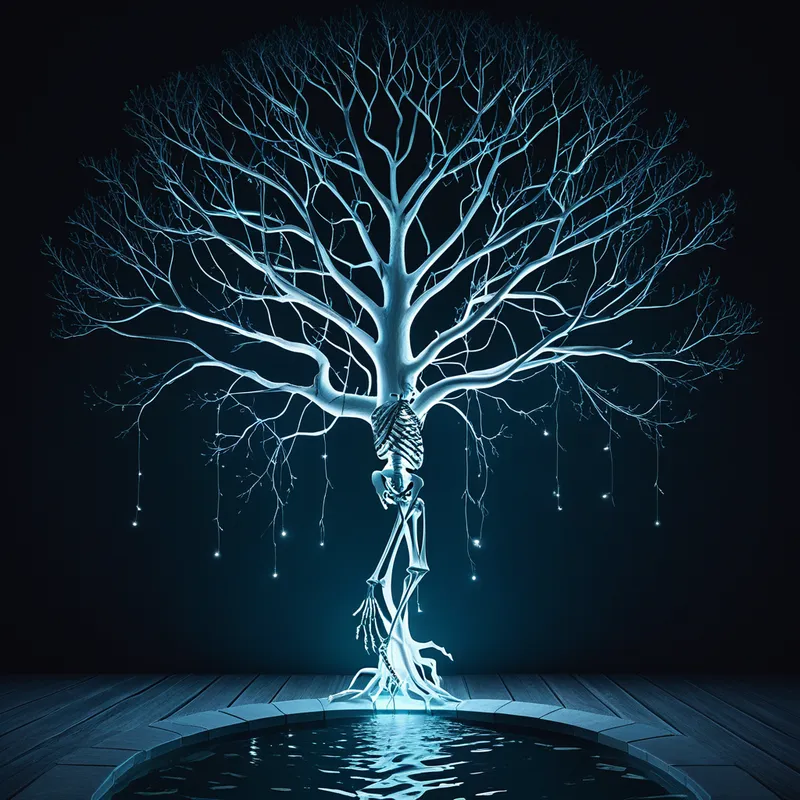
Alchemical Translation
The alchemical process mirrored here is the [nigredo](/myths/nigredo “Myth from Alchemical culture.”/), the blackening, the descent into the darkest matter of the soul. Odin’s ordeal is the ultimate sacrificium—not of something you have, but of what you are.
For the modern individual, this myth models the path of psychic transmutation when one confronts a foundational, life-questioning crisis. It could be the end of a career that defined you, the shattering of a core belief, a profound loss, or a deep depression. The instinct is to fight it, to escape the pain. The myth instructs: lean into the spear. Consciously endure the dissolution. Withdraw the projections and certainties that once sustained you.
The gallows of Yggdrasil is the crucible where the lead of the limited personality is subjected to the fire of suffering, not to destroy it, but to release the gold of the authentic Self hidden within.
The “runes” gained are the insights that emerge from this process: a clarity about one’s true values, a connection to a deeper creative source (poetry/magic), an acceptance of life’s inherent fragility and beauty, and the ability to “see” with the inner eye—the eye that was paid for at Mímir’s well and activated on the tree. One does not return from this process “better” in a conventional sense. One returns different, bearing the scars of the wound and the power of the symbols etched within. You become, in your own life, the sage who has stared into the abyss and returned with the terrible, liberating knowledge of what you are, and what you are not.
Associated Symbols
Explore related symbols from the CaleaDream lexicon: